
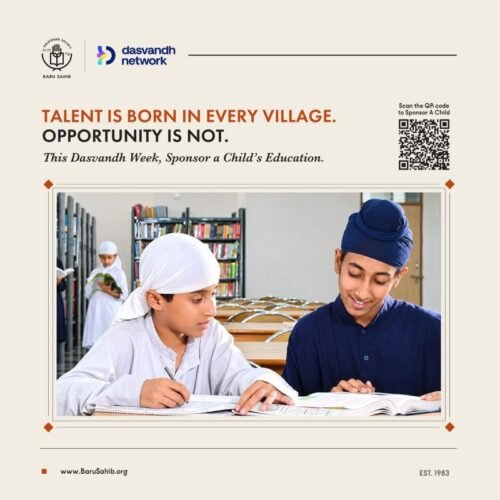
 Pooja
Nearly 73% of students in India drop out before they finish higher secondary school, a parliamentary panel reported in August 2026 (Business Standard). In rural India, the loss starts earlier: 72.9% of Class 3 children cannot yet read a Class 2 text (ThePrint).
Behind each number is a child who had the ability but not the means. That is why the decision to sponsor a child’s education reaches far beyond one school fee.
The numbers behind India’s dropout crisis
Rural children start school in large numbers. Far fewer finish. India’s enrolment data shows the drop at every stage.
In 2024–25, 6.18 crore children were enrolled in primary classes (1–5). That fell to 4.09 crore in upper primary (6–8), 2.37 crore in secondary (9–10) and just 1.64 crore in higher secondary (11–12).
Secondary retention improved to 51.9% in 2025–26, which still means about one in two children leaves school early (Deccan Herald, UDISE+ 2025–26).
Staying enrolled is not the same as learning. In rural Punjab, only 34.2% of Class 3 students could read a Class 2 text in ASER 2024 (The Pioneer).
Why a child’s education pays back for generations
Every additional year of schooling raises a person’s earnings by about 9%, according to a World Bank review of 1,120 estimates across 139 countries. The same review finds higher returns for women and for lower-income countries.
That return does not stay with one child. It reaches parents in old age, siblings who follow, and the village that gains a nurse, a teacher or an engineer.
A tradition built on giving back
Dasvandh is the Sikh practice of giving one-tenth of one’s earnings for the common good. It treats income as a trust, not a possession: a share of every blessing belongs to someone who has not yet received theirs.
We spend our lives earning for ourselves and our families. Dasvandh asks how much of that life we give back. For a child in a village in Punjab, the answer looks like a uniform that fits, a teacher who stays, and a classroom the family no longer has to trade for the harvest.
Educate To Save and The Kalgidhar Society: closing the gap in 130 schools
Educate To Save connects sponsors with children at Akal Academies, 130 CBSE-affiliated, English-medium schools run by The Kalgidhar Society across rural northern India. The network reaches 6,450 villages in 33 districts and 5 states. Today 33,906 students study on free or aided fees.
In July 2026, the programme received the CSR Award for India’s Largest Rural Child Sponsorship Programme at the 7th Bharat CSR & Sustainability Summit (India CSR). It supports children of small and marginal farmers, landless labourers, Granthi Singh families, and orphaned children.
The results speak through students. Jashandeep Kaur, the daughter of a village salesman, studied at Akal Academy Reeth Kheri with Educate To Save support and scored 98.4% in CBSE Class XII 2026 (DNA India).
How sponsoring a child works
- Choose a child or a sponsorship option on educatetosave.com.
- Give once, monthly or yearly, for about the cost of a coffee a day.
- Follow your child’s progress through the school year.
- Claim the tax benefit your registration status allows, after checking your regime.
How to choose the best NGO to sponsor a child
The best NGO to sponsor a child is one whose credentials you can check yourself. Five checks cover it.
- Legal registration. It is registered under the Societies Registration Act, the Trusts Act or as a Section 8 company, with a Unique ID on NGO Darpan.
- Tax registrations. It holds valid 12A and 80G numbers, which you can verify on the Income Tax portal.
- CSR and foreign-contribution eligibility. It holds CSR-1 registration for company funds and FCRA registration for donations from abroad.
- Independent accreditation. An outside body has reviewed its governance and accounts, and its accounts are independently audited.
- Visible progress. Sponsors can follow the child’s journey and read published impact reports.
Educate To Save against the five checks
- Legal registration: The Kalgidhar Society is registered under the Societies Registration Act, 1860 (Reg. No. 3111/83, 25 March 1983), and listed on NGO Darpan. Source: CSR for Change: Diligence; CSR Fact Sheet
- Tax registrations: 80G: AAATT1306LF20133; 12A: AAATT1306LE19830. Source: CSR for Change: Diligence
- CSR and FCRA: CSR-1: CSR00004523 on the National CSR Portal; FCRA registered; Section 135 implementing agency. Source: Baru Sahib: Why you can trust us; CSR for Change FAQ
- Independent accreditation: Credibility Alliance Desirable Norms, valid through January 2029; GuideStar India NPO Verified (GSN 4956); independently audited accounts. Source: Educate To Save
- Visible progress: sponsor login on educatetosave.com, a published impact report, and 8,566 students sponsored in 2026.
Donors abroad can also give tax-effectively: The Kalgidhar Trust holds 501(c)(3) status in the US, UK Charity No. 1041548 with Gift Aid, CRA registration in Canada and ACNC registration in Australia. Enrolment figures source: UDISE+ 2024–25, as reported by the parliamentary Committee on Estimates.
Give your Dasvandh a future
We spend our lives building our own future. Our Dasvandh can build someone else’s.
Give with gratitude. Give with purpose. Sponsor a child on Educate To Save →
Frequently asked questions
How can I sponsor a child’s education in India?
Choose a registered NGO with a child sponsorship programme, such as Educate To Save, and give monthly or yearly towards a child’s schooling.
Which is the best NGO to sponsor a child in India?
Choose a registered NGO with 80G status and a long-term model. Educate To Save won a 2026 CSR award for rural child sponsorship.
How do I check if an NGO is registered in India?
Search its name on NGO Darpan, then verify 80G and 12A status on the Income Tax portal using its PAN.
Is a donation to sponsor a child’s education tax-deductible?
Yes, if the NGO holds valid 80G registration and you file under the old tax regime. Keep your donation receipt.
What is Dasvandh and how does it support education?
Dasvandh is the Sikh practice of giving one-tenth of earnings. Directed to a child’s schooling, it turns a share of income into opportunity.






Add comment