
 Pooja
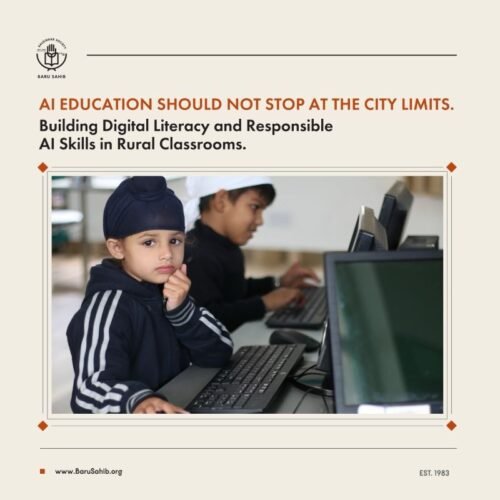
The future of Artificial Intelligence should not belong only to children growing up in cities. A child in a village deserves the same chance to understand AI, explore technology and prepare for a fast-changing world. As AI in school education becomes a national priority, rural schools in India face a simple test: will their students learn to use AI, or learn to use it well?
The answer depends on digital skills for students, not on the number of devices a school owns.
Why Rural Schools in India Need More Than Devices
Rural children already have access to technology. Access has not yet become learning. According to ASER 2024Q, 82.2% of rural children aged 14–16 know how to use a smartphone. Only 57% used it for an educational activity in the week before the survey, while 76% used it for social media.
The same survey found that roughly four in ten rural teens on social media did not know how to make a profile private. School infrastructure adds another gap: UDISE+ 2025-26 shows about one in three Indian schools still has no internet connection.
Scrolling is not the same as learning. A child who swipes through reels with ease may still not know how to check a fact, protect a password or spot a fake post. Explore in our Educate To Save blog on AI in rural education, giving children access to AI is only the beginning. Teaching them to use it responsibly is what truly matters.
How AI in School Education Is Changing in India
AI in school education has moved from an elective idea to the national curriculum. In April 2026, the Ministry of Education and CBSE launched a Computational Thinking and AI curriculum for Classes 3 to 8, starting in the 2026–27 session. Children learn step-by-step problem-solving from Class 3 and basic AI ideas from Class 6.
CBSE has also announced that computational thinking and AI will become compulsory modules for Classes 9 and 10. The curriculum goes beyond coding. Its aims include logical thinking, problem-solving and the ethical use of AI.
For rural schools in India, this raises the stakes. Every village classroom now needs the skills, teachers and rules to deliver what the curriculum expects.
Three Digital Skills for Students in Rural Schools
Rural schools need to build three essential things alongside any device.
1. Digital literacy. Students learn to separate reliable information from misinformation and understand how the digital world works. They check claims against a textbook or teacher, recognise fake posts and edited images, keep profiles private, and block or report unsafe contact.
2. Responsible AI use. Students learn to question AI-generated answers, protect personal information and use AI to strengthen their thinking, not replace it. The Educate To Save blog describes two ways to use a chatbot: copying an answer, or asking for an explanation and testing oneself. A randomised study reported by The Economic Times found students who used ChatGPT for assignments scored higher at first, but lower on a test taken weeks later.
In a rural classroom, responsible use can look like this:
- A Class 6 student asks AI to explain photosynthesis in Punjabi or Hindi, then explains it back to the teacher in her own words.
- A student who missed school asks for five practice questions on fractions and solves them in a notebook.
- A class asks AI about its own district and finds the mistakes together, learning that AI can be wrong while sounding sure.
Five simple rules keep children safe: check every AI answer, never share personal details, use AI with an adult nearby, report strange answers to a teacher, and know when to put AI aside.
3. Teacher preparedness. Educators need the training to guide students in using AI meaningfully, safely and creatively. The UNESCO Global Education Monitoring Report 2023 advises that technology should support face-to-face teaching, not replace it. For village schools, the practical order is clear: train teachers first, set clear AI rules, start with screen-free computational thinking activities, teach in the mother tongue and add devices step by step.
How Akal Academies Are Using AI in Schools
At The Kalgidhar Society, this vision is shaping village classrooms through the Future Skills initiative. Students across the Akal Academy Group of Schools are being introduced to Artificial Intelligence, Robotics, Coding, STEM and Computational Thinking.
The model began at Akal Academy, Baru Sahib, the network’s innovation hub, where teachers were trained before the programme moved to other schools. It now extends across 130 Akal Academies in Punjab, Haryana, Himachal Pradesh, Rajasthan and Uttar Pradesh, reaching more than 75,000 students. Alongside it, a dedicated AI programme mentored by AI researcher Dr Sandeep Singh Sandha began in the 2025–26 session. More than 15,000 students in Classes 7 to 12 are learning AI, Machine Learning, Robotics, Drones and 3D Printing.
Technology here is taught alongside discipline, humility and service. The students show what that looks like in practice.
Building With AI: Akal Academy Gomtipul at STEM Carnival 6.0
AI and Robotics students from Akal Academy Gomtipul secured third position among 30 schools at STEM Carnival 6.0, held at Delhi Public School, Pilibhit. Their project, “Self Driving Car (AI)”, showed how AI can make transport safer and smarter.
The winning team of Tejaswi Singh, Nandini Agarwal and Simran Kaur, all Class IX students, refined their model under the mentorship of Mr Amar Singh. It is a clear example of classroom learning turned into practical innovation.
Questioning AI: Akal Academy Dakra Sahib Puts AI on Trial
Building AI is one skill. Questioning it is another. Eight students from Classes VIII to X at Akal Academy Dakra Sahib, a village school near Raipur Rani in Haryana’s Panchkula district, staged a courtroom science drama titled AI on Trial: Friend, Tool or Threat?
The play won second position at the block-level Northern India Science Drama Contest 2026–27 and took the team to the district stage in Panchkula. On stage, students tested four questions: can AI transform healthcare and education, what happens when it is misused, who is accountable for AI decisions, and how can AI serve humanity responsibly?
That is responsible AI use in its purest form. The students did not treat AI as a shortcut. They treated it as a subject to investigate.
From Village Classrooms to the World Stage
The journey reaches beyond India too. A team from Akal Academy, Baru Sahib represented India at the Codeavour 7.0 International Finals in Jakarta with its “Anti-Collision Truck” project.
Together, these stories show the full picture of AI in school education: students who can build with AI, question it and use it to solve real problems.
A Child’s Village Should Not Limit Their Digital Future
The real promise of technology lies not in how many devices a school owns, but in how many young minds it empowers. Digital literacy, responsible AI use and prepared teachers turn a phone from a distraction into a learning tool.
A child’s village should never determine the limits of their digital future.
Should every rural school in India teach students to build with AI and question it? Share your thoughts in the comments, and follow us for more stories of village students shaping the future of AI in school education.
Follow Us For More
Source: ASER 2024, Annual Status of Education Report (Rural).



 Amit Rao





Add comment