
 Pooja
Every conversation about AI in school education eventually reaches the same question. Should students simply learn to use Artificial Intelligence, or should they also learn to question it?
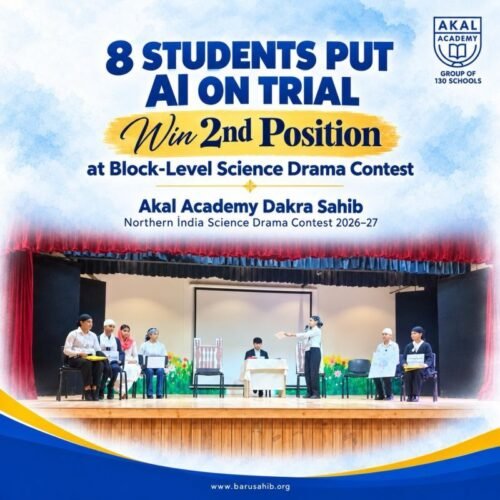
Eight students from Akal Academy Dakra Sahib answered with a courtroom. Their science drama, AI on Trial: Friend, Tool or Threat?, won 2nd position at the block-level Northern India Science Drama Contest 2026–27. The students, from Classes VIII to X, performed under the contest theme Science & Society.
The achievement belongs to one school. The question it raises belongs to every classroom in India, especially now that AI is entering the national school curriculum.
AI on Trial: A Science Drama Born in a Village School
The play placed Artificial Intelligence in the dock. The charge was simple to state and hard to settle: is AI a friend, a tool or a threat?
A courtroom was a smart choice of setting. In a trial, no claim stands without evidence. Every argument is presented, tested and answered before a verdict is reached. Public debate about AI rarely works that way. It tends to swing between promises that AI will solve everything and warnings that it will replace everyone. The courtroom format forced both sides to make their case.
For the audience, this turned an abstract global argument into something they could follow, scene by scene. They did not just watch a performance. They were asked to judge.
Who Are the Students Behind the Verdict?
Akal Academy Dakra Sahib is a CBSE-affiliated school in Village Dakra, near Raipur Rani in Haryana’s Panchkula district. It opened in 2012 and teaches students from Nursery to Class 12. The school is managed by The Kalgidhar Society, Baru Sahib.
It belongs to the Akal Academy Group of Schools, a network that began in 1986 with five students in a thatched hut at Baru Sahib in Himachal Pradesh. Today the network runs about 130 schools across Punjab, Haryana, Rajasthan, Uttar Pradesh and Himachal Pradesh. Its schools are English-medium and low-cost, and they largely serve students from rural and economically disadvantaged families.
That context matters. When students from a village school stand on a district stage and cross-examine one of the most advanced technologies of our time, they are making a point about who gets to shape the AI conversation.
Four Questions About AI in School Education the Students Asked
The students built their case around four questions. Policymakers, technologists and teachers worldwide are still working through each of them.
Can AI transform healthcare and education?
This was the case for the defence. AI tools can help analyse medical information and support diagnosis. In classrooms, they can personalise learning and help teachers reach more students. The promise is real, but so is the follow-up question: transformation for whom, and on whose terms?
What happens when technology is misused?
AI can produce convincing false information, imitate real voices and faces, and repeat the biases hidden in its data. The same power that makes it useful is what makes it risky.
Who should be accountable for AI-driven decisions?
When an AI recommendation leads to a wrong outcome, who answers for it: the developer, the organisation that deployed it, or the person who followed its advice? Courts and regulators are still deciding. It is the natural centre of any courtroom drama.
How can we ensure AI serves humanity responsibly?
This question moves from judgement to direction. If AI is here to stay, the task is not to accept or reject it wholesale. The task is to shape it through transparency, fairness, human oversight and an informed public.
Why AI in School Education Is No Longer Optional
The timing of this drama is significant. In April 2026, the Ministry of Education and CBSE launched a curriculum on Computational Thinking and Artificial Intelligence for Classes 3 to 8, starting in the 2026–27 session. CBSE has also announced that computational thinking and AI will become compulsory modules for Classes 9 and 10, with AI board exams expected from 2029.
The curriculum is not only about coding. Its stated aims include logical thinking, systematic problem-solving and an understanding of the ethical use of AI. CBSE has made ethics and responsible use of AI one of the sub-themes for teacher training this session.
In other words, the questions these eight students asked on stage are now part of what every CBSE school is expected to teach. AI in school education has moved from an elective idea to a national priority.
How to Use AI in Schools Without Losing Critical Thinking
So how should schools use AI? The drama offers a useful model. Students did not treat AI as a shortcut. They treated it as a subject to investigate.
For schools working out how to use AI in schools responsibly, a few principles stand out:
- Teach the questions alongside the tools. When students use an AI tool, they should also ask how it reached its answer and whether that answer can be checked.
- Use AI to support thinking, not replace it. AI can help a teacher plan a lesson or help a student explore a topic. It should not do the reasoning that learning requires.
- Bring ethics into every subject. Questions of fairness, honesty and accountability belong in science, social studies and language classes, not only in computer lessons.
- Train teachers first. Teachers who understand AI’s strengths and limits can guide students far better than any tool. CBSE’s teacher-training focus this session reflects that.
- Use creative formats. Science drama, debates and projects let students argue both sides of the AI debate. That builds judgement in a way worksheets cannot.
- AI on Trial reflects this approach, and it does so through performance rather than lecture. For any school still asking how to use AI in schools, that is a practical place to begin: start with a question, not a tool.
AI in Rural Education: Why Access Is Only Half the Story
Conversations about AI in rural education usually begin with access: devices, internet connections and trained teachers. Those gaps are real, and closing them matters.
But access alone is not enough. A rural student who can use an AI app but cannot question its output is no better prepared than one who has never seen it. The students of Akal Academy Dakra Sahib show the other half of the story. Understanding AI does not depend on living in a city. It depends on being taught to think critically about what technology does and whom it serves.
This is also a matter of fairness. If AI shapes jobs, public services and information in the years ahead, rural communities need young people who can take part in those decisions, not just live with them. A science drama from a village school in Panchkula is a small but clear example of that participation.
The Akal Academy network was built on this idea long before AI arrived. Founded in 1986 in a remote hill area, it set out to bring value-based education to rural communities. Applying that same purpose to AI in rural education means giving village students not just access to technology, but the confidence and critical skills to judge it.
AI Learning Courses Are a Start. Judgement Must Come With Them.
Interest in AI learning courses is growing fast among students, parents and teachers. CBSE already offers AI as a skill subject from Class 6 through a short module in thousands of schools, and as an optional subject in Classes 9 to 12. For teachers, the government’s NISHTHA training programme includes components on AI-based learning resources and the ethical use of technology.
These courses build valuable skills. They teach how AI works and how to use it. What no course can do on its own is build the habit of asking hard questions. That habit grows through discussion, debate and practice, which is exactly what this drama gave its cast.
The best preparation combines both: AI learning courses for knowledge, and classroom experiences like AI on Trial for judgement.
From the Block-Level Podium to the District Stage
The 2nd-position finish at block level carried the team into the next round. They represented Akal Academy Dakra Sahib at the District-Level Science Drama Competition in Panchkula on 8 October 2026. Reaching the district stage meant performing again before a new panel and a wider field of schools, valuable experience for students in Classes VIII to X.
The Team Behind the Performance
The script was written by Ms. Reeta Sharma, who turned a debate as wide as AI into a stage play that fits a competition format. The production was directed by Mr. Sourav Dhiman, who gave the courtroom its shape and the arguments their timing. Eight students carried it on stage and turned a complex global conversation into clear science communication.
Future-Ready Education at Akal Academy
At Akal Academy Group of Schools, future-ready education is not limited to preparing students to work with emerging technologies. It means preparing them to think critically, act ethically and lead responsibly in an AI-driven world.
AI on Trial showed what that looks like in practice. Eight students did not simply explain a technology. They cross-examined it.
Should AI ethics become an essential part of school education?
We invite educators and parents to share their views. Follow Akal Academy Group of Schools for more stories of students learning to question the future.


 Amit Rao


 barublog




Add comment