
 Amit Rao
With fewer than four years left before the 2030 deadline, the world is behind on most of its development promises. The United Nations’ Sustainable Development Goals Report 2026, released in July 2026, looked at 139 targets with enough data to judge. Only 36% are on track or making moderate progress. Almost half (49%) are moving too slowly, and 15% have actually slipped below where they stood in 2015.
A large part of what happens next will be decided in villages. About 63% of India’s population still lived in rural areas in 2024, as per World Bank data. That is roughly 90 crore people. India has made real gains here. Rural extreme poverty fell from 18.4% in 2011-12 to 2.8% in 2022-23, according to the World Bank figures shared in a PIB factsheet. But many villages still wait for specialist doctors, steady internet and schools where every child stays till Class 12.
This is why sustainable rural development in India carries so much weight in the global SDG story.
What Are the Sustainable Development Goals?
The Sustainable Development Goals (SDGs) are 17 shared goals, with 169 targets, that all UN member countries adopted in 2015 to end poverty, protect the planet and improve lives by 2030. They are also called the Global Goals, and the full list sits on the UN SDG website.
The goals were built to work together. The UNDP describes them as integrated, which means progress in one area pushes progress in others. A tap in every home, for example, saves the hours girls once spent fetching water, and those hours can go to school instead. A working health centre keeps parents fit to earn, which keeps children out of child labour.
In India, NITI Aayog leads SDG work and tracks every state and union territory through the SDG India Index. The Ministry of Statistics and Programme Implementation keeps a separate National Indicator Framework to measure national progress.
Why Rural Development Sits at the Heart of the SDGs
Rural development runs through most of the 17 goals. The UN’s own page on rural development describes a “Nexus approach” that links villages to energy, health, education, water, food, gender and economic growth. The SDG Resource Centre by RELX makes a similar point: work in rural areas feeds directly into ending poverty and hunger, clean water, sustainable communities, health, education, gender equality and reduced inequalities.
For India, the reason is simple arithmetic. When nearly two out of three people live in villages, a national average on schooling, health or income can only rise as fast as rural numbers rise. That is the real meaning of sustainable rural development in India: growth that a village can keep up on its own, without slipping back when a scheme or project ends.
Such development also needs people on the ground. Government schemes build the pipes, roads and health centres. Panchayats, self-help groups, schools and NGOs make sure those assets are used, looked after and trusted by the families they are meant for.
The 17 SDGs Explained One by One
All 17 goals are connected, and each one has a clear rural side in India, from school dropout and health centres to tap water and internet access.
SDG 1: No Poverty
Goal 1 asks every country to end poverty in all its forms. Worldwide, about one person in ten still lives in extreme poverty, according to the UN’s 2026 review of Goal 1.
India has made strong progress on this goal. As per the World Bank’s 2025 poverty brief on India, the gap between rural and urban poverty narrowed from 25 to 15 percentage points between 2011-12 and 2022-23. The harder task now is protection. A family that has just crossed the line can slip back after one failed crop, one hospital bill or one flood.
SDG 2: Zero Hunger
This goal covers hunger, nutrition and farming together. Around 2.1 billion people worldwide faced moderate or severe food insecurity, and stunting among children under five has come down from 26.4% to 23.2%.
In a village, SDG 2 is about the food on a child’s plate and also the income of the farmer who grew it. India’s score here has improved. The SDG India Index 2023-24 moved Goal 2 up from the “Aspirant” to the “Performer” category. Even so, the Sustainable Development Report 2026 still lists hunger among India’s biggest SDG challenges. School meals, ration access and better farm practices all feed into this goal.
SDG 3: Good Health and Well-being
Goal 3 aims for healthy lives at every age. Globally, trained health workers attended 87% of births in 2025, up from 80% in 2015. Maternal deaths, however, are still nearly three times the 2030 target.
Rural India has more doctors at primary health centres than before, but specialists remain scarce. The government’s Health Dynamics of India 2022-23 report, its latest edition, found that rural community health centres had only 4,413 of the 21,964 specialists they needed, a shortfall of nearly 80%. Where public services are thin, a free primary health care NGO running medical camps or mobile clinics often becomes a village’s first stop for check-ups and treatment.
SDG 3 also includes target 3.5, which covers the prevention and treatment of substance abuse, including drugs and the harmful use of alcohol. This target is easy to overlook in villages, yet addiction can hit a family’s health, savings and a young person’s studies all at once. Where it has reached village youth, a structured drug deaddiction program with counselling and rehabilitation becomes part of health work too.
SDG 4: Quality Education
The aim is free, fair and good-quality education for every child, plus chances to keep learning through life. Around 273 million children and young people across the world are out of school today.
India’s numbers are improving, but the later school years are still where children are lost. The UDISE+ 2025-26 report shows the secondary dropout rate has come down to 7.0%. Yet retention at the secondary stage is just 51.9%, so roughly half the children who enter school stay on till the end of it. In villages, having a secondary school close to home can decide whether a child keeps studying after Class 8.
This is why a good rural education development programme in India has to look past enrolment. It should check whether a Class 9 student in a village can read with understanding, has a teacher for every subject and has a reason to stay. Many families need direct help with fees, transport or hostel stays to keep a child in school. That is the gap an NGO for rural education in India usually steps into, through village schools, teacher training or child sponsorship.
SDG 5: Gender Equality
Goal 5 seeks equal rights, safety and opportunity for women and girls. Progress here is slow. As per the UN, women now hold 27.4% of seats in national parliaments worldwide, and equal representation is still decades away.
Rural India shows a mixed but hopeful picture. As per the Periodic Labour Force Survey, the labour force participation rate of rural women rose from 24.6% in 2017-18 to 47.6% in 2023-24. More women are working, but many still have limited schooling and few formal skills. Higher education for girls, skill training and safety awareness are the areas where an NGO for women education can make the clearest difference.
SDG 6: Clean Water and Sanitation
This goal promises safe water and sanitation for all. Since 2015, 961 million people worldwide have gained safely managed drinking water, and 1.2 billion have gained safely managed sanitation.
Rural India has seen one of the biggest changes on this front. When the Jal Jeevan Mission began in 2019, only 3.23 crore rural households had tap water. By March 2026, more than 15.82 crore did, as per a PIB note on the mission. The next challenge is quality and upkeep. Village water quality teams now test supply with field kits, because a tap only helps if the water in it is safe every day.
SDG 7: Affordable and Clean Energy
Goal 7 is about reliable, affordable and cleaner power for everyone. Electricity reached 92% of the world’s population in 2024, up from 87% in 2015, and installed renewable power capacity hit a record high the same year.
India is one of the success stories here. The UN Sustainable Development Solutions Network’s 2026 report singles out India’s progress on electricity access. For villages, the question has shifted from “Is there a connection?” to “Is the supply steady enough to run a computer lab, a water pump or a small workshop?” Rooftop solar on schools and solar pumps on farms are two practical answers that many rural areas are now adopting.
SDG 8: Decent Work and Economic Growth
This goal wants growth that creates safe, fairly paid jobs. Young people face the toughest market. Worldwide, one in five young people is not in work, education or training, and the youth unemployment rate is nearly four times the adult rate.
India’s unemployment rate for people aged 15 and above was 4.9% in 2024, as per the Periodic Labour Force Survey reported by Deccan Herald. In rural areas, though, the bigger worry is the quality of work. Many young people stay on small family farms or take seasonal labour because there are few skilled jobs nearby. Vocational courses, apprenticeships and local enterprise help close that gap.
SDG 9: Industry, Innovation and Infrastructure
Roads, internet, factories and research all sit under Goal 9. By 2025, 4G networks covered 93% of the world’s population and 5G reached 55%.
The village-city divide in India is still sharp on this goal. At the end of March 2026, rural wireless tele-density stood at 59.89%, against 143.10% in urban areas, according to TRAI. For a rural student, that gap means fewer online classes, slower access to exam forms and less exposure to digital skills that employers now expect.
SDG 10: Reduced Inequalities
Goal 10 asks countries to reduce gaps in income and opportunity, both within and between nations. It covers caste, gender, disability, region and every other line along which people get left behind. The UN reports that six in 10 countries have reduced the share of people living on less than half the median income since 2015, which means four in 10 have not.
India’s composite SDG score has risen, but inequality is the area where progress has largely stalled, as per reporting on the NITI Aayog index. For villages, this goal is about making sure that schemes and services reach the last household, including families from Scheduled Castes, Scheduled Tribes and those living with disability. General programmes work best when they are backed by targeted support for the people most likely to miss out.
SDG 11: Sustainable Cities and Communities
The name says cities, but the goal is about safe and lasting communities of every size. Around 1.16 billion people across the world live in slums or informal settlements, many of them migrants from villages.
That link matters for rural India. When villages lack schools, clinics and jobs, families move to crowded city edges in search of them. Stronger villages, with safe housing, clean surroundings and disaster-ready planning, ease that pressure on both sides.
SDG 12: Responsible Consumption and Production
Goal 12 asks people, farms and companies to produce and consume without wasting resources. Worldwide, 1.05 billion tonnes of food was wasted at shops, eateries and homes, about 19% of all the food available. In rural India, it shows up in everyday choices: how much groundwater a farm draws, what happens to crop residue after harvest, and where a village’s plastic waste ends up. Composting, careful water use and waste segregation in schools are small steps, but they build habits that last a generation.
SDG 13: Climate Action
Goal 13 calls for urgent action on climate change and its effects. The share of people affected by disasters in 2015-2024 was more than double that of the previous decade, and 2025 was around 1.43°C warmer than pre-industrial levels.
Villages feel this first. A late monsoon, a heatwave at harvest time or a flash flood can wipe out a year’s income in days. The 2025 floods in Punjab were a recent reminder of how quickly homes, crops and schools can be lost. Early warning, flood-safe buildings and quick help after a disaster are all part of climate action. A trusted NGO for disaster relief that already works in the area can reach affected families faster, because it knows the villages, the roads and the people.
SDG 14: Life Below Water
This goal protects oceans, seas and marine life. Globally, 35.5% of assessed fish stocks were overfished in the latest assessment, and only about 10% of the ocean is formally protected. In India, it matters most to the nine coastal states, which is why the SDG India Index keeps Goal 14 out of its composite score.
For fishing villages along the coast, the goal is personal. Overfishing, plastic and damaged mangroves affect both food and income. Civil society has a voice here too: the UN published a long list of NGOs and stakeholders accredited to take part in its 2025 Ocean Conference.
SDG 15: Life on Land
Goal 15 covers forests, soil, wildlife and land that is turning barren. On average, only 45% of each key biodiversity area was under protection by 2025, and progress has largely stalled since 2015.
Most of rural India lives directly off the land, so its health is tied to theirs. Tree planting around schools, community-managed forests, water harvesting and less chemical-heavy farming all help keep soil fertile for the next generation of farmers.
SDG 16: Peace, Justice and Strong Institutions
This goal is about fair laws, safety and institutions that people can trust. Globally, the homicide rate fell from 5.9 to 5.1 per 100,000 people between 2015 and 2024. Bribery remains a bigger burden in poorer nations, where 27% of people in low-income countries reported it, against 9% in high-income countries. In a village, that means a gram panchayat that answers to residents, a birth certificate for every child, access to legal aid and freedom from violence at home or in public. When local institutions work well, every other goal on this list becomes easier to deliver.
SDG 17: Partnerships for the Goals
Goal 17 is the engine for the other sixteen. It covers money, technology, data and the partnerships needed to put all of them to work. The money side is under strain. Official development assistance fell by 23.1% in 2025, the steepest yearly fall on record, and the external debt of low- and middle-income countries reached a record $8.9 trillion in 2024.
With less outside aid, countries like India rely more on their own partnerships: governments working with companies, philanthropists, universities and NGOs. The UN runs an SDG Actions Platform where governments, businesses, academic bodies and civil society groups can register partnerships and voluntary commitments towards the goals. Registering an action asks for clear objectives, partners, deliverables and a way to measure results, which is a useful discipline for any organisation.
Where India Stands on the SDGs Today
India is improving steadily, though it is still off track on several goals. Two scorecards give the clearest picture.
The first is NITI Aayog’s SDG India Index. Its latest edition, for 2023-24, gave India a composite score of 71 out of 100, up from 66 in 2020-21 and 57 in 2018. The index tracks 113 indicators across 16 goals for every state and union territory. Every state improved its score in this edition, while Zero Hunger and Gender Equality were flagged as areas that need more effort.
The second is the global SDG Index in the Sustainable Development Report 2026 by the UN Sustainable Development Solutions Network. India ranked 94th with a score of 68.3, its best position since 2015 and up from 99th in 2025. Since the goals were adopted, India has climbed 18 places, one of the biggest jumps among major economies. It still ranks below neighbours such as Bhutan, the Maldives, Nepal and Sri Lanka.
Taken together, the two reports say the same thing. National systems for water, power, banking and connectivity have grown quickly. The slower work, in learning outcomes, nutrition, women’s opportunities and rural health, depends on steady effort at the village level.
How NGOs in India Can Align Their Work with the SDGs
An NGO aligns with the SDGs when it can show which targets its work serves, how it measures progress and who it partners with to scale up. Whether it is a small social welfare NGO in India working in one district or a large network across states, the steps are much the same.
- Map programmes to specific targets. Linking a project to “SDG 4” is too broad. A village school, for instance, serves target 4.1 (every child completing free primary and secondary education) and target 4.5 (removing gender gaps in education). Naming the target makes the purpose clear to donors and staff alike.
- Use India’s own indicators. The Ministry of Statistics publishes a National Indicator Framework progress report that lists how each target is measured nationally. Borrowing those measures, such as dropout rate or institutional births, lets an NGO’s results sit alongside government data.
- Measure outcomes along with activities. Counting medical camps held or books handed out is a start. What funders and communities want to know is whether children are reading better, patients recovered or women found work. A simple baseline at the start of a project makes that comparison possible.
- Work with panchayats and government schemes. Gram panchayats now plan their development around localised SDG themes. An NGO that plugs its work into these village plans, and into schemes like Jal Jeevan Mission or the National Health Mission, avoids duplication and makes its work last after a project ends.
- Build partnerships under SDG 17. Companies in India spend part of their profits on social causes under Section 135 of the Companies Act, and Schedule VII lists education, health care and rural development among eligible areas. To receive CSR funds, a registered NGO in India needs the right paperwork, including registration with the Ministry of Corporate Affairs on Form CSR-1, along with valid 12A and 80G certificates.
- Report openly and publicly. Annual reports, audited accounts and impact stories build trust. Registering a project on the UN’s SDG Actions Platform is another way to put commitments on record.
For an NGO for rural education in India, this approach turns everyday work into evidence. Enrolment numbers, board results, girls moving to college and teachers trained become proof of progress on SDG 4. The same records also show where the work is falling short, so the next year’s plan can fix it. Over time, that kind of honest evidence attracts the long-term partners needed for sustainable rural development in India.
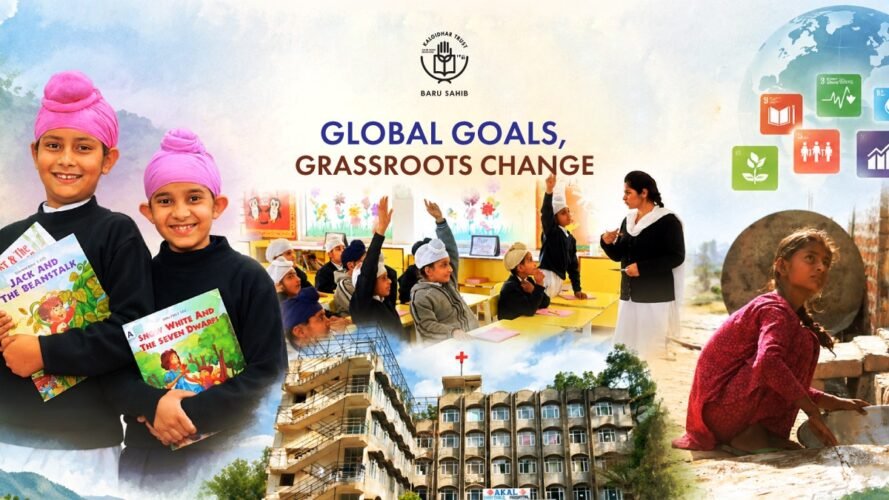
SDGs in Practice: Rural Work by The Kalgidhar Society and Kalgidhar Trust, Baru Sahib
The Kalgidhar Society and Kalgidhar Trust, Baru Sahib offer one example of how long-term community work lines up with several goals at once. Started under the vision of Sant Baba Iqbal Singh Ji, the organisations work mainly in rural North India. As of 1 April 2026, they ran 130 Akal Academies and 2 universities, educating 75,000 students and reaching 6,450 villages across 33 districts in 5 states.
| SDG | Work on the ground |
| SDG 4: Quality Education | Rural education through Akal Academies,
and higher education at Akal University and Eternal University |
| SDG 3: Good Health | A charitable hospital, free medical
camps and two |
| SDG 5: Gender Equality | Women empowerment through
education and skill training, including the Akal Institute of Rural Women Empowerment (AIRWE) |
| SDG 2: Zero Hunger | A joint initiative with Zomato’s Feeding India
that provides three meals a day to 400+ students of Akal Model School and Gurmat Sangeet Vidyalaya |
| SDG 7, 13 and 15 | Environment work such as solar power,
tree planting and waste management, along with disaster relief during the 2025 Punjab floods |
| SDG 17: Partnerships | Corporate CSR partnerships through
CSR for CHANGE and child sponsorship through Educate To Save |
The table shows the main point of SDG alignment in action: a school, a hospital and a skills centre in the same region support one another, and each serves more than one goal.
Frequently Asked Questions
What are the 17 Sustainable Development Goals?
They are No Poverty, Zero Hunger, Good Health and Well-being, Quality Education, Gender Equality, Clean Water and Sanitation, Affordable and Clean Energy, Decent Work and Economic Growth, Industry, Innovation and Infrastructure, Reduced Inequalities, Sustainable Cities and Communities, Responsible Consumption and Production, Climate Action, Life Below Water, Life on Land, Peace, Justice and Strong Institutions, and Partnerships for the Goals. All UN member countries adopted them in 2015, with a 2030 deadline.
Which SDG covers rural education?
SDG 4, Quality Education, covers schooling for every child, including those in villages. Target 4.1 aims for every child to complete free primary and secondary education, and target 4.5 aims to remove gender and other gaps in education. Rural education also supports SDG 1, SDG 5 and SDG 8.
How is India doing on the SDGs in 2026?
India ranked 94th out of 167 countries in the 2026 global SDG Index, with a score of 68.3, its highest position so far. Its own SDG India Index score rose to 71 in the 2023-24 edition. Hunger, health and gender equality remain the hardest areas.
Why does SDG 17 matter for NGOs?
SDG 17 is about partnerships and resources. With global development aid falling sharply in 2025, NGOs depend more on partnerships with companies, government schemes, local bodies and individual donors to keep their programmes running and growing.
How can an NGO for rural education in India support the SDGs?
It can link its programmes to SDG 4 targets, track results such as dropout rates and learning levels, work with panchayats and schools, and report its outcomes openly. Support for girls’ schooling and teacher training also counts towards SDG 5 and SDG 8.
What does sustainable rural development in India mean?
It means improving incomes, education, health, water and the environment in villages in a way that lasts. The aim is progress that rural communities can carry forward on their own, without depending on a single scheme or project.
Conclusion
The 17 SDGs can look like a long global checklist, but in India most of them come down to the same places: a village school, a primary health centre, a water tap and a farm. The national numbers show real progress on water, power and poverty. The gaps that remain, in secondary schooling, specialist health care, women’s opportunities and digital access, are mostly rural.
Closing them before 2030 will take patient work by governments, companies, communities and NGOs together, which is exactly what SDG 17 asks for. Readers who want to see how education, health and women’s empowerment come together across rural North India can explore the work of The Kalgidhar Society and Kalgidhar Trust, Baru Sahib, and find ways to support a child’s schooling or a village health camp.


 barublog






Add comment