Relics of Guru Gobind Singh Ji are Coming to your City for Sangat Darshan from May 6!

Relics of Guru Gobind Singh Ji will be made available from May 6 for Sikh devotees to view. These relics were with descendants of Patiala and Nabha Riasat until now. These relics were brought from Qila Mubarak to Gurdwara Sri Dukh Niawaran Sahib with full discipline and under surveillance of experts. The relics will be […]

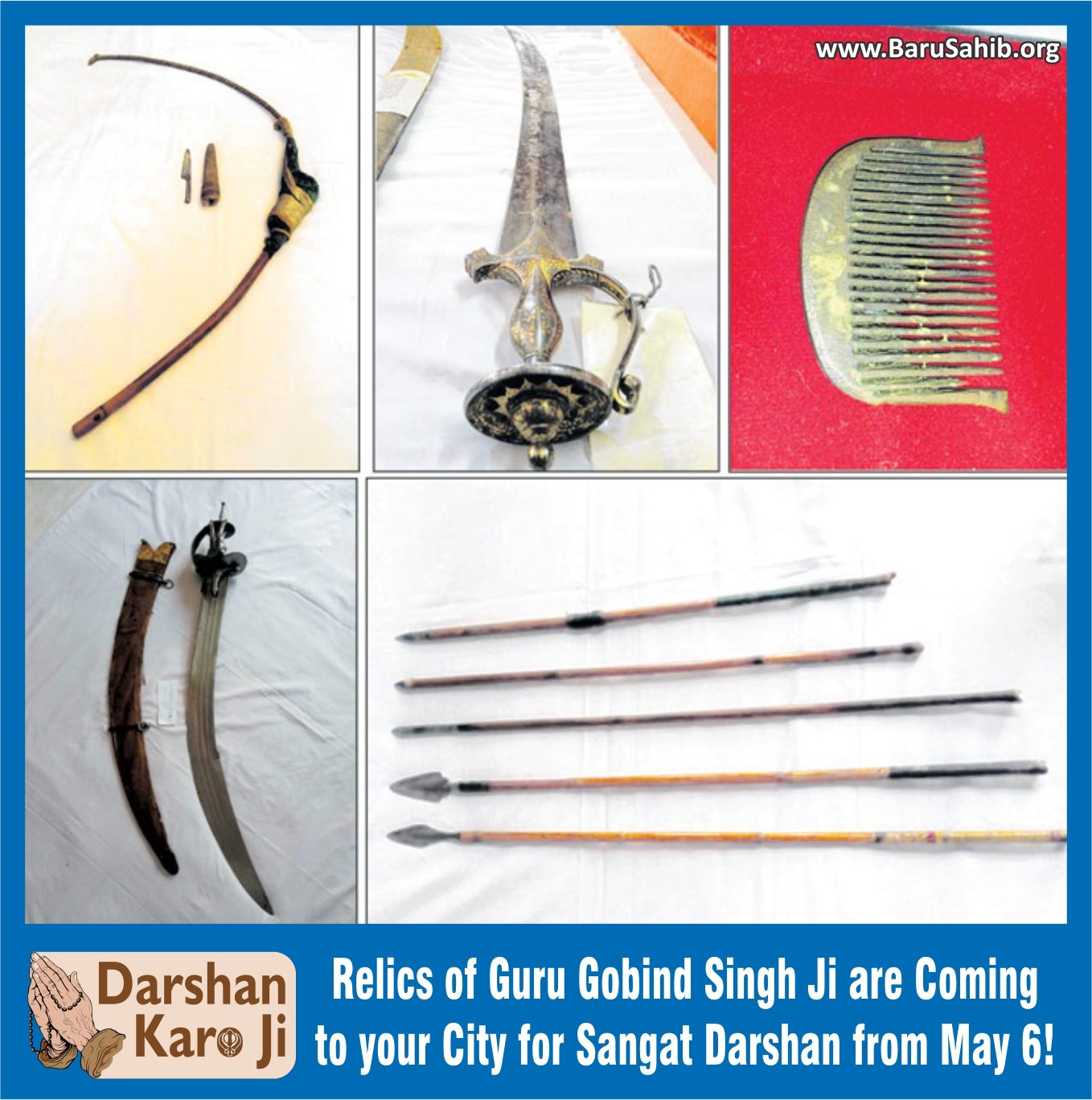
Relics of Guru Gobind Singh Ji will be made available from May 6 for Sikh devotees to view. These relics were with descendants of Patiala and Nabha Riasat until now. These relics were brought from Qila Mubarak to Gurdwara Sri Dukh Niawaran Sahib with full discipline and under surveillance of experts. The relics will be brought to every part of Punjab in the form of a Nagar Kirtan.

A 33-feet long bus carrying the revered relics of three Gurus of Sikhism, will be flagged off tomorrow from Gurudwara Dukhniwaran Sahib in Patiala. The relics related to Guru Sahiban, their clothes and weapons would be displayed in a bus.
The relics also include Chola Sahib, manuscript, hair, comb and turban; 20 inches long iron arrow; three-and-a-half inch long Siri Sahib; 30 inches long wooden spear and five arrows.

High priests of all the five Takhts, Punjab Chief Minister Parkash Singh Badal and deputy CM Sukhbir Singh Badal will flag off the yatra drenched in colors of Khalsa, the spokesman said. The yatra will culminate on May 20 at Anandpur Sahib where the relics would be put at Takht Kesgarh Sahib.

DATE DETAILS OF ROUTE

May 6, 2015 Patiala, Nabha, Bhawanigarh, Sangrur and Barnala
May 7, 2015 Barnala, Mansa, Maur and Talwandi Sabo
May 8, 2015 Talwandi Sabo, Bathinda, Malout and Sri Muktsar Sahib
May 9, 2015 Sri Muktsar Sahib, Kotakpura, Faridkot, Ferozepur and Wazidpur
May 10, 2015 Wazidpur, Moga, Kot Isse Khan, Zira, Makhu and Harike
May 11, 2015 Harike, Patti, Bhikhiwind, Jhabaal and Tarn Taran
May 12, 2015 Tarn Taran, Jandiala, Baba Bakala, Chowk Mehta and Amritsar
May 13, 2015 Stay at Amritsar
May 14, 2015 Amritsar, Batala, Sri Hargobindpur, Kahnuwan and Chota Ghalughara
May 15, 2015 Chota Ghalughara, Gurdaspur, Mukerian, Dasuya and Hoshiarpur
May 16, 2015 Hoshiarpur, Tanda, Bhogpur, Kartarpur, Kapurthala, Sultanpur Lodhi (via Talwandi Choudharian)
May 17, 2015 Sultanpur Lodhi, Malsian, Nakodar, Jalandhar and Phagwara
May 18, 2015 Phagwara, Ludhiana and Fatehgarh Sahib
May 19, 2015 Fatehgarh Sahib, Mohali, Kharar, Morinda, Chamkaur Sahib and Ropar
May 20, 2015 Ropar, Sri Anandpur Sahib (Takht Sri Kesgarh Sahib)

~ Source: Sikh24.com

Sikh Sermon Valarie Kaur highlights the essence of ‘Seva’ – selfless service in the Sikh at Pentagon!

The following are the prepared remarks of Valarie Kaur at the Pentagon’s second-ever commemoration of the Sikh faith on May 1, 2015. Kaur spoke alongside Simran Jeet Singh and Inni Kaur on “Seva” – selfless service in the Sikh religion. Hosted by the Pentagon Chaplain on Vaisakhi, the program was organized by Major Kamal Singh […]

The following are the prepared remarks of Valarie Kaur at the Pentagon’s second-ever commemoration of the Sikh faith on May 1, 2015. Kaur spoke alongside Simran Jeet Singh and Inni Kaur on “Seva” – selfless service in the Sikh religion. Hosted by the Pentagon Chaplain on Vaisakhi, the program was organized by Major Kamal Singh Kalsi and the Sikh Coalition, an organization leading the campaign for turbaned Sikhs and other people of faith to be allowed to serve in the U.S. military. Kaur’s remarks at the first-ever Sikh event at the Pentagon in 2014 can be found here.

Waheguru Ji Ka Khalsa, Waheguru Ji Ki Fateh.

Thank you to the Pentagon Chaplain for gathering us here for the Sikh celebration of Vaisakhi. I am honored to reflect with you on the Sikh tradition of service – seva – and what it means for us, here and now.

In this moment, we know that children are lying beneath the rubble of the earthquake in Nepal without chance of rescue. Families are mourning as the smoke clears from another ISIS car bombing. The Supreme Court is debating recognition of the human heart to love anyone without reference to gender or sexual preference. And just forty minutes away from Washington, a city is burning in the wake of another killing of a young, unarmed black man in what our President has called – from Ferguson to Staten Island to Baltimore – “a slow-rolling crisis.”

We may be tempted to turn away from these crises of our time. But the Sikh faith calls us to face the fires of life, no matter how they rage – and respond. Service is the core of Sikh practice, but it’s not the kind of service we think we know. Seva is not safe. Seva is not easy. Seva means selfless service. To pursue a life of seva is to walk boldly into the hot winds of the world with a saint’s eyes and a warrior’s heart – and draw from a deep well of love to pour our body, breath, and blood into others.

This kind of selfless service requires the courage of Mai Bhago, the 17th century Sikh woman warrior who told forty soldiers who abandoned their post during a great battle: “You will not hide from the fire. You will return to the fight – and I will lead you.” Donning a turban and mounting a horse with a sword in her hand, she led them when no one else would. Because seva means becoming the one you are waiting for.

I believe that seva is the call of our time. Let me show you why.

Five centuries ago in South Asia, Guru Nanak, our first teacher, found himself in a similar time of crisis – a time of violence between Hindus and Muslims, denigration of women, and cruelty towards the poor. One day, the story goes, Nanak disappeared by the river for three days; people thought him a dead man, a drowned man, but he had experienced a divine revelation and emerged with a single profound utterance on his lips: Ik Onkar, God is One; we are One.

Guru Nanak was birthed anew. He began singing a song of Oneness – music and poetry meant to lift us into sacred experience. When we pray like that, our ego – haumai, the voice inside us that separates self from selflessness – starts to quiet. And something marvelous happens: we fall in love.

“I see no stranger,” Guru Nanak said. “I see no enemy.” When we are in love, we begin to see with new eyes: we look upon the faces of people who are different from us and say: Brother. Sister. I cannot live if you are dying. I cannot stand by if you are suffering. That kind of love is revolutionary. When we serve the child, the parent, the family, the community, the country, we do so not out of obligation but because we love them; and in turn, that kind of love saves us.

Only through seva do you attain God, Guru Nanak taught us. That means: we pray to remember God (simran) but we serve to realize God (seva). That’s why the way we serve matters, not with stress or despair, but with joy and boundless optimism called Chardi Kala. In fact, every Sikh gurdwara (house of worship) contains a prayer hall and a langar hall, a place where we cook and serve free meals, so that we can practice serving selflessly.

But remember, seva is not safe. “If you want to play the game of love with me,” says Guru Nanak, “then step onto my Path with your head on your hand.”

Our first teacher called us to play the game of love. Two hundred years later, our tenth teacher showed us how. In 1699, Guru Gobind Singh called Sikhs to a clearing in a place in Northern India called Anandpur Sahib. It was another time of crisis. The Sikh community was struggling to survive onslaught at the hands of Mughal rulers. Our numbers were dwindling, and the future was dark.

There stood the Guru – a warrior dressed in a tall turban, sword in hand, often seen with a falcon on his shoulder. He rose before the thousands with fire in his eyes, and called out: “Who among you is ready to give your head for the love of God and one another?” The crowd was silent. The wind rustled, and the people did not move – until one brave soul, Daya, stepped forward.

The Guru took Daya inside a tent and a few moments later, emerged with his sword dripping with blood, and called: “Now, who else is ready to give their head for love?” Not a word was spoken. The wind rustled, and the people did not move. Until courage stirred within another, Dharam, and he stepped forward and entered the tent. The Guru emerged once again with the same call, again and again, until five had offered their lives. The Guru appeared once more, but this time, he opened the tent for all to see – and there they stood. They were all alive and well, but they were changed.

“These are my Panj Pyare,” said the Guru. “My five beloved ones. These are the ones who were willing to offer their body, breath, and blood for the sake of love. The death of their egos has birthed them anew. The Guru gave them new names and anointed them, and was anointed by them in return.

On that day, we as a community were also birthed anew. We too shed our old separate names and were given new names – Singh and Kaur, lion and lioness – to honor our equality and courage. We received the gift of five articles of faith, including long uncut hair, which men and some women wrap in a turban, so that we may never hide from the call to serve again.

That is the story of Vaisakhi. That’s why we are here today – to celebrate our birth as the Khalsa, a spiritual sister and brotherhood, a collective body of beloved ones.

Now, I have a confession. As a little girl, this story always made me tremble. After all, isn’t it madness to give up your life like that? But today, I see the story’s meaning with new eyes. Seva springs from a love so deep we would give our lives for it.

When I gave birth to a baby boy a few months ago, and held my son for the first time, I knew that I would give my life for him. I looked at my own mother and saw all the ways she had poured her body, breath, and blood into me. What greater bravery, what deeper love? If the story of Vaisakhi calls us to serve selflessly, then perhaps motherhood is our most ancient and profound model. So today, as we celebrate Vaisakhi, let us honor all of those who teach us the truth of seva, the same way mothers and fathers show devotion to the lives of their children and their children after them.

Let us honor our elders who teach us how to hold fast to our faith in the fire – like my grandfather Captain Gurdial Singh who followed seven generations before him and served in the military, fighting on the frontlines in World War II against Hitler’s armies. When his British commander told him to remove his turban, he refused, saying, “My turban represents my faith, and I cannot serve without faith.” So he went to war and when German aircraft swooped down and shot his best friend, he did not run. He wrapped his friend’s wounds with the cloth of his turban and brought him home. Because seva means leaving no one behind.

Let us honor the faith and fearlessness of all our uniformed soldiers, including the Sikh Americans in this room: Corporal Simran Preet Singh Lamba, Captain Tejdeep Singh Rattan, Colonel Tina Kaur Sodhi, Staff Sargent Bree Kaur, Petty Officer Geena Kaur Sidhu, Senior Airman Jasreen Kaur, Private Sukhreet Kaur, and Lieutenant Jaspreet Kaur Saini.

Let us honor Major Kamal Singh Kalsi, a decorated hero who when treating the wounded in Afghanistan, was moved to tears when one young bleeding soldier looked at him and said, “Thank you, brother.” Because seva inspires love in others.

Finally, let us honor all the brothers and sisters in this room who are fighting for justice with modern-day swords – the lawsuit, the camera, the megaphone – not to vanquish others but to reconstitute the cultures and institutions that separate us.

~ Source: huffingtonpost.com

Sikh Devotee presents a 6-feet long hand-written Guru Granth Sahib Ji at Harmandir Sahib!

It is said that devotion has no limits, and a city-based Sikh devotee has certainly proved it by preparing a hand-written Holy Guru Granth Sahib, which is 6-feet long and 90 kg in weight. It is a copy of ‘Adi Granth’ written by Harvinder Pal Singh, a resident of Kaushal Puri, Kanpur, it is made […]

It is said that devotion has no limits, and a city-based Sikh devotee has certainly proved it by preparing a hand-written Holy Guru Granth Sahib, which is 6-feet long and 90 kg in weight.

It is a copy of ‘Adi Granth’ written by Harvinder Pal Singh, a resident of Kaushal Puri, Kanpur, it is made of German-made paper that can last for around 400 years. The `Granth Sahib’ will be placed at Golden Temple, Amritsar-Punjab.

The Saroop has been hand written by Harvinder Singh. The Pen was specially imported from USA to write a Holy Guru Granth Sahib, It took him 3 years to complete the entire saroop. The specialty of the pen is that its writing gives an impression of print.

Six people are required to handle the Guru Granth Sahib, while 3 people are needed to turn its pages, which are quite large in size. The `Granth Sahib’, before being taken to Golden Temple in Amritsar, was kept in Ranjit Nagar Gurudwara in the city for some time”, Bhalla said.

Harvinder Singh also wrote 2 other copies of Guru Granth Sahib in the past. One copy of the `Granth Sahib’ is in Paonta Sahib Gurudwara, Dehradun while other one is in a Punjab Gurdwara.

~ Source: TOI

Sikh resident of Dubai honored with Canada’s Bravery Award for saving 6 lives from a crashed burning plane!

A few brave hearts alone cannot save people from death without a divine intervention, according to a Dubai resident who was instrumental in saving six people from a burning plane in Canada. Mandeep Singh Dhaliwal is humble enough to attribute his bravery to a miraculous intervention appeared in the form of a heavy wind when […]

A few brave hearts alone cannot save people from death without a divine intervention, according to a Dubai resident who was instrumental in saving six people from a burning plane in Canada.

Mandeep Singh Dhaliwal is humble enough to attribute his bravery to a miraculous intervention appeared in the form of a heavy wind when the small plane crashed on a busy highway in Richmond in British Columbia on October 27, 2011.

“I was at a loss along with scores of others when we saw the plane in flames a few yards away and a heavy wind was intensifying the flames. Then plane’s door was opened and two passengers jumped out of the flames. They were able to do so because the wind was in opposite direction of the door, keeping the flames away from the door,” Dhaliwal told Gulf News.

“Had the wind was blowing along the door’s direction, the two passengers would have never come out and we would never get the courage to approach the burning plane,” said the 32-year-old Indian IT Specialist in Aviation sector, who was on a business trip to Canada when the incident occurred.
Ignoring the intense heat and dense smoke enveloping the aircraft, he and other rescuers entered the plane several times to help pull the injured passengers out.

He was surprised to receive a call after a few months from a Canadian Government official, saying he was nominated for a bravery award. He was again surprised when he was invited to visit Canada to receive the award late in 2012. Six other rescuers were also awarded for their courage in the incident. But Dhaliwal could not visit Canada then, being busy with his works in India. He moved to Dubai in June 2014.

When Arif Z Lalani, the Canadian Ambassador to the UAE, came to know Dhaliwal was living in Dubai, he organized Presentation Ceremony of the Canadian Decoration for Bravery on Saturday at the ambassador’s residence on Saturday (May 2). Lalani presented the award on behalf of David Johnston, Governor General of Canada.

Decorations for Bravery recognize people who risked their lives to try to save or protect another. The Decorations were created by Queen Elizabeth II in 1972. The governor general personally presents the Decorations in ceremonies held at Rideau Hall, in Ottawa, or at La Citadelle, in Québec City. They consist of the Cross of Valor, the Star of Courage and the Medal of Bravery.

Lalani said: “ Mr Dhaliwal is a hero. He reflects the essence of the Canadian Governor General’s medal for bravery – helping others simply because they need help and you can offer it. It is a great honour to present the medal to Mr Dhaliwal in the UAE where he lives and works.

Dhaliwal’s humbleness further attributes his bravery to his attire. “Being a Sikh, my turban might have helped others easily recognise me among other rescuers,” he told Gulf News. There were many others who also risked their life along with others, he said. Dhaliwal is working with Flydubai now and his wife Kamalpreet Kaur is a school teacher. The couple has a four-year-old son Nirvaan Singh.

He has not been carried away by the award and ensuing flame. “Anyone trying to rescue others must ensure their own safety first. I did it because four other friends were also with me. I may do the same. But when we do so, we should take care of our safety too!” Dhaliwal said.

~ Source: Gulf News

Sikh parade through Manchester brings a vibrant breeze of Divinity to grey Sunday!

Thousands took part in a colourful procession through Manchester’s streets to mark the annual Sikh celebration Nagar Kirtan. Meaning ‘singing hymns in the street’, it sees lavishly-decorated lorries and people on foot make their way from one temple to another as a way of sharing their faith. This year the procession began at the Dasmesh […]

Thousands took part in a colourful procession through Manchester’s streets to mark the annual Sikh celebration Nagar Kirtan.

Meaning ‘singing hymns in the street’, it sees lavishly-decorated lorries and people on foot make their way from one temple to another as a way of sharing their faith.

This year the procession began at the Dasmesh Sikh Temple in Cheetham Hill, making its way down Cheetham Hill Road, crossing to Bury New Road and into the city centre along Deansgate

The parade then stopped outside the Town Hall where free food was distributed, with dignitaries including police chief Sir Peter Fahy taking part.

It then continued down Princess Street and Oxford Road before travelling through Hulme and Moss Side, finishing at the Sri Guru Gobind Singh Gurdwara on Upper Chorlton Road in Whalley Range.

With around 5,000 participants estimated to be taking part, some made their way barefoot, sweeping the road as a sign of respect to the holy book, carried on the main float.

Many also wore orange – the traditional colour of the five most learned Sikhs, represented by five people leading the parade.

~ Source: manchestereveningnews.co.uk

Best out of Waste Activities & Labour Day Celebrations by Students of Mander Dona!

In order to make children aware of uses of waste material, to give them a lesson on reducing waste to save our future, a ‘Best out of Waste’activities were organized for students. Innovative, beyond expectation, fantabulous ideas were demonstrated by students.

Right from waste ropes to broken bangles, plastic bottles, bulbs, waste nails to plastic glasses every waste material was used and the result was a hall full of projects made out of waste. The teachers appreciated the models made by children.

Apart from this Labour Day was also celebrated by the students to commemorate & appreciate the selfless service of the academy workers. The students were acquainted about the history that backed the day. They were encouraged to realize the value and role of working people in our daily life.

The day ended on a warm note of gratitude by the students which was much applauded & appreciated by the staff & workers.

Akal Academies under the aegis of Kalgidhar Society ensure to raise the children in best learning environments by involving them in a plethora of activities.

~ Tapasleen kaur
~ New Delhi, 5th May ’15

Another Warm Gesture by Sikhs- Gurdwara Bangla Sahib sends 25,000 food packets to quake-hit Nepal every day!

Two leading Sikh organisations are sending food packets for the earthquake victims in Nepal and will continue to do so till normalcy returns. Flagging off a fleet of three trucks carrying relief material and packaged food from ‘langar’ at the Gurdwara Bangla Sahib, many Sikh organizations are also appealed to join hands for support. As […]

Two leading Sikh organisations are sending food packets for the earthquake victims in Nepal and will continue to do so till normalcy returns. Flagging off a fleet of three trucks carrying relief material and packaged food from ‘langar’ at the Gurdwara Bangla Sahib, many Sikh organizations are also appealed to join hands for support.

As reported they would send 25,000 food packets every day to Nepal.

Another Warm Gesture by Sikhs- Gurdwara Bangla Sahib sends 25,000 food packets to quake-hit Nepal every day!

“We will continue to send food packets as long as these are needed in Nepal by the earthquake victims,” said GK. The food packets would contain four to five chapatis, dry vegetable cooked in ‘desi ghee’ and pickle wraped in silver foil, said GK. A team of DSGMC had flown to Nepal to oversee the arrangements for preparation and to serve langar while cooks along with required man force and machinery would prepare fresh food over there.

As per the arrangements envisioned, fresh langar would be prepared for more than 10,000 victims daily. Langars are currently being served in Kathmandu, which will be replicated in other affected areas later.

Nepal Victims would surely find solace from the warm gesture by Sikhs!

Dhan Sikhi! Dhan Khalsa!

Like & Share to appreciate.

Indulging in Sewa beyond Gurdwaras – United Sikh Mission sets an exemplary!

Sewa is not confined to the premises of Gurdwara. It’s rather a reflection of the dedication of your soul to the principles of Sikhism! “Sarbat Da Bhala ” Langar project of United Sikh Mission to feed the needy in Govt Hospitals, Slums and Garbage Areas where kids eats from garbage. In association with ANAS TRUST […]

Sewa is not confined to the premises of Gurdwara. It’s rather a reflection of the dedication of your soul to the principles of Sikhism!

“Sarbat Da Bhala ” Langar project of United Sikh Mission to feed the needy in Govt Hospitals, Slums and Garbage Areas where kids eats from garbage.

Indulging in Sewa beyond Gurdwaras - United Sikh Mission sets an exemplary!

In association with ANAS TRUST TEAM blessed with the Weekly Sewa on every Saturday at 12-1pm Pictures of Langar at Deen Dayal Hospital New Delhi depict their true spirit of selfless service to mankind. After 150 Juggis burnt in Hari Nagar this sewa emerged as a real blessing for them.

Appeal to Sadh Sangat Ji to join us in this Project. Contact: 9871126257, 9818843056

Hats off to these Noble Souls! Dhan Sikhi! Dhan Khalsa!

~ Tapasleen Kaur

Singh risks his own life to rescue a blind man on subway tracks in Boston!

Brave efforts by Gurtej Singh rescued of a visually impaired man after he fell on train tracks of a subway in Boston, Mass. The time was around 10 a.m. Friday when the man didn’t notice warning signs on the track and fell on the subway tracks of Park Street MBTA. The man started scream for […]

Brave efforts by Gurtej Singh rescued of a visually impaired man after he fell on train tracks of a subway in Boston, Mass.

The time was around 10 a.m. Friday when the man didn’t notice warning signs on the track and fell on the subway tracks of Park Street MBTA.

The man started scream for help and soon after the Sikh jumped onto the tracks to lift him out of dangers way.
“I heard a scream and when I looked up I saw someone tumbling onto the tracks,” Gurteg Singh said. “He’s blind so there’s no way he could see his footing or step up to try to pull himself.”

The Sikh demonstrated what Sikhs live for which is helping others in need. “I think that many of us are human beings and we care about each other. If you look at it people are willing to jump in and risk their own safety to help others who fall and injure themselves,” Harry Skeffington said. Gurtej told reporters that he didn’t think twice to help as his religion teaches him to help others.

“In the moment fight-flight sort of kicked in so I jumped in to push him up, try to give him leverage and help the people on the platform pull him up,” he said. The man was taken to the hospital and released after evaluation.

Bravery & Willpower to help others describe the true quality of a Guru’s Sikh!

~Source:

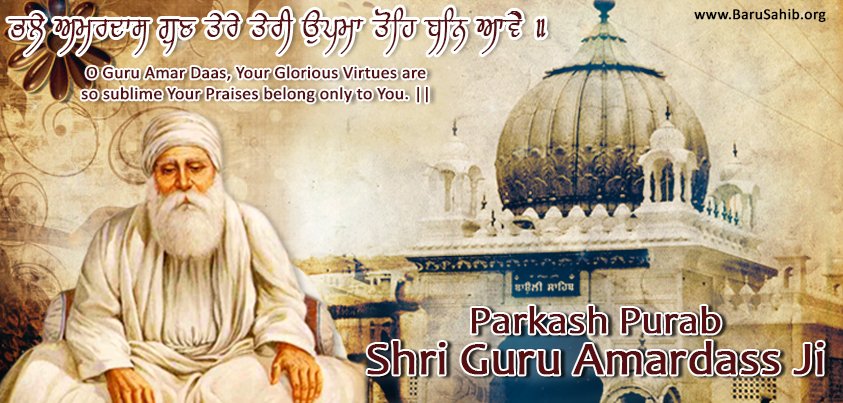
Prakash Purab of Shri Guru Amardas Ji!

Guru Amardas was born in the Bhalla family to father Tejbhan and mother Sulakhani in village Basarke, near Amritsar on May 5, 1479. He was married to Mansa Devi (also known as Ram Kaur), daughter of Devi Chand Behal. The couple had four children – two sons, Mohri and Mohan; and two daughters, Dani and […]

Guru Amardas was born in the Bhalla family to father Tejbhan and mother Sulakhani in village Basarke, near Amritsar on May 5, 1479. He was married to Mansa Devi (also known as Ram Kaur), daughter of Devi Chand Behal. The couple had four children – two sons, Mohri and Mohan; and two daughters, Dani and Bhani.

Every year Baba Amardas used to go for pilgrimage to Haridwar, which is a holy place for the Hindus, located on the banks of the river Ganges in North India. Once, while returning from the pilgrimage, Baba Amardas rested at an inn, which was owned by a Brahmin, who was also a renowned palmist and astrologer. At night, Baba Amardas was sleeping in such a posture that his head and feet were visible. The Brahmin could tell the future of a person by reading lines on the feet and hands. He chanced to see the feet of Baba Amardas, which were embedded with Padam Rekha – luckiest line on the feet – which denotes that such persons are supreme. Padam Rekha is embedded either on the feet of the Prophets, divine persons or the very renowned kings.

Next morning, before departure, when Baba Amardas offered money for the night stay in the inn, the owner being a knowledgeable palmist pronounced that the Baba would become either a highly divine person or a renowned king. Then, he would get all the bounties from him. Hearing this, tears rolled down the eyes of Baba Amardas. He wondered that for realising the divine within, he had been visiting Haridwar regularly for twenty years but still could not perceive the divine Truth. The Brahmin palmist was so sure of his palmistry knowledge that he emphatically predicted that he was bound to become a divine person and then he would come to him for seeking the divine bounties.

Wretched is he, who has no Guru (the divine guide): Baba Amardas was a Vaishnavite and used to go on a pilgrimage to Haridwar every year, but even after many visits to the holy place, he had not yet found the bliss of self-realisation. Once, an ascetic (Brahmachari, who observes celibacy) was attracted by the divine virtues of Baba Amardas. He accompanied him to his village Basarke. As the food was being served, the Brahmachari casually enquired from Amardas who was his Guru? Baba Amardas humbly submitted that he was still in search of one. The Brahmachari became upset and angry. He would not partake of the food from a person, who had no Guru for getting instructions to tread the divine Path and left the house in a huff after cursing the Baba. This incident shook the conscience of

Baba Amardas, who vigorously started searching for the Guru from that very day.

Meeting the Guru: One early morning, Baba Amardas heard Bibi Amro recite the divine Hymns. Bibi Amro, Guru Angad Dev‟s daughter was recently married to Baba Amardas‟s nephew. These Hymns touched his conscious and he developed an immense urge to become a disciple of the Guru, who had composed these verses. He asked Bibi Amro, “Whose Hymns are you reciting?” She humbly replied, “My Divine father, who is now second Guru Nanak Dev, has imbibed all these hymns from His Mentor.” He expressed a wish to meet the Guru. Bibi Amro took Baba Amardas to Guru Angad Dev. A glimpse of the Guru made Baba Amardas his devout disciple. Setting aside the worldly conventions of the society, he presented himself in the service of Guru Angad Dev‟s door-step; in other words, at the door-step of the father-in-law of his brother‟s son and rendered utmost divine service to the Divine Master. Baba Amardas was at that time about sixty-two years old while Guru Angad Dev was only about thirty-six. Just after midnight every day, he would walk about ten kilometres to the river Beas for his bath and then fetch a pitcher of water for His Mentor‟s bath in the ambrosial hour. Throughout the day, he worked tirelessly in various services of Langar.

Guruship: On 25 March, 1552, Baba Amardas was bestowed the Guruship at Khadur Sahib by his Divine Master Guru Angad Dev, who followed all the rituals, as Guru Nanak Dev did for Him. (Guru Angad Dev‟s life story has already been given in the previous chapter.)

~ Extract from Sikh Faith Book
~ Written by Iqbal Singh Ji(Baba)