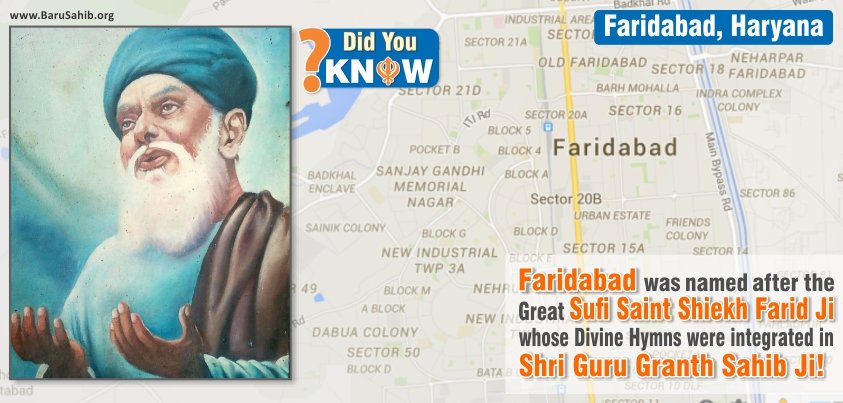
Did You Know – Faridabad was named after the Great Sufi Saint Bhagat Shiekh Farid Ji!

Faridabad was named after the Great Sufi Saint Bhagat Shiekh Farid Ji whose Divine Hymns were integrated in Shri Guru Granth Sahib Ji! There are 134 hymns of Sheik Farid incorporated in the Guru Granth Sahib. Many Sikh scholars ascribe them to Farid Shakarganj (1173 – 1265AD or 569-664 AH) of Pak Pattan, a disciple […]

Faridabad was named after the Great Sufi Saint Bhagat Shiekh Farid Ji whose Divine Hymns were integrated in Shri Guru Granth Sahib Ji!

There are 134 hymns of Sheik Farid incorporated in the Guru Granth Sahib. Many Sikh scholars ascribe them to Farid Shakarganj (1173 – 1265AD or 569-664 AH) of Pak Pattan, a disciple of the Sufi Qutbuddin Bakhtiyar Kaki. The tenth in succession to his post was Sheikh Brahm (Ibrahim), also known as “Farid Sani” or “Farid the 2nd”, and it is this Farid who Guru Nanak Dev met on two occasions.

Max Arthur Macauliffe who has been described as a ‘Matchless Scholar of Sikh Lore’ states that hymns ascribed to Farid are compositions by the latter Farid, whereas others have ascribed them to Farid Shakarganj.
There are still other scholars who believe that the hymns were composed by different Sufis of the Pak Pattan centre, all using the poetic name Farid as was the custom in those days as the leader of an order chose his most suitable devotee to take his place shortly before his death.

~ Source: Wikipedia

Get Ready for the Third All India Inter-Varsity Gatka Tournament !

Punjabi University Patiala will host third all India Inter-University Gatka (Men & Women) prize money tournament-2015 from March 25 to March 27 at university campus in which more than two dozen university Gatka teams would vie for championship. Disclosing this here today, Director Sports of Punjabi University. Dr. Raj Kumar Sharma said the team winners […]

Punjabi University Patiala will host third all India Inter-University Gatka (Men & Women) prize money tournament-2015 from March 25 to March 27 at university campus in which more than two dozen university Gatka teams would vie for championship. Disclosing this here today, Director Sports of Punjabi University. Dr. Raj Kumar Sharma said the team winners would be awarded cash prizes from Rs 31,000, Rs 21,000 and Rs 11,000 respectively for their three top positions.

He informed that former Union Minister Sukhdev Singh Dhindsa and Secretary General SAD, also president of World Gatka Federation, would inaugurate the tournament on March 25. Mr SP Singh Oberoi president Asian Gatka Federation and Mr Harcharan Singh Bhullar president Gatka Federation of India would also grace the occasion as guests of honour.

He further added that Dr Jaspal Singh Vice Chancellor Punjabi University would preside over the prize distribution ceremony on March 27 for which sports department has already made adequate arrangements for successful conduct of this tournament. He added that Dr Jaspal Singh Vice Chancellor was longing earnestly for preservation and promotion of this ancient martial art at national level and Punjabi University has taken initiative to organize all India inter-varsity Gatka competitions with the help of Gatka Federation.

He said that earlier, the Gatka was only the domain of males, now even the females have been outperforming the males by displaying their rare acumen in the Gatka sport. The present martial art form, Gatka, had been acknowledged as a sport and being played in the entire country and diaspora.

It is mentioned here that Gatka is a style of fighting only with sticks between two Gatka players, intended to simulate the sword and focuses on infusing physical, spiritual and mental fitness. No sharp edged weapons are used in the Gatka game and it has become a “cosmopolitan sport”.

~ Source: Gatka Fedration, Punjab

EcoSikh joins hand with World Bank in breaking the Shackles of Poverty!

EcoSikh board member Suneet Singh Tuli and EcoSikh program manager Sumeet Kaur last week joined a roundtable discussion for faith-based organizations, hosted by Dr. Jim Yong Kim, President of the World Bank.The aim of the meeting, held at the institution’s headquarters in Washington DC, was to bring together prominent leaders from the world’s major faiths […]

EcoSikh board member Suneet Singh Tuli and EcoSikh program manager Sumeet Kaur last week joined a roundtable discussion for faith-based organizations, hosted by Dr. Jim Yong Kim, President of the World Bank.The aim of the meeting, held at the institution’s headquarters in Washington DC, was to bring together prominent leaders from the world’s major faiths to address how religious communities can work with secular organizations to eradicate extreme poverty by 2030.

Suneet Singh Tuli stressed the importance of energy security as it relates to the Millennium Development Goals, and implored the World Bank group to make climate change a main focus of the discussion. “Faith communities must be the forefront of environmental action to combat climate change,” he said, especially since climate change will affect those “least responsible for the problem.”

The participants, from Christian, Islamic, Jewish, Baha’i, Sikh and interfaith perspectives, will be releasing a call to action for faith communities to fulfill the Millennium Development Goals and end extreme poverty in the world. Many participants emphasized the need for local partnerships to lead a grassroots movement to end extreme poverty.

“At EcoSikh we’ve found that we have to have a holistic approach to addressing poverty and the kind of environmental crises that will lead to poverty in the future,” said EcoSikh program manager, Sumeet Kaur. “How will people succeed in their education when they don’t have clean water to drink? In Punjab and in the rest of our outreach, we find that what’s needed is a comprehensive toolkit to address extreme poverty and promote growth among the poorest people in the world,” Kaur added.

Nearly half of those who live in extreme poverty (defined by the World Bank as people living under $1.25 a day) live in India and China. EcoSikh projects in India address environmental aspects of poverty, and help many to mitigate and adapt to climate change, and to become aware of the urgency of the issue.

“For the past two years we have been running a programme to make all Nagar Kirtans [Sikh religious processions sometimes involving thousands of people] greener and cleaner,” said EcoSikh’s Punjab-based Project Manager Ravneet Singh.

“This, as well as our Green Gurdwara initiative, and the thousands of communities taking part in Sikh Environment Day every March 14, help to teach many locals the importance of living a life in harmony with the earth,” he added. “Through education, we hope Sikh communities, especially in areas of poverty, will be able to slow down and eventually stop climate change’s disastrous effects,” Singh continued.

~ Source: www.ecosikh.org

Rare Exhibition “Sikhs: Legacy of the Punjab” on Display in Texas till January 2016!

The Sikh tradition has long been at the forefront of social innovation. The Institute of Texan Cultures, a unit of the University of Texas at San Antonio, is hosting an exhibition titled ‘Sikhs: Legacy of the Punjab’. More than 100 pieces of Sikh artwork and artifacts are on display at the exhibition, which will remain […]

The Sikh tradition has long been at the forefront of social innovation. The Institute of Texan Cultures, a unit of the University of Texas at San Antonio, is hosting an exhibition titled ‘Sikhs: Legacy of the Punjab’. More than 100 pieces of Sikh artwork and artifacts are on display at the exhibition, which will remain open till January 3 next year.

The idea of holding an exhibition about the Sikh community came to Gurvinder Pal Singh (an entrepreneur and Sikh community leader in San Antonio), post an instance of shooting in a Sikh gurdwara, after which he approached the institute in October 2012. The dire urge to educate people about this community made him take this step.

Developed by Smithsonian Institution and sponsored by the Sikh Heritage Foundation, the exhibition presents paintings; arms and armour; traditional textiles and dress; musical instruments; jewellery; sacred texts; and modern works of art, apart from a scale model of the Golden Temple.

“The bulk of the exhibit originated at the Smithsonian Institution, with whom we’re an affiliate.

That part of the exhibition covers Sikhism in general. We added three small sections, one of which depicts the story of Sikhs in early Texas. Most of them intermarried with Mexican or Mexican-Americans, and developed a unique cultural blend around El Paso, Texas. We also added material about the Sikh military legacy. San Antonio has a sizeable military presence, so we felt this was appropriate. Along with covering Sikh contributions to world history, including their role in World Wars I and II, we cover Sikhs in the US Armed Forces, including issues surrounding permission to retain their articles of faith in uniform, which has recently resurfaced here in the US,” shared Bryan Howard, director of Research, Exhibits, & Collections at the institute.

On the other hand, senior religion fellow for The Sikh Coalition, Simran Jeet Singh, revealed that a number of important artifacts on display, from coins of the Sikh Raj to paintings and sculptures by prominent Sikh artists. “The exhibit also highlights the Gadar movement for India’s independence and contributions made by Sikhs have to the US military,” Singh added.

In fact, many of the objects on display are on loan from private collections and were used for public display for the first time when the exhibition opened in 2004 at the Smithsonian Institution. “In each subsequent venue, there have been local variations and additions, including the present venue at the University of Texas. This venue includes a section on the history of Sikhs in Texas; a Texan family’s heirloom phulkari (shawl) textile,” said Paul Michael Taylor, director of the Smithsonian Institution’s Asian Cultural History Program and Curator of the Sikh Heritage Project.

Activities during the exhibition

Talking of activities which have been arranged especially for the exhibition aimed at spreading awareness about the Sikh diaspora, Taylor shared, “There are many activities planned in San Antonio during this exhibition which include family festivals, performances, and other events. Other cities have also been pitching in so as to be the subsequent venues for the exhibition, though no decision has been taken in this regard.”

“Students from local schools will be visiting the exhibit everyday, and we will have special programmes to get more local communities to learn about Sikhism,” added Simran Jeet.

~ Source – Hindustan Times

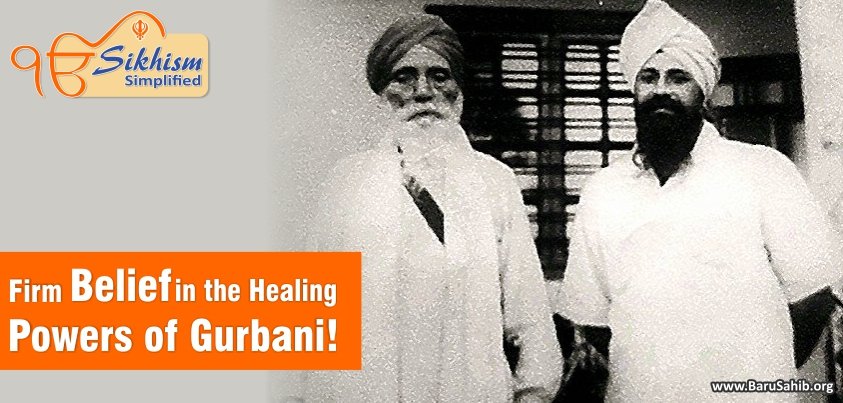
Firm Belief in the Healing Powers of Gurbani!

In 1928 Bau Mal Singh jee received a request to do an Akhand Kirtani Samagam in Rawalpindi (now in Pakistan). When Bau jee along with the Jatha arrived at Rawalpindi, they found Bibi Kundan Kaur, a young daughter of Doctor Gurbaksh Singh seriously sick with TB. As per doctor’s advice, she was residing near the […]

In 1928 Bau Mal Singh jee received a request to do an Akhand Kirtani Samagam in Rawalpindi (now in Pakistan). When Bau jee along with the Jatha arrived at Rawalpindi, they found Bibi Kundan Kaur, a young daughter of Doctor Gurbaksh Singh seriously sick with TB. As per doctor’s advice, she was residing near the Saanvali fountain in Maree (a hill station) because the water of this fountain was said to be good for the patients of TB.

Doctor Gurbaksh Singh the girl’s father had firm belief in the healing power of Gurbani and at his request the whole Jatha arrived at Maree for a 3 day Samagam.

This place possessed extreme natural beauty. It was surrounded by tall beautiful hills covered with heavy forest. There were natural fountains and lakes in this area.

The air was naturally perfumed because of abundance of wild flowers in this area. As soon as the Singhs arrived there, their Surthees moved upwards spiritually, because of the natural beauty of the area. The Sodar Chaunkee (evening Kirtan) was done in extreme Chardi Kala. The Singhs experienced such divine bliss here that they had never experienced before.

The next day, after Amritvela program, Siri Asa kee Vaar was started in great spirits. After the completion of Siri Asa kee Vaar, an Ardaas for starting of Siri Akhand Paath Sahib was performed by Bau Mal Singh jee in extreme Bairaag. The whole Sangat was in Bairaag and begged before Satguru jee for the healing of Bibi Kundan Kaur.

The Bibi was asked to stay in Maharaj jee’s Darbar and concentrate on Gurbani and chant Naam with Rasna. The remaining Sangat too engaged in earning the spiritual profits by listening to Gurbani Paath and chanting Naam.

Power of Gurbani

The already beautiful atmosphere of this area was greatly enhanced because of Gurbani Paath and arrival of Sangat there. Apart from the Ardaas performed by Bau jee, the rest of Sangat too was doing Gupt Ardaas for the healing of this fortunate young Bibi.

By the evening of the first day, the Bibi told the doctor that she was feeling much better. The doctor checked and noticed that fever had substantially come down. Next day again her fever was checked and it was found that the temperature was only 99 degrees now.

On the final day, her fever had almost subsided and she was feeling almost normal. Doctor Gurbaksh Singh the Bhujangan’s father, in extreme happiness stood up and with folded hands thanked Guru Sahib and the Sangat. He said that very soon his daughter would be healed.

When Bau jee heard this, he uttered a loud Jaikaara and announced that what was the need to wait any longer and announced the starting of another Siri Akhand Paath Sahib. Who was going to say no, when Bau jee had made the announcement? The next Siri Akhand Paath Sahib was started after the completion of Siri Asa kee Vaar of first Siri Akhand Paath Sahib.

This Siri Akhand Paath Sahib too concluded in great spiritual colours. By the end of this Paath, Bibi jee was totally healed as if nothing had ever happened to her.

The news about this miracle healing reached the Sangat of Rawalpindi (Rawalpindi is close to this hill town) and in gratitude, the Sangat there announced a third Siri Akhand Paath Sahib to thank Guru Sahib.

After the conclusion of the third Siri Akhand Paath Sahib, numerous people begged the Jatha to organize an Amrit Sinchaar Samagam.

Bau jee and other Jatha Singhs were extremely pleased at this development and right after the bhog of Siri Asa kee Vaar, an Amrit Sinchaar Samagam was started. In this Samagam, wife of Bhai Dogar Singh, and who later became famous in the Jatha as Bibi Kunji, had great mystical experiences.

As soon as she was done Naam DriR after Amrit Chhak, her eyes moved upwards and she lost her worldly consciousness. The Naam Khanda inside her was going on very vigorously. He condition was like this Pankiti:

ਹਉ ਆਕਲ ਬਿਕਲ ਭਈ ਗੁਰ ਦੇਖੇ ਹਉ ਲੋਟ ਪੋਟ ਹੋਇ ਪਈਆ ॥1॥

After her, whoever took Amrit from Punj Pyare, reached similar spiritual state as Bibi Kunji. Hearing such spiritual miracles occuring at this Samagam, many more requested to be given Amrit but it was decided that they would receive Amrit in the next Samagam.

Such were the Singhs of Bhai Sahib’s times. May Guru Sahib bless us too, with some Kirpa.

Daas,
Kulbir Singh

~ Source: dailysikhupdates.com

Different Perspective of The Story You Know about Mai Bhago!

The story that most of us know about Mai Bhago and the Forty Liberated Ones seems fairly simple: During the siege of Anandpur Sahib, 40 men decided to desert Guru Gobind Singh. They signed a letter of renunciation, left the fort, and arrived back home in Jhabal, outside of Amritsar. One of the deserters, Nidhan […]

The story that most of us know about Mai Bhago and the Forty Liberated Ones seems fairly simple:

During the siege of Anandpur Sahib, 40 men decided to desert Guru Gobind Singh. They signed a letter of renunciation, left the fort, and arrived back home in Jhabal, outside of Amritsar. One of the deserters, Nidhan Singh Patti, was married to Bhago Kaur. When Bhago Kaur heard her husband had renounced Guru Gobind Singh, she became furious. She rallied her husband and the other deserters. They rode to Khidrana, (which is now known as Sri Mukatsar Sahib), and fought a battle against the Mughals. Every Sikh in the battle died except Mai Bhago. Guru Gobind Singh, at the dying request of Mahan Singh, tore up the note of renunciation and the 40 became liberated.

Mapping the Journeys

As we worked on the script, being a stickler for details, I wanted to actually chart on a map the journey that the 40 took and the journey Guru Gobind Singh took after the fall of Anandpur Sahib, to see how the story worked from a logistical standpoint. The more we charted the history, the less the story made sense.

First, there was the issue of distance and timing:

  • Jhabal is approximately 123 miles (or 198 km) northwest of Anandpur Sahib.
  • Khidrana (Sri Mukatsar Sahib) is approximately 101 miles (or 164 km) south of Jhabal.
  • Khidrana (Sri Mukatsar Sahib) is approximately 160 miles (or 257 km) kilometers southwest of Anandpur Sahib.

For the 40 to travel from Anandpur Sahib to Jhabal and then head, after a brief rest, towards Khidrana, would have taken perhaps a couple weeks – if they traveled an average of 25 miles/40 km a day. 25 miles a day is an average pace for a horse. It is also an 8-hour walking day if someone averages 3 miles an hour.

With this rudimentary math, we can say that the story of the 40 as we know it implies perhaps a two-three week lapse between the time the 40 left Anandpur Sahib and when they arrived, under Mai Bhago’s leadership, at Khidrana.

Guru Gobind Singh ji’s Odyssey

However, this timing does not work if you look at what happened to Guru Gobind Singh ji after the fall of Anandpur Sahib.

Sometimes, we do not realize what an incredible odyssey Guru Gobind Singh embarked upon after the fall of Anandpur Sahib. The Mughal army, tens, if not hundreds of thousands of men strong, enacted a cat and mouse hunt with the Guru, trying to destroy him once and for all. You can see from the map below how many stops the Guru made along the way to Khidrana (Mukatsar). Incredibly significant events happen in these places.

Here are just some highlights of what happened to Guru Gobind Singh as he eludes the Mughal army.

As you read through these stories, imagine how much time it would have taken for these events to unfold. And how unlikely that Guru Gobind Singh could have arrived in Khidrana in two or three weeks.

The Mughal army pursues Guru Gobind Singh to Nirmoh and there is a battle there.

At Ropar, Guru Gobind Singh meets up with his mother and two youngest sons. He wants them to find a safe haven. A former cook of the Guru’s, Gangu, offers to take his mother and two sons to his home in Sarhind. They spend the night in Ropar. Then Mata Gujri, Baba Zorawar Singh and Baba Fateh Singh proceed to Sarhind.

At Chamkaur. a fierce battle unfolds. Guru Gobind Singh and 40 Sikhs turn the house of a Jat farmer into a mini-fort. At least tens of thousands of soldiers attempt to annihilate them. According to Guruji’s Zafarnama, the Mughal forces are a million strong. The Sikhs engage the enemy six at a time and create tremendous destruction before they die. The Guru’s oldest sons, Baba Ajit Singh and Baba Jujhar Singh, fight valiantly but fall in battle.

When only the Guru and five Sikhs remain, the five Sikhs ask him to please save himself. At this point, Guru Gobind Singh passes the Guruship to the Panj. “Wherever there are five Sikhs, I shall be there.” According to the history recorded in The Sikh Religion, Guru Gobind Singh circumambulates the five Sikhs three times, lays his plume and crest in front of them, offers his arms, and says, “Wahe Guru Ji Ka Khalsa, Wahe Guru Ji Ki Fateh.”

Two Sikhs – Bhai Sant Singh and Bhai Sangat Singh – stay in the fort at Chamkur. Bhai Sant Singh wears the Guru’s armor and plume. The two hold off the enemy as long as possible, and deceive them about the identity of the true Guru. The other three Sikhs, Bhai Daya Singh, Bhai Dharam Singh and Bhai Man Singh, leave with the Guru. All four scatter in different directions. They agree to meet again according to a particular star.

Machhiwara Forest. Guru Gobind Singh walks barefoot through the Machhiwara forest, damaging his feet in the process. During this period of absolute isolation, Guru Gobind Singh composes the shabad, Mittar Pyare Nu.

Eventually, the three Sikhs who left Chamkur with him find the Guru in the forest, sleeping with a water-pot for a pillow. The Guru says he cannot go any further because his feet are badly wounded, and that they should save themselves. Bhai Man Singh carries the Guru on his back.

The Guru and his men arrive in a village in the jungle. A man named Gulaba gives shelter to the Guru. While in Gulaba’s house, a Sikh woman comes to the Guru. She had previously seen him and vowed to spin and weave cloth for him, which she presents. The Guru has the cloth dyed blue and made into a robe, so he can imitate a Muslim Pir. Two Muslims who had previously known and visited the Guru come and offer their services. When they leave Gulaba’s village, the Guru is on a manji, carried by four people with a fifth person waving a chauri above his head. The four are Ghani Khan, and Nabi Khan (in front); Bhai Dharam Singh and Bhai Man Singh in the back, and Bhai Daya Singh waving a chauri. They proceed from the forest like this – claiming that the person they are carrying is a high Muslim priest ‘Uch Da Pir’.

Guru Gobind Singh and his group eventually arrive at Jatpura. There, the Guru sends a servant to Sarhind to inquire about the fate of his mother and sons. Jatpura is 50 miles/80 km away from Sarhind. He stays at Jatpura, waiting for the servant to return with the news.

This is where Guru Gobind Singh learns about the death of his mother and two youngest sons Baba Zorawar Singh and Baba Fateh Singh. This is where he vows to uproot the Mughals, and lay waste to Sarhind.

After Jatpura, Guru Gobind Singh arrives at Dina. There, he composes the Zafarnama to Aurangzeb. Bhai Daya Singh and Bhai Dharam Singh are dispatched to deliver the letter to Aurangzeb.

There are many other stops along the way, many other stories. Guru Gobind Singh comes to Kot Kapura. There, the Guru asks Kapura for permission to take shelter in his fort. Kapura refuses, saying he cannot stand against the Imperial forces. At this point, the Mughal army is in hot pursuit of the Guru

Guru Gobind Singh arrives at Dhilwan. At Dhilwan, a Sikh presents the Guru with a suit of clothes. The Guru removes and burns the blue robe Muslim Pir disguise. He saves a piece of the cloth to remember his hardships and journey, and proclaims that the Mughals will be destroyed completely.

(The Nihangs and Akali adopt blue as their color in memory of this time during the Guru’s life – this hard journey he took as a refugee.)

There are more stops, more stories, before the actual battle at Khidrana (Sri Mukatsar Sahib.) These stories listed are highlights of where Guru Gobind Singh traveled and what happened in those places.

When we look at this odyssey of Guru Gobind Singh, it is easy to see that it would have taken many weeks – perhaps months – for him to arrive in the forests around Khidrana after the fall of Anandpur Sahib.

In this way, the timing makes no sense if we say that the 40 left Anandpur Sahib, went to Jhabal, and then, under Mai Bhago’s leadership, turned around and arrived at Khidrana, ready to fight. There is too much that happens before this battle for the process to be so straight-forward.

In addition, how would Mai Bhago and the 40 know where to go? How did they end up at Khidrana?

The Story You’ll Hear

As we asked ourselves these questions, we found a reasonable alternative version of the story in The Sikh Religion by Max Aurthur Macauliffe.

Macauliffe is one of the earliest Sikh historians who wrote in English. The value of his work is that he recorded the stories of the Sikhs who lived in Punjab during the late 1800’s.

Here is what the voices from those times told Macauliffe.

It was not only forty people who deserted Guru Gobind Singh at Anandpur Sahib. MOST of the Sikhs abandoned the Guru. We don’t know the exact number but it could have been hundreds who signed letters of renunciation. In fact, Macauliffe says that only 40 Sikhs stayed true to Guru Gobind Singh at Anandpur Sahib.

“The Guru then turning to the Sikhs said, ‘My brethren, they who desire to go may now renounce me and depart’.

“The Sikhs began to reflect. ‘We have spent all our lives in the Guru’s service. How can we leave him now? It is he who assisteth us both here and hereafter. He asketh us to remain with him for five days more. What will happen in five days? We shall only lose our lives in vain. We will certainly go forth. It is better to fight and die than to starve. We will not formally renounce the Guru. Were we to do so, we should incur great obloquy, and the seed of Sikhism would perish.’

“After much reflection and hesitation, however, the Sikhs changed their minds and said, ‘It is better for us to break with him, and write a document to the effect that he is no more our Guru and we are no more his Sikhs. If we again meet him alive, we shall induce him to pardon us’.

“On seeing the Guru’s mother take her departure, the Sikhs began to waver in their allegiance to the Guru. Paper, pens and ink were produced for those who wished to write letters of renunciation and in the end only forty Sikhs decided to remain with the religious Chief and share his fortunes.” – The Sikh Religion by Max Arthur Macauliffe. Volume 5. Page 183-184.

So then where do the Forty Liberated Ones come from?

Macauliffe talked about the 40 Sikhs who fought in Khidrana, but he tells a very different version of the story. In The Sikh Religion, these “Manjha” Sikhs feel bad about abandoning the Guru at Anandpur Sahib, after they hear of all the intense difficulties the Guru and his family suffer. So they decide to find him and convince him to surrender to the Emperor.

“All the contests and suffering of the Guru became known in the Manjha, and the Sikhs who dwelt there censured themselves for having listened to Duni Chand and abandoned the Guru at Anandpur. They now began to consider how they could make reparation and assist their spiritual master in his dire extremity.

They were, however, of the opinion…that the Guru should adopt the way of Baba Nanak and cease all hostilities. They sent a large deputation to press their advice on him, and promised that, if he accepted it, they would use their influence with the Emperor to pardon him. Otherwise, they would not consider themselves his Sikhs or him their Guru….

The deputation of the Manjha Sikhs found the Guru after much search. On hearing their representation, he said, ‘If you were my Sikhs, you would receive and not give me instruction. I do not require you. You deserted me formerly. Who hath sent for you now? You have come to adjust my quarrels, but where were you when I needed your assistance? You used no influence with the Emperor when Guru Arjan was tortured to death or when Guru Teg Bahadur was beheaded. On this account, my brethren, I cannot listen to your advice. When I am again in difficulty, you will betray me as before. Put on record that you renounce me and go to your home.’ Upon this, the deputation drew up a formal document to the effect that they renounced the Guru unless he ceased to contend with the Turks….

Five of the Manjha Sikhs repented of their renunciation of the Guru, and decided to return and render him all assistance. They induced thirty-five more of their number to return with them. The Guru thus obtained an unexpected reinforcement of forty good and earnest fighting men. They were joined by a heroine named Bhago who through zeal for the Sikh cause had donned man’s attire and vowed to suffer death if necessary on the bloodstained field on behalf of the Guru.” – The Sikh Religion by Max Arthur Macauliffe. Volume 5. Page 210-212.

Although Macauliffe does not discuss the role Mai Bhago played in causing the 40 to return to fight, this version of the story really helps answer the key questions of timing and how Mai Bhago and the 40 knew where to go. If hundreds deserted the Guru at Anandpur Sahib, and these 40 are among them, then they have time to return to Jhabal, and recover their strength while Guru Gobind Singh embarks on his dark and difficult odyssey.

Then, when the 40 renounce and sign a letter after finding the Guru in a village near Khidrana (1), the timing works much better. Mai Bhago immediately rallies the 40 to return to the fight (2). And having just met with Guru Gobind Singh, they know exactly where to go (3) (The forest outside of Khidrana: present day Mukatsar).

The version of the story recorded in The Sikh Religion matches the map of their respective journeys much better. This is why, in the animation KAUR, Saibhang Kaur’s grandmother tells the story from this perspective.

The Importance of Mai Bhago in Sikh history

Why is it so important to try to get these details right? During our research, what I personally realized is that Mai Bhago did far more than lead forty men back into battle to regain their honor. The Battle of Mukatsar is THE moment when the Mughal’s relentless pursuit of Guru Gobind Singh ends once and for all. If we do not understand the incredibly painful odyssey that the Guru underwent after the fall of Anandpur Sahib, if we do not give ourselves the eyes to see the depth of the journey he took, then we will never understand the crucial importance of Mai Bhago’s decision to lead these men into battle. Energetically, she turned the tide in favor of the Guru, even though so much had been lost.

After the Battle of Mukatsar, Guru Gobind Singh ji could proceed relatively unmolested to Nanded, where he established one final center before leaving his physical body. Sikhi as practiced today is the direct result of Guru Gobind Singh’s last instructions at Nanded (Abchal Nagar). Mai Bhago’s heroism helped the Guru in his time of need. In that moment, she not only supported these 40 men in regaining their honor and becoming liberated. She protected the future of the entire Sikh community, as well.

When it comes to Sikh history, these old stories are a starting point. We understand there may be resources or research about Mai Bhago and the Forty Liberated Ones that our creative team could not access. We know other people may come forward with more information, or different perspectives. We do not claim this to be the final, definitive version of Mai Bhago and the Forty Liberated Ones.

~ Source: www.sikhnet.com

Harjus Singh Is Determined To Make American Sikhs More Prominent In Hollywood!

Harjus Singh is a Graduate student at Chapman University who has an admirable calling to help his fellow Sikhs gain more acceptance in American Culture. Harjus Singh hopes to grant more Sikhs roles in the films he plans on directing and producing in the future. All of his hopes stem from the desire to do […]

Harjus Singh is a Graduate student at Chapman University who has an admirable calling to help his fellow Sikhs gain more acceptance in American Culture.

Harjus Singh hopes to grant more Sikhs roles in the films he plans on directing and producing in the future. All of his hopes stem from the desire to do something that will have a lasting impact on his culture. With a recent appearance in the Rose Parade, Singh believes that he is on a path that will allow him to fulfill his goals.

FROM DOCTOR TO DIRECTOR

Harjus Singh was not always going to be a director. Prior to enrolling at Chapman University’s Dodge College of Film and Media Arts, he was poised to become a neuro-oncologist. He put this career to the side when he realized that he had a unique opportunity to give American Sikhs more positive exposure as a director. He realized that there were plenty of other students who could step into his place as a doctor, but that he had a unique desire and gift for directing.

Now, Harjus Singh wants to cast Sikh actors in his films, telling stories that are both for the Sikhs but not necessarily about their religion. More than anything, he says that he just wants others to look at Sikhs as people, not just at their turbans and beards.

THE 2015 ROSE PARADE

In Pasadena, Singh had the opportunity to appear in the Rose Parade with the first-ever float dedicated to Sikh Americans. His goal was to raise awareness about Sikhs living in America. Parading in front of some of the most prestigious people in New York City, Singh certainly achieved national recognition. This comes as a sharp contrast to his youth, when he felt as though he was completely unable to fit in with those around him. He believes that part of this feeling of isolation could be explained by the fact that he could not lose himself in television like others could. After all, there were no people on television or in films that could relate to him as a Sikh.

Now, Harjus Singh is looking to change that. With his newfound direction to make Sikhs relevant in the United States, it appears as though he is off to a good start. With his thesis project underway, Singh looks to explore how Sikhs have been relevant throughout American history, and many people are looking forward to his films and hoping for his success.

~ Source: www.theindianpanorama.com

Gurdwara Dera Sahib Panjvin Patshahi, Lahore!

Gurdwara Dera Sahib is situated opposite Lahore Fort near BadShahi Mosque. This is the place where Sat Gur Arjun Dev Ji was martyred in the River Ravi facing the tortures inflicted by Chandu on 30th May 1606 AD. The site where Guru Arjun Dev was martyred a Thara (platform) Sahib was built at by Guru […]

Gurdwara Dera Sahib is situated opposite Lahore Fort near BadShahi Mosque. This is the place where Sat Gur Arjun Dev Ji was martyred in the River Ravi facing the tortures inflicted by Chandu on 30th May 1606 AD. The site where Guru Arjun Dev was martyred a Thara (platform) Sahib was built at by Guru Hargobind Ji in Samvat 1619 when he came to Lahore visiting Gur Asthans. Later Maharaja Ranjit Singh constructed a building of the Gurdwara which was very small.

Gurdwara Dera Sahib Panjvin Patshahi, Lahore!

In 1909 AD construction of Parakashasthan and Manji Sahib was started for the Prakash of Guru Granth Sahib. Arrangement for daily diwan were made. Inn for the residence of the pilgrims were also constructed. In 1925 AD a local committee was constituted by Shiromni Committee in the wake of Gurdwara reform movement. In 1927 Shiromani Committee took over the charge of Gurdwara and its construction restarted on the 21st April 1930 AD which was completed on 9th Sept 1934 AD. The domes were gold-plated. Floors were cemented. The front of Gurdwara is built in marble. Prakash takes place daily. Evacuee Waqf Board has appointed two Granthis. International sangats are held every year on Shaheedi Jor Mela, Vaisakhi, Death Anniversary of Maharaja Ranjit Singh and birthday of Sat Gur Guru Nanak Dev Ji.

Gurdwara Dera Sahib Panjvin Patshahi, Lahore!

In November 1996, Govt of Pakistan built 47 roomed Mian Mir Block for visitors. Guru’s langar serves round the clock. Gurdwara DehraSahib is situated opposite the Royal mosque or Shahi Masjid. At the place, after torturing, the fifth Guru was drowned into the Ravi. At that time, the Ravi flowed along the wall of the fort. The Guru after enduring the most unheard and unseen tortures, without repining, merged into the eternal light on 30th May,1606.In A.D. 1619, when the sixth Guru Hargobind visited this historical place, he got a memorial rostrum built here to commemorate the martyrdom of his Guru-father. Maharaja Ranjit Singh got built a small but beautiful Gurdwara. As there was no congregational hall attached to this place, the present hall was founded in A.D. 1909 and daily congregations were regularly held. A Sarai was got built for the convenience of the pilgrims. The marble gate was erected. The Flag post was fixed nearby. The Gurdwara has a square passage-way inside. In 1925 A.D. a local committee was formed during the Gurdwara Reform Movement that render a good service to this Shrine. In A.D. 1927, the S.G.P.C. took over the management and started rebuilding a Gurdwara on 21th April, 1930. That was completed on 9th September, 1934 wherein on both sides of the Gurdwara was clay area which was paved. Domes were gold plated. The number of Devotees in daily congregations increased. Another scheme to extend the hall was chalked out but due to the partition of the country, that could not be accomplished. On 9th September 1947, the Sikhs had to leave this Gurdwara too. The recitation of Sri Guru Granth Sahib at this Gurdwara continues to date. Two Singh render daily service to this Shrine. Every year at the occasion of the martyrdom of Guru Arjan Dev Ji (On Shahidi Jor Mela) Sikh Devotees visit the Shrine to pay homage to the great Guru.

~ Source: www.worldgurudwaras.com

Sikh Entrepreneur – Sonny Singh Launches the Innovative Level of Personalized Communication!

Sonny Singh Caberwal, founder and CEO of Bond told Fast Company. New York-based Bond initially launched in 2013 as a gift-giving service with a less adept note-writing bot. The company transitioned to just notes, after recognizing how much people liked the personalization aspect of the business. In its new incarnation, Bond wants to retain the […]

Sonny Singh Caberwal, founder and CEO of Bond told Fast Company. New York-based Bond initially launched in 2013 as a gift-giving service with a less adept note-writing bot. The company transitioned to just notes, after recognizing how much people liked the personalization aspect of the business.

Sikh Entrepreneur - Sonny Singh Launches the Innovative Level of Personalized Communication!

In its new incarnation, Bond wants to retain the delight of giving and receiving notes, without the hassle of heading to the stationery store, writing out a letter, finding stamps, and locating a mailbox. “Nobody has ever said, ‘You know what’s awesome? I had the best experience at American Greetings,'” said Caberwal. Bond wants to bring the romance back to letter writing with a more modern experience. “We have really set out to reimagine what that would look like—how we can create a truly personal experience that lets people deliver that personal touch that is truly theirs, but let them do it from anywhere,” he added.

Sikh Entrepreneur - Sonny Singh Launches the Innovative Level of Personalized Communication!

Thanks to Bond’s robots, writing a note is indeed as easy as shooting off an email. That is, after the initial intake process, which involves completing and returning a handwriting sample designed to extract a person’s distinctive handwriting characteristics and style. The bot doesn’t just copy letters; it learns spacing patterns, angulation, how a person connects certain letters, and how far someone veers from the margins. Those details are what make your handwriting yours. For a computer to fully learn the nuances of a person’s penmanship would take pages and pages of samples. To avoid a too laborious a sign-up, the typeface specialists at Bond have whittled the process down to a couple of paragraphs, which allows for a pretty accurate representation of your handwriting, if not a 100% copy. For an added personal touch, there’s also a page where you can draw or select a doodle, like a smiley or peace sign, as your signature stamp.

Sikh Entrepreneur - Sonny Singh Launches the Innovative Level of Personalized Communication!

Filling out the four pages of forms took no more than 10 minutes. For someone who spends little time with a pen in hand, it’s pretty fun. (I chose a heart as my doodle; I’m no artist.) Getting a scanned copy to Bond for processing, however, adds some of the friction Bond is hoping to remove from the letter writing process. Bond asks for scans that are 300 dpi or higher resolution, which is too high for smartphone cameras and the Fast Company office photocopy machine. An employee from Bond had to come pick up my forms to input into the system—an option not available to non-media civilians. Those stuck without a high-quality scanner can mail in the forms. (Ironic.)

Sikh Entrepreneur - Sonny Singh Launches the Innovative Level of Personalized Communication!

After receiving the sample, Bond’s software analyzes the handwriting and within two to three days you’re set to write. Unlike services such as Pilot Pens and MyScriptFont, Bond doesn’t create a font out of your handwriting; the final result isn’t digitized. A robot literally pens the words.

Sikh Entrepreneur - Sonny Singh Launches the Innovative Level of Personalized Communication!

To write a note, head to the website, pick a stationery and font, then type. In addition to your own handwriting, Bond has five other options, including Nikola Tesla’s markings. (Due to popular demand, more famous peoples’ penmanship is coming soon.) There are also various stationery templates, some of them customizable for companies that might want to add their logo, or a couple doing wedding thank-yous that might want to use special cards. If inspiration doesn’t strike, the “click here for inspiration” link cycles through some messages. As you type, a rendering of what the robot will create appears on the screen.

Sikh Entrepreneur - Sonny Singh Launches the Innovative Level of Personalized Communication!

Because each card is made to order, even if you send out ten thousand of the same message—something a company might do around the holidays, say—none will look the exactly same as the next. The robots inject some variety in handwriting into each letter. Once finished, within 48 hours the bot will inscribe your message on quality paper and send it out to the recipients. (Caberwal hopes to get that time frame down to between 24 and 36 hours.) The cards cost $2.99 a pop, but can go as low as $1.49 for businesses ordering in bulk.

Sikh Entrepreneur - Sonny Singh Launches the Innovative Level of Personalized Communication!

As the machine writes a message, it moves along the page like an old-school line printer. In a 10-hour day, each of the company’s 11 machines can produce 500-700 notes (and without all those pesky hand cramps).

The robot was designed to ensure the highest fidelity. Caberwal’s theory is that if it the cards don’t look and feel beautiful, people won’t buy into Bond. “It’s a lot of work to make sure the thing looks perfect,” explained Caberwal. “We thought about: what is the right kind of pen? What is the right kind of paper? How does the ink bleed into these things?” The final result looks perfect, but not too perfect, avoiding a potential uncanny valley situation. I could have written the notes on the thick card stock paper with “Rebecca” calligraphed in purple ink at the top, and would be perfectly OK with the recipient thinking I did. (Nowhere on the cards does it say: “a Bond robot wrote this,” at least not by default.)

Sikh Entrepreneur - Sonny Singh Launches the Innovative Level of Personalized Communication!

Right now Bond makes the most sense for businesses, and that’s where the bulk of the company’s orders come from. Caberwal says he couldn’t keep up with demand over the holiday season. But Caberwal created Bond to “make relationships better,” and hopes that more individuals take the opportunity to partake in the gesture.

Sikh Entrepreneur - Sonny Singh Launches the Innovative Level of Personalized Communication!

Some people might not understand the company’s move to physical, paper goods in an increasingly digital world. But Caberwal argues that despite decades of the Internet, people still participate in the analog world. “Ultimately people are about the human experience,” Caberwal, whose previous startup was the popular online Indian retail company Exclusively.in, said. “You want convenience but you also want to feel things. I don’t mean literally feel things, but the emotional context. Good communication elicits a response and an emotion for someone.”

Sikh Entrepreneur - Sonny Singh Launches the Innovative Level of Personalized Communication!

Getting a handwritten letter in the mail feels special, but maybe that’s because of the time, energy, and thought it takes. If Bond takes away all the friction and everyone starts sending each other cards, all of a sudden getting a letter in the mail will feel more like receiving an e-card. Caberwal counters, “We don’t think it’s necessarily about the time you take to put together the gift; it’s the intent.” Bond is for all those times you’re thinking of someone and want to do something about it. “We want to create technology that will let you finally act upon that intention.”

~ Source: Source: www.fastcompany.com

Guru Nanak Dev Ji Visited Empire of 100 Islands!

Bhai Gurdas’s Var is the earliest account of Guru Nanak’s travels. He says: “Winning the fort (religious centre) of Baghdad he won over Mecca and Medina. He exposed the false philosophies of the Sidhas. He won over nine regions of the earth and spread his message of True Name of God.” The reason of travels […]

Bhai Gurdas’s Var is the earliest account of Guru Nanak’s travels. He says: “Winning the fort (religious centre) of Baghdad he won over Mecca and Medina. He exposed the false philosophies of the Sidhas. He won over nine regions of the earth and spread his message of True Name of God.” The reason of travels of Guru Nanak has been described by Bhai Gurdas in his first ‘var’ (verse) to redeem the ‘the four lands and nine regions’ and to convey the True message of the Lord.[1]

Janamsakhi Bhai Bala (JS BB) edited by Dr Surinder Singh Kohli mentions that Guru Nanak visited Kings Sudhar Sain, Madhur Bain and Kawal Nain. “Guru Nanak bestowed the kingdom of 100 islands in 3 continents to Sudhar Sain on the recommendation of Inder Sain. These islands were ruled by 18 kings. (p.176) This Empire was earlier ruled by Kawal Nain son of Sur Sidh Misr/Brahman by caste. (p.198) [2]. Guru Nanak travelled for seven months and thirteen days to Swanrnpur, the capital of the kingdom of Kawal Nain which could be seen from 4 cosa from sea. The empire of Kawal Nainwas spread in 7700 jojan.

It had 18 vessel states in 3 continents ruled by 17 kings under him. These were:
(a). Madhurbain (b). Sudharsain (c).Naga Paras Ram (d) Sukh Sagar (e). Raja Atika Ghatika (f). Sukhchain (g). Budh Bibek Balka (h). Asrapnah (j). Sudh Sobhalka (k). Sagar Sain (l). Raja Nain Jot (m). Bir Bain (n).Raja BalSanghar (o) Lal Chain (p). Raja Turtrang (q). Rai Ain (r) Raja Magan Rai (s) Kawal Nain(JS BB p.166, 178, pp.192-198)

The ruler of 100 islands is not found mentioned in any of the resource materials. However Nagarakertagama (Desawarñana) claimed for Majapahit an empire of 98 tributaries, stretching from Sumatra to New Guinea. Majapahit fleets periodically visited many parts of the archipelago to obtain formal submission, or that the splendour of the Majapahit court led many regional rulers to send it tribute, in much the same way as they sent tribute to China, without any intention of submitting to orders from eastern Java. The trading power of Majapahit gave it a powerful sanction against defiant rulers. The eastern Java kingdom established especially close trading links with pepper suppliers in Sumatra and with other spice-producing regions in eastern Indonesia. It is probably best, therefore, to assess Majapahit’s claims of empire as representing real authority, with the proviso that such authority never gave Majapahit significant administrative power outside Java, Bali and Madura.

Majaapahit was an Indianized kingdom based in eastern Java from 1293 to around 1527. Its greatest ruler was Hayam Wuruk, whose reign from 1350 to 1389 marked the empire’s peak, when it dominated other kingdoms in the southern Malay Peninsula, Borneo, Sumatra, Bali, Kalimantan and eastern Indonesia, and the Philippines

Majapahit empire was the last of the major Hindu empires of the Malay archipelago andis considered one of the greatest states in Indonesian history. Majapahit society developed a high degree of sophistication in both commercial and artistic activities. its capital was inhabited by a cosmopolitan population among whom literature and art flourished. It had a thriving cash economy based on rice cultivation and trade which supported a wide variety of industries and professions. Around 1527 it succumbed to the Sultanate of Demak.

As per Janam Sakhi Bhai Bala: The king did not want his people to bow before him. The 17 kings bowed in front of him and accepted his sovereignty. But he did not go to any one himself. Whatever he said was done. Guru Nanak said, “It is time of everyone. All are God’s Creation. They are as God’s creation as I am. We are not going to sleep in his protection but we must see him. The king who has won over pride; I have placed Sudhar Sain over him. Let us see what God does.” (JS BB, p.196).

There have been records to show that Guru Nanak visited China and the place ‘Nanking’ is named after Guru Nanak’s name’.[8] In various Janamsakhis also, the accounts are available describing Guru Nanak’s journey to ‘Brahampur’, ‘Silmila Dweep’ and numerous other Dvipas (Islands). His journey by sea is well explained by Dr. Kohli, which leaves no doubt that Guru Nanak visited the islands of 3 continents.

Majapahit kingdom thus fits into the explanation of Bhai Bala Janamsakhi hence discussed in detail further.

The Majapahit Empire was based in eastern Java and ruled much of the Southern Malay, Borneo, Sumatra, and Bali from about 1293 to around 1527. The Majapahit was the last of the great Hindu empires of the Malay Archipelago. The powerful Hindu kingdom, Majapahit, emerged in the 13th century and united much of what is now modern Indonesia. This Hindu-Buddhist state emerged as a trading Empire by the end of the 13th century and gained control over much of the archipelago, including Sumatra, Borneo, Sulawesi, Maluku, Sumbawa, Lombok, and Timor. Its territorial expansion was credited to its significant naval power and, to some extent, to Gadjah Mada, who was the military commander of the kingdom from 1336. Majapahit Kingdom was the last great Hindu-Buddhist Kingdom of Indonesia, whose influence started to decline in the late 14th century and early 15th centuries. The Kingdom finally collapsed at the beginning of the 16th century. It is sometimes seen as establishing a precedent for the present political boundaries of the Republic of Indonesia (Ricklefs 1993: 19).

In the 13th century the Hindu Javanese kingdom known as Majapahit spread across South East Asia eclipsing the previous Srivijaya empire. By 1377 the Majapahit soldiers had taken control of the last stronghold in Sumatra, the Minangkabau capital Palembang. They fought off the rebellion and could now control the gold trade route which gave so much power to the Minangkabau kingdom.

Although the Majapahit rulers extended their power over other islands and destroyed neighboring kingdoms, their focus seems to have been on controlling and gaining a larger share of the commercial trade that passed through the archipelago.

During the reign of Hayam Wuruk (1350-1389) there were 12 provinces of Majapahit, administered by king’s close relatives. When Majapahit entered the imperial phase during the administration of Gajah Mada, several overseas vassal states were included within the Majapahit sphere of influence, as the result the new larger territorial concept was defined.

The model of political formations and power diffusion from its core in Majapahit capital city that radiates through its overseas possessions was later identified by historians as “mandala” model. The term mandala derived from Sanskrit “circle” to explain the typical ancient Southeast Asian polity that was defined by its centre rather than its boundaries, and it could be composed of numerous other tributary polities without undergoing administrative integration. The territories within Majapahit Mandala sphere of influence were those categorized as Mancanegara and Nusantara. These areas usually had their own indigenous rulers, enjoyed substantial autonomy and had their own political institution intact without further integration into Majapahit administration. The same mandala model also applied to previous empires; Srivijaya and Angkor and also Majapahit’s neighboring mandalas; Ayutthaya (Ayudhya) and Champa.

Majapahit power began to decline with a war over succession that started in 1401 and went on for four years. Majapahit found itself unable to control the rising power of the Sultanate of Malacca. Dates for the end of the Majapahit Empire range from 1478 to 1527. A large number of courtiers, artisans, priests, and members of the royalty moved east to the island of Bali at the end of Majapahit’s existence, where they remained isolated.

The king was the paramount ruler, as the chakarvartin he was considered as the universal ruler and believed to be the living god on earth. The king held the highest political authority and legitimacy. This fits into the description of Kawal Nain’s kingdom and his administration system as explained in Janamsakhi Bhai Bala.
ome of the important states under Majapahit were Sumatra, Borneo, Sulawesi, Maluku, Sumbawa, Lombok, and Timor. Other states associated with the kingdom included Sunda, Malay, and Burma.

Majapahit dominance declined with the spread of Islam to Malacca in 1402. Although the Majapahit royal family stabilized itself in 1486, warfare broke out with the Muslim state of Demak and the dynasty, then ruling only a portion of eastern Java, ended in the 1520s or 1530s. Bhatara Prabhu Girindrawardhana Dyah Ranawijaya, was the last known king of Majapahit, possibly ruling until around 1520, when the capital was .0finally overrun by the forces of Demak. Little of the Majapahit Empire’s former glory still stands in East Java, however, with the exception of temple ruins and some archeological discoveries.

Some modern ethnic groups of interior Sumatra claim affinity with medieval Javanese empires. The highland Rejangs of Bengkulu Province claim their culture derived directly from Majapahit. The Rejangs’ oral history relates that a major change in their customary laws occurred when four `princes’ (pangeran) of Majapahit, after losing a dispute at court, fled to the hinterland in search of territory to rule. The four princes offered the Rejang people what they knew best: government.

According to Janam Sakhi Bhai Bala details of Guru Nanak’s visit to various areas ruled by Kawal Nain which he passed on to Sudhar Sain are as under:

1. Bisiar Des on sea shore travelling for 15 days 15 nights and meeting Jhanda Badhi, Sudhar Sain and Inder Sain. (JS Bhai Bala pp. 164, 168-176, pp. 156-158, p.165-166, pp. 168-177)

2. Asrapnah, Bisiar Des to Silmila Dvipa visiting the kingdom of Madhurbain at Brahmpur travelling by boat/ship for 6 months. JS BB pp. 177-180

3. Visiting Jambu Dvipa travelling by boat/ship for 27 days and 27 nights and won over Devloot and Devdoot. He stayed with them at Deoridhar for nine months. JD BB pp.180-183

4. Going to Parasnama travelling for three months from Jambu Dvipa and meeting King Teekhtain and visiting ape like men. (JS BB pp. 183-184)

5. Visiting Mecca, Medina, Baghdad (JS BB pp.184-185)

6. Travelled for seven months and thirteen days to Swanrnpur, the kingdom of Kawal Nain son of Sursi Misr/Brahman by caste saw a city visible from 4 kos. Kigdom in 7700 jojan.Following 17 kings are under him:

(a). Madhurbain (b). Sudharsain (c).Naga Paras Ram (d) Sukh Sagar (e). Raja Atika Ghatika (f). Sukhchain (g). Budh Bibek Balka (h). Asrapnah (j). Sudh Sobhalka (k). Sagar Sain (l). Raja Nain Jot (m). Bir Bain (n).Raja BalSanghar (o) Lal Chain (p). Raja Turtrang (q). Rai Ain (r) Raja Magan Rai (JS BB p.166, pp.192-198)

Puratan Janamsakhi edited by Shamsher Singh Ashok [15] mentions Guru Nanak;s visit to Bisiar Des meeting Jhanda Badhi (Puratan JS Shamsher Singh Ashok, p. 66) Blessing to Badhi (p.87)

The names quoted in Janamsakhis have been discussed by various researchers as under;

(a) Both Dr. Trilochan Singh and Dr. Surinder Singh Kohli agree that Burma is recorded as Brahampur, and Swaranpur was actually Sondeep and part of Burma. However the old chronicles record Swarnpur as Sumatra.

(b) Atak-Ghatk is a modified name of Chittagaon/Chittaging which was originally known as Chitta-Chatoka[16]. A Gurdwara called Gurdwara Sikh Temple was constructed in the Chak bazar of the town. Bhai Mohan Singh, a poor Khatri of Patna Sahib who rose to be a diwan (Revenue Minister) of Nawab ‘Ali Vardi Khan’ of Bengal from 1740 to 1756 donated some property to the Gurdwara, which remained under the control of mahants. Later a Management Committee was formed under the orders of District Judge. In 1972, when Capt Bhag Singh alongwith a deputation visited the Gurdwara, Sri Satish Chander Roy was the President and Shri S.K. Barman was the secretary of the Managing Committee.[17]

(c) Silmila dweep has been identified as Malaya Peninsula and includes, Siam. Annam, Cambodia, Jawa, Sumatra, Bali and Borneo'[18].

(d) Sudharsain is stated to be a powerful king of Chittagaon and Sondweep'[19].

(e) Dr. Kohli mentions, “It is said that there was a “Charan Padka” (the impression of the holy feet of the Guru) in Vat Sarkate (Temple) in Bangkok (Siam-Thailand). He is understood to have washed his hair at this place. He washeld in profound veneration like Lord Buddha, therefore, the annual function at the temple is held on Kartik Purnima. Another temple in Bangkok is known as Trei Mitter (temple of three friends) is supposed to have been built in memory of the Guru and his two companions Bala and Mardana. It is also probable that the Guru visited Ayodhya, also in Thailand, though the Ayodhya Chronicles did not mention Guru Nanak’s visit to Thailand. [20].

(f) He further mentions. “If even the Guru touched China and Japan by this sea journey, we can assume that the Guru went to Peking and Nanking at this time. He was received respectfully by King of China and the King and the people of China were so much impressed by the Guru that the city of Nanking was named in his honour'[21].

(g) Gyani Lal Singh Sangrur also records in his account that Guru Nanak visited Assam, Kamakhia in Kamrup, Cachar, Khasi Hills, Manipur, Lushai areas of Burma, Syllhet, Ajmer Ganj, Karim Ganj and Ghargaon in Bangladesh, Rangoon and Mandley in Burma, Salmala Dvipa, Palpasare, Brahmpur, Chandpur, Swarnpur, ratanKhali, Faridpur, Kasabpur and Nanking and Peking in China. He also records, ‘At many places in China, Guru Nanak’s idol is worshipped even now and he is remembered by the name of “Baba Bhusa” (Fusang). Due to lack of missionaries, places connected with the Guru could not be preserved. Guru Nanak having discussions with Lama-Gurus in China blessed them with True Name. Many Jains and Buddhists became followers of Sikh religion.'[22].

(h) There are places named Nanking (Zhuangsu province), Nantong (Jiangsu Province) Nanjang (Henang Province), Nayang (Jianxi Province) and Nanping (Fujian Province) in China,[23] which similarly would have been named on Guru’s Name.

(j) Guru Nanak’s travels to Singapore are also recorded in the form of a standing monument at Singapore'[24].

(k) Giani Gyan Singh in Twareekh Guru Khalsa, Guru 1 Part1, pp. mentions of Parsnama the city of Teekh Tain in Assam, Jhanda Badhi and Sudhar Sain as king of Cachar Manipur with capital at Aseemphal. From Cachar Manipur he went to Salmala Dvipa and stayed in Brahmpur with the king Maduhr Bain and then visited Kanwal Nain’s place Swaranpur [25]

Since Majapahit and its 98 islands turn out to be the main points of Guru Nanak’s journey, the general route of his travel in these islands could be as follows:

Starting from Bengal he met Sudharsain in Chittagon or Sondeep, visiting Devloot in Burma area enroute to Malay Peninsula Dvipa, meeting Madhurbain in Malay Peninsula, meeting Kawal Nain in Swarnpur in Indonesia (Java-Sumtra), meeting Teekhtain in remote island around Australia or American continent, Guru Nanak returned to Bengal for onward journey.

Describing the area above, Janamsakhi Bhai Bala mentions ‘When Mardana, the companion of the Guru expressed his desire to see all the seven dvipas the Guru said, “The great Jambu Dvipa is spread over one lakh yojan and lies in the middle of the other dvipas. The great mountain Sumeru lies within it. You have already seen the nine regions of this dvipa and one of these regions is Bharata Varsha. I cannot refuse to show you the other dvipas, therefore, let us go”. Then the Guru started on this great journey.

An ocean, one lakh yojan in length was crossed within a short period. The Guru reached Plaksha dweep with his companions. This dvipa was named after white Plaksha (or Pakhar) tree which was found is abundance in the region. The word Plaksha in Sanskrit means white. The people in this region were white and lustrous and lived a comfortable life like gods. They lived up to one thousand years. This dvipa was divided into seven parts and had seven rivers.

Several people of the dvipa gathered around the Guru considering him a holy man from another dvipa and presented fruits of the area. The Guru asked them about the general condition of life in their dvipa. They said, “We have all comforts of life, but we have certain vices which create troubles. Jealousy is created on seeing the superiors; ego is created on seeing inferiors and enmity on seeing the equals. If these vices are shed away, there will be bliss forever. Kindly suggest some remedy for these ills”.

The Guru said, “There is light of God within everybody and there is none without Him. If you think in this way, the inequality will cease. There will be no trouble. Remember the name of the Lord. Join the holy congregation as brothers and pray”. The people of the Dvipa became his followers.

After staying there for several days, the Guru proceeded to the next Dvipa after crossing the Plaksha Dvipa spread over two lakh yojans. There was an ocean of sugarcane juice, one lakh yojans in length which was crossed by the Guru and his companions. They remained thirsty throughout this journey. They then entered the next Dvipas i.e., Salmalaadvipa. This dvipa derived its name from Salmali (Simmal) or silk-cotton tree. The Guru visited the town in this Dvipa. The people and the king received him with great respect. The Guru initiated the king into the worship of true Lord’s name and the subject into His discipline’5. Details as given in Janamsakhi Bhai Bala are as follows:

‘There is a foreign country named Asrapan under a king. Guru Nanak started his journey to the place. There is seat of Jhanda Badhi over there. They moved to Bisihar Desh which is on an island in the ocean……They moved ahead…..It was a journey for fifteen days and nights. All of them survived on air. Thereafter they reached Bisihar Desh, where Sudhar Sain was the king’6. Guru Nanak blessed Jhanda Badhi and Inder Sain in Bisihar Desh. Jhanda Badhi a carpenter by trade, was appointed as preacher in the area. Inder Sain the nephew of the king established a great rapport with the Guru. The king Sudhar Sain was enlightened by Guru’s teaching and became his life-long disciple. Janam Sakhi further records.

Then King Sudhar Sain got the news of Guru Nanak’s arrival. He said to his courtiers, “A saint has come to my city who has been accepted as Guru by Jhanda Badhi. Please bring him to me”. Inder Sain proceeded to Guru Nanak and bowing before him gave whatever he had brought. He prayed to the Guru “Sire, the king is eagerly waiting for you. You must bless him”. Guru Nanak then blessed him and sang a hymn in Raag Bilawal, ‘Mite aandh agg gaya bikara, Aisa sahib (meet the great Lord, whom we love.) Guru Nanak blessed Sudhar Sain and bestowed upon him the kingdom of 100 islands.

King Sudhar Sain then ruled hundred islands for hundred years. There were eighteen other kings over which he ruled. He ruled three continents on the name of Guru Nanak and became a great person ….Guru Nanak stayed with king Sudhar Sain and Jhanda Badhi for one month on the request of Inder Sain.

While travelling through sea for thirty seven days & nights, they saw a city, named Deogandhar. Its ruler was Deoloot, who ruled 17 lakh gods. He was a cannibal. As he came to know of the three sitting outside his city, he ordered his soldiers to bring them for his food. When the soldiers came to arrest them, they were unable to see the Guru and his companions. On the failure of soldiers, Devloot himself tried but he too was unable to see Guru. One of his minister, Devdoot, told Devloot, “The saint seems to be a person of great divine power. Let me go with no ill feeling and see what happens. If I too get blinded, you can do to me whatever you wish.” The king Devloot agreed. As Devdoot went with pure heart he could see Guru Nanak and his companions. He asked Guru Nanak his name and the place he came from. Guru Nanak told him Amar Nagar as his residence and Nanak Nirankari as his name. The minister requested him to go to the city with him which Guru Nanak refused stating that he being a saint was happy wherever he was…..The minister told the complete details to the king Devloot, but the king remained adamant to hunt upon the Guru and said, “Let us all go. In case I am able to catch him, you will be punished”. As they all went, all except the minister became blind again. Raja Devloot was repentant at his act. He prayed to Guru Nanak to excuse him. At this Guru Nanak asked him to open his eyes. Astonishingly the king, on opening his eyes, found Guru Nanak in front of him. Guru Nanak then asked him to change his food habits, to stop cannibalism and to consider all men equal. He also asked him to follows king Sudharsain. He stayed there for nine months.

This area of Devloot was probably Rakhine (Arakan). The term Rakhine is believed to have been derived from the Pali word Rakkhapura (Sanskrit Raksapura), meaning “Land of Ogres” Rakshas), possibly a pejorative referring to the original Negreto inhabitants. The Pali word “Rakkhapura” (“Rakkhita”) means “land of the people of Rakhasa” (also Rakkha, Rakhaing). The reign Mrauk U as per Araknese chronicle Rakhine Razavin Thit (Sandamala Linkara Vol. 2 1931) was from 1429 to 1785 AD.The Marak U first kingdom started from 1429 AD and continued till 1531 AD. During the times of visit of Guru Nanak Salingathu ruled the kingdom from July 1494 to February 1502 followed by his sons Raza upto Novemeber 1513 and Gazapati upto January 1515, Saw O, brother of Salingathu from January 1515 to July 1515 and Thazta son of Dawlya from July 1515 to Aril 1521. Name Arakan for it was used in British colonial times and is believed to be a Purtuguese corruption of the word Rakhine that is still popularly used in English. Mrauk U was declared capital of the Arakanese kingdom in 1431. At its peak, Mrauk U controlled half of Bangladesh, modern day Rakhine State (Arakan) and the western part of Lower Burma. As the city grew, many pagodas and temples were built. Several of them remain, and these are the main attraction of Mrauk-U. From the 15th to 18th centuries, Mrauk U was the capital of a mighty Arakan kingdom, frequently visited by foreign traders (including Portuguese and Dutch), and this is reflected in the grandeur and scope of the structures dotted around its vicinity.[26][27][28] Mrauk-U went on to be a powerful kingdom in its own right between 15th and 17th centuries, including East Bengal between 1459 and 1666. Arakan was the only post-Pagan kingdom not to be annexed by the Toungoo dynasty of Burma.

There from they proceeded to Malay Penisula (Silmilla Dvipa). They moved on vast stretch of waters of the sea as if they were moving on earth. It took six months for them to reach. When they reached Silmilla Dvipa, Guru Nanak’s name was already well known. Everyone narrated how he bestowed upon Sudhar Sain the kingdom of three dvipas and how he made Jhanda Badhi a great saint.

All three stayed in the garden of a city. Mardana desired to go to the city. In fact he was hungry and wanted to have some food from the city. Guru Nanak said, “The name of this city is Brahampur and is ruled by Madhur Bain.” As they were discussing, Raja Madhur Bain turned up there hunting. He questioned them. When he found that they were accompanied by the saint who has been to Bisihar to bless Sudharsain with a kingdom, he was very much pleased. He gave out details of his kingdom and surrounding areas. He stated, “I am Madhur Bain, I am the king of this area and a Brahman by caste. Name of this city is Brahampur….There are eighteen kings in these three dvipas. They are Kaul Nain, Madhur Bain, Sudhar Sain, Sukhchain, Asrapan, Sagar Sain, Bir Nain, Lal Nain, Rai Sain, Sukh Sagar, Naga Paras Ram, Raja Atak-Ghatak, Sudhi Balka, Budh-Bibek-Balka, Raja Nam Jyoti, Raja Bali Sanghar, Raja Jur Jarang and Raja Madan Raja”. Bala told him, ‘Guru Nanak has blessed Sudhar Sain to rule over all of you. Raja Madhurbain invited Guru Nanak to city. Guru Nanak sang hymn in Raag Bilaval ‘Ek bhandar ke jin sahib kichh dia, bhukh nang sabh cheenkar apna kar liya’ (God his given me every thing by giving me the store of True Name. He has snatched hunger and nakedness and made me his own). Raja Madhurbain then became his disciple. Guru Nanak asked him to serve Sudharsain. All three stayed with Madhurbain for one month before departing.

His next journey was to the capital of Majapahit for seven months and thirteen days. After reaching Suwaranpur (Sumatra), Guru Nanak and Bala sat outside the premises of the city while Mardana entered the city. Mardana found it to be the land of gold. On enquiry he found the name of the city to be Suwaranpur ruled by king Kaul Nain, son of Surat Singh. Every one could eat whatever he wanted, there was no check. Order of the king was that every visitor will be given free food of his choice. Every item including the balance and weights in use, were of gold. The person known as Dharam Singh gave Mardana whatever he desired and asked him to take some sweet for his companions. Mardana however took nothing. On return, he told all the details, about the city to Guru Nanak. Guru Nanak was happy that Mardana brought nothing. He told Mardana, “This is the city of Dharma. Hence, no one does any evil. Everyone is contented. They do not have Turks in this state. They do not know Turks or even the idol worshippers”. Guru Nanak told him the limits of the kingdom to be equal to nine thousand seven hundred yojan. No other king had such a vast terriory in the world.

Mardana visited the city for 7 consequent days. Eighth day, Dharam Singh asked him about his companions, as to why they did not come. Mardana said, “They are contented. They live on air”. Dharam Singh gave Mardana 2.5 seer of sweets for him and 5 seers for Guru Nanak and Bala and reached alongwith Mardana to the location where they had stayed.

Announcing his arrival with God’s name, Dharam Singh presented the food. Guru Nanak refused to take it, stating, “Your king has done some wrong and he should be knowing what it was about.” Dharam Singh was perplexed. He wanted to know what wrong his King had done but Guru Nanak refused to tell. Dharam Singh went to the king and stated what all happened. The king pondered over his entire past. Finding nothing wrong, he proceeded to Guru Nanak to clarify. Guru Nanak welcomed him and told him the details of his previous birth and the present life pointing out that he should not allow himself to be worshipped as he was not a God. The king fell at Guru’s feet and begged for forgiveness. Guru Nanak asked him to serve Sudharsain and rule over the area as a Dharam-Raja as he has been doing so far.

From Malaysia Guru Nanak’s next journey to the capital of Kawal Nain which was in Sumatra also known as Suwarnpur. Sumatra was known in ancient times by the Sanskrit names of Swarnadw īpa (“Island of Gold”) and Swarnabhūmi (“Land of Gold”), because of the gold deposits of the island’s highland.[29] The first word mentioning the name of Sumatra was the name of Srivijiyan (king) Sumatrabhumi (“King of the land of Sumatra”), [30] who sent an envoy to China in 1017. One of the earliest known kingdoms was Kantoli, which flourished in the 5th century CE in southern Sumatra. Kantoli was replaced by the Empire of Srivijaya and then later by the King of Samudra. Srivijaya was a Buddhist monarchy centered in what is now Palembang.

Late in the 14th century the name Sumatra became popular in was replaced reference to the kingdom of Samudra Pasai, which was a rising power until it by Sultanate of Aceh. Sultan Alauddin Shah of Aceh, on letters written in 1602 addressed to Queen Elizabeth I of England, referred to himself as “king of Aceh and Samudra”. The word itself is from Sanskrit “Samudra”

The longest axis of the island runs approximately 1,790 km (1,110 mi) northwest-southeast, crossing the equator near the centre. At its widest point, the island spans 435 km (270 mi). The interior of the island is dominated by two geographical regions: the Barisan Mountains in the west and swampy plains in the east. To the southeast is Java, separated by the Sunda Trait. To the north is the Malay Peninsula, separated by the Strait of Malacca. To the east is Borneo, across the Karimata Strait. West of the island is the Indian Ocean. The backbone of the island is the Barisan Mountain chain, with the active volcano Mount Kerinci as the highest point at 3,805 m (12,467 ft), located at about the midpoint of the range. The volcanic activity of this region endowed the region with fertile land and beautiful sceneries, for instance around lake Toba. It also contains deposits of coal and gold. The volcanic activity stems from Sumatra’s location on the Pacific Ring of Fire- which is also the reason why Sumatra has had some of the most powerful earthquakes ever recorded.

Sumatra is not particularly densely populated, with just over 100 people per km2 – more than 50 million people in total. Because of its great extent, it is nonetheless the fourth [33] most populous island in the world. The most populous regions include most of North Sumatra and central highlands in West Sumatra, while the major urban centers are Medan and Palembang.

His next visit was to Parasarama city. It was a three months journey. This area was ruled by king Teekhantain the king of apes. These apes used to live on wild-animal-hunt and jungle food. Seeing Guru Nanak and his companions, all except one ran. The one who stopped presented a tasty fruit which they enjoyed. Most probably it was beyond South East Asia, may be either in Microasia or Marshal Islands. Dr Kohli and Lala Singh Sangrur even mentioned that Guru Nanak visited Japan and Australia. This needs further research.

~ by Col Dr Dalvinder Singh Grewal
~ dalvinder45@rediffmail.com
~ Source: Sikhnet.com