Sikh HELPLINE Launched in Australia to provide much needed Support Platform for SIKHS

Australia has now set up it’s own version of a Sikh Helpline for Sikhs in the country, as an avenue for seeking counseling and advice for numerous issues that commonly effect the community. A statement released by the service providers has been published below: “With the aim of providing much needed support platform for Sikhs […]

Australia has now set up it’s own version of a Sikh Helpline for Sikhs in the country, as an avenue for seeking counseling and advice for numerous issues that commonly effect the community.

A statement released by the service providers has been published below:

“With the aim of providing much needed support platform for Sikhs in Australia, the Sikh Helpline service is launched by Red Khanda Inc. The Helpline sewa run by volunteers will provide Australia-wide sangat confidential counselling, information and help on various issues in Punjabi and English.

“Presence of Sikhs in Australia can be traced back to early settlement periods but the number of Sikhs in Australia since those periods had not grown much until the end of 20th century mainly due to white Australia policy and Sikhs from Punjab favouring Canada, UK and USA over Australia. This scene has changed in last 10 years when young Sikh students and skilled migrants shifted their focus to Australia and made down under their home. The Sikh Australians are positively contributing to growth and development of their adopted country.

“While Sikh Australians report their experience in Australia en masse as good, the challenges faced by Sikh Australians cannot be pushed aside. Living away in a foreign land and as minority immigrant in adopted country is never easy but for Sikh Australians the incidents like 9/11 and Martin Place siege bring alive realities of racism and hatred. Adults and children come face to face with bullying, harassment and discrimination on day to day basis. Some can deal with situations on their own, others need some system of support to gather a response to these problems.

“Then there are our in house issues which need to be attended. Although Sikhi propounds abstinence from intoxicants and mandates equality, but the harsh truth is that some Sikh households do suffer from domestic violence, addictions etc. Due to stigma attached with such issues the victims don’t want to discuss things openly and need community support. Growing up in high pace modern materialistic societies either gives one less exposure to Sikhi or sometimes causes confusion and conflicts within about ones faith and identity.

“Above are some examples of situations and circumstances when one needs to seek help and guidance. With a view to help fellow Sikhs in need to help in such situation Sikh Helpline Australia is being launched.”

The confidential service has now rolled out and is available as a community run service throughout Australia.

Sikh Helpline can be reached at inquiries@sikhhelpline.com.au

~ Source: sikh24.com

Taranjit Singh sculpts Impressive Figurines of Warriors from Sikh History in UK!

Taranjit Singh, a digital designer based in the UK has an impressive portfolio of Sikh related digital designs. His latest Endeavour, however is worth particular attention as he produces impressive figurines of the famous Bhai Garja Singh, companion of Bhai Bota Singh, hailing from the 18th century. Taranjit Singh creates an inspirational hero from Sikh […]

Taranjit Singh, a digital designer based in the UK has an impressive portfolio of Sikh related digital designs. His latest Endeavour, however is worth particular attention as he produces impressive figurines of the famous Bhai Garja Singh, companion of Bhai Bota Singh, hailing from the 18th century.

Taranjit Singh creates an inspirational hero from Sikh history, Bhai Garja Singh. Taranjit Singh creates an inspirational hero from Sikh history, Bhai Garja Singh

A successful Kickstarter campaign has seen the pledged goal of £11500 being surpassed in but a few days.

The 3d prints of the small statues are described by Taran Singh as follows, “The sculpture will be 12 inches tall and will be cold cast in resin bronze. There will also be a real bronze version which will be limited to 10 casts only. I have researched and carefully crafted each and every component in 3D.

“Sikh history and art are my passion and I have always been inspired by stories about the brave Sikh warriors who rose to forge their own Sikh empire in Punjab during the 1700’s. I wanted to create something that would remind people of their bravery and celebrate their inspirational sacrifice. This is my way of sharing their story with the next generation.”

Bota Singh and Garja Singh are famed for their single-handed challenge to the oppressive ruling regime of the time. Keeping their swords in their sheaths and arming themselves with only staffs, they fought off the cavalry and infantry of a 100 man contingent.

They eventually succumbed to their injuries and laid down their lives, but not before propping their broken-boned bodies against each other, back to back, to spend their last few breaths dealing a few more deathly blows to the shocked soldiers who had come to ‘arrest’ them.

~ Source: sikh24

Young Sports Enthusiasts of Akal Academy Bhadaur!

Akal Academy Bhadaur conducted an Inter-House sports activity. It was organized by Sports department which included 3 events; Tag of War (Nur to V), Badminton Tournament for Girls of VI to VIII grade and a Volleyball tournament for the Boys of IX to XII grade. It was heartening to watch students perform in full of […]

Akal Academy Bhadaur conducted an Inter-House sports activity. It was organized by Sports department which included 3 events; Tag of War (Nur to V), Badminton Tournament for Girls of VI to VIII grade and a Volleyball tournament for the Boys of IX to XII grade.

It was heartening to watch students perform in full of Vigor and enthusiasm showcasing their talent. A total of 316 students participated in it. The event was scheduled from 9:30 am to 3:30 pm.

Young Sports Enthusiasts of Akal Academy Bhadaur!

All drew hearty applause from their fellow teammates, a fitting appreciation for weeks of hard work. As the students’ wild cheers rent the air, the players, with grit and determination, performed to achieve victory and glory for their respective houses.

Principal Ms. Gurdeep Kaur took around for supervision. She encouraged the students to perform their best.

Young Sports Enthusiasts of Akal Academy Bhadaur!

The result were as follows

Atul House emerged as the winner of the Tug of War & Badminton Championship while Ajay House clinched the first position for the Volleyball Match.

Apart from commemorating victories, such activities are aimed at imparting lessons on sportsman spirit and camaraderie to children.

Young Sports Enthusiasts of Akal Academy Bhadaur!

The day ended with a cheerful note, filled with promises for all the young sports enthusiasts.

Share & Spread to appreciate the efforts!

~ Tapasleen Kaur
~ New Delhi, 27th OCt ’15

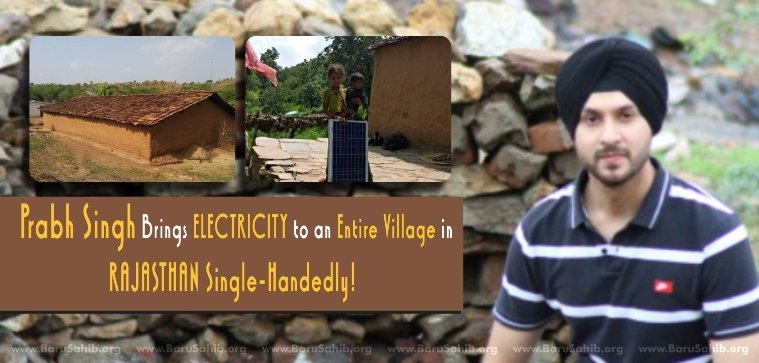
Prabh Singh Brings ELECTRICITY to an Entire Village in RAJASTHAN Single-Handedly!

In era of Modern Age, where even a short power cut tends to disturb our entire day, there are so many villages in India that have never even experienced electricity. Rural electrification is a big issue in India and more than 18,000 Indian villages still await to be electrified. Such was the fate of Naro […]

In era of Modern Age, where even a short power cut tends to disturb our entire day, there are so many villages in India that have never even experienced electricity. Rural electrification is a big issue in India and more than 18,000 Indian villages still await to be electrified.

Such was the fate of Naro ka Kheda a small village in Rajasthan with 76 households until Prabh Singh, a Sikh student who pursued his higher education in Durham University Business School in England, took it upon himself to bring electricity to the village. His ‘Project Kiran’ electrified around 76 households in that village.
Until then, the villagers had to walk 7 s just to charge their mobile phones.

This project costed around 7 Lakhs, which was crowd-funded by the villagers and contributed by North East Centre for Technology Application and Reach (NECTAR), an autonomous society in the Indian government.
Prabh decided to stay while implementing his project with the villagers to experience their lifestyle & get a sense of benefit his project could bring.

The ‘easy to install and service’ electricity kit created in this project comprises of the following things.

A solar panel
Three light bulbs
A strip light
A charging socket

This ensured that the initiative was accessible to residents in remote locations.

Prabh Singh wants to take this project to other villages too. “I am in talks with an Indian central government agency to replicate the same project in 50 remote Indian villages based on the similar kind of revenue and service mechanism,” he said.

“The happiness and the amazement which I saw in those villagers’ eyes after they used electricity in their house for the first time is unmatched to any professional accomplishment that I could ever imagine achieving.” Added prabh Singh after turning their Dream into reality!

~ Source – huffingtonpost.co.uk

SIKH Solider who survived a Japanese bullet in WORLD WAR II celebrates his Century!

Sikh Solider who survived a Japanese bullet through the jaw serving in the British Army during Second World War celebrates his century in Hitchin. Pritam Singh, from Meadow bank, had his family around him to mark the milestone, including a number of his five children, 12 grandchildren and 19 great-grandchildren. Mr Singh, who came to […]

Sikh Solider who survived a Japanese bullet through the jaw serving in the British Army during Second World War celebrates his century in Hitchin.

Pritam Singh, from Meadow bank, had his family around him to mark the milestone, including a number of his five children, 12 grandchildren and 19 great-grandchildren.

Mr Singh, who came to England in 1962 after surviving a bullet through his jaw fighting the Japanese with the fearsome 16th Punjab Regiment during the war – worked at Bowmans in Hitchin and Ickleford.

His son Jas Phurgura said: “Dad feels blessed.”

Via: GT1588

Divine Agricultural Scientist – Dr Khem Singh Gill

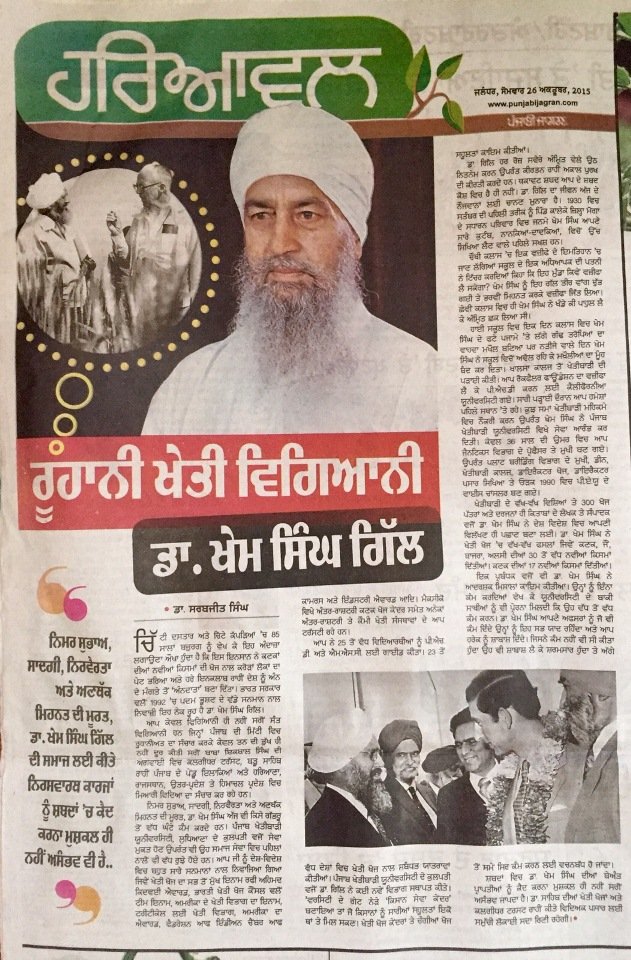
Dr Khem Singh Gill is the Vice-President of the Kalgidhar Society, Baru Sahib.He was associated with Baba Iqbal Singh ji since the days that they met Sant Teja Singh ji at Khalsa College Amritsar. He has been the Chairman of 45 Akal Academies in Punjab, Haryana, HP, UP and Rajasthan, run by different Trusts and […]

Dr Khem Singh Gill is the Vice-President of the Kalgidhar Society, Baru Sahib.He was associated with Baba Iqbal Singh ji since the days that they met Sant Teja Singh ji at Khalsa College Amritsar. He has been the Chairman of 45 Akal Academies in Punjab, Haryana, HP, UP and Rajasthan, run by different Trusts and Societies. He has also been honoured with the PADMA BHUSHAN by the Govt of India.

He is also the Former Vice-Chancellor, Punjab Agricultural University, Ludhiana.

He initiated and strengthened teaching and research programmes in Genetics at Hisar and Ludhiana campuses of PAU. He led the Department of Plant Breeding of the University to raise its status to international level. As the team leader of Wheat Improvement Programme, Dr Gill did remarkable work on the development and identification of improved cultivars of wheat, which revolutionized wheat production in Punjab and several other parts of India and Pakistan.

Khem Singh Gill earned his BSc (Ag) and MSc (Ag) degrees from the Punjab University and served the Department of Agriculture, Punjab and Punjab Agricultural University (PAU) as Research Assistant and Assistant Oilseed Breeder, respectively (1955-63). He studied at the University of California, Riverside, USA (1963-66) and obtained PhD (Genetics).

He has been the Chairman of 45 Akal Academies in Punjab, Haryana, HP, UP and Rajasthan, run by different Trusts and Societies.

Divine Agricultural Scientist - Dr Khem Singh Gill

The following are some of his credentials:

  • Trustee on board of International Centre for the Improvement of Maize and Wheat , Mexico.
  • Sr. V.P., Int’l. Triticale Assn, Australia & Brazil.
  • Rafi Ahmad Kidwai Memorial Prize by ICAR.
  • Fellow, 3rd World Academy of Sciences, Italy – Indian Society of Agricultural Sciences & Indian Society of Genetics and Plant Breeding.

Trustee on board of International Centre for the Improvement of Maize and Wheat , Mexico.

Professor Gill founded the Crop Improvement Society of India and remained its President (1974-79) and Patron till date. He was Adviser, Wheat and Triticale Research at the Global Level, having been on the Board of Trustees and Programme Committee of the CIMMYT, Mexico (1988-93) and Senior Vice-President of International Triticale Association (1988-94).

Dr Gill made Advanced Study Visits to 23 overseas countries. Through the Akal Academies, he has started a value-based quality education in rural areas of Northern India. Gill served the Council of INSA during 1983-85.

~ Tapasleen Kaur

Sikh Turban & Langar were the talk of the Parliament of World’s Religions 2015 at Salt Lake City

The 2015 Parliament was officially opened with a parade of flags and Native American drumming as regional tribal chiefs welcomed us to their land, and prayed for world peace. It was attended by 10,000 people from 80 countries and 50 faith and non-faith groups. This year, UNITED SIKHS volunteers at the Parliament spoke on service […]

The 2015 Parliament was officially opened with a parade of flags and Native American drumming as regional tribal chiefs welcomed us to their land, and prayed for world peace. It was attended by 10,000 people from 80 countries and 50 faith and non-faith groups.

This year, UNITED SIKHS volunteers at the Parliament spoke on service (seva) as a pathway to alleviate human suffering; that society will have to address fear in order to address hate crime and prejudice; how technology may help alleviate poverty in Panjab where a farmer is committing suicide every few hours; and how there can be no peace until truth is revealed for justice and reconciliation to take place.

Kamalla Kaur addressed attendees on her journey discovering Sikhi and said, “Having so many people from so many faith traditions talking, singing, praying and working for world peace is grand. The Parliament of World Religions gives me renewed hope for humanity, and faith in Creation/Creator.”

Prof Indira Prahst, from Vancouver, examined media representations of Sikhs and how the turban has been signified through a “violent” gaze by the public towards the turban against the back drop of the war on terrorism, secularism and Nation Building. She argued that the image of Sikhs is a politics of representation.

Langar was prepared and served by Sikhs to thousands of attendees every day of the Parliament. Langar is a Sikh tradition of a free community meal for anyone, regardless of race, religion, gender, colour or class. By the end of the conference, maybe a third of those serving Langar were non-Sikhs who were inspired to join in the great seva.

Rev. Marie Gasau, from Oak Creek, Colorado, who had not partaken Langar before, approached one of the Langar organisers, Balwant Singh, and requested his help to start Langar in her home town where there is no Gurdwara (Sikh place of worship).

Sikhs also made their presence felt, when volunteers of the American Sikh Council tied turbans for non-Sikh Parliament attendees. Hundreds of non-Sikhs were seen sporting colourful turbans at the Parliament and on the streets and shopping malls near the Parliament venue.

One non-Sikh attendee who wore his turban to the airport on his way home said, “I have not taken my turban off because I want to know what Sikhs go through at airports when their turbans are searched.”

~ Source: www.unitedsikhs.org

Issued By-
Mejindarpal Kaur
International Legal Director
International Civil and Human Rights Advocacy (ICHRA), UNITED SIKHS

Saroop of Adi Granth Sahib ji dictated by Guru Arjan Dev Ji to Bhai Gurdas at Kartarpur

Guru Arjun then set to compile the Shabads into a single volume, the Adi Granth. He sifted through the Shabads which had been passed down from the first four Gurus, and filtered out those which had been added by imposters. Bhai Gurdas was the scribe who recorded the words of Guru Arjun. When he asked […]

Guru Arjun then set to compile the Shabads into a single volume, the Adi Granth. He sifted through the Shabads which had been passed down from the first four Gurus, and filtered out those which had been added by imposters. Bhai Gurdas was the scribe who recorded the words of Guru Arjun. When he asked Guru Arjun how he could distinguish between the true and the false Shabads, Guru Arjun replied, “Even in a great herd of cows and calves, the mother cow will recognize the cry of her calf, above all others. Just so, the True Shabad resonates truly, and is easily distinguished from the false.”

Guru Arjun added a great many of his own Shabads to those of Guru Nanak, Guru Angad, Guru Amar Das and Guru Ram Das. He also added Shabads of thirty-six Hindu and Muslim Saints, among them Kabir, Ravi Das, Naam Dev, Trilochan and Sheikh Farid. This was the first time any religion incorporated the works of sincere devotees of other religions into its own scripture; this reflects the universality of thought which underlies the Sikh belief in One God, and the one family of humanity as children of God.

Guru Arjun left some blank pages in the Granth. When Bhai Gur Das asked the purpose of this, he answered that one of the Gurus to follow him would add the Shabads in their proper place at the proper time. In time the shabads of Guru Teg Bahadur, the ninth Manifestation of the Guru’s Light, were added by Guru Gobind Singh and thus the Siri Guru Granth Sahib was complete.

The Adi Granth was completed in 1604, and installed in the Golden Temple; Baba Buddha was appointed Guru’s Granthi. Guru Arjun told his Sikhs that the Adi Granth was the embodiment of the Guru, and should be treated in the same fashion as they respect him. When Guru Arjun first completed the Adi Granth, he placed it upon his own bed and slept on the floor. Its words were written without any spaces or breaks, which nowadays is hard for most people to follow.

Share & Spread the divinity!

The Rich Sikh Heritage Gurdwaras of Potohar, Pakistan!

A majority of the buildings which once belonged to the Sikhs and Hindus were given to immigrants from India. These families still live in these buildings, but surprisingly the structures and the artwork on the walls are still intact. Several Hindu and Sikh monuments; temples and Gurdwaras have been discovered gracing the landscape of this […]

A majority of the buildings which once belonged to the Sikhs and Hindus were given to immigrants from India. These families still live in these buildings, but surprisingly the structures and the artwork on the walls are still intact.

Several Hindu and Sikh monuments; temples and Gurdwaras have been discovered gracing the landscape of this region. Three of the Gurdwaras are located at Kanoha, Doberan Kalan and Mohara Bhatta, and are especially noted for their elegance and paintings. Of these, the Sikh Gurdwara located 10 kilometres from Kallar Syedan at Kanoha is the most prominent.

Historically, the Gurdwara has been used to meet the religious and social needs of the Sikh community here. Guru Hargobind, the sixth guru of Sikhs (1606-1644), was believed to have first used the word ‘Gurdwara’.

Before that, the name used for such structures was ‘dhramsala’, which means a rest house for travellers in its normal Indian context, but was used in the early days of Sikhism to denote a room or building used for devotional singing (kirtan) and prayers.

The gurdwara of Kanoha is a very large three-storied structure crowned with canopy – a distinctive feature of the Potohari style of gurdwara. Built on a square plain, it formerly housed Sikh families who would visit here to recite the Guru Granth Sahib and performing various religious rituals. Apart from the Kanoha Gurdwara, there is another Gurdwara located in the Doberan Kallan town.

The connection of Sant Attar Singh ji to Dhan Potohar

In 1892 Sant ji got his name struck off from the role of army and devoted himself solely to the propagation of the Guru’s message. He toured extensively in Jammu­ Kashmir, Sindh and North Western Frontier Province.

In Pothohar region, such places as Shah Di Dheri, Thamali, Kanoha, Dera Khalsa, Sagri, Malakpurj, Rawalpindi, Haripur, Kahuta, Dhan Mangwal, Chakwal, Gujjarkhan, Loom and Bhaun were the main venues of Sant Attar Singh Ji’s activities. His religious tours were a remarkable success. Quite a large number of people imbibed Sikh ethos.

Needless to say, the Punjab tourism department, should chalk out a viable strategy to promote religious tourism in the Kallar Syedan Tehsil. These wondrous and historically rich Gurdwaras can be a great tourist attraction; Sikhs who visit Gurdwara Panja Sahib at Hassan Abdal should also be able to come to here.

~ Source – dawn.com

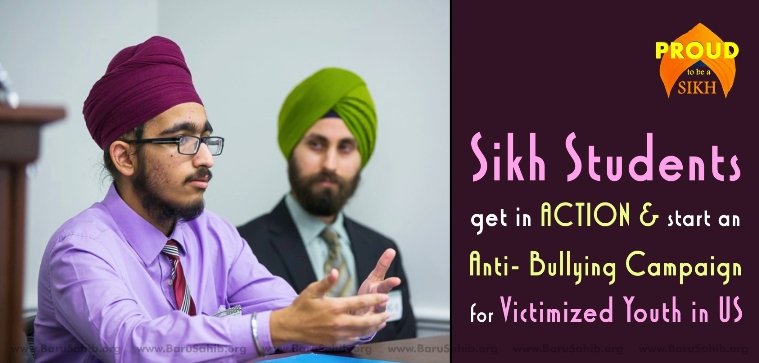
Sikh Students get in ACTION & start an Anti – Bullying Campaign for Victimized Youth in US!

Japjee Singh, a 17-year-old Sikh student in Georgia, who had been bullied because of his religion since the second grade. The issue escalated once he began middle school and continued into high school. Students would call him names, refer to his turban as a “bomb,” or suggest he was a terrorist. A group of students […]

Japjee Singh, a 17-year-old Sikh student in Georgia, who had been bullied because of his religion since the second grade. The issue escalated once he began middle school and continued into high school.

Students would call him names, refer to his turban as a “bomb,” or suggest he was a terrorist. A group of students once beat Japjee multiple times, leaving him with a broken nose, fractured chin, and bruised body.

“This is something we haven’t been able to forget,” Aasees Kaur, Japjee’s 20-year-old sister, told ThinkProgress in a phone interview. “He was sitting there with blood all over him and an ice pack in his hand and kids were telling him ‘go back to your country.’ When kids are saying such harsh things, it really broke my family.”

Japjee required two surgeries after the beating, his sister recalled. And when he eventually came back to school, the bullying didn’t stop. One student reportedly threatened to go after Japjee and his family with “a 9-millimeter and a blade.”

Aasees said that the school never took action. Japjee lost his entire sense of belonging.

Aasees said. “These were kids that he grew up with. He went to school with them for years and now all of a sudden, he didn’t know who his friends were. They didn’t quite get the line between harassment and joking around.”

Between May 2013 and November 2014, the U.S. Department of Justice entered two settlements with the DeKalb County School District near Atlanta, Georgia on behalf of Japjee. The first agreement reached in May required DeKalb County to create a safety plan for Japjee and to train students and staff on post-9/11 backlash and discrimination. The second agreement reached in November required DeKalb County to “engage in comprehensive measures” to stop “peer-to-peer bullying” among the district’s 100,000 students, including Sikh students, according to a press release from the Sikh Coalition.

Though things have gotten better for Japjee, discrimination still hasn’t ended for their family. Aasees’ cousin is still being bullied, according to a recent interview with The Huffington Post.

But Japjee and Aasees are taking action. Two years ago, Japjee testified before Congress as part of a larger advocacy effort to end bullying against Sikh American school children. And now, the family is hoping to get their story out.

Japjee’s case is part of a larger issue that the White House Initiative on Asian American and Pacific Islanders (WHIAAPI) is trying to address through its launch of an anti-bullying campaign this week to combat bullying against Asians and to empower students to report, stop, and prevent bullying. The Sikh Coalition and the Coalition of Asian Pacifics in Entertainment (CAPE) are campaign partners.

WHIAAPI’s Act to Change public awareness website includes YouTube videos of Asian celebrities like Charlotte Hornets basketball player Jeremy Lin and actor Maulik Pancholy talking about being bullied. It also provides resources in Chinese, Hindi, Korean, Punjabi, Urdu, and Vietnamese. The campaign calls on the public to take a pledge to end bullying or to help someone who has been bullied.

“Bullying is a major civil rights issue for the Asian American and Pacific Islander community in particular,” Initiative Executive Director Kiran Ahuja said in a press statement. “We’ve seen too often AAPI groups, including Sikh, Muslim, Micronesian, LGBT, and limited English proficient youth, targeted for bullying and harassment.”

Aasees believes that the campaign could help people like her brother and other bystanders raise their voices against bullying. She said that the multilingual resources would be important for some parents who may not read English fluently so that they would be able to know what to do with when their children are bullied. But the presence of the campaign would also let students know that they’re not alone.

“There are thousands of Japjees out there who haven’t spoken out yet,” Aasees said. “There are thousands of Japjees out there who don’t know what to do. This campaign will really let them know that they have a tremendous amount of support behind them and could be a guide for what they should do if they’re being bullied.”

In a 2014 Sikh Coalition survey of 500 Sikh students and focus groups with over 700 students, researchers found that over 50 percent of Sikh children endured school bullying, with 67 percent of turbaned Sikh children saying that they are bullied in school. Nationally, about 32 percent of all children ages 12 and 18 reported that they were bullied in school. What’s more, 50 percent of Asian American students in New York City public schools reported biased-based harassment, a statistic that could be under-reported.

Over the past 15 years, public consciousness has been raised about bullying and multiple states have moved to pass legislation to address the issue. According to a recent study published by JAMA Pediatrics, students living in states that have passed anti-bullying laws reported lower levels of bullying.

“School systems and community outreach programs and parents really need to partner up strongly with under-represented communities to make sure that our children are better protected, that their needs are being met,”

Aasees said. “Parents have a responsibility too, so it’s a matter of education in both the home and the school to teach about bullying. Kids like Japjee only have one childhood. When you see kids that withdrawn, it breaks you.”

A Campaign which will inspire them NOT TO LOOSE their Sense of Belongingness!

~ Source: thinkprogress.org