Guru Arjan Sahib Ji’s attire restored at Gurdwara Sahib at village Bilga in Jalandhar

Jalandar, Punjab: It is learnt that a team of experts has restored the chola and other articles of Fifth Sikh Guru, Guru Arjan Sahib Ji at a historic Gurdwara Sahib at village Bilga in Jalandhar. These articles include Guru Sahib’s ‘chola’, ‘pyjama’, ‘dushala’, a handkerchief, a wallet made of cloth and a rosary. According to […]

Jalandar, Punjab: It is learnt that a team of experts has restored the chola and other articles of Fifth Sikh Guru, Guru Arjan Sahib Ji at a historic Gurdwara Sahib at village Bilga in Jalandhar. These articles include Guru Sahib’s ‘chola’, ‘pyjama’, ‘dushala’, a handkerchief, a wallet made of cloth and a rosary.

According to a news reported by The Tribune, the Gurdwara Sahib is associated with Guru Arjan Sahib’s wedding and its affairs are being managed by the SGPC, which roped in a team of experts led by former National Museum Director SP Singh for the restoration work. Talking to The Tribune, SP Singh said the SGPC had entrusted the job of preserving these articles with NRI Harbhajan Singh Shergill.

Harbhajan Singh Shergill said the condition of the articles, especially those made of cloth — ‘chola’, ‘payjama’ and handkerchief — had deteriorated with the passage of time. “First, we took stock of the condition of these articles and prepared a report on it. During the entire process, the experts minutely examined the cloth which was used in making the attire and also identified the damage caused to it over the period of time. Prior to taking corrective measures, the articles were photographed and video-graphed,” SP Singh. Silk and cotton were used to make the ‘pyjama’ and its threads had lost the grip with time. Similarly, the ‘chola’, too, was in a bad shape. He said the ‘dushala’ was also made of silk. “We cleaned these articles scientifically and strengthened their threads. At the same time, we took care to ensure their originality remained intact,” said Singh. He said it took the team around three months to restore these articles which have now been kept on display in special glass cases for the pilgrims visiting the shrine.

~ Source: Punjab Sikh Sangat

Sikhism is all about Inter-Faith!

Various names used in Shri Guru Granth Sahib Ji pertaining to GOD and number of time they are used:- Hari = 8324 Ram = 2533 Prabhu = 1371 Gopal = 431 Gobind = 475 Parbrahm = 324 Thakur = 283 Karta = 228 Daata = 151 Parmeshar = 139 Murari = 97 Narayan = 85 […]

Various names used in Shri Guru Granth Sahib Ji pertaining to GOD and number of time they are used:-

  1. Hari = 8324
  2. Ram = 2533
  3. Prabhu = 1371
  4. Gopal = 431
  5. Gobind = 475
  6. Parbrahm = 324
  7. Thakur = 283
  8. Karta = 228
  9. Daata = 151
  10. Parmeshar = 139
  11. Murari = 97
  12. Narayan = 85
  13. Antaryami = 31
  14. Jagdeesh = 60
  15. Satnaam = 59
  16. Mohan = 54
  17. Allah = 46
  18. Bhagwan = 30
  19. Narhari = 29
  20. Mukand = 28
  21. Madhav = 27
  22. Paramananda = 22
  23. Krishna = 21
  24. Saaringpani = 20
  25. Vitthal = 16
  26. Waheguru = 15
  27. Banwari = 15
  28. Narsingh = 15
  29. Daamoder = 9
  30. Madhusudan = 7
  31. Raghusudan = 6
  32. Bavan = 3
  33. Saarangdhar = 3
  34. Achyut = 3
  35. Raghurai = 2
  36. Gopinath = 2
  37. Govardhan = 2


Other than names mentioned above we have names used for the god which may include Gosain, Kamala Kant, Laxmidhar, Chakadhar, Chaturbhuj, Machchh, Kuram, Varah, Gorakh, Rudra, Khuda, Khaliq, Qadir , Kareem, Sarvpratipalak, Raheem, Alakh, Apar, Beshumar, Bhagwant, Bhav_Bhanjan, Rishikesh, Vasudev, Liladhar, in Guru Granth Sahib Ji, we have worship of Ek Oankar, eternal being lord or god. As per the philosophy of the Guru Granth Sahib ji names used by all religions and communities are synonyms for one God only.

Therefore, otherwise all name of lord are accepted to be remembering god. Just for the sake there is no difference between Akal Purakh, Hari, Ishwar, Allah, this point of view comes to us from Shri Guru Granth Sahib Ji.

Millions visit Virasat-e-Khalsa in 2 years!

Anandpur Sahib, Punjab: With around five million persons visiting it within two-and-a-half year of its opening, the Virasat-e-Khalsa has not only become one of the most popular museums in world, it has also boosted the economy of Anandpur Sahib town. The income of nearby Takht Sri Kesgarh Sahib has registered an annual increase of Rs […]

Anandpur Sahib, Punjab: With around five million persons visiting it within two-and-a-half year of its opening, the Virasat-e-Khalsa has not only become one of the most popular museums in world, it has also boosted the economy of Anandpur Sahib town.

The income of nearby Takht Sri Kesgarh Sahib has registered an annual increase of Rs 15 crore since the opening of the museum, while shopkeepers and banks in the town have seen a boom in their business. Rents of the shops in the area have increased manifold during the past couple of years and the annual business of banks has crossed over Rs 500-crore mark. The result: Banks such as HDFC, AXIS Bank, UCO Bank and Allahabad Bank have opened their branches here over past couple of years.

Anandpur Sahib Vyapar Mandal president Inderjit Singh Arora said there was no big industry in the area and the major source of income for the local residents was from shops. During the past two years, the shopkeepers have witnessed a sudden boom in their business. The annual rent of the land auctioned by the SGPC to set up vends near Takht Sri Kesgarh Sahib has increased to Rs 3.5 crore from Rs 75 lakh over the past three years, he said.
The Virasat-e-Khalsa, a museum of Punjab culture and history of Sikhism, was opened on November 27, 2011. It stands at the site that is the birthplace of the Khalsa Panth. It was here in 1699, on the day of Baisakhi, that Guru Gobind Singh founded the Khalsa Panth and baptised the “‘Panj Piaras”.

Till now, over 46 lakh persons, comprising around 20 per cent NRIs and foreigners, have visited the Virasat-e-Khalsa. Dr Karamjit Singh Sra, chief executive officer, Anandpur Sahib Foundation, said the museum was built considering that 4,000 persons would visit it everyday and the staff was employed accordingly. However, the number remained nearly its double. On many occasions, around 25,000 visitors reached here on a single day, he said.
Canadian Prime Minister Stephen Harper and ambassadors of many countries have visited it so far. Prince Charles with his wife Camilla Parker came here during its construction in 2006.

This was perhaps the only museum in the world that displayed religious exhibits without asking the visitors to follow any religious norms while entering and that might be one of the reasons behind such a big footfall, Sra said.

It was also an attraction for students of architecture and civil engineering. A 72-minute round of the museum told a whole lot of things about Sikh history to the visitors, he added.

The work on the second part of the museum was going on smoothly and four of the 17 galleries of that part would be opened for the visitors very soon. The first phase displayed Sikh history till the installation of Guru Granth Sahib. The second phase would acquaint visitors about Sikh history from the installation of Guru Granth Sahib to the present day, he added.

The museum

  • Virasat-e-Khalsa is a museum that acquaints visitors with Punjab culture and history of Sikhism
  • The museum, situated at the birthplace of the Khalsa Panth, was opened for public on November 27, 2011
  • In just over two years of its opening, it has attracted over five million visitors
  • Besides becoming one of the most popular museums in world, it has also boosted the economy of Anandpur Sahib town

 
Economy booster

  • The income of Takht Sri Kesgarh Sahib has registered an annual increase of Rs 15 crore since the opening of Virasat-e-Khalsa
  • Rents of the shops in the area have increased manifold during the past couple of years
  • The annual business of banks operating in the area has crossed over Rs 500-crore mark
  • The annual rent of the land auctioned by the SGPC to set up vends near Takht Sri Kesgarh Sahib has increased to Rs 3.5 crore from Rs 75 lakh over the past three years

 
~ Source: The Tribune

Ramadan Cultural Exchange Program

Speech by Mr. Surender Singh Kandhari, Chairman – GuruNanak Darbar Gurudwara
in the Holy Mosque of the Al Manar Centre, Dubai
Friday 4th July 2014

Assalamalekum Rahmatullah.
Good evening Ladies & Gentlemen.

On behalf of the entire Sikh Community of UAE and the Guru Nanak Darbar Gurdwara, I take this opportunity to extend my best wishes to all our brothers and sisters during this holy month of Ramadan – Ramadan Kareem.

Our community is highly honoured and indebted to His Highness Sheikh Mohammad Bin Rashid Al Maktoum, the Vice president and Prime minister of UAE and Ruler of Dubai, for his kind and thoughtful generosity in granting permission and allocating land for the noble cause of building a Sikh place of worship in Dubai.

And in the words of His Excellency Sheikh Nahyan bin Mubarak Al Nahyan, Minister of Culture, Youth and Community Development when he visited the Gurudwara He said “Guru-Nanak Darbar must rank among the most attractive worship sites for Sikhs around the world.

I would also like to extend my gratitude to Her Highness Sheikha Hind Bint Makhtoum Bin Juma Al Makhtoum & Al Manar Centre for inviting us for this Cultural Exchange Programme to interact and learn about this blessed month whilst living together in the UAE.

Ramadan is a time for self-reflection and devotion through prayer and fasting, Ramadan is also an occasion when Muslims around the world reaffirm their commitment to helping the less fortunate, including those struggling because of economic hardship and inequality

Ramadan also reminds us of our shared responsibility to treat others as we wish to be treated ourselves and the basic principles that bind people of different faiths together: a yearning for peace, justice, and equality.

As the subject today is about inter-faith and inter-culture, I would like to bring to light similarities between Islam & Sikhism. But before that I would like to give you a little insight about Sikhism.
Sikhism and its relationship with Islam is going back many centuries. The founder of Sikhism was our first Guru, GuruNanak Devji. The first to recognize GuruNanak was Rai Bullar a Muslim noble who saw the divine light in GuruNanak. Gurunanak’s companion for life Bhai Mardana was a Rababi born in a Muslim family.
For that matter our most sacred Shrine Shri Harmandir Sahib–The Golden Temple (as it is commonly called) the foundation for it was laid by a Muslim Sufi Saint Sai Mia Mir.
Such is the association of Muslims & Sikhs.

There are many instances where there is uniformity of principles in Sikhism & Islam

  1. Both Islam & Sikhism are Monotheistic religions i.e. both believe in One God.
  2. Both do not believe in idol worship.
  3. Both have Holy Scriptures – A Sikh’s life revolves around One Guru – Guru Granth Sahib; and in every moment of joy, happiness and sadness, Shabad of Guru Granth Sahib is recited. Similarly, life of a Muslim is centered on the Holy Quran.
  4. The Sikhs Gurus never claimed to be God, but only a messenger of God. Hazrat Muhammad Sahib (Peace be upon Him) also never claimed himself to be God, but only a messenger.
  5. Sikhs believe that the beloved creator of this world is all-powerful, omni present One God and he has created the universe in his order. Islam also believes that everything in the universe is in order of one God called Allah.


Some of Guru Nanak Devji’s teachings and its similarity to Islam:-

Guru Nanak taught us:

  1. Naam Japna
  2. Kirat Karni
  3. Vand Chakna

First principle

Naam Japna – Practice meditation & constantly immersed in appreciation of the Creator. The One Eternal God -Allah or Waheguru as we call Him.

Second Principle

Kirat Karni – To honestly earn by ones physical and mental effort while accepting both pains and pleasures as GOD’s gifts and blessings. Make honest and truthful living and keep 10% of it for charity – that is what we call “Dusvant” – Just like in Islam you have “Zakat” – the same principle.

I salute the mandate of Dubai Cares Program of educating children around the world.

Children are our Future. Their Future is Education. So OUR Future is Education. Children are born with no prejudices! Prejudices, it is well known, are most difficult to eradicate from the heart whose soil has never been loosened or fertilized by education: Education gets rid of the Prejudice in our society that we so need today.
We as humans should take care of the people and this way we serve God Almighty. Serving children is a great act of humanity and we should all pray that we all get the opportunity to do Sewa to the mankind, Giving is a bliss. Serve others – for life is too short and you have to make your life meaningful.
So let us be quick to love and prompt to serve humanity. You have two hands, one to help yourself and one to help others.

Third principle

Vand Chakna – Share and consume together. Sharing and Giving is an important message from Guru Nanak – which is what is being done here, especially now in Ramadan – on the same lines GuruNanak Devji introduced free community kitchen called “Guru Ka Langar” where all sit and eat together regardless of caste, creed and status.

In Islam one of the greatest principle is feeding the hungry.

We still follow the same principle in the Dubai Gurudwara where all day food is served free to all. We serve daily 1000 people and on Fridays 10,000 people. This is our commitment to Society.
In Islam a Muslim is born to serve not only Muslims but all humanity. This is mentioned in the Quran Shareef Sura 21 Ayaat 107.

Similarly in Sikhism we pray for the entire humanity in our daily prayers which is SARBAT DA BHALA.

Sri Guru Granth Sahib our holy book also has religious similarities with the Quran Shareef.

Beginning of Sri Guru Granth Sahib
Mul Mantar – which is the entire essence of our religion is similar to the
Sura Al Fateh the beginning of Holy Quran.

Ikoankaar Sathnaam Karathaa Purakh Nirabho Niravair
Akaal Moorath Ajoonee Saibhan Gurprasaadh II
One Universal Creator God,
The Name is Truth, Creative being Personified,
No Fear, No Hatred,
Image of Undying,
Beyond Birth, Self-Existent
By Guru’s Grace.

Beginning of Holy Quran

  1. In the name of Allah, the Beneficent, The Merciful.
  2. Praise to be Allah, Lord of the Worlds,
  3. The Beneficent, the Merciful.
  4. Master of the Day of Judgment,
  5. Thee (alone) we worship; Thee (alone) we ask for help.
  6. Show us the straight path,
  7. The path of those whom Thou hast favoured; Not the (path) of those who earn Thine anger nor of those who go astray.

In the Islamic world, Baba Shaikh Farid ji (1173-1265) is a highly respected Sufi Saint. His Bani has been included in Guru Granth Sahib. The presence of Sufi saints Bani in Guru Granth Sahib is an example of the universal message that Guru Granth Sahib contains.

Today we are proud at the same time humbled that His Highness Sheikh Mohammad Bin Rashid Al Maktoum, the Vice president and Prime minister of UAE and Ruler of Dubai has donated land and encouraged us to make the Gurudwara – which is the greatest symbol of the inter-faith-respect and regard for another. This gesture has been appreciated not only by the Sikhs of Dubai but by Sikhs all over the world. This magnanimous gesture has put a firm seal on a relationship which goes back hundreds of years.

In the end I would like to sum up with the words of H.E. Sheikh Nahyan bin Mubarak Al Nahyan, Minister of Culture, Youth and Community Development; He said and I quote UAE is a multicultural community and an occasion like this reflects tolerance and respect for all other faiths. UAE is a tolerant country that allows people from different places and from different religious and ethnic backgrounds to live here in harmony and cooperation, as good human beings. Good human beings tolerate and respect one another and understand each other’s good motives, whatever their cultural differences may be.

I would once again like to wish everyone a month blessed with the joys of family, peace, love and understanding.

Ramadan Kareem.

To commemorate this occasion my wife and I have prepared a memento showing the Sura Al Fateh and Mul Mantar framed together and I can say that it could be probably first of its kind. Kindly accept this humble gift from us.

image004

Indians In The Trenches: On The Western Front

Young actors have been given a rare opportunity to dress up in British World War One uniforms and re-enact the real life experiences of Sikhs who fought during the conflict for a new film, being released on Friday 4th July 2014.

“Indians in the Trenches” depicts the real life stories of those from the subcontinent who left their villages in 1914 to fight in a faraway land for the first time. The film uses the original letters sent from the trenches of France and Flanders to delve into what the Indian soldiers felt and experienced at different key points during the four-year war.

It’s the first time a Sikh re-enactment has taken place in Britain, and the first time the original writings of those who fought have been enacted and captured on film. Around 126,000 Sikhs fought during the conflict in every arena of the war – from the western front to Mesopotamia; and their contribution is all the more remarkable when considered that despite being only 2% of the Indian population at the time they made up 20% of the fighting force of the British Indian Army.

The letters contain a strong belief of their faith and identity. One Sikh soldier wrote “It was my very good fortune to be engaged in this war. We shall never get such another chance to exalt the name of race, country, ancestors, parents, village and brothers.” while another Sikh remarked “We are fortunate men to have been able to join in this great war. We will do our best to uphold the family traditions and the reputation of our tribe.”

But the experience for the Indians was also very harrowing as they faced the harsh realities of the conflict during the winter of 1914 without proper warm kit. One Sikh soldier remarked “The guns fire all day like the thunder in Sawan. The heaven and earth are undistinguishable and at night there is a regular Diwali festival.”

Speaking about the film, director Jay Singh-Sohal said: “This has been a fantastic way of highlighting the Indian contribution during the war through real life letters and experiences. The Sikh story itself is inspiring because of the overwhelming contribution this small community made to the war effort, and this is reflected in that a quarter of Indian gallantry awards were given to this martial race. It’s something people today should not forget.”

This was the first role for aspiring young actor Pavandeep Singh Sandhu (pictured above), who plays the role of cavalrymen Bhaga Singh says: “It’s been a really exciting opportunity to portray this role, especially as Sikhs made such a dramatic impact during the course of the war. It makes me feel proud that our forefathers made this sacrifice. To delve into the psyche of the soldiers enabled me to appreciate what they went through – and be inspired by it.” The film is being released on the online film site and broadcast on British television as part of efforts to raise awareness during the centenary commemorations of World War One.

The team will then be working alongside members of the Armed Forces to create a national memorial to remember the sacrifices of Sikh soldiers.

~ Source: http://www.sikhnet.com/

Sikh Community Welcomes New Train to Amritsar!

NAGPUR: The Sikh community in the city has welcomed the introduction of a new train between Nagpur and Amritsar. This addition is significant for the community as till now there is only one train that connects the two regions. There is a significant presence of the community in the city and a direct train connecting […]

NAGPUR: The Sikh community in the city has welcomed the introduction of a new train between Nagpur and Amritsar. This addition is significant for the community as till now there is only one train that connects the two regions.

There is a significant presence of the community in the city and a direct train connecting Nagpur to their roots and their holy city has brought much joy to them. “It is really great news and I am sure each one of us is very happy,” said Jaspal Singh Saluja.

The demand for a direct train to Amritsar had been a long standing one. “We have been wanting it for long and this year we, the Nagpur Sikh Sangat, met Nitin Gadkari with this request. I am happy that he considered it and realized our dreams,” said Balbir Singh Renu.

As of now, people had to either travel about 35 long hours to reach Amritsar directly or change trains at New Delhi to get there. Many a time, all this would prove too troublesome, especially for the elderly. “Changing trains at New Delhi is very tiresome. And it becomes even more difficult after a long journey up till there, especially for elders in the family. So this is a really good thing to have happened,” said Swaranjeet Kaur Arora.

Understandably, Amritsar has a great emotional connect with the Sikh community and that is why the demand for a train was so strong. Arora said, “It is a matter of great joy and celebration for us. Now, the road to heaven (Golden Temple) has also become like heaven.”

Agreeing with her was Parshan Singh Kalsi, who said, “The city of Amritsar with the Golden Temple has a special place in our hearts. And now the demand for a direct train was considered by Gadkari and it is indeed a very happy and emotional thing for us.”

Another factor was the wish to be connected to one’s roots. “Most of us have relatives staying in Punjab. Now, this train will help us to be in touch with them even more easily,” said Charanjeet Kaur Gandhi. Agreeing with her, was Saluja who added, “Most of us can go to our native places only during vacations and that time it is nearly impossible to get reservation. The introduction of a new train might take the load off a bit.”

In a characteristically Punjabi way Gandhi added, “Now, the train should just start soon and everything will be ‘balle balle’.”

~ By Aparna Nair
~ Source: http://timesofindia.indiatimes.com/

Gurdwara Spreads Message of Harmony!

Share

Gurdwara Spreads Message of Harmony!

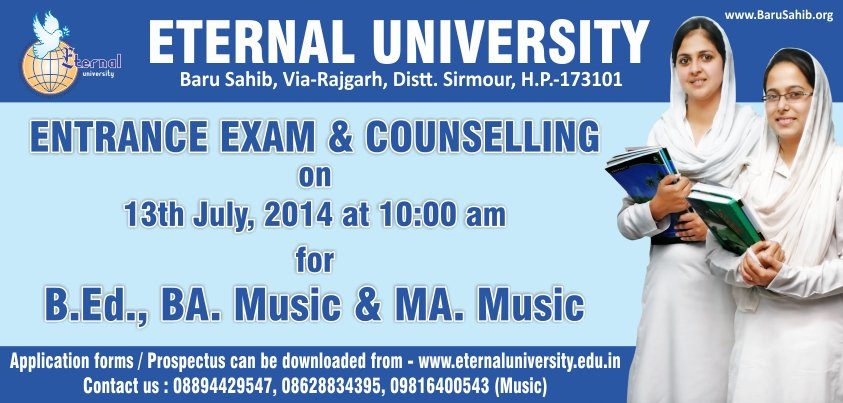
Entrance Exam & Counselling for B.Ed., BA and MA in Music

Mark your calendars for the most awaited event to be happening tomorrow – Entrance Exam and Counselling session for B.Ed, BA and MA in Music on 13th July, 2014 at 10:00 AM. Check out the centers and be there on time! Share

Mark your calendars for the most awaited event to be happening tomorrow – Entrance Exam and Counselling session for B.Ed, BA and MA in Music on 13th July, 2014 at 10:00 AM. Check out the centers and be there on time!

Entrance Exam & Counselling for B.Ed., BA and MA in Music

Bright Voices of Tomorrow: Speech and Poetry Competition observed during ‘Gurmat Samagam’ at Gurdwara Cheema Sahib

At the Gurdwara located at the birth place of Sant Attar Singh Ji Cheema Sahib a Speech and Poetry Competition was organized during the ongoing yearly Gurmat Samagam in the memory of Bhai Santokh Singh and Darshan Singh Ji.


Both Senior and Junior School Students participated in this competition which was organized by Guru Gobind Singh Study Circle.

In the picture: Winners of the competition whilst receiving the prizes for the Speech and Poetry Competition.

~ Deeksha Singh
~ New Delhi, 11th July ’14

News Coverage: