
 Harmeet Singh
Ajit Reports Baba Iqbal Singh Ji’s Recognition in the Sikh 100 Global Ranking
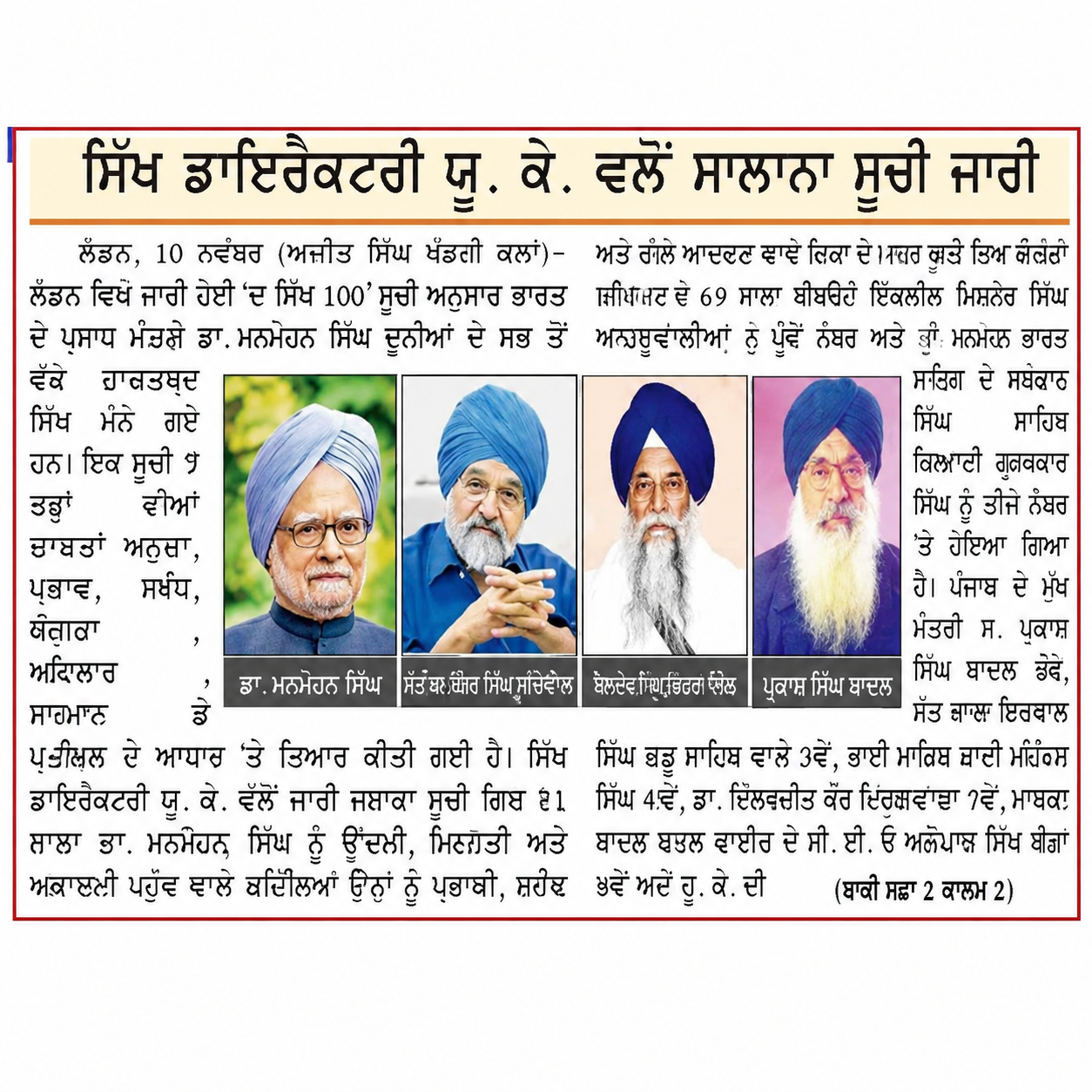
Ajit Baba Iqbal Singh Ji coverage brought international recognition to readers across Punjab after the leading Punjabi daily reported Baba Iqbal Singh Ji’s inclusion in the prestigious Sikh 100 Report published by Sikh Directory UK. The recognition celebrated his lifelong contribution to rural education, humanitarian service and institution building through The Kalgidhar Trust (The Kalgidhar Society), Baru Sahib.
The report introduced Punjabi readers to an international publication that recognised influential Sikh personalities from around the world whose work had created measurable and lasting impact across society. Baba Iqbal Singh Ji’s inclusion reflected decades of dedicated service focused on expanding educational opportunities for children living in villages and underserved communities.
Unlike awards centred on politics or commercial achievement, the Sikh 100 Report acknowledged individuals whose leadership had transformed lives through education, public service, healthcare, philanthropy and community development. Daily Ajit highlighted Baba Iqbal Singh Ji’s recognition as an important milestone because it demonstrated that sustained educational service could receive appreciation far beyond regional and national boundaries.
For readers throughout Punjab, the article represented more than a news report. It documented an occasion when the work of an educationist rooted in rural India received international acknowledgement, reinforcing the importance of education as a foundation for long-term social progress.
Quick Facts
| Newspaper | Daily Ajit |
|---|---|
| Country | India |
| Recognition Covered | Sikh 100 Report |
| Published By | Sikh Directory UK |
| Recognised Personality | Baba Iqbal Singh Ji |
| Recognised For | Contribution to Rural Education and Humanitarian Service |
| Organisation | The Kalgidhar Trust (The Kalgidhar Society), Baru Sahib |
| Category | International Media Coverage |
What Ajit Reported About Baba Iqbal Singh Ji
The Ajit Baba Iqbal Singh Ji article informed readers that Baba Iqbal Singh Ji had been included in the internationally recognised Sikh 100 Report published by Sikh Directory UK. The report brought together distinguished Sikh personalities from different professions whose work had demonstrated exceptional leadership, influence and public contribution.
Daily Ajit explained that the Sikh 100 Report evaluated individuals representing diverse fields including education, governance, business, healthcare, entrepreneurship, public administration, philanthropy and community leadership. Baba Iqbal Singh Ji’s inclusion reflected the growing international appreciation for educational initiatives that had improved access to learning for children living in rural areas.
The newspaper described the recognition as an important achievement because it acknowledged decades of educational service rather than political office or commercial accomplishment. Through its reporting, Ajit highlighted how sustained commitment to education could earn international respect while remaining deeply connected to local communities.
For Punjabi readers, the story also reinforced the importance of educational institutions that continue to strengthen rural society through academic excellence, ethical values and community engagement. The recognition demonstrated that meaningful social contribution often extends beyond geographical boundaries and receives appreciation from global audiences.
Ajit’s coverage served as a bridge between international recognition and local readership, ensuring that people across Punjab became aware of an achievement that reflected positively on educational leadership originating from the region.
Understanding the Sikh 100 Report
The Sikh 100 Report was developed to recognise influential Sikh personalities whose work had created significant impact within their respective fields. Rather than focusing solely on public visibility, the publication considered leadership, service, professional achievement and contribution to society while presenting a diverse representation of the global Sikh community.
Its publication attracted attention from newspapers and media organisations because it documented achievements extending across multiple professions. By recognising educators alongside political leaders, entrepreneurs, healthcare professionals and social reformers, the report highlighted the many ways individuals contribute to the advancement of society.
For Daily Ajit, reporting this recognition provided readers with insight into an international initiative that celebrated excellence beyond regional boundaries. The newspaper’s coverage connected local audiences with a global story while emphasising the importance of educational leadership as a form of lasting public service.
Why Daily Ajit Considered This Story Important
As one of Punjab’s oldest and most influential Punjabi-language newspapers, Daily Ajit has consistently highlighted stories that reflect the achievements, aspirations and social progress of the Punjabi community. Its decision to report Baba Iqbal Singh Ji’s inclusion in the Sikh 100 Report demonstrated that educational leadership deserved recognition alongside accomplishments in politics, business and public life.
For the newspaper’s readers, the story represented more than an international honour. It illustrated how decades of dedicated work in education had earned appreciation on a global platform. By publishing the report, Ajit connected an international recognition with local communities that understood the importance of education in creating opportunities for future generations.
The article also reflected a broader editorial perspective—that meaningful contributions to society are often made quietly through long-term commitment rather than public visibility. Baba Iqbal Singh Ji’s recognition became an example of how service, education and institution building can create influence that extends well beyond geographical boundaries.
Educational Leadership Beyond Recognition
International rankings often celebrate political leaders, industrialists or public personalities. The recognition reported by Daily Ajit highlighted another form of leadership—one built through education, institution building and social responsibility.
Educational institutions influence communities over generations. Their impact is reflected not only in academic achievements but also in the confidence, values and opportunities they provide to students. Media coverage of educational leadership therefore carries significance because it encourages greater public appreciation for the long-term role of education in nation building.
By reporting Baba Iqbal Singh Ji’s recognition, Ajit demonstrated that educators and institution builders also deserve international acknowledgement for creating sustainable social impact.
The Role of Regional Newspapers in Preserving History
Regional newspapers perform an important public service by documenting events that shape the cultural and social history of their communities. Reports published in newspapers such as Daily Ajit become valuable historical references that help future generations understand how significant achievements were recognised during their time.
The coverage of Baba Iqbal Singh Ji’s international recognition illustrates this role clearly. Rather than simply announcing a ranking, the newspaper preserved an important milestone in the history of educational leadership connected with Punjab. Today, the report continues to serve as an archival record for researchers, educators, students and readers interested in the evolution of educational initiatives in the region.
Historical reporting also provides context that extends beyond the original news event. It enables readers to appreciate why particular achievements attracted attention and how those achievements contributed to wider discussions about education, community development and public service.
International Recognition and Community Pride
When individuals working within local communities receive international recognition, the achievement often becomes a shared source of pride. Daily Ajit’s coverage reflected this perspective by presenting Baba Iqbal Singh Ji’s recognition as an accomplishment that resonated with readers across Punjab.
The report demonstrated that educational initiatives developed within India could earn appreciation beyond national borders. Such recognition encourages confidence in locally driven solutions to social challenges while inspiring educators, students and community organisations to continue investing in quality education.
For many readers, the story also reinforced the idea that lasting influence is measured by positive contributions to society rather than public prominence alone. This message remains relevant today as educational institutions continue working to expand opportunities for future generations.
Why This Historical Coverage Still Matters Today
Although the news was originally published more than a decade ago, its historical value has only increased with time. Media archives allow researchers and readers to revisit important milestones and understand how educational achievements were recognised within their historical context.
Daily Ajit’s report continues to provide insight into how international recognition of educational leadership was received by Punjabi readers. It also illustrates the enduring relationship between journalism and public memory, where newspapers preserve achievements that might otherwise fade from public awareness.
For students of media, history and education, articles such as this offer valuable evidence of how regional journalism documents contributions that shape society over the long term. They demonstrate that newspapers not only report current events but also help build a lasting historical record.
Timeline
- 1986: Baba Iqbal Singh Ji began his educational mission at Baru Sahib following his retirement from public service.
- 2013: Sikh Directory UK published the inaugural Sikh 100 Report recognising influential Sikh personalities worldwide.
- 2013: Daily Ajit reported Baba Iqbal Singh Ji’s inclusion in the Sikh 100 Report.
- Present Day: The newspaper coverage continues to serve as an important historical reference documenting international recognition of educational leadership.
Frequently Asked Questions
Why did Daily Ajit report Baba Iqbal Singh Ji’s recognition?
Daily Ajit considered the recognition newsworthy because it highlighted an educationist from India who had earned international appreciation through his contribution to rural education and humanitarian service. The report reflected the growing importance of educational leadership within the global Sikh community.
What is the Sikh 100 Report?
The Sikh 100 Report, published by Sikh Directory UK, recognises influential Sikh personalities whose work has made a meaningful contribution to society across fields such as education, public service, business, healthcare, entrepreneurship and community leadership.
Who is Baba Iqbal Singh Ji?
Baba Iqbal Singh Ji was an educationist, humanitarian and founder of The Kalgidhar Trust (The Kalgidhar Society), Baru Sahib. His work focused on expanding access to quality, value-based education for children living in rural and underserved communities.
Why is this Daily Ajit article historically important?
This report preserves an important historical moment when an international recognition received by Baba Iqbal Singh Ji was presented to Punjabi readers through one of the region’s leading newspapers. It remains part of the historical media record documenting educational leadership.
How does this recognition differ from other awards?
The recognition highlighted educational and humanitarian service rather than political authority or commercial success. It acknowledged long-term social impact created through education and community development.
Why do historical newspaper reports remain valuable?
Historical newspaper coverage provides contemporary evidence of important events, helping researchers, students and future generations understand how achievements were recognised when they occurred.
What role does regional journalism play in preserving history?
Regional newspapers document achievements that shape local communities and become valuable historical archives. Their reporting helps preserve milestones that contribute to the broader history of education, culture and public life.
Why is this article still relevant today?
The article continues to demonstrate how education, ethical leadership and sustained public service receive international appreciation. It also highlights the important role newspapers play in documenting achievements that influence future generations.
Historical Note
This page is based on historical media coverage originally published by Daily Ajit. The content has been expanded to provide additional historical context while preserving the purpose of the original report. It forms part of the media archive documenting significant milestones associated with Baba Iqbal Singh Ji and educational leadership.
Related Resources
- About Baru Sahib
- The Kalgidhar Trust
- Media Coverage Archive
- Frequently Asked Questions
- Akal Academies
- Educate To Save
References
- Daily Ajit – Historical newspaper coverage.
- Sikh Directory UK – Sikh 100 Report.
Conclusion
The coverage published by Daily Ajit remains an important historical record documenting the international recognition received by Baba Iqbal Singh Ji through the Sikh 100 Report. By presenting the story to readers across Punjab, the newspaper highlighted the wider significance of educational leadership and demonstrated that contributions made through service and institution building can receive appreciation on a global platform.
Beyond the recognition itself, the article reflects the enduring role of regional journalism in preserving milestones that shape public memory. Newspaper archives continue to provide valuable historical insight into how educational achievements were recognised and celebrated, ensuring that future generations can better understand the evolution of educational leadership and social development.
Today, this coverage serves not only as a record of an international honour but also as a reminder that education, ethical leadership and community service remain among the most enduring forms of public contribution. The article continues to hold relevance for readers interested in the history of education, media, rural development and the preservation of important milestones through responsible journalism.