
Muslim Woman learns about Sikhism on her visit to Gurdwara Dera Sahib

There is no harm in learning from any individual or a different faith as every entity in its entirety comprises salient attributes that must be acknowledged and learnt from Being the most sacred place of worship in Islam, the Grand Mosque of Makkah, more commonly known as Masjid-ul-Haram, is visited my millions of Muslims all […]

There is no harm in learning from any individual or a different faith as every entity in its entirety comprises salient attributes that must be acknowledged and learnt from

Being the most sacred place of worship in Islam, the Grand Mosque of Makkah, more commonly known as Masjid-ul-Haram, is visited my millions of Muslims all year round. But here is a quick reality check – there have been such incidents reported where some non-Muslims also furtively sneaked into the holy city of Makkah. This is not something that I am claiming (please don’t kill me!), but is, in fact, present all over the internet. Even the Saudis punish the non-Muslims who are caught red-handed from Makkah or Madinah by inflicting nothing more than penalties and/or deportations. However, the stationing of religious police beyond the turnoff on the main roads to prevent non-Muslims from proceeding into Makkah highlights two main aspects: Muslim custodians of the sacred sites are efficient in ensuring that no violation of the law takes place; and some non-Muslims are inquisitive enough to know more about true Islamic values and culture whose practical manifestation can be seen only at its religious centres.

The purpose behind setting the grounds for this article is again based on two reasons: not only Muslims but the followers of all religions are equally efficient in guarding their respective places of worship; and there are certain Muslims that burn with curiosity to visit churches, temples and Gurdwaras. One such Muslim was me (I still am a Muslim!) whose spirit of interest made her look towards the northern side of the Hazuri Bagh Baradari.

The Holy Kaaba is venerated as the most sacred site in Islam and is claimed by Muslim ideology to have been the House of God since forever. This is our ideology and no one among Muslims can deny this. But the fact is, as historians narrate, that this building at the centre of Islam’s most sacred mosque was once a house to approximately 360 idols until the Conquest of Makkah and was converted into a mosque. Although Muslims eye this as restoration of the mosque originally established by Prophet Ibrahim, this single incident has been recorded in pages of history from different angles. It is all about perspective (I hope to have not committed blasphemy by saying this!).

Similarly, for how long will we all blame Ranjit Singh for constructing a Gurdwara adjacent to the Badshahi Mosque? Let us all get over it and acknowledge the fact that if these two religious sites can stand side by side, so can their ardent followers.

As mentioned earlier, the administration of Gurdwara Sri Dera Sahib in Lahore is as strict and vigilant as the Muslim religious police in Saudi Arabia; both of them efficiently identify the non-believers and ask them about their purpose of entering the premises of the religious sites. In my case, however, special mention of Mr Ahtisham Jan Butt and Mr Aroon Kumar is an obligation on me as they facilitated and organised a memorable tour to the Gurdwara.

We were welcomed into the Gurdwara by Rana Shahid, a Muslim member of the staff who was willingly serving as an acolyte. By the amount of knowledge he had treasured in his heart and the level of respect and deference he was giving to the Sikh ideology, one could have never guessed that he was not a Sikh had our fellow Aroon Kumar not told us. It touched my heart, if not others’, as it was actually the first time I saw a non-believer of a religion serving it with such devotion and passion. Following his footsteps, all of us wore handkerchiefs on our heads to show our respect for the sanctuary.

We were guided to the hall where specially prepared Langar was to be served, a tradition known as Pangat. Rana Shahid taught us some basic etiquette of the institution of Guru ka Langar, some beautiful pearls of wisdom which might have been prescribed in almost every religion but whose practical manifestation could be seen during these community meals. Food is prepared in ample quantity so as to suffice to everyone’s need, but it is an individual’s moral duty to put only as much food on a plate as he needs; wastage of food is strictly admonished. It is for this reason and to eliminate the possibility of transmission of communicable diseases that sharing of food is also highly discouraged.

The Langar is served to all the visitors, and so were we, without distinction of faith or background, and for free. It is pertinent to mention here that it was one delicious meal – and, of course, without meat. This clarified one facet on me that vegetarian food can be toothsome. We were served mixed vegetable and palak paneer along with rice and roti (Parshada). If one had to refuse from getting more food, one would do it by gesturing Pranamasana, i.e. hands pressed together with palms touching, fingers pointing upwards and thumbs close to the chest; saying a direct “no” to food is considered insult to the rizq being provided by God.

Another interesting custom is to wash your own dish and glass. This act serves to promote the idea of equality of all human beings. Believe me when I say that all these little yet significant acts practically taught me those moralities which have been enjoined by my own religion. Yet we are unable to see their applications in our madrasahs and mosques. We then thanked Rana sahib for the flawless arrangement by doing Pranamasana. We should learn from everywhere, why just from our own religious sanctuaries?

Rana sahib then led us to the Shaheed Asthan of Guru Arjun Dev Ji, the place where the fifth Sikh Guru had embraced martyrdom. As per tradition, the Mughal emperor Jahangir had subjected Guru ArjunDev in late May of 1606 by making him sit on a burning hot plate and pouring red-hot sand over his head and body. Mian Mir, a renowned Muslim Sufi saint who laid the foundation stone of the Golden Temple in Amritsar and taught us the lesson of cooperative, constructive and positive interaction between people of different faiths, tried to intervene but was stopped by Guru Dev Ji, saying that it is the “Will of the Almighty”. On the fifth day of inhumane torture, Guru Ji was permitted to take a bath in the River Ravi on presumption that his blisters will burn even more intensely on coming in contact with cold water. However, as legend has it, Guru Ji dipped in the river but never returned, thus sowing the seeds of martyrdom in context of which his Shaheed Asthan, a memorial rostrum, was erected at the site.

Later, we were guided to the entrance of the Gurdwara adjacent to which was standing the Roshnai gate in its original form.At the top of the entrance were embossed the figures of three Hindu deities, namely Brahma, Ganpati and Krishna. Rana sahib, despite anything to the contrary, clarified that these figures have nothing to do with Sikh ideology and were added later by the Hindu-turned-Sikh Kashmiri rajas Gulab Singh Dogra and Dhiyan Singh Dogra. It was quite amusing for me to know that Sikhism, in its essence, is a monotheist religion.

Rana sahib apprised us that the Guru Granth Sahib, the Holy Book of Sikhism, is treated as a living entity and the eleventh and the last Guru of Sikhs owing to which the place (dwara) where it (Guru) is kept and recited, along with the effectuation of all measures of deference, is known as Gurdwara. Hence all the visiting devotees and listeners revere the premises with utmost respect, sit on the carpeted floor, and never show back while leaving the place where the holy scripture is placed on an elevated throne in a prominent central position under the shadow of a crown made of pure gold. Guru Granth Sahib has 1,430 Ang (parts) and yet another flabbergasting piece of information was the congruency of the first Ang with Surah Ikhlas (chapter 112) of the Holy Qur’an.

Adjacent to the Gurudwara is Maharaja Ranjit Singh’s Samadhi, the building housing his funerary urns. Also, next to the Guru Granth sahib’s resting place are the Samadhis of Kharak Singh and Nau Nihal Singh, Ranjit Singh’s son and grandson, respectively.

Along with amusing my eyes with the features of architecture associated to a totally different religion, this tour to Gurudwara Sri Dera sahib was enlightening in a way that it taught how to respect humanity as equally as the creed. While the Holy Scripture and Gurus are venerated with extreme honour, human beings are also served with equal respect in the forms of Seva during distribution of Langar, washing of dishes, valuing the food being offered, and Serais(accommodation) in the premises of every Gurdwara.

There is no harm in learning from any individual or a different faith as every entity in its entirety comprises salient attributes that must be acknowledged and learnt from. After all, it is all about perspective!

PakistanToday.com

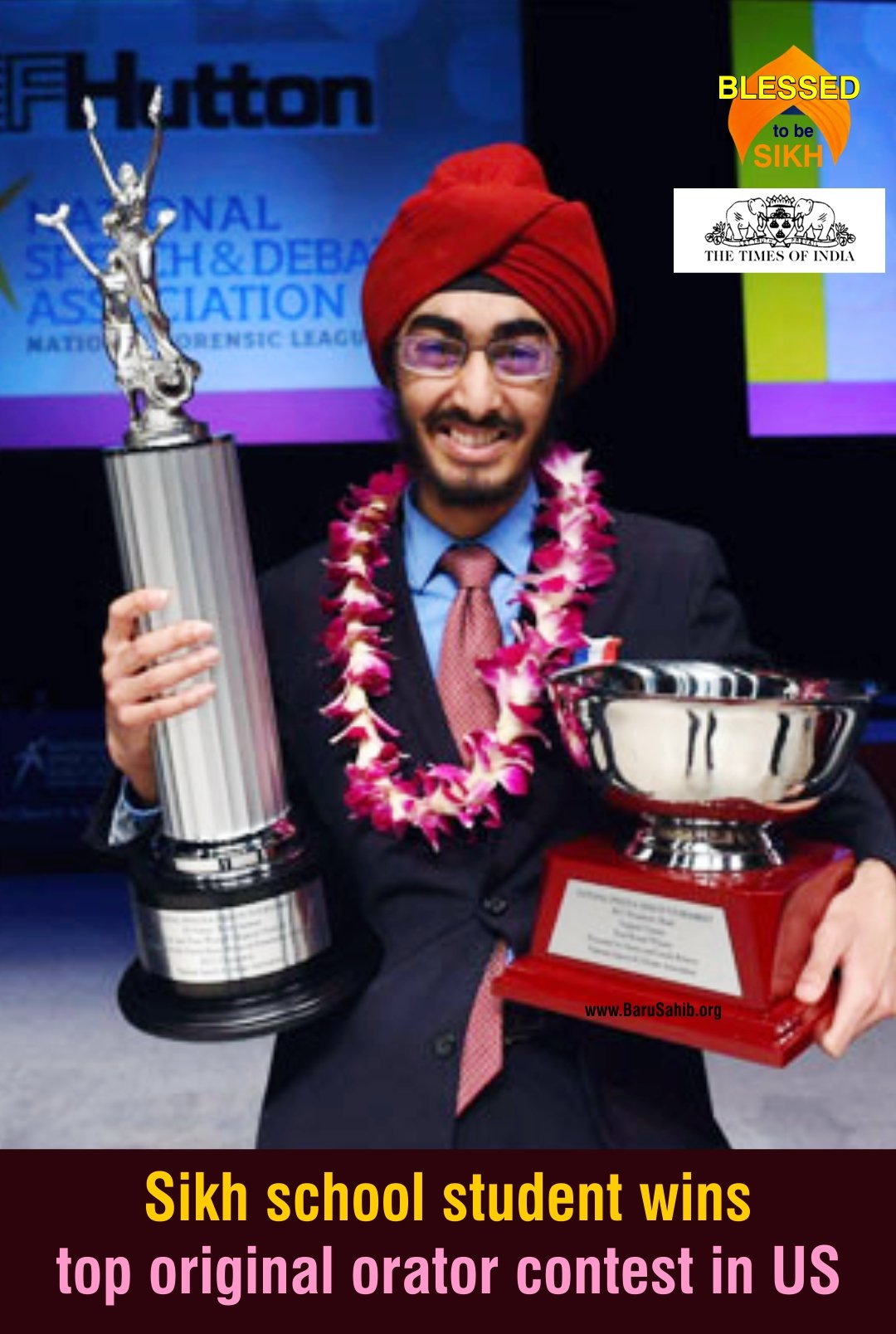
Sikh school student wins top original orator contest in US

J Singh Kapur, a Sikh student of Valley High School in West Des Moines, Iowa in US, won the 2017 National Speech and Debate Tournament in the category of original oratory -considered to be the most prestigious high school speech and debate competition in the US. Taking off with a jig on a Punjabi song, […]

J Singh Kapur, a Sikh student of Valley High School in West Des Moines, Iowa in US, won the 2017 National Speech and Debate Tournament in the category of original oratory -considered to be the most prestigious high school speech and debate competition in the US.

Taking off with a jig on a Punjabi song, the speech titled `Let’s Dance’ exposes the tendency of building simplified narratives and ignoring the complexities of the past as well as contemporary times.Both his style and content are attracting admiration or reaction.

His speech is rocking social media and radio channels are inviting him for talk shows.
His speech takes off from the Bollywood films’ disconnect with reality and its simplified narratives.
“We are a story-telling society. We each seek to provide our scattered and confusing experiences with a sense of coherence, by arranging the episodes of our lives into stories. But our problem arises when our complex realities do not match the narrative.”

Apart from quite a few other examples of simplified narratives, he narrated his experience to highlight the stereotyping of Sikh and Muslim identities post-911. He told the audience that he was two years old when 911 happened and (as his parents told him later). His family was watching the horrific tragedy unfold on TV when he shouted `Papa’ after seeing an image on the screen. “The image was that of Osama bin Laden.My father told me that this was a moment of profound fear for him as he realized that Americans may see his beard and turban and think he’s a terrorist.”

JJ, who bagged thee first prize, won a scholarship of $2,000.
In his blog “Story of a Sikh American”, JJ tells how a group of teenagers at restaurant shouted “hey Osama go home”. “There have been times when I’ve been tempted to remove my turban and to cut off my hair, but my father encourages me to strengthen my roots,” he wrote. In the light of such provocations, this high school student co-founded “The Iowa Sikh Turbanators” in January 2017.The forum is being run by youth Sikhs dedicated to raising awareness about Sikhism. The goal of the Iowa Sikh Turbanators is simple: to “turban-ate” the negative stigma surrounding the Sikh faith through community service events.

Source- Times of India

Sikh school student wins top original orator contest in US

J Singh Kapur, a Sikh student of Valley High School in West Des Moines, Iowa in US, won the 2017 National Speech and Debate Tournament in the category of original oratory -considered to be the most prestigious high school speech and debate competition in the US. Taking off with a jig on a Punjabi song, […]

J Singh Kapur, a Sikh student of Valley High School in West Des Moines, Iowa in US, won the 2017 National Speech and Debate Tournament in the category of original oratory -considered to be the most prestigious high school speech and debate competition in the US.

Taking off with a jig on a Punjabi song, the speech titled `Let’s Dance’ exposes the tendency of building simplified narratives and ignoring the complexities of the past as well as contemporary times.Both his style and content are attracting admiration or reaction.

His speech is rocking social media and radio channels are inviting him for talk shows.
His speech takes off from the Bollywood films’ disconnect with reality and its simplified narratives.
“We are a story-telling society. We each seek to provide our scattered and confusing experiences with a sense of coherence, by arranging the episodes of our lives into stories. But our problem arises when our complex realities do not match the narrative.”

Apart from quite a few other examples of simplified narratives, he narrated his experience to highlight the stereotyping of Sikh and Muslim identities post-911. He told the audience that he was two years old when 911 happened and (as his parents told him later). His family was watching the horrific tragedy unfold on TV when he shouted `Papa’ after seeing an image on the screen. “The image was that of Osama bin Laden.My father told me that this was a moment of profound fear for him as he realized that Americans may see his beard and turban and think he’s a terrorist.”

JJ, who bagged thee first prize, won a scholarship of $2,000.
In his blog “Story of a Sikh American”, JJ tells how a group of teenagers at restaurant shouted “hey Osama go home”. “There have been times when I’ve been tempted to remove my turban and to cut off my hair, but my father encourages me to strengthen my roots,” he wrote. In the light of such provocations, this high school student co-founded “The Iowa Sikh Turbanators” in January 2017.The forum is being run by youth Sikhs dedicated to raising awareness about Sikhism. The goal of the Iowa Sikh Turbanators is simple: to “turban-ate” the negative stigma surrounding the Sikh faith through community service events.

Source- Times of India

This Sikh Politician Shared his Childhood Experience of Growing Up In Canada & is really Resonating!

On Canadian Multiculturalism Day, Singh shared his personal experiences of growing up in Canada, and how the country’s official embrace of diversity often falls short of reality. “While Canada is known for celebrating Multiculturalism, as a kid growing up, it didn’t always feel that way,” Singh wrote on Twitter. “I remember feeling like there was […]

On Canadian Multiculturalism Day, Singh shared his personal experiences of growing up in Canada, and how the country’s official embrace of diversity often falls short of reality.

“While Canada is known for celebrating Multiculturalism, as a kid growing up, it didn’t always feel that way,” Singh wrote on Twitter. “I remember feeling like there was something wrong with me for just being me, and I wanted to belong.”
Singh said he learned early on that he had to “work twice as hard for half as much,” and that his turban and beard made him stand out.

Singh said he has been racially profiled and stopped by police during his time as a defence lawyer and even after he entered politics.

“Since being elected, I’ve faced criticism for caring about how I dress,” Singh said. “The truth is, like many [people of colour], I don’t have the privilege to not care.”

How people of colour dress “impacts how they are perceived and treated.” Singh said. “It is something we grapple with everyday.”

Singh, who is well-known for his sharp personal style, said that fashion allowed him the confidence to own his identity and do the work he was passionate about.

“Fashion became my social armour,” Singh said.

Singh said he hoped his story would help young people going through similar struggles with identity and belonging

This Sikh Politician Shared his Childhood Experience of Growing Up In Canada & is really Resonating!

On Canadian Multiculturalism Day, Singh shared his personal experiences of growing up in Canada, and how the country’s official embrace of diversity often falls short of reality. “While Canada is known for celebrating Multiculturalism, as a kid growing up, it didn’t always feel that way,” Singh wrote on Twitter. “I remember feeling like there was […]

On Canadian Multiculturalism Day, Singh shared his personal experiences of growing up in Canada, and how the country’s official embrace of diversity often falls short of reality.

“While Canada is known for celebrating Multiculturalism, as a kid growing up, it didn’t always feel that way,” Singh wrote on Twitter. “I remember feeling like there was something wrong with me for just being me, and I wanted to belong.”
Singh said he learned early on that he had to “work twice as hard for half as much,” and that his turban and beard made him stand out.

Singh said he has been racially profiled and stopped by police during his time as a defence lawyer and even after he entered politics.

“Since being elected, I’ve faced criticism for caring about how I dress,” Singh said. “The truth is, like many [people of colour], I don’t have the privilege to not care.”

How people of colour dress “impacts how they are perceived and treated.” Singh said. “It is something we grapple with everyday.”

Singh, who is well-known for his sharp personal style, said that fashion allowed him the confidence to own his identity and do the work he was passionate about.

“Fashion became my social armour,” Singh said.

Singh said he hoped his story would help young people going through similar struggles with identity and belonging

Mexican Sikhs beautifully retell a Sakhi about Guru Gobind Singh Ji

To serve Infinity, a Sikh serves the Guru; and serving the Guru means serving the sangat—the congregation composed of common people. Our Gurus could never restrain their longing and willingness to serve the sangat. We need to understand what giving to the Infinite means. In Sikh Dharma the sevadar serves without his personal identity and […]

To serve Infinity, a Sikh serves the Guru; and serving the Guru means serving the sangat—the congregation composed of common people. Our Gurus could never restrain their longing and willingness to serve the sangat.

We need to understand what giving to the Infinite means. In Sikh Dharma the sevadar serves without his personal identity and does not consider the identity of the person in front of him. The sevadar always tries to find the Infinite in the finite. He does not serve an individual or a person; he serves God represented in front of him.

Obey, Serve, Love, Excel

We must understand that seva is not a duty, a donation, a charity, etc. Seva is a personal discipline in which a Sikh aspires to develop his spiritual ability and power through a defined attitude by the application of the formula (Gur) of OBEY, SERVE, LOVE, EXCEL.

The following is a cautionary tale about seva, from the life of Guru Gobind Singh:One day a farmer was passing through, traveling in his loaded cart pulled by two oxen. It was already evening and he was in a hurry because he had to cross the jungle before darkness. However, out of his devotion and love he could not go without receiving the prasad of his Guru.

He jumped out of his cart, leaving his oxen unchained, and hurriedly entered the camp. He approached the old sevadar, who instructed him to go behind, sit in the sangat and wait his turn. The peasant tried to explain his situation, that he was in hurry because he had to catch his moving cart. He insisted that the sevadar make an exception in his case.

The man’s clothes were dirty, his turban was in disarray, and his matted hair was falling down. The sevadar got angry and shouted, making signs with his right hand: “You dirty man! Do not jump like a bear over me! Go back and wait your turn!” With the movement of his hand, a small portion of prasad fell on the ground. The farmer collected that small portion and proclaimed silently, “My job is done.”

Shortly thereafter the elderly sevadar passed away. A few years later a juggler with a bear appeared in the darbar of the Tenth Master. He asked Guru Ji to allow him to offer a show to the sangat. Guru Ji, after requesting the sangat’s permission, allowed the juggler to do his performance. This time the bear really gave an excellent show. Even the juggler himself was surprised to note that the bear was very happy and had satisfied everyone with his presentation.

The son of the old sevadar happened to witness the performance, and was jumping and laughing loudly. Guru Ji asked him if he knew who the bear was in reality. Guru Ji then narrated the story of the bear, who in his past life had been the elderly sevadar, this young man’s father. As he did not give proper attention to the farmer, the farmer cursed him, wishing him to be a bear in his next life.

Upon hearing this, the sangat fell silent. Everyone was sad; the young man was crying. People asked the Guru: “ How is it that a man who had served the Guru for his whole life, instead of being liberated was punished in such a terrible way?”

Guru Ji proceeded to explain that the sevadar had made the mistake of seeing the farmer as a person and judging his personal identity, based on his aspect and attitude. Guru Ji stressed the importance of compassion, tolerance and respect for everybody. One must not hurt anybody during the seva and must serve everybody unconditionally without any personal identity.

The sangat petitioned Guru Ji to do something to abolish the old sevadar’s mistake and liberate his soul. So Guru Ji asked for fresh prasad. Ardas was performed and the prasad was offered to the Guru and was first given to the bear. The moment the bear ate the prasad, it instantly passed away and was liberated. Everybody, particularly the young man, was grateful and happy.

The story ends with a perfect illustration of Guru Gobind Singh’s infinite wisdom and unconditional compassion. The juggler now claimed that the bear was his only source of income. He had offered his performance as seva and did not expect such an awful outcome. Guru Ji accepted the responsibility.

He then asked the sangat to donate money or jewels to compensate the juggler. The whole sangat cooperated and Guru Ji himself added the same amount so that the juggler could find some other means of livelihood. Wahe Guru Ji Ka Khalsa! Wahe Guru Ji Ki Fateh!