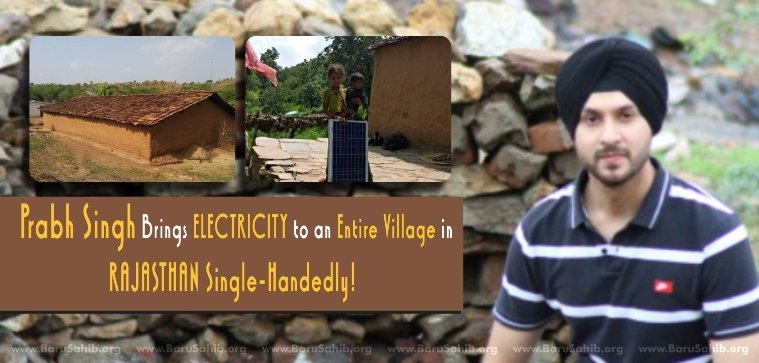
Prabh Singh Brings ELECTRICITY to an Entire Village in RAJASTHAN Single-Handedly!

In era of Modern Age, where even a short power cut tends to disturb our entire day, there are so many villages in India that have never even experienced electricity. Rural electrification is a big issue in India and more than 18,000 Indian villages still await to be electrified. Such was the fate of Naro […]

In era of Modern Age, where even a short power cut tends to disturb our entire day, there are so many villages in India that have never even experienced electricity. Rural electrification is a big issue in India and more than 18,000 Indian villages still await to be electrified.

Such was the fate of Naro ka Kheda a small village in Rajasthan with 76 households until Prabh Singh, a Sikh student who pursued his higher education in Durham University Business School in England, took it upon himself to bring electricity to the village. His ‘Project Kiran’ electrified around 76 households in that village.
Until then, the villagers had to walk 7 s just to charge their mobile phones.

This project costed around 7 Lakhs, which was crowd-funded by the villagers and contributed by North East Centre for Technology Application and Reach (NECTAR), an autonomous society in the Indian government.
Prabh decided to stay while implementing his project with the villagers to experience their lifestyle & get a sense of benefit his project could bring.

The ‘easy to install and service’ electricity kit created in this project comprises of the following things.

A solar panel
Three light bulbs
A strip light
A charging socket

This ensured that the initiative was accessible to residents in remote locations.

Prabh Singh wants to take this project to other villages too. “I am in talks with an Indian central government agency to replicate the same project in 50 remote Indian villages based on the similar kind of revenue and service mechanism,” he said.

“The happiness and the amazement which I saw in those villagers’ eyes after they used electricity in their house for the first time is unmatched to any professional accomplishment that I could ever imagine achieving.” Added prabh Singh after turning their Dream into reality!

~ Source – huffingtonpost.co.uk

SIKH Solider who survived a Japanese bullet in WORLD WAR II celebrates his Century!

Sikh Solider who survived a Japanese bullet through the jaw serving in the British Army during Second World War celebrates his century in Hitchin. Pritam Singh, from Meadow bank, had his family around him to mark the milestone, including a number of his five children, 12 grandchildren and 19 great-grandchildren. Mr Singh, who came to […]

Sikh Solider who survived a Japanese bullet through the jaw serving in the British Army during Second World War celebrates his century in Hitchin.

Pritam Singh, from Meadow bank, had his family around him to mark the milestone, including a number of his five children, 12 grandchildren and 19 great-grandchildren.

Mr Singh, who came to England in 1962 after surviving a bullet through his jaw fighting the Japanese with the fearsome 16th Punjab Regiment during the war – worked at Bowmans in Hitchin and Ickleford.

His son Jas Phurgura said: “Dad feels blessed.”

Via: GT1588

Sikh Turban & Langar were the talk of the Parliament of World’s Religions 2015 at Salt Lake City

The 2015 Parliament was officially opened with a parade of flags and Native American drumming as regional tribal chiefs welcomed us to their land, and prayed for world peace. It was attended by 10,000 people from 80 countries and 50 faith and non-faith groups. This year, UNITED SIKHS volunteers at the Parliament spoke on service […]

The 2015 Parliament was officially opened with a parade of flags and Native American drumming as regional tribal chiefs welcomed us to their land, and prayed for world peace. It was attended by 10,000 people from 80 countries and 50 faith and non-faith groups.

This year, UNITED SIKHS volunteers at the Parliament spoke on service (seva) as a pathway to alleviate human suffering; that society will have to address fear in order to address hate crime and prejudice; how technology may help alleviate poverty in Panjab where a farmer is committing suicide every few hours; and how there can be no peace until truth is revealed for justice and reconciliation to take place.

Kamalla Kaur addressed attendees on her journey discovering Sikhi and said, “Having so many people from so many faith traditions talking, singing, praying and working for world peace is grand. The Parliament of World Religions gives me renewed hope for humanity, and faith in Creation/Creator.”

Prof Indira Prahst, from Vancouver, examined media representations of Sikhs and how the turban has been signified through a “violent” gaze by the public towards the turban against the back drop of the war on terrorism, secularism and Nation Building. She argued that the image of Sikhs is a politics of representation.

Langar was prepared and served by Sikhs to thousands of attendees every day of the Parliament. Langar is a Sikh tradition of a free community meal for anyone, regardless of race, religion, gender, colour or class. By the end of the conference, maybe a third of those serving Langar were non-Sikhs who were inspired to join in the great seva.

Rev. Marie Gasau, from Oak Creek, Colorado, who had not partaken Langar before, approached one of the Langar organisers, Balwant Singh, and requested his help to start Langar in her home town where there is no Gurdwara (Sikh place of worship).

Sikhs also made their presence felt, when volunteers of the American Sikh Council tied turbans for non-Sikh Parliament attendees. Hundreds of non-Sikhs were seen sporting colourful turbans at the Parliament and on the streets and shopping malls near the Parliament venue.

One non-Sikh attendee who wore his turban to the airport on his way home said, “I have not taken my turban off because I want to know what Sikhs go through at airports when their turbans are searched.”

~ Source: www.unitedsikhs.org

Issued By-
Mejindarpal Kaur
International Legal Director
International Civil and Human Rights Advocacy (ICHRA), UNITED SIKHS

Saroop of Adi Granth Sahib ji dictated by Guru Arjan Dev Ji to Bhai Gurdas at Kartarpur

Guru Arjun then set to compile the Shabads into a single volume, the Adi Granth. He sifted through the Shabads which had been passed down from the first four Gurus, and filtered out those which had been added by imposters. Bhai Gurdas was the scribe who recorded the words of Guru Arjun. When he asked […]

Guru Arjun then set to compile the Shabads into a single volume, the Adi Granth. He sifted through the Shabads which had been passed down from the first four Gurus, and filtered out those which had been added by imposters. Bhai Gurdas was the scribe who recorded the words of Guru Arjun. When he asked Guru Arjun how he could distinguish between the true and the false Shabads, Guru Arjun replied, “Even in a great herd of cows and calves, the mother cow will recognize the cry of her calf, above all others. Just so, the True Shabad resonates truly, and is easily distinguished from the false.”

Guru Arjun added a great many of his own Shabads to those of Guru Nanak, Guru Angad, Guru Amar Das and Guru Ram Das. He also added Shabads of thirty-six Hindu and Muslim Saints, among them Kabir, Ravi Das, Naam Dev, Trilochan and Sheikh Farid. This was the first time any religion incorporated the works of sincere devotees of other religions into its own scripture; this reflects the universality of thought which underlies the Sikh belief in One God, and the one family of humanity as children of God.

Guru Arjun left some blank pages in the Granth. When Bhai Gur Das asked the purpose of this, he answered that one of the Gurus to follow him would add the Shabads in their proper place at the proper time. In time the shabads of Guru Teg Bahadur, the ninth Manifestation of the Guru’s Light, were added by Guru Gobind Singh and thus the Siri Guru Granth Sahib was complete.

The Adi Granth was completed in 1604, and installed in the Golden Temple; Baba Buddha was appointed Guru’s Granthi. Guru Arjun told his Sikhs that the Adi Granth was the embodiment of the Guru, and should be treated in the same fashion as they respect him. When Guru Arjun first completed the Adi Granth, he placed it upon his own bed and slept on the floor. Its words were written without any spaces or breaks, which nowadays is hard for most people to follow.

Share & Spread the divinity!

The Rich Sikh Heritage Gurdwaras of Potohar, Pakistan!

A majority of the buildings which once belonged to the Sikhs and Hindus were given to immigrants from India. These families still live in these buildings, but surprisingly the structures and the artwork on the walls are still intact. Several Hindu and Sikh monuments; temples and Gurdwaras have been discovered gracing the landscape of this […]

A majority of the buildings which once belonged to the Sikhs and Hindus were given to immigrants from India. These families still live in these buildings, but surprisingly the structures and the artwork on the walls are still intact.

Several Hindu and Sikh monuments; temples and Gurdwaras have been discovered gracing the landscape of this region. Three of the Gurdwaras are located at Kanoha, Doberan Kalan and Mohara Bhatta, and are especially noted for their elegance and paintings. Of these, the Sikh Gurdwara located 10 kilometres from Kallar Syedan at Kanoha is the most prominent.

Historically, the Gurdwara has been used to meet the religious and social needs of the Sikh community here. Guru Hargobind, the sixth guru of Sikhs (1606-1644), was believed to have first used the word ‘Gurdwara’.

Before that, the name used for such structures was ‘dhramsala’, which means a rest house for travellers in its normal Indian context, but was used in the early days of Sikhism to denote a room or building used for devotional singing (kirtan) and prayers.

The gurdwara of Kanoha is a very large three-storied structure crowned with canopy – a distinctive feature of the Potohari style of gurdwara. Built on a square plain, it formerly housed Sikh families who would visit here to recite the Guru Granth Sahib and performing various religious rituals. Apart from the Kanoha Gurdwara, there is another Gurdwara located in the Doberan Kallan town.

The connection of Sant Attar Singh ji to Dhan Potohar

In 1892 Sant ji got his name struck off from the role of army and devoted himself solely to the propagation of the Guru’s message. He toured extensively in Jammu­ Kashmir, Sindh and North Western Frontier Province.

In Pothohar region, such places as Shah Di Dheri, Thamali, Kanoha, Dera Khalsa, Sagri, Malakpurj, Rawalpindi, Haripur, Kahuta, Dhan Mangwal, Chakwal, Gujjarkhan, Loom and Bhaun were the main venues of Sant Attar Singh Ji’s activities. His religious tours were a remarkable success. Quite a large number of people imbibed Sikh ethos.

Needless to say, the Punjab tourism department, should chalk out a viable strategy to promote religious tourism in the Kallar Syedan Tehsil. These wondrous and historically rich Gurdwaras can be a great tourist attraction; Sikhs who visit Gurdwara Panja Sahib at Hassan Abdal should also be able to come to here.

~ Source – dawn.com

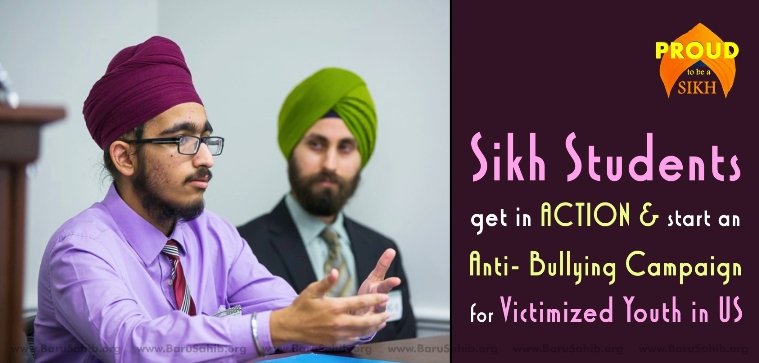
Sikh Students get in ACTION & start an Anti – Bullying Campaign for Victimized Youth in US!

Japjee Singh, a 17-year-old Sikh student in Georgia, who had been bullied because of his religion since the second grade. The issue escalated once he began middle school and continued into high school. Students would call him names, refer to his turban as a “bomb,” or suggest he was a terrorist. A group of students […]

Japjee Singh, a 17-year-old Sikh student in Georgia, who had been bullied because of his religion since the second grade. The issue escalated once he began middle school and continued into high school.

Students would call him names, refer to his turban as a “bomb,” or suggest he was a terrorist. A group of students once beat Japjee multiple times, leaving him with a broken nose, fractured chin, and bruised body.

“This is something we haven’t been able to forget,” Aasees Kaur, Japjee’s 20-year-old sister, told ThinkProgress in a phone interview. “He was sitting there with blood all over him and an ice pack in his hand and kids were telling him ‘go back to your country.’ When kids are saying such harsh things, it really broke my family.”

Japjee required two surgeries after the beating, his sister recalled. And when he eventually came back to school, the bullying didn’t stop. One student reportedly threatened to go after Japjee and his family with “a 9-millimeter and a blade.”

Aasees said that the school never took action. Japjee lost his entire sense of belonging.

Aasees said. “These were kids that he grew up with. He went to school with them for years and now all of a sudden, he didn’t know who his friends were. They didn’t quite get the line between harassment and joking around.”

Between May 2013 and November 2014, the U.S. Department of Justice entered two settlements with the DeKalb County School District near Atlanta, Georgia on behalf of Japjee. The first agreement reached in May required DeKalb County to create a safety plan for Japjee and to train students and staff on post-9/11 backlash and discrimination. The second agreement reached in November required DeKalb County to “engage in comprehensive measures” to stop “peer-to-peer bullying” among the district’s 100,000 students, including Sikh students, according to a press release from the Sikh Coalition.

Though things have gotten better for Japjee, discrimination still hasn’t ended for their family. Aasees’ cousin is still being bullied, according to a recent interview with The Huffington Post.

But Japjee and Aasees are taking action. Two years ago, Japjee testified before Congress as part of a larger advocacy effort to end bullying against Sikh American school children. And now, the family is hoping to get their story out.

Japjee’s case is part of a larger issue that the White House Initiative on Asian American and Pacific Islanders (WHIAAPI) is trying to address through its launch of an anti-bullying campaign this week to combat bullying against Asians and to empower students to report, stop, and prevent bullying. The Sikh Coalition and the Coalition of Asian Pacifics in Entertainment (CAPE) are campaign partners.

WHIAAPI’s Act to Change public awareness website includes YouTube videos of Asian celebrities like Charlotte Hornets basketball player Jeremy Lin and actor Maulik Pancholy talking about being bullied. It also provides resources in Chinese, Hindi, Korean, Punjabi, Urdu, and Vietnamese. The campaign calls on the public to take a pledge to end bullying or to help someone who has been bullied.

“Bullying is a major civil rights issue for the Asian American and Pacific Islander community in particular,” Initiative Executive Director Kiran Ahuja said in a press statement. “We’ve seen too often AAPI groups, including Sikh, Muslim, Micronesian, LGBT, and limited English proficient youth, targeted for bullying and harassment.”

Aasees believes that the campaign could help people like her brother and other bystanders raise their voices against bullying. She said that the multilingual resources would be important for some parents who may not read English fluently so that they would be able to know what to do with when their children are bullied. But the presence of the campaign would also let students know that they’re not alone.

“There are thousands of Japjees out there who haven’t spoken out yet,” Aasees said. “There are thousands of Japjees out there who don’t know what to do. This campaign will really let them know that they have a tremendous amount of support behind them and could be a guide for what they should do if they’re being bullied.”

In a 2014 Sikh Coalition survey of 500 Sikh students and focus groups with over 700 students, researchers found that over 50 percent of Sikh children endured school bullying, with 67 percent of turbaned Sikh children saying that they are bullied in school. Nationally, about 32 percent of all children ages 12 and 18 reported that they were bullied in school. What’s more, 50 percent of Asian American students in New York City public schools reported biased-based harassment, a statistic that could be under-reported.

Over the past 15 years, public consciousness has been raised about bullying and multiple states have moved to pass legislation to address the issue. According to a recent study published by JAMA Pediatrics, students living in states that have passed anti-bullying laws reported lower levels of bullying.

“School systems and community outreach programs and parents really need to partner up strongly with under-represented communities to make sure that our children are better protected, that their needs are being met,”

Aasees said. “Parents have a responsibility too, so it’s a matter of education in both the home and the school to teach about bullying. Kids like Japjee only have one childhood. When you see kids that withdrawn, it breaks you.”

A Campaign which will inspire them NOT TO LOOSE their Sense of Belongingness!

~ Source: thinkprogress.org

First Sikhs Remembrance Visit to Helles Memorial in Gallipoli, Turkey!

By early 1915, the war on the Western Front had reached a stalemate. The Gallipoli campaign was intended to break the deadlock. In the spring of 1915, Allied warships bombarded the peninsula’s costal forts and attempted to force their way through the narrow Dardanelles Straits, controlled by the forces of the Ottoman Empire. On 18th […]

By early 1915, the war on the Western Front had reached a stalemate. The Gallipoli campaign was intended to break the deadlock. In the spring of 1915, Allied warships bombarded the peninsula’s costal forts and attempted to force their way through the narrow Dardanelles Straits, controlled by the forces of the Ottoman Empire. On 18th March, three Allied battleships were lost to mines and naval attack was abandoned.

A 70,000 strong Mediterranean Expeditionary Force was assembled, comprising British, Canadian, Indian and French troops, along with the Australian and New Zealand Army Corps (ANZAC).

Its mission was to seize the peninsula, opening the Straits for Allied warships which could attack Constantinople (now Istanbul), taking the Ottoman Empire out of the war, and opening up a route to provide Russia with much needed supplies.

The Allies landed on the peninsula on 25-26 April 1915; the 29th Division at Cape Helles in the south and the Australian and New Zealand Corps north of Gaba Tepe on the west coast, an area known as Anzac.

On 6 August, further landings were made at Suvla, just north of Anzac, and the climax of the campaign came in early August when simultaneous assaults were launched on all three fronts. However, the difficult terrain and stiff Turkish resistance soon led to the stalemate of trench warfare. From the end of August, no further serious action was fought and the lines remained unchanged.

Despite a major offensive in August 1915, the Allies were unable to break the deadlock. An evacuation began in December and on 9th January 1916, the last Commonwealth soldier left the peninsula.

The United Kingdom and Indian forces named on the Helles memorial died in operations throughout the peninsula, the Australians at Helles. There are also panels for those who died or were buried at sea in Gallipoli waters. The memorial bears more than 21,000 names.

Few of us are aware of the role Sikh soldiers played in the Gallipoli campaign that ran from April 25, 1915 to January 9, 1916.

Being subjects of the Crown under British rule in India, Sikhs and Indians had no choice but to participate in WW1, a war that was certainly not of their making and a war that they were sent to fight in simply because they were recruits of the British Indian Army.

The Gallipoli campaign cost the lives of some 36,000 Commonwealth, 10,000 French and at least 86,000 Turkish troops. 1,358 Indians died and some 3,421 were injured in the Gallipoli campaign.

Records tell us that 371 who died fighting at Gallipoli on June 3 and 4, 1915, were from the battalion of the 14th Sikh regiment. General Sir Ian Hamilton was in charge of the troops against the Turks during that operation and he wrote glowingly of this regiment that fought valiantly.

In a letter to his Commander-in-Chief back in India, he wrote: “In spite of the tremendous losses there was not a sign of wavering all day. Not an inch of ground was given up and not a single straggler came back.

“The ends of the enemy’s trenches were found to be blocked with the bodies of Sikhs and of the enemy who died fighting at close quarters, and the glacis slope was thickly dotted with the bodies of these fine soldiers all lying on their faces as they fell in their steady advance on the enemy.

“The history of Sikhs affords many instances of their value as soldiers, but it may be safely asserted that nothing finer than the grim valour and steady discipline displayed by them on the 4th of June has ever been done by soldiers of the Khalsa.

“Their devotion to duty and their splendid loyalty to their orders and to their leaders make a record their nation should look upon with pride for many generations.”

The names of the 14 K.G.O. Ferozepore Sikhs, 15th Ludhiana Sikhs, 51st ,53rd 54th Sikhs and others are on the panels at the Helles memorial. 56th Punjabi rifles, 90th, 92nd ,66th, 69th,89th Punjabies, 28th Mountain Battery, 23rd Peshawar MTN.BTY, 26th Jacob’s MTN.BTY, 27th Mountain Battery, Indian Army Res of offrs and 21st Kohat MTN BTY are some panels in which Sikh names are engraved.

The Ferozepur Sikhs fought true to their reputation. In the Battle of Krithia, they led frenzied charges on Terkish trenches. A Times of India (newspaper) detailed how the Sikhs, despite facing heavy losses in face of heavy machinegun and rifle fire, led a bayonet charge on the Turkish trenches facing them and killed the defenders. But this bravery cost them dear: the battalion lost 82% of its strength and had to be attached to a Gurkha battalion until they were reinforced by Patiala state troops.

We must make special efforts to perpetuate the memory of all the valiant soldiers who laid down their lives including the Sikh regiments that fought alongside the Australian and New Zealanders at Gallipoli.

Remembering and honouring the fallen is the greatest tribute we can give to all those who gave their lives for our tomorrow.

The purpose of the remembrance gathering is also to raise awareness.

We need to know that the Sikh soldiers also made a contribution, similar to other nations of the world, to help bring peace and freedom for people in Europe by sacrificing their lives in large numbers, especially in Gallipoli.

~ Source: Facebook.com

GurSIKH Candidates FINALLY made a Historic entry into the Canadian Parliament!

With the spectacular win of Liberal Party in the federal elections, several turbaned Sikh MPs and five South Asian women have made a historic entry into Canadian parliament. They are among 15 South Asian Liberal MPs elected in the 42nd parliamentary election. Among the turbaned Sikh MPs are Navdeep Singh Bains and Raj Grewal from […]

With the spectacular win of Liberal Party in the federal elections, several turbaned Sikh MPs and five South Asian women have made a historic entry into Canadian parliament. They are among 15 South Asian Liberal MPs elected in the 42nd parliamentary election.

Among the turbaned Sikh MPs are Navdeep Singh Bains and Raj Grewal from Ontario. Bains has served as MP in the past.

Likewise, two turbaned Sikh MPs Harjit Singh Sajjan and Randeep Singh Sarai have been elected from BC.

In Alberta Darshan Singh Kang was elected, while the first turbaned Sikh minister in the previous Conservative government Tim Uppal has been defeated by Amarjit Sohi of the Liberal Party. Uppal was also from Alberta which is considered as Conservative hotbed.

Interestingly, the previous government’s decision to ban niqab during citizenship oath ceremonies did not sit well with the minorities. If the victories of five turbaned Sikh Liberal MPs is any indication, it was a clear mandate against ban on religious symbols.

~ Source: Hindustan Times

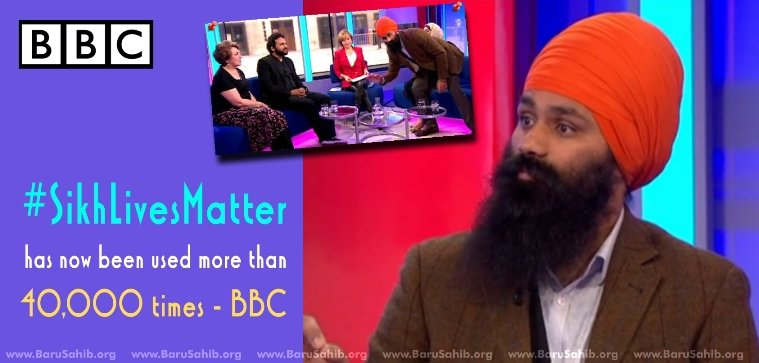
“Sikh Lives Matter” has now been used more than 40,000 times – BBC!

After the deaths of two protesters in India, Sikhs around the world have been using online protest tactics to highlight what they say is injustice – and one supporter went off-topic on a BBC TV programme to make his case. “Sikh Lives Matter” has now been used more than 40,000 times, has spread to other […]

After the deaths of two protesters in India, Sikhs around the world have been using online protest tactics to highlight what they say is injustice – and one supporter went off-topic on a BBC TV programme to make his case.

“Sikh Lives Matter” has now been used more than 40,000 times, has spread to other social networks such as YouTube and Facebook, and was surging again on Monday.

When pages of the Guru Granth Sahib, Sikhism’s central text, were found ripped up, protests spread across the Indian state of Punjab. Police used water cannons, batons and live rounds to disperse the crowds, and at one protest last week police opened fire, leaving at least two dead and more than 50 injured, according to reports. One of those shot, 27-year-old Gurjit Singh, had reportedly gone to give food to the protesters, according to an interview with his father by the Indian Express newspaper. Online and in the streets, a movement quickly sprang up. Tweets showing his body, and photos of other injured protesters were shared widely along with the hashtag “Sikh Lives Matter” on Twitter.

In the UK the campaign got another shot of notoriety when Jagmeet Singh – representing a Sikh point of view and from the educational charity Basics of Sikhi – appeared on BBC One’s Sunday Morning Live programme. After a studio debate about interfaith marriage, Singh went off-topic, stood up in front of the camera and interrupted presenter Sian Williams, saying: “Sikhs are being killed in Punjab and nobody is reporting it, please report it.”

Online, protest messages are coming not only from India but from large Sikh communities abroad – especially the UK. One of the first people to re-ignite the hashtag’s popularity was Bally Singh, based in Wolverhampton, who tweeted: “Police violence towards our peaceful Sikh protestors should not go unnoticed.”

“Sikh Lives Matter”, which borrows its language from US protest movements such as “Black Lives Matter” and “Muslim Lives Matter,” actually began in the US too – where it originally was used to highlight the bullying of Sikh children who are sometimes confused with Muslims. But it’s been used in recent days to highlight the events in India and rail against Western media reporting, a big theme of the protests. A petition to the BBC on Change.org has received more than 70,000 signatures. It calls for more coverage of the story and for coverage of India’s treatment of its Sikh citizens.

“The BBC is covering this story online and on radio and it has been discussed on the BBC Asian Network,” the BBC press office said in a statement. The story has also been covered by the BBC’s Hindi language service.

~ Source- bbc.com

How Heroic Tales of SIKH GURUS are helping Christians to FIGHT FORCED CONVERSIONS!

Sikh Guru’s are revered by people from many faiths and in Pakistan, they are the inspirational force for the minority Christian community which is being forced to embrace Islam by fundamentalists. Recently an incident took place in which a Christian family of Gujjranwala district in Pakistan’ Punjab province blatantly refused to accept Islam stating that […]

Sikh Guru’s are revered by people from many faiths and in Pakistan, they are the inspirational force for the minority Christian community which is being forced to embrace Islam by fundamentalists.

Recently an incident took place in which a Christian family of Gujjranwala district in Pakistan’ Punjab province blatantly refused to accept Islam stating that they would not bow to their dictates, quoting examples of Sikh Guru’s.

President of British Pakistani Christian Association, Wilson Chaudhary, told TOI over the phone from UK on Monday that forced conversions are unfair. “You failed to convert Sikh Guru’s to embrace Islam, so why try converting us? This is what Christians reply to fundamentalists who force them to embrace Islam,” he said.

Quoting a recent incident, he informed that Akash and Adnan, both sons of Aftab Gill, 40, resident of Railway Colony in Wazirabad in Gujaranwala district refused to bow down to the threats of local fundamentalists by giving examples of Sikh Gurus. The family was forced to embrace Islam since they fetched water for household use from a nearby mosque’s tap.

“The exploits of first Sikh master Guru Nanak who was born in Pakistan’s Punjab province are commonly quoted. In a time of socio-political turmoil, he bravely shared his message of hope, peace and love, travelling into dangerous territory at the time when Babar was conquering India. He even found himself imprisoned for a short time and other Sikh Gurus bravely opposed forced conversions, ” he said adding that their volunteers inspire Christian community with the inspiring and heroic tales of Sikh Gurus.

He said following Christians rising against their persecution and giving example of Sikh Gurus, the fundamentalists didn’t turn up again but a local Muslim cleric advised Aftab to leave the village for safety.

“Life for Christians in Pakistan is now worse than ever. They are attacked daily and treated worse than rats. At this time, examples of Sikh Gurus have been helping Christians to voice their concerns bravely,” he said.

Source- Times Of India