Two Sikh Men used their TURBANS & saved lives of Ganesha Devotes!

A group of young men lost balance in a canal while immersing Ganesha idols. Two Sikh men instantly opened their turbans and threw them towards the drowning people to save their lives. This is how they did it. Inderpal Singh and Kamalpreet Singh, two Sikh men from Sangrur in Punjab, set aside their religious code, […]

A group of young men lost balance in a canal while immersing Ganesha idols. Two Sikh men instantly opened their turbans and threw them towards the drowning people to save their lives. This is how they did it.

Inderpal Singh and Kamalpreet Singh, two Sikh men from Sangrur in Punjab, set aside their religious code, and saved the life of a group of drowning people with the help of their turbans.

A group of young men lost balance in a canal while immersing Ganesha idols. Two Sikh men instantly opened their turbans and threw them towards the drowning people to save their lives. This is how they did it.

Inderpal Singh and Kamalpreet Singh, two Sikh men from Sangrur in Punjab, set aside their religious code, and saved the life of a group of drowning people with the help of their turbans.

After this, three other people jumped in to rescue those who were still struggling in the water. But all of them got stuck in the intense whirlpool. It was then that Inderpal threw in his turban, and pulled the three men out. Kamalpreet also followed him, and directed his turban towards remaining three people, pulling them out.

Thanks to these selfless Singhs, an impending disaster could be avoided.

~ Source: TOI

A Unique Pilgrimage to Sachkhand Shri Hazoor Sahib, Nanded, on a Special Train leaves TODAY!

A unique pilgrimage to Sachkhand Sri Hazoor Sahib, Nanded, Maharashtra on a special dedicated train undertakes TODAY Chandigarh to Nanded and back in order to commemorate 350th birth anniversary of Guru Gobind Singh Ji, falling in Year 2017. Over 1300 passengers are confirmed to board this one-time special train for 6-day pilgrimage from Chandigarh Railway […]

A unique pilgrimage to Sachkhand Sri Hazoor Sahib, Nanded, Maharashtra on a special dedicated train undertakes TODAY Chandigarh to Nanded and back in order to commemorate 350th birth anniversary of Guru Gobind Singh Ji, falling in Year 2017.

Over 1300 passengers are confirmed to board this one-time special train for 6-day pilgrimage from Chandigarh Railway Station and will return back on 4th Oct. The marathon endeavor has been undertaken by a Chandigarh-based socio-religious organization, Mata Tripta ji Charitable Trust ®, in association with its youth wing, Guru Nanak Phulwari (GNP).

It is worth highlighting that this is in continuation to earlier mega ventures successfully conducted by Trust in August 2014 and December 2013 when they took dedicated special train to Sri Patna Sahib and Sri Hazur Sahib Nanded, respectively with 1500+ passengers onboard. The train will be flagged off from Chandigarh Railway Station by ‘Panj Pyaras’.

The event is a dream come true for several hundreds of aspiring people including the aged and the underprivileged ones who have been longing to visit the sacred shrine but could not because of the absence of any such convenient arrangements earlier. About 120 needy people (including children) have been offered free seats for this pilgrimage. by trust members, who have not just contributed through tireless efforts but also contributed financially for the purpose.

Bhai Arvinderjit Singh (popularly known as Veerji) Chief organizer of the mega event, further added, “Suitable arrangements have been made to ensure the availability of routine provisions en-route the 24-hour train journey, like preparation and distribution of community-kitchen services (i.e., Langar), Medical-Aid, hygiene and other essentials round the clock for the comfort of passengers.”

Source- Punjab News Express

US President, Obama announces Jasjit Singh to be a part of his Advisory Council!

President Barack Obama announced three Indian Americans to an advisory council on faith-based and neighborhood partnerships that brings together religious and secular leaders as well as scholars and experts in their fields. The Council focuses on steps the government should take to reduce poverty and inequality and create opportunity for all, according to a White […]

President Barack Obama announced three Indian Americans to an advisory council on faith-based and neighborhood partnerships that brings together religious and secular leaders as well as scholars and experts in their fields.

The Council focuses on steps the government should take to reduce poverty and inequality and create opportunity for all, according to a White House announcement.

Naming Preeta Bansal, Nipun Mehta and Jasjit Singh and 14 others Obama said: “I am confident that these outstanding men and women will serve the American people well, and I look forward to working with them.”

Jasjit Singh is Executive Director of the Sikh American Legal Defence and Education Fund (SALDEF), a position he has held since 2012. Singh first joined SALDEF as the Associate Executive Director in 2009. Prior to joining SALDEF, he worked at Deloitte & Touche.

He also founded the Sikh Student Association at the University of Illinois, and served as its President from 2000 to 2002. Singh is a BS from Illinois University.

~ Source: PTC News

US Navy Officers saluting Indian Navy Vice Adm. Surinder Pal Singh during his Tour!

Indian navy Vice Adm. Surinder Pai Singh, Commanding-in-Chief of the Western Naval Command comes aboard Pre Commissioning Unit Gerald R. Ford (CVN 78) during a scheduled tour. Singh along with an Indian navy flag delegation toured the ship with Rear Adm. Thomas Moore, Program Executive Officer Aircraft Carriers, and Capt. John F. Meier, commanding officer […]

Indian navy Vice Adm. Surinder Pai Singh, Commanding-in-Chief of the Western Naval Command comes aboard Pre Commissioning Unit Gerald R. Ford (CVN 78) during a scheduled tour. Singh along with an Indian navy flag delegation toured the ship with Rear Adm. Thomas Moore, Program Executive Officer Aircraft Carriers, and Capt.

John F. Meier, commanding officer of Pre Commissioning Unit Gerald R. Ford (CVN 78). Earlier this year the U.S. and Indian navy announced a joint working group (JWG) to share aspects of aircraft carrier technology and design. This visit is part of the first meeting of that JWG.

Remembering Muslim Sufi Saints who contributed to the Bani of SGGS on Eid!

The students of Akal Academy Bilga remembered the contributions of Muslim Sufi Saints on the occasion of Eid. After the Shabad Ceremony, short speech was delivered by a student Gurpreet Kaur (XI Science) telling about importance of Eid and contribution of Sufi Saints in Sikhism. After this an enlightening speech was delivered by Principal Madam […]

The students of Akal Academy Bilga remembered the contributions of Muslim Sufi Saints on the occasion of Eid. After the Shabad Ceremony, short speech was delivered by a student Gurpreet Kaur (XI Science) telling about importance of Eid and contribution of Sufi Saints in Sikhism.

Remembering Muslim Sufi Saints who contributed to the Bani of SGGS on Eid!

After this an enlightening speech was delivered by Principal Madam on the role of Muslim saints in the Sikh history & their contribution in Guru Granth Sahib Ji mentioning about Sai Mian Meer ji, Pir Buddhu Shah ji, and also 5 Sufi saints whose bani have been incorporated in Guru Granth Sahib , Bhagat Farid ji, Bhagat Kabir ji, Rababi Balwand Ji, Rababi Satta ji, Bhagat Bhikhan ji.

When a Sikh devotee bows in reverence before Guru Granth Sahib, he bows to the divine hymns of not only the Sikh Gurus but also to these saints, who initially followed their own spiritual path whether Hindu, Muslim or any other faith.

Remembering Muslim Sufi Saints who contributed to the Bani of SGGS on Eid!

The students were motivated to welcome all faiths wholeheartedly as all religious faiths tread us towards the path of one God. They are taught to pay respect to the Holy Scripture which itself is inter-faith in itself and thus has a universal message for the entire humanity.

The students were told that In Guru Granth Sahib, Allah, the Divine Name recited by the Muslims have been incorporated 46 times.

At the end Karah parshad was distributed among all the students & staff members.

~ Tapasleen kaur
~ New Delhi, 26th Sep ’15

Sikh Religious Leaders share the stage with POPE FRANCIS at the 9/11 Memorial, New York!

Sikh community leaders from across the United States joined the Sikh Coalition’s Sapreet Kaur and Simran Jeet Singh in celebrating the recognition of the Sikh faith during Pope Francis’ 9/11 Memorial interfaith service. University at Buffalo professor, Dr. Satpal Singh, shared a Sikh prayer with Pope Francis, while his daughter, Dr. Gunisha Kaur, delivered the […]

Sikh community leaders from across the United States joined the Sikh Coalition’s Sapreet Kaur and Simran Jeet Singh in celebrating the recognition of the Sikh faith during Pope Francis’ 9/11 Memorial interfaith service.

University at Buffalo professor, Dr. Satpal Singh, shared a Sikh prayer with Pope Francis, while his daughter, Dr. Gunisha Kaur, delivered the English translation for the hundreds in attendance and for the millions watching around the world. Dr. Singh and Dr. Kaur were two of just eleven interfaith community members who were invited to be on stage for the service.

The Sikh Coalition worked with Dr. Singh and the Sikh Council for Interfaith Relations to coordinate Sikh community attendance at the service. The Sikh Coalition then worked to publicize the Sikh story through U.S. and international news channels.

“We were honored when Dr. Singh and the Sikh Council for Interfaith Relations reached out to the Sikh Coalition for our support in coordinating Sikh attendance for the service today,” said the Sikh Coalition’s Executive Director, Sapreet Kaur. “It’s not every day that the Sikh faith is so prominently featured at such a high profile international event. This once again highlights the continued progress being made on multiple fronts to ensure that our presence and participation as a community is heard around the world.”

Since the beginning of September the Sikh Coalition has worked with Dr. Singh and Dr. Kaur to secure news coverage in several news outlets, including the Wall Street Journal, Religion News Service, Buffalo News,NBC News, India Today, the Metro, and the Huffington Post.

As always, the Sikh Coalition urges Sikhs everywhere to continue to practice their faith fearlessly.

Source- SikhCoalition.org

Its an Honour to have Sikh faith is so prominently featured at such a high profile international event.

A Pictorial Journey of SIKH SHRINES of #PUNJAB by a Singh!

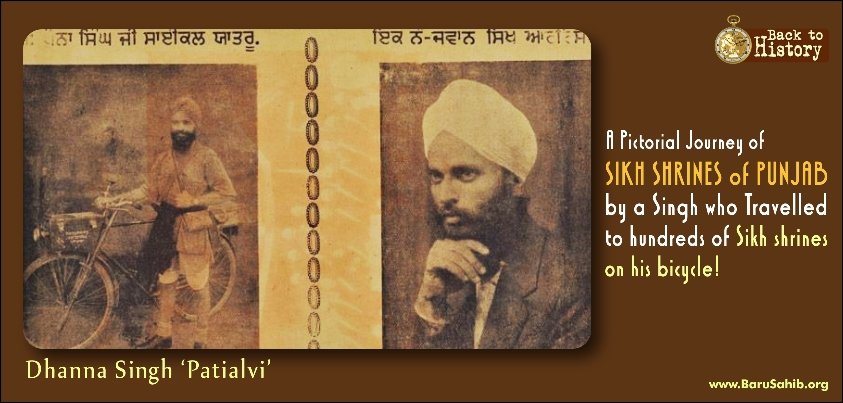
A Pictorial Journey of SIKH SHRINES of #PUNJAB by a Singh who travelled to hundreds of Sikh shrines on his bicycle! Some stories can only begin with “once upon a time” — like this little-known history of an indefatigable pilgrim, Dhanna Singh ‘Patialvi’, who travelled to every Sikh shrine in an undivided India on his […]

A Pictorial Journey of SIKH SHRINES of #PUNJAB by a Singh who travelled to hundreds of Sikh shrines on his bicycle!

Some stories can only begin with “once upon a time” — like this little-known history of an indefatigable pilgrim, Dhanna Singh ‘Patialvi’, who travelled to every Sikh shrine in an undivided India on his humble bicycle in the 1920s and 1930s, clicking pictures and chronicling his travels.

SIKH SHRINES of PUNJAB (1)

When his lost legacy — eight diaries and more than 200 pictures — came up for preservation at the Punjab Digital Library (PDL) in Chandigarh, Singh returned to life, 85 years later, to tell the story of the Sikh shrines as they stood in that bygone era. While many of these Gurdwaras are big centres of the Sikh faith today, some have lingered on the margins and a few remain unknown. What we know about Singh is from his diaries and a brief mention in the Sikh Encyclopaedia.

Born as Lal Singh Chahal in the early 1890s at Ghannauri village of Sangrur district, he grew up in an orphanage with his brother and later served the royal family of Patiala, taking care of the cars of Maharaja Bhupinder Singh. “The royal family records would have some details on him,” said PDL head Davinder Pal Singh.

A Pictorial Journey of SIKH SHRINES of #PUNJAB by a Singh!

Baptised as Dhanna Singh at Nanded in his thirties, he quit royal service to feed his hunger for travel. A devout Sikh, he bicycled to every gurdwara in India, starting in the 1920s with a trip to Uttar Pradesh, Bihar, Bengal and Assam. Newspapers published the accounts of what he saw.

From Wazirabad, he came to Gujarat on the April 6, 1932. His first photograph is of Takht Damdama Sahib (dedicated to the sixth Guru), where he stopped on his way from Kashmir; the second of a Gurdwara in the northeast of Gujarat linked to Guru Hargobind Sahib ji; and the third of Shaheedi Gurdwara Fatehsar, north of Gujarat, where Singh reports that “the Sikhs saved 17,000 Hindus from the cruel Muslim forces” — the entry translated by Mannat, a volunteer at PDL.

A Pictorial Journey of SIKH SHRINES of #PUNJAB by a Singh!

“Dhanna Singh wished the world to see these places too. So he bought a camera, an expensive proposition in those times, and learnt photography before starting his next journey — across undivided Punjab, Jammu and Kashmir and what is now Pakistan,” said digital libray head Davinder Pal. Visiting various Sikh shrines and historical places, the pilgrim took several hundred photos, which he captioned, dated and signed meticulously, as his gift to posterity.

He called himself “cycle yatru” and he appeared in pictures with his ride twice in the 1935 edition of ‘Phulwari’, a popular magazine of that time, which recounts one of his trips to the hills. The same year, it reported that Singh, who had logged 25,000 miles on his bicycle by then, had been killed by a freak gunshot.

A Pictorial Journey of SIKH SHRINES of #PUNJAB by a Singh!

The Sikh Encyclopaedia reports that while travelling to the North Western Frontier Province (NWFP), he halted at Hasokhel village near Mir Ali in Bannu district, now in Pakistan. “It was a common practice for the people in that disturbed area to keep loaded weapons by their side at night. Next morning, as the host was unloading his gun, it went off, killing Dhanna Singh on the spot.

A Pictorial Journey of SIKH SHRINES of #PUNJAB by a Singh!

His earlier travel notes were safe in the custody of one Seva Singh, son of the late mistri Gurbaksh Singh of Patiala, but his photographs were lost, until a family, which wishes to remain anonymous, brought these to the languages department in Patiala. The family said he had left the works with a friend for safekeeping before setting out on the final picture pilgrimage.

~ Source: DailySikhUpdates

Passion Driven Amardeep Singh brings BACK the LOST Sikh Heritage in Pakistan!

A good part of the Sikh history lies in what is today the modern Pakistan. Kartapur is an example. Guru Nanak, the first Sikhs Guru, had spent some 18 years here. It lies only a few miles from the Dera Baba Nanak, the town now in the modern-day Punjab on the Indian side. But not […]

A good part of the Sikh history lies in what is today the modern Pakistan. Kartapur is an example. Guru Nanak, the first Sikhs Guru, had spent some 18 years here. It lies only a few miles from the Dera Baba Nanak, the town now in the modern-day Punjab on the Indian side.

But not many have been able to visit the sites connected to the early days of the Sikh faith. Travel to Pakistan is still restricted, especially for those holding Indian passports.

A soon-to-be-launched book, Lost Heritage – The Sikh Legacy in Pakistan, aims to plug the gap.

Come December 2015, Amardeep Singh, a Singapore-based author and photographer, plans to roll out the book. It contains over 50,000 words, interspersed with 523 photographs, to present the diverse remnants of the community across the country.

“Seven decades after the searing partition of 1947, the Sikh community remains deprived of its glorious heritage, wrenched from it and now virtually inaccessible to most,” he tells Asia Samachar in an email interview.

When asked how did the idea come about to write the book, Amardeep said that he did not embark on writing a book. “Mine was just a travel to the remote areas of Pakistan to satisfy my curiosity.

But the journey to give life to the book had been full of challenges.

A 500 page book, with over 50,000 words, interspersed with 523 photographs and 14 maps, is a humongous task to be completed in one years’ time. While this specific aspect was challenging enough but it was under my direct control, so manageable.

“The biggest hurdle emerged to be to get the book published and I hadn’t comprehended this would be such a challenge. Publishers viewed this as commercially unviable and hence no one was forthcoming to undertake it,” he said.

For him, the project was a life time’s labour of love, which he was unwilling to compromise. At times it felt that the project would not see the light at the end of the tunnel but he maintained my focus, strongly believing that if there is value in this work then it will find its way.

~ Source: asiasamachar.com

How a French Man abandoned his Nationality to become an Amritdhari Sikh!

Darshan Singh Rudel, 57, a French national, earlier known as Michael Rudel, had converted to the Sikh faith and married a Sikh woman. Now settled at Nurpur Bedi in Ropar district, Rudel is doing organic farming for the past 17 years. This french man renounced his citizenship for embracing the Sikh faith. Rudel had requested […]

Darshan Singh Rudel, 57, a French national, earlier known as Michael Rudel, had converted to the Sikh faith and married a Sikh woman. Now settled at Nurpur Bedi in Ropar district, Rudel is doing organic farming for the past 17 years. This french man renounced his citizenship for embracing the Sikh faith.

Rudel had requested a French court in 1995 for changing his name from Michael Rudel to Darshan Singh Rudel, which was declined. Thereafter, he renounced French citizenship and became a UK national, which had issued him a passport in his new name — Darshan Singh Rudel.

In 1997, he became an amritdhari (baptized) Sikh at Anandpur Sahib – the place of birth of Khalsa — and married Malvinder Kaur, who teaches English at a college in Nangal. The couple is living at Nurpur Bedi since then. He strictly follows the tenets of Sikhi and has even written outside his house that “drunkards are not allowed to enter.”

Darshan Singh, a dedicated Sikh missionary with profound knowledge of “gurbani” and “gurmat”, said that Sikhs were known for their honesty, integrity, hard work and bravery. But today the virtues are evaporating in the present environment of Punjab .

Harvesting wheat at his fields, Rudel states, “Politicians in Punjab are confined to making money and fighting each other. They don’t focus on larger social issues of the state and have almost forgotten the concept of ‘sarbat da bhala’ (welfare of all).

Today, Punjabis have stopped working in farms, become drug addicts and distanced themselves from hard work and have become money-centric.”

“Youth from Punjab, once considered a nursery for defence forces since British era, have stopped joining the Army,” he stated.

Rudel uses only organic methods at his farm.

~ Source: DailySikhUpdate

Despite being 1% of the population in UK, the Heroic Sikh Soldiers made BIG HEADLINES!

When Britain remembers those fallen in service of their country in November, this year’s ceremony will be particularly poignant, writes Telford & Wrekin Council leader Kuldip Sahota. Seventy years since the end of the Second World War, and a century after some of the bloodiest battles in the First World War, the nation will unite […]

When Britain remembers those fallen in service of their country in November, this year’s ceremony will be particularly poignant, writes Telford & Wrekin Council leader Kuldip Sahota.

Seventy years since the end of the Second World War, and a century after some of the bloodiest battles in the First World War, the nation will unite to remember the millions who gave their lives in service of Britain.

It is important also that we should also remember the contribution by the British Indian Army, and the Sikhs in particular, in both conflicts.

Although Sikhs are only two percent of the Indian population today and may have been even less at the turn of the 20th century, they formed well over 20 per cent of the British Indian Army.

Even today, Sikhs number only 20 million in Indian in a population of some 1.2 billion, yet they represent well over 12 per cent of India’s armed forces.

During the First World War, one in seven Sikhs of fighting age volunteered to serve in the British army and were, along with Gurkhas, regarded as a warrior or martial race by the British.
They served in all the major theatres of war: The Somme, Flanders, Ypres, East Africa, Palestine, Gallipoli, Middle East, Mesopotamia and so on.

After the bloody battle of Neuve Chapelle in 1915, the Sikh regiments had lost 80 per cent of their men and three regiments stood at only 16 per cent of their original composition. In Gallipoli, 14th Sikh regiment lost 371 officers and men in mere minutes.

The Sikhs did not wear hard helmets as were the standard issue for Army regiments. Instead they chose to remain true to their faith and wore their turbans with pride, just as I and thousands of my fellow Sikhs do today in all spheres of life.

In the trenches and deserts, the Sikh battle-cry, ‘Bole So Nihal, Sat Sri Akal’ (Victory belongs to those who recite the name of God with a true heart) was heard on all battlefronts.

As well as their standard issue British rifle, they all retained and used their traditional weapons such as swords and daggers for close combat fighting. Known for their martial prowess and never-say-die attitude, Sikhs would win gallantry awards across the Empire.

Close to 1.5 million Indians served in what was the largest volunteer army ever assembled.

Every sixth British soldier serving was from the Indian sub-continent, making the BIA as large as all the forces from the rest of the British Empire combined – including Australia, Canada, New Zealand and South Africa.

My grandfather Baba Labh Singh was in the British Army and I have tried to find out more about his service record, but this is difficult.

When he died in the 1960s, I was boy of 11 or 12 and we all lived in the same house. He used to hallucinate that he was experiencing gas attacks and he would gather up his bed sheets at night and run round the house shouting, ‘run away, run away, gas is coming’.

A few months later he died from natural causes. His Army record shows he served in Mesopotamia, now Iraq, but he must have also served early in the war on the Western Front where he must have experienced the horror of gas attacks.

So when the Second World War broke out, Sikh soldiers were once again at the forefront and made up a disproportionate number of the forces that India gave to the war effort. Sikh men helped to swell the BIA from 189,000 at the start of the war to more than 2.5 million by the end of the war.

They served in Middle East, Burma, Greece, the North African desert and Italy. They fought and stopped the Japanese advance through Burma and into India. Not only were they in the Army, they also served in the Navy and Royal Air Force – remember Mr Singh from the 1960s film Squadron 633.

My uncle served in Burma and won a medal for his bravery in Rangoon and he lived to tell us his tales. Growing up in India in the late 1950s and early 1960s, almost every Sikh family in our village would talk about their loss in the Second World War and how they were affected by it.

When after the war British industry needed unskilled labour, Sikhs who had served in the British Army were given priority visas to come to Britain. This explains why Sikhs make up a disproportionally high number of people originally from India now living in the UK.

Most worked in the West Midlands foundries where the work was hard, heavy and dirty and from which they did not shy away.

That generation has now retired or have passed away and their children and grandchildren now live in times of greater tolerance, pride and status than their forefathers.

As I sit here and write this article I feel that in a small way I am giving a voice to all those Sikhs who gave their loyalty and life voluntarily to the British Empire – and now the British have accepted their children and grandchildren as their equal.

~ Source: shropshirestar.com