Series of Paintings “Raagas & I” inspired by the Raagas of the Sri Guru Granth Sahb Ji by Dr Navjeet Kaur!

This is a springtime Raag to be recited in the morning hours. This Raag is associated with the yogis…. Sidh Gosht is composed in this Raag by Guru Nanak. Guru Nanak Dev ji says Ang 840 He alone is a yogi who realizes the word of the guru’s shabad Ang 878 He alone is a […]

This is a springtime Raag to be recited in the morning hours.
This Raag is associated with the yogis….
Sidh Gosht is composed in this Raag by Guru Nanak.

Guru Nanak Dev ji says

Ang 840 He alone is a yogi who realizes the word of the guru’s shabad
Ang 878 He alone is a Sidha (a seeker) who meditates on the one perfect Lord.

So this is a scene of a sunrise in the mountains with the snow clad peaks in the distance.
In the foreground the Yogis have gathered together as if to receive the Gur Gyan.
There is no physical appearance of Guru Nanak in the painting.
The rays of the rising sun are the “Gur Gyan” that is Guru Nanak.
Metaphorically the Sun represents Guru Nanak.

~ Dr. Navjeet Kaur

Series of Paintings “Raagas & I” inspired by the Raagas of the Sri Guru Granth Sahb Ji by Dr Navjeet Kaur!

The ideal season to recite the raag is in the winter time. Guru Arjan Dev ji says, Ang 868 ….Meeting with the true Guru and singing the Lord’s praises I have found an incomprehensible treasure. So for this painting the inspiration is from nature once again. The seashell holds its precious pearl within it. Realizing […]

The ideal season to recite the raag is in the winter time.

Guru Arjan Dev ji says,
Ang 868 ….Meeting with the true Guru and singing the Lord’s praises I have found an incomprehensible treasure.

So for this painting the inspiration is from nature once again.
The seashell holds its precious pearl within it.
Realizing that each of us has a precious and divine treasure within.
This realization IS the true blessing.

~ Dr. Navjeet Kaur

Sikhs Explain the Symbolism & Sacredness of Turban to the US Lawmakers!

Sikhs have to explain to American people what the turban means because that is the immediate source of their identification, according to the author of a new report on Sikhs in America presented to US lawmakers. “Sikhs have to explain what it symbolizes and what values it represents,” said Geoff Garin, former political strategist for […]

Sikhs have to explain to American people what the turban means because that is the immediate source of their identification, according to the author of a new report on Sikhs in America presented to US lawmakers.

“Sikhs have to explain what it symbolizes and what values it represents,” said Geoff Garin, former political strategist for presidential candidate Hillary Clinton presenting the key findings of the report at a briefing arranged by the National Sikh Campaign (NSC).

“This will have a very powerful impact on the broader American public,” he said. “The study shows that when people see Sikhs on the streets anywhere, people are very confused about what Sikh faith is and that confusion leads to tragic consequences,” said Gari

“They also feel that they will not have very much in common with Sikhs.”

Garin, whose current clients include the World Bank, Bill and Melinda Gates Foundation and the Harvard University, heads the Hart Research Associates, one of the leading survey firms in the US.

The firm conducted a six-month long nationwide polling and focus group study to understand how Sikhs are perceived in America and what strategies would be helpful to change perceptions.

The report lists specific messaging techniques which Sikhs could use in their media strategies resonating with American public. Garin said the survey showed that 6 out 10 Americans acknowledge that they know nothing at all about Sikhs and Sikhism.”

“Better educated Americans are likely to come in contact with Sikhs,” he said. “Younger Americans are likely to have some information about Sikhs.”Judy Chu, founder and vice chair of the Congressional American Sikh Caucus, called it “a very significant report about the American perceptions of the Sikh community.”

John Garamendi, co-chair of the Sikh Caucus, said, “It’s extremely important that the people of the United States and beyond learn and understand the multiple cultures that we have in the United States.”

Dr. Rajwant Singh, senior advisor to NSC, said the NSC plans to start a media ad campaign based specifically on this study and the various intricate details input collected from common Americans.

~ Source: ibnlive.in.com

Young aces of Akal Academy, Dhotian secured First Position in Gurmat Competition!

Students of Akal Academy, Dhotian receive honor for their Gurmat performances. Gurmat competition was conducted in Goindwal Sahib. Students stood first in Gurbani Kanth competition as well as in speech presentations. It’s great to see these little young aces perform so well in front of the Sangat. It gives us a sense of satisfaction that […]

Students of Akal Academy, Dhotian receive honor for their Gurmat performances. Gurmat competition was conducted in Goindwal Sahib. Students stood first in Gurbani Kanth competition as well as in speech presentations.

It’s great to see these little young aces perform so well in front of the Sangat. It gives us a sense of satisfaction that our students are equally growing both academically & spiritually, which is the main objective of our organization & all Academies.

The young children are given a thorough knowledge of all walks of life. These Students will be shaped as preachers of Guru Khalsa Panth’s thoughts and well equipped with modern techniques.

~ Tapaseen Kaur
~ New Delhi, 8th May ’15

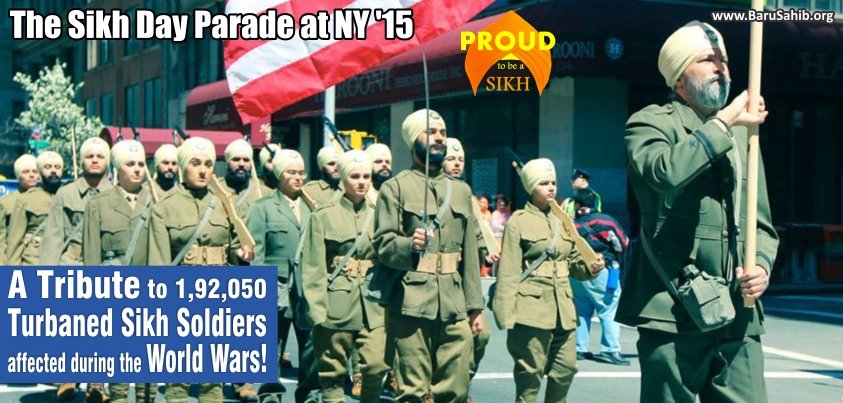
This photograph is from The Sikh Day Parade in New York City 2015 by Paramjeet Singh.

“Finally, we that live on can never forget those comrades who in giving their lives gave so much that is good to the story of the Sikh Regiment. No living glory can transcend that of their supreme sacrifice, may they rest in peace. In the last two world wars 83,005 turban wearing Sikh soldiers were […]

“Finally, we that live on can never forget those comrades who in giving their lives gave so much that is good to the story of the Sikh Regiment. No living glory can transcend that of their supreme sacrifice, may they rest in peace. In the last two world wars 83,005 turban wearing Sikh soldiers were killed and 109,045 were wounded. They all died or were wounded for the freedom of Britain and the world and during shell fire, with no other protection but the turban, the symbol of their faith.” – General Sir Frank Messervy KCSI, KBE, CB, DSO

We all thank you Major Kamal S. Kalsi for preparing these young men and women to represent Sikhs from both Wars.

~ Source: facebook.com/PortraitsofSikhs

Sikhs in Singapore take Charge of Nepal Relief Operations by raising S$20,000!

The Sikh community in Singapore has raised S$20,000 so far for the relief efforts in quake-hit Nepal, the Coordinating Council of Sikh Institutions (CCSI) said in a media release on Wednesday (May 6). “The contribution collected by various gurdwaras (places of worship) comes with even more poignancy in light of reports citing damage and destruction […]

The Sikh community in Singapore has raised S$20,000 so far for the relief efforts in quake-hit Nepal, the Coordinating Council of Sikh Institutions (CCSI) said in a media release on Wednesday (May 6).

“The contribution collected by various gurdwaras (places of worship) comes with even more poignancy in light of reports citing damage and destruction of numerous cultural heritage sites, many which are centuries old, in the Kathmandu Valley,” CCSI said. It noted that priests, whose temple complexes had crumbled in the earthquake, are among those left homeless.

The funds collected have been passed on to Mercy Relief, which has already deployed medical and response teams to Nepal.

However, CCSI said more donations are welcome. “The Sikh community is prepared to donate more and indeed, the donation drive is continuing, so we will go on providing help to the best of our abilities, and share what we have with the victims of this catastrophic disaster,” said CCSI chairman Gurcharan Singh Kesail.

– Source: CNA/hs

Students of Akal Academies recited 50,000 Japuji Sahib paths!

Dedicated to 425th incarnation day of Shri Guru Arjun Dev Ji Maharaj “Gurbani Jaap” samagam was organized at Gurdwara Shri Dukh Nivaran Sahib by Nanaksar Patiala on 2nd may 2015. In this samagam students from various schools, teachers, Sant Mahapurush and many famous personalities of the Sikh panth were present. On the occasion of birth […]

Dedicated to 425th incarnation day of Shri Guru Arjun Dev Ji Maharaj “Gurbani Jaap” samagam was organized at Gurdwara Shri Dukh Nivaran Sahib by Nanaksar Patiala on 2nd may 2015.

In this samagam students from various schools, teachers, Sant Mahapurush and many famous personalities of the Sikh panth were present. On the occasion of birth anniversary of Shri Guru Arjun Dev Ji Maharaj thousands of students from different Akal Academies participated.

In this samagam 5000 students and teachers from Akal Academies including Balbehra, Reeth Kheri, Fatehgarh Channa, Cheema Sahib, Bhai Desa, Dhudial, Benra, Seona, Dhindsa, Mander, Fatehgarh Ganduan, Rajia, Bhadaur, Bhunsla, Ubhia, Madhopur, Ratola, Ranno, Manal, Uddat Saidewal, Moonak, Chak Bhai ke, Dharamgarh Channa and Phaphre Bhai Ke collectively recited paths of ‘Shri Japji Sahib’ and seeked blessings from Shri Guru Arjun Dev Ji.

During samagam, Baba Harcharan Singh Nanaksar honored the sewadars of Baru Sahib on behalf of Baba Iqbal Singh Baru Sahib wale.

All the participants of this Japp-Tapp samagam were rewarded with the certificate.

~ Harsimrat Kaur
~ Cheema Sahib, 7th May ’15

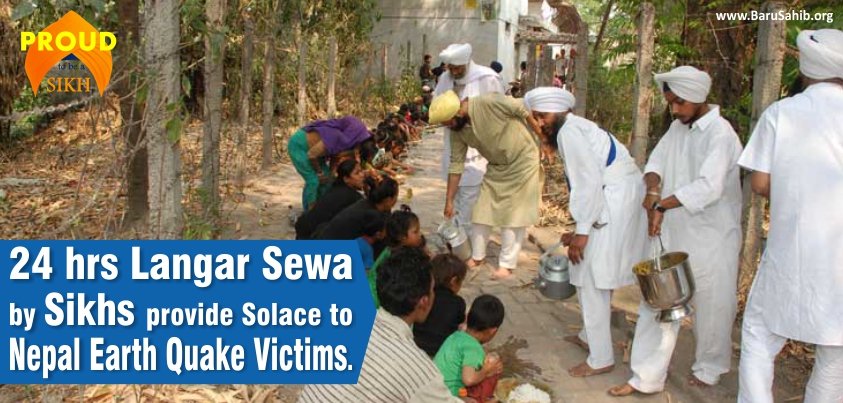
24 hrs Langar Sewa & First-Aid provisions by Sikhs provide Solace to Nepal Earth Quake Victims

A 7.8 magnitude earthquake struck Nepal near the capital of Kathmandu. The government said the death toll has reached 7,040 people, including at least 54 foreigners and that more than 14,000 people were injured with numbers expected to rise as more victims are found by rescue teams. Eight million affected across Nepal. One million children […]

A 7.8 magnitude earthquake struck Nepal near the capital of Kathmandu. The government said the death toll has reached 7,040 people, including at least 54 foreigners and that more than 14,000 people were injured with numbers expected to rise as more victims are found by rescue teams. Eight million affected across Nepal.

One million children are urgently in need of help. Some 70,000 houses were destroyed and another 530,000 homes damaged across the quake-affected districts. These are the startling numbers that indicate the scale of the devastation from the huge earthquake that struck the Himalayan nation on Saturday, April 25th, 2015.

The startling new numbers came hours after a U.N. official said that customs inspections at Kathmandu airport are holding up vital relief supplies for survivors in Nepal. Immediate needs for survivors include Food, Water, Medical aid, Clothes and Shelter.

With immediate effect Shri Guru Nanak Dev Sewa Society International have started 24 hrs Langar sewa (Free Food & water) and working on providing first aid. Our staff members are reaching out to the people who can’t come to our Relief Camps. We are taking food, water and first aid to hospitals, people living in Tents in different parts of Kathmandu and other remote areas where no one else have reached so far.

Dhan Sikhi! Dhan Guru Ka Langar!

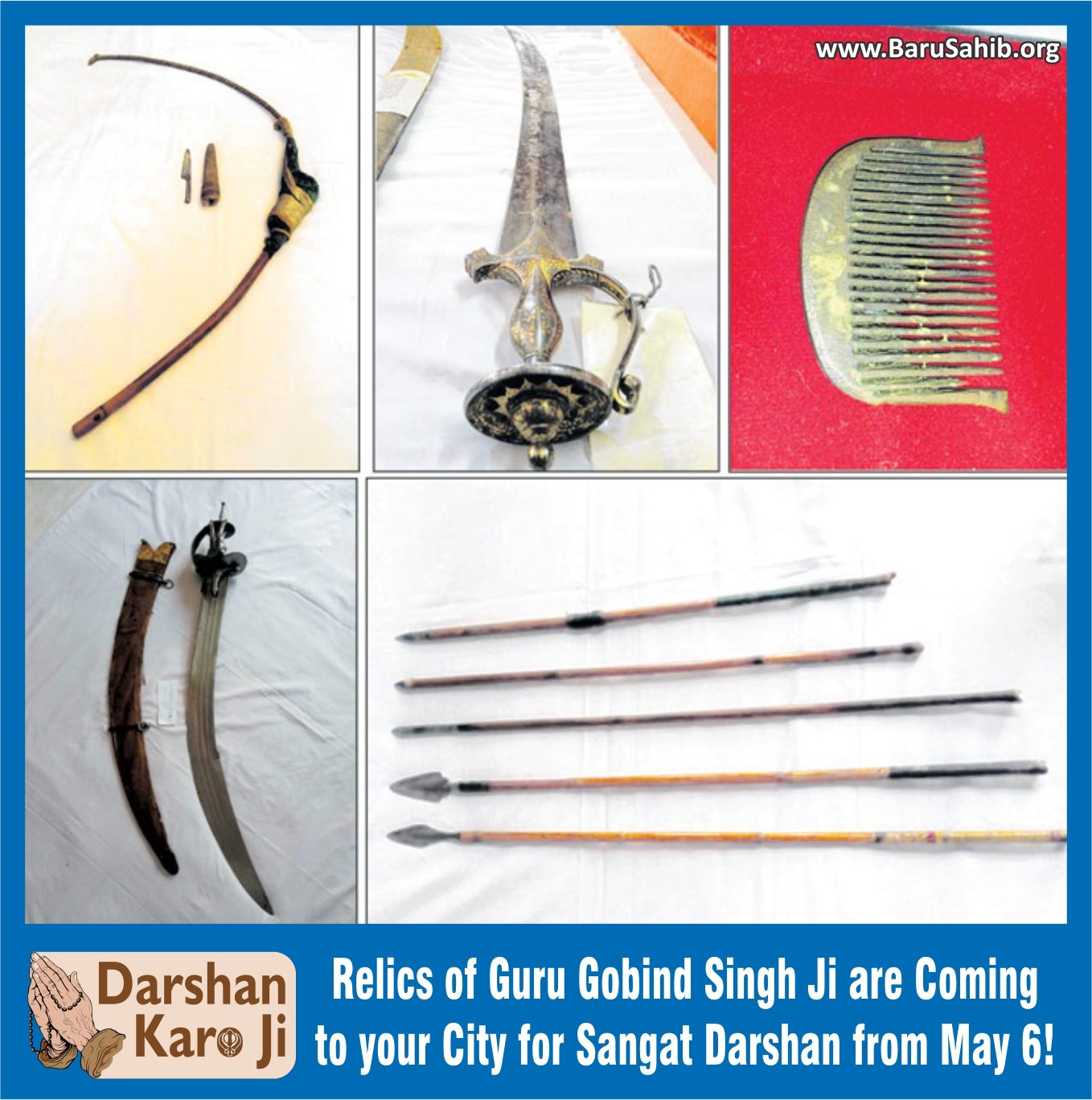
Relics of Guru Gobind Singh Ji are Coming to your City for Sangat Darshan from May 6!

Relics of Guru Gobind Singh Ji will be made available from May 6 for Sikh devotees to view. These relics were with descendants of Patiala and Nabha Riasat until now. These relics were brought from Qila Mubarak to Gurdwara Sri Dukh Niawaran Sahib with full discipline and under surveillance of experts. The relics will be […]

Relics of Guru Gobind Singh Ji will be made available from May 6 for Sikh devotees to view. These relics were with descendants of Patiala and Nabha Riasat until now. These relics were brought from Qila Mubarak to Gurdwara Sri Dukh Niawaran Sahib with full discipline and under surveillance of experts. The relics will be brought to every part of Punjab in the form of a Nagar Kirtan.

A 33-feet long bus carrying the revered relics of three Gurus of Sikhism, will be flagged off tomorrow from Gurudwara Dukhniwaran Sahib in Patiala. The relics related to Guru Sahiban, their clothes and weapons would be displayed in a bus.
The relics also include Chola Sahib, manuscript, hair, comb and turban; 20 inches long iron arrow; three-and-a-half inch long Siri Sahib; 30 inches long wooden spear and five arrows.

High priests of all the five Takhts, Punjab Chief Minister Parkash Singh Badal and deputy CM Sukhbir Singh Badal will flag off the yatra drenched in colors of Khalsa, the spokesman said. The yatra will culminate on May 20 at Anandpur Sahib where the relics would be put at Takht Kesgarh Sahib.

DATE DETAILS OF ROUTE

May 6, 2015 Patiala, Nabha, Bhawanigarh, Sangrur and Barnala
May 7, 2015 Barnala, Mansa, Maur and Talwandi Sabo
May 8, 2015 Talwandi Sabo, Bathinda, Malout and Sri Muktsar Sahib
May 9, 2015 Sri Muktsar Sahib, Kotakpura, Faridkot, Ferozepur and Wazidpur
May 10, 2015 Wazidpur, Moga, Kot Isse Khan, Zira, Makhu and Harike
May 11, 2015 Harike, Patti, Bhikhiwind, Jhabaal and Tarn Taran
May 12, 2015 Tarn Taran, Jandiala, Baba Bakala, Chowk Mehta and Amritsar
May 13, 2015 Stay at Amritsar
May 14, 2015 Amritsar, Batala, Sri Hargobindpur, Kahnuwan and Chota Ghalughara
May 15, 2015 Chota Ghalughara, Gurdaspur, Mukerian, Dasuya and Hoshiarpur
May 16, 2015 Hoshiarpur, Tanda, Bhogpur, Kartarpur, Kapurthala, Sultanpur Lodhi (via Talwandi Choudharian)
May 17, 2015 Sultanpur Lodhi, Malsian, Nakodar, Jalandhar and Phagwara
May 18, 2015 Phagwara, Ludhiana and Fatehgarh Sahib
May 19, 2015 Fatehgarh Sahib, Mohali, Kharar, Morinda, Chamkaur Sahib and Ropar
May 20, 2015 Ropar, Sri Anandpur Sahib (Takht Sri Kesgarh Sahib)

~ Source: Sikh24.com

Sikh Sermon Valarie Kaur highlights the essence of ‘Seva’ – selfless service in the Sikh at Pentagon!

The following are the prepared remarks of Valarie Kaur at the Pentagon’s second-ever commemoration of the Sikh faith on May 1, 2015. Kaur spoke alongside Simran Jeet Singh and Inni Kaur on “Seva” – selfless service in the Sikh religion. Hosted by the Pentagon Chaplain on Vaisakhi, the program was organized by Major Kamal Singh […]

The following are the prepared remarks of Valarie Kaur at the Pentagon’s second-ever commemoration of the Sikh faith on May 1, 2015. Kaur spoke alongside Simran Jeet Singh and Inni Kaur on “Seva” – selfless service in the Sikh religion. Hosted by the Pentagon Chaplain on Vaisakhi, the program was organized by Major Kamal Singh Kalsi and the Sikh Coalition, an organization leading the campaign for turbaned Sikhs and other people of faith to be allowed to serve in the U.S. military. Kaur’s remarks at the first-ever Sikh event at the Pentagon in 2014 can be found here.

Waheguru Ji Ka Khalsa, Waheguru Ji Ki Fateh.

Thank you to the Pentagon Chaplain for gathering us here for the Sikh celebration of Vaisakhi. I am honored to reflect with you on the Sikh tradition of service – seva – and what it means for us, here and now.

In this moment, we know that children are lying beneath the rubble of the earthquake in Nepal without chance of rescue. Families are mourning as the smoke clears from another ISIS car bombing. The Supreme Court is debating recognition of the human heart to love anyone without reference to gender or sexual preference. And just forty minutes away from Washington, a city is burning in the wake of another killing of a young, unarmed black man in what our President has called – from Ferguson to Staten Island to Baltimore – “a slow-rolling crisis.”

We may be tempted to turn away from these crises of our time. But the Sikh faith calls us to face the fires of life, no matter how they rage – and respond. Service is the core of Sikh practice, but it’s not the kind of service we think we know. Seva is not safe. Seva is not easy. Seva means selfless service. To pursue a life of seva is to walk boldly into the hot winds of the world with a saint’s eyes and a warrior’s heart – and draw from a deep well of love to pour our body, breath, and blood into others.

This kind of selfless service requires the courage of Mai Bhago, the 17th century Sikh woman warrior who told forty soldiers who abandoned their post during a great battle: “You will not hide from the fire. You will return to the fight – and I will lead you.” Donning a turban and mounting a horse with a sword in her hand, she led them when no one else would. Because seva means becoming the one you are waiting for.

I believe that seva is the call of our time. Let me show you why.

Five centuries ago in South Asia, Guru Nanak, our first teacher, found himself in a similar time of crisis – a time of violence between Hindus and Muslims, denigration of women, and cruelty towards the poor. One day, the story goes, Nanak disappeared by the river for three days; people thought him a dead man, a drowned man, but he had experienced a divine revelation and emerged with a single profound utterance on his lips: Ik Onkar, God is One; we are One.

Guru Nanak was birthed anew. He began singing a song of Oneness – music and poetry meant to lift us into sacred experience. When we pray like that, our ego – haumai, the voice inside us that separates self from selflessness – starts to quiet. And something marvelous happens: we fall in love.

“I see no stranger,” Guru Nanak said. “I see no enemy.” When we are in love, we begin to see with new eyes: we look upon the faces of people who are different from us and say: Brother. Sister. I cannot live if you are dying. I cannot stand by if you are suffering. That kind of love is revolutionary. When we serve the child, the parent, the family, the community, the country, we do so not out of obligation but because we love them; and in turn, that kind of love saves us.

Only through seva do you attain God, Guru Nanak taught us. That means: we pray to remember God (simran) but we serve to realize God (seva). That’s why the way we serve matters, not with stress or despair, but with joy and boundless optimism called Chardi Kala. In fact, every Sikh gurdwara (house of worship) contains a prayer hall and a langar hall, a place where we cook and serve free meals, so that we can practice serving selflessly.

But remember, seva is not safe. “If you want to play the game of love with me,” says Guru Nanak, “then step onto my Path with your head on your hand.”

Our first teacher called us to play the game of love. Two hundred years later, our tenth teacher showed us how. In 1699, Guru Gobind Singh called Sikhs to a clearing in a place in Northern India called Anandpur Sahib. It was another time of crisis. The Sikh community was struggling to survive onslaught at the hands of Mughal rulers. Our numbers were dwindling, and the future was dark.

There stood the Guru – a warrior dressed in a tall turban, sword in hand, often seen with a falcon on his shoulder. He rose before the thousands with fire in his eyes, and called out: “Who among you is ready to give your head for the love of God and one another?” The crowd was silent. The wind rustled, and the people did not move – until one brave soul, Daya, stepped forward.

The Guru took Daya inside a tent and a few moments later, emerged with his sword dripping with blood, and called: “Now, who else is ready to give their head for love?” Not a word was spoken. The wind rustled, and the people did not move. Until courage stirred within another, Dharam, and he stepped forward and entered the tent. The Guru emerged once again with the same call, again and again, until five had offered their lives. The Guru appeared once more, but this time, he opened the tent for all to see – and there they stood. They were all alive and well, but they were changed.

“These are my Panj Pyare,” said the Guru. “My five beloved ones. These are the ones who were willing to offer their body, breath, and blood for the sake of love. The death of their egos has birthed them anew. The Guru gave them new names and anointed them, and was anointed by them in return.

On that day, we as a community were also birthed anew. We too shed our old separate names and were given new names – Singh and Kaur, lion and lioness – to honor our equality and courage. We received the gift of five articles of faith, including long uncut hair, which men and some women wrap in a turban, so that we may never hide from the call to serve again.

That is the story of Vaisakhi. That’s why we are here today – to celebrate our birth as the Khalsa, a spiritual sister and brotherhood, a collective body of beloved ones.

Now, I have a confession. As a little girl, this story always made me tremble. After all, isn’t it madness to give up your life like that? But today, I see the story’s meaning with new eyes. Seva springs from a love so deep we would give our lives for it.

When I gave birth to a baby boy a few months ago, and held my son for the first time, I knew that I would give my life for him. I looked at my own mother and saw all the ways she had poured her body, breath, and blood into me. What greater bravery, what deeper love? If the story of Vaisakhi calls us to serve selflessly, then perhaps motherhood is our most ancient and profound model. So today, as we celebrate Vaisakhi, let us honor all of those who teach us the truth of seva, the same way mothers and fathers show devotion to the lives of their children and their children after them.

Let us honor our elders who teach us how to hold fast to our faith in the fire – like my grandfather Captain Gurdial Singh who followed seven generations before him and served in the military, fighting on the frontlines in World War II against Hitler’s armies. When his British commander told him to remove his turban, he refused, saying, “My turban represents my faith, and I cannot serve without faith.” So he went to war and when German aircraft swooped down and shot his best friend, he did not run. He wrapped his friend’s wounds with the cloth of his turban and brought him home. Because seva means leaving no one behind.

Let us honor the faith and fearlessness of all our uniformed soldiers, including the Sikh Americans in this room: Corporal Simran Preet Singh Lamba, Captain Tejdeep Singh Rattan, Colonel Tina Kaur Sodhi, Staff Sargent Bree Kaur, Petty Officer Geena Kaur Sidhu, Senior Airman Jasreen Kaur, Private Sukhreet Kaur, and Lieutenant Jaspreet Kaur Saini.

Let us honor Major Kamal Singh Kalsi, a decorated hero who when treating the wounded in Afghanistan, was moved to tears when one young bleeding soldier looked at him and said, “Thank you, brother.” Because seva inspires love in others.

Finally, let us honor all the brothers and sisters in this room who are fighting for justice with modern-day swords – the lawsuit, the camera, the megaphone – not to vanquish others but to reconstitute the cultures and institutions that separate us.

~ Source: huffingtonpost.com