Inspirational Story of Transformation of Bhai Manvir Singh, UK

This is Bhai Manvir Singh UK ‘s story of keeping Kesh (unshorn hair) and coming back to sikhi. He used to be a mona (cut my hair), who became keshdhari (stopped cutting my hair) and kept Guru’s Rehat (Sikh discipline). The story dates from May/April – August 2000. He has recorded and added his experiences […]

This is Bhai Manvir Singh UK ‘s story of keeping Kesh (unshorn hair) and coming back to sikhi. He used to be a mona (cut my hair), who became keshdhari (stopped cutting my hair) and kept Guru’s Rehat (Sikh discipline). The story dates from May/April – August 2000. He has recorded and added his experiences from prior this time as well and how he have struggled to keep Kesh. He believes that his story isn’t anything exceptional, however he thought it might help to inspire those who might be in similar situation as he was in before.

_________________________________

Waheguru Ji Ka Khalsa,
Waheguru Ji Ki Fateh!!

I have recently kept my Kesh. Thanks to my parents, I feel I have been brought up with Sikh values and beliefs. I am able to do Keertan and read Gurbaani and have an interest in Sikh philosophy and history. I am not saying that I am a saint or anything, but as I grew older I realised the value of my actions and the distinction between gurmat and manmat acts. So my ‘Manmat’ actions were becoming aware to me.

However, I had always felt one thing missing in my life. Like a jigsaw puzzle with a couple of pieces missing. One of those pieces missing was my KESH! I had always wanted to have Kesh from when I was a child. As I grew up I learnt more and more things, and started realising more about Sikhi. I looked at other Keshdhari Sikhs and children and thought, ‘why am I not like them’, ‘why am I not a Sikh, but I call myself Sikh!’ I wished and wanted to look like them, with a ‘guttee’ (hair knot), ‘keshki’ and ‘dastaar’ (turban).

I enjoyed going to the Gurdwara and sitting in Saadh Sangat and listening to what the person on the stage was saying. Sometimes when I was really young, my dad used to tie a pagh on me when going to the Gurdwara. I liked wearing the ‘dastaar’. When I was about twelve to fourteen years old I used to tie a pagh by myself with a little help from my dad. I would tie a pagh when going to the Gurdwara on Gurpurbs. My Taya Ji (uncle) used to like me wearing a pagh to the Gurdwara. He used to always tell rishtedaar (relatives) about how good I am, and how I wear a pagh to the Gurdwara. He was happy and all excited when he used to tell people. However sometimes I used to feel awkward and annoyed. I felt a fool, as if I was tricking myself. Wearing pagh on Gurpurbs and then cutting my hair. So it felt a little embarrassing when my Taya Ji or someone else would say how good I am, how I can I sing shabads, do Keertan, read Paat and wear a pagh and look smart. I used to think that people must think what a fool I am. Doing all of this and thinking I am a Sikh, when I cut my hair. However, now I realise why my Taya Ji and others were happy, and I remain grateful to them for their support and guidance they gave me, which I realised later.

The town where I live is mostly full of gore and a strong minority of Pakistanis. There is only a small community of Sikhs, like 60 homes. However there are not any Keshdhari youngsters. In the whole town the only people I know who have Kesh are one or two old people and one or two very young children, but no teenagers or young adults have Kesh. I always dreamt and pictured myself in the future as being Keshdhari. I would say that one day I would have kesh. At night sometimes I would dream of being in full Sikhi Saroop. I never saw myself as a mona (cut haired), instead I used dream that as an adult I would have a pagh (turban) and an uncut beard, looking smart and proud.

I never liked having a hair cut! I remember as a child sometimes my dad would cut my hair with a trimming machine. Looking back now it reminds me of pictures and scenes when a Hindu child gets his head shaved by an elder family member in the Hindu initiation ceremony for babies. I wanted to keep Kesh but couldn’t. Like a hungry child who wants roti but can’t make it. I felt guilty and ashamed that as a Sikh, I was cutting my hair when great Sikhs like shaheed Bhai Taru Singh Ji refused to have his Kesh cut and instead he said that he would rather have his scalp removed. That is how much pyaar (love) Bhai Taru Singh Ji had for the Kesh, the identity, the image that the Guru had bestowed upon him.

I couldn’t bring myself around to saying that I am a Singh and that I am proud to be Sikh (even though I was proud). Instead I felt I was a disgrace to my religion because I had my hair cut and still had the nerve to call myself a Sikh. Even though I had religious views I wasn’t practising what I believed; so I felt awkward.

At school gore would ask me what my religion was. When I said I was ‘Sikh’ they would say, ‘yeah but why is your hair cut then, aren’t Sikhs supposed to have uncut hair and wear a turban’. WHAT ANSWER COULD I GIVE THEM! What that it is common for (BLIND FOOLISH) Sikhs to cut their hair? All I could say is that I am not religious, HOWEVER I was and was proud to be a Sikh! But again, I had put myself to shame. Shaheeds (martyrs) like the two young sahibzaade, sons of Guru Gobind Singh Ji, aged 5 and 7yrs old, were bricked alive for refusing to give up their Sikhi. When faced with the challenge of death or converting to another faith they chose death. They were confident and kept their faith, however difficult the times were, and they roared “BOLE SO NIHAL, SAT SIREE AKAAL” on being martyred. And there I was sitting in England, with an easy life, no one to asking me to convert or die; yet I was being forced to say that I am not Sikh when I really was.

-Source- SinghStation

This Singh’s Interfaith Spirit is INSPIRING! – KP Singh with Dalai Lama

He exudes love, kindness, grace and compassion without limit; exhibits moral authority; shares friendliness and invites an amazing response. The Dalai Lama envelopes us in his charming aura. For nearly 2 hours during his Public Talk on June 25th, with more than an hour devoted to audience questions and exchange, at the Indiana Farmers Coliseum, […]

He exudes love, kindness, grace and compassion without limit; exhibits moral authority; shares friendliness and invites an amazing response. The Dalai Lama envelopes us in his charming aura.

For nearly 2 hours during his Public Talk on June 25th, with more than an hour devoted to audience questions and exchange, at the Indiana Farmers Coliseum, part of the sprawling Indiana State Fair Grounds in Indianapolis, the Dalai Lama of Tibet kept his audience of 6,400 spellbound with his enlightened and all-embracing spirit; spiritually-engaging message and vision that to accomplish “Compassion as the Pillar of World Peace” all of us have a responsibility to end violence since man created it and a few in society among the 7 billion human beings indulge in mischief. The Dalai Lama emphasized: a terrorist is a terrorist – whether the terrorist is a Muslim, Buddhist, Christian, Hindu, or Jewish (Jew). For the most part, these faiths get along under the secular Constitution of India.

The Dalai Lama reminded the audience that the message of all faiths is love and compassion, harmony and peace, service and our shared humanity. The Dalai Lama saw education and action, not just prayer and hope to transform society, to uplift humanity, to assure justice and human dignity to bring about a change of heart and spirit toward peace and harmony.

The Dalai Lama said that science and scientist confirm this and asked that we must analyze our ideas and beliefs to give them practical shape and improve human condition, advance our individual and collective well-being. As always, he was thoughtful and personable; at moments light-hearted; he laughed mostly at his own expense; he was serious as an ancient teacher; disciplined in his own routine. The Dalai Lama saw himself not special, but as one of the 7 billion human beings that inhabit this earth that we share as a human family.

A PRAYERFUL PERSONAL REFLECTION

I thought this time and all the previous times as I listened to his illuminating words, witnessed his radiating persona and scholarship of Buddhist scripture, respect and knowledge of other world religions, I felt that I was in the presence of not just one of the most admired men of our times, but a messenger carrying a living light of all the ancient wisdom sent by a Higher Spirit, not just for the Tibetan Buddhists, but for all faiths, cultures, and communities. The Dalai Lama spoke of India being the birthplace of Buddhism, Jainism, Hinduism, and Sikhism, and home to followers of Islam, Christianity, Baha’i, 100,000 Parsis (Zoroastrian faith) and others. He mentioned Guru Nanak, the Founder of the Sikh faith travelling to Mecca. The Dalai Lama saw a transcendent message reverberating in all scriptures and diverse religious traditions.

The Dalai Lama asked us to work through our differences and make a difference to life, liberty, freedom, and dignity of our brothers and sisters in faith; to end the culture of violence, human suffering, hunger, and violations of human rights in all nations. We should safeguard the environment, protect human health; dispel fear, unproductive divisiveness, and work for mutual harmony. We are in this together as One God’s Children. Education, compassion, and kindness are our sacred anchors to build trust. All else will fall in place.

I saw, as millions across the world have seen, god-light in the Dalai Lama’s message and testimony. I have followed the events since the Dalai Lama’s flight from his beloved Tibet in 1959 and living in exile in India and emerging as the noble conscience of humanity. Today he is honored around the world, not just a great humanitarian, but as an interfaith global spiritual rattna (a rare and precious jewel).

Thank you Your Holiness, for giving millions the much-needed inspiration, in these difficult times, to serve others for the good of us all. You make it real; you embody and manifest what you teach. We pray for your long life and continued guidance to humanity as man struggles to find his way through the maze of challenges, fog of uncertainty, and pockets of heart-breaking deprivation amidst incredible abundance and promising future. You have called us to embrace our better angels, serve and honor God and His Creation.

The Dalai Lama’s transcendent message in his eloquent and spirited remarks in “Compassion as the Pillar of World Peace” and his personal stature and deep conviction took us on a pilgrimage of conscience and personal responsibility to translate the lessons of our faith to make this world a more just and hopeful place for all beings and as our legacy for future generations.

“With a boundless mind, one should cherish all life; Radiating friendliness over the entire world- above, below, all around without limit.” (Meta Sutra, Buddhist Scriptures). We find echoes of this unifying spirit and lesson in every sacred text.

REFLECTING ON THE DALAI LAMA’S LIFE, SPIRIT, AND CHALLENGE

His Holiness the 14th Dalai Lama of Tibet has visited Indiana seven times since 1989. His late elder brother, Dr. Thubten Norbu, settled in Bloomington, Indiana in 1950’s and taught at Indiana University for a number of years and founded the Tibetan Mongolian Buddhist Cultural Center.

The Dalai Lama is regarded as the Buddha of Compassion to his Tibetan followers; a venerable spiritual, humanitarian interfaith leader, and a champion of non-violence, justice, and human dignity for all God’s Children. The Dalai Lama understands and sees human struggle and devastating problems through the lens of peace, our intertwined humanity, and our shared destiny, and guided by a kinder spirit. He prays and advocates that we should make the 21st as a “Century of Compassion.” Towards that end, sponsors of the Dalai Lama’s visit have challenged Indiana Hoosiers to work towards 100,000 Acts of Compassion before the end of the year. Now imagine if the whole world got involved, we could achieve making the 21st as the “Century of Compassion” much sooner.

This is no small challenge. Man has struggled from the beginning of Life to wrap his heart and spirit around this profound and challenging, yet liberating and emancipating wisdom. The Sikh and other sacred scriptures remind us, that it is with God’s Grace and blessings of an Enlightened Teacher our transition to a kinder spirit is possible. The Dalai Lama is among the most venerable teachers and interfaith leaders of our times.

I have had the honor and blessing of being in his presence during each of his seven Indiana visits including his 2016 visit and the 2013 visit to Louisville. In 2003 and 2007, I participated in Interfaith Prayer Services in honor of the visit of His Holiness. The Dalai Lama’s 2016 visit to Indianapolis was sponsored by the Indiana Buddhist Center (IBC), Center for Interfaith Cooperation (CIC), and Compassionate Indy and made possible by generous friends and many dedicated volunteers.

Source:www.KPSinghDesigns.com

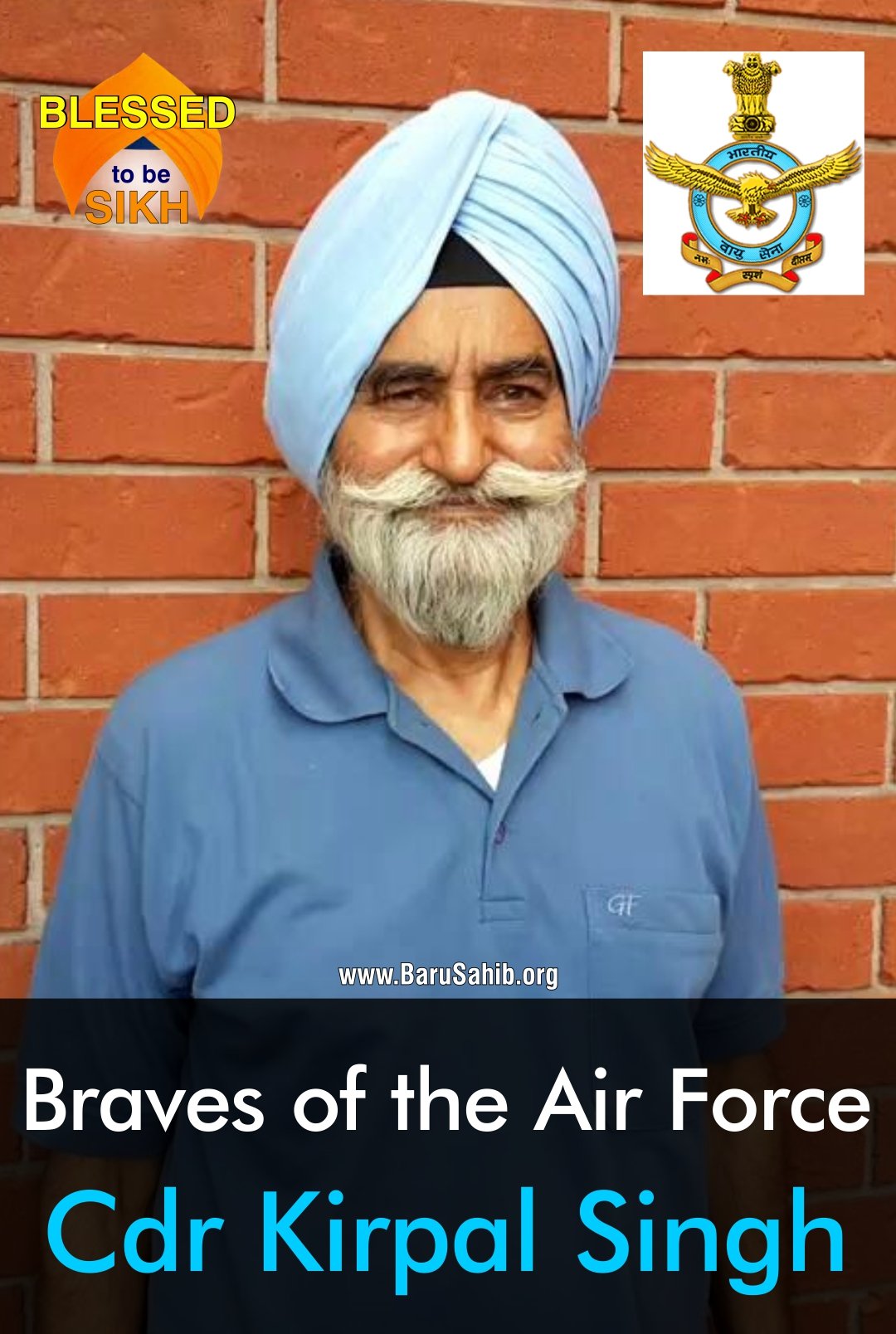
Braves Of The Air Force – Cdr Kirpal Singh

Young Kirpal Singh was a refugee from that part of India which is today called Pakistan. India got partitioned in 1947 and millions were massacred in the name of a religion which cannot accept non-believers. It was an ordeal for everyone to escape and so many of us did just that. Kirpal, born in Abbottabad,(NWFP) […]

Young Kirpal Singh was a refugee from that part of India which is today called Pakistan. India got partitioned in 1947 and millions were massacred in the name of a religion which cannot accept non-believers. It was an ordeal for everyone to escape and so many of us did just that. Kirpal, born in Abbottabad,(NWFP) in 1935, escaped & resettled with his family in Dehradun.

Nothing deterred this brave son of India and he joined the Indian Air Force by clearing the SSB for the 66th Pilots’ Course. He was commissioned in 1956 and joined a Vampire Squadron.

Kirpal was an ‘Ace’ in Gunnery and won the “Arjuna’ award in his very first gunnery meet. ‘Arjuna’ award was an in-house award of the IAF and apparently has been, since discontinued. Young Flt Lt Kirpal was soon to be a test pilot and was sent to the Empirical Test Pilots’ School in England for his training. He was instrumental in developing so many varied flying ‘platforms’ for the IAF, which the IAF used, both during peace and the ensuing wars. He was awarded the Vayu Sena Medal for his exceptional flying skills.

Kirpal was posted with N0 27, No 20 Squadrons where he flew Gnats and many other aircraft as well, but his testing and flying skills on a Hunter were soon to become legendary. He took an active part in the 1965 & 1971 wars. His own creation of a platform in an unarmed Mig 21, carrying a special camera, was extensively flown and used by him during the 1971 operations. He successfully flew alone,at very low heights all over the borders and brought back photographic intelligence of the ongoing war. Recognising his contribution to the war efforts, especially in the face of a treacherous enemy, Kirpal was decorated with a Vir Chakra in 1972.

He was later posted with the ASTE as an Instructor from where he switched jobs and joined the Steel Authority of India as their chief pilot.

In nearly forty years of his flying career, Kirpal Singh has logged over 10000 flying hours in 56 different types of aircraft. He also remained the flying examiner for seventeen years with the DGCA.

There are heroic stories about him and about his flying skills where he brought back a totally crippled Mig-21 which had suffered a total electrical failure thus denying him all references and controls. He had landed that aircraft safely to fly another day. Many others would have possibly ejected in such a situation.

Kirpal is settled in Rajpura, Punjab. His three children are well accomplished and are doing well in their lives.
He often lives with his two sons in Toronto, Canada and met with me here to give me the honour to write about him. The Kirpals celebrated their golden jubilee this year in January.

The AFA wishes both Mrs. Kirpal and the 82 years young Kirpal Singh all the best for the future.

Braves Of The Air Force – Cdr Kirpal Singh

Young Kirpal Singh was a refugee from that part of India which is today called Pakistan. India got partitioned in 1947 and millions were massacred in the name of a religion which cannot accept non-believers. It was an ordeal for everyone to escape and so many of us did just that. Kirpal, born in Abbottabad,(NWFP) […]

Young Kirpal Singh was a refugee from that part of India which is today called Pakistan. India got partitioned in 1947 and millions were massacred in the name of a religion which cannot accept non-believers. It was an ordeal for everyone to escape and so many of us did just that. Kirpal, born in Abbottabad,(NWFP) in 1935, escaped & resettled with his family in Dehradun.

Nothing deterred this brave son of India and he joined the Indian Air Force by clearing the SSB for the 66th Pilots’ Course. He was commissioned in 1956 and joined a Vampire Squadron.

Kirpal was an ‘Ace’ in Gunnery and won the “Arjuna’ award in his very first gunnery meet. ‘Arjuna’ award was an in-house award of the IAF and apparently has been, since discontinued. Young Flt Lt Kirpal was soon to be a test pilot and was sent to the Empirical Test Pilots’ School in England for his training. He was instrumental in developing so many varied flying ‘platforms’ for the IAF, which the IAF used, both during peace and the ensuing wars. He was awarded the Vayu Sena Medal for his exceptional flying skills.

Kirpal was posted with N0 27, No 20 Squadrons where he flew Gnats and many other aircraft as well, but his testing and flying skills on a Hunter were soon to become legendary. He took an active part in the 1965 & 1971 wars. His own creation of a platform in an unarmed Mig 21, carrying a special camera, was extensively flown and used by him during the 1971 operations. He successfully flew alone,at very low heights all over the borders and brought back photographic intelligence of the ongoing war. Recognising his contribution to the war efforts, especially in the face of a treacherous enemy, Kirpal was decorated with a Vir Chakra in 1972.

He was later posted with the ASTE as an Instructor from where he switched jobs and joined the Steel Authority of India as their chief pilot.

In nearly forty years of his flying career, Kirpal Singh has logged over 10000 flying hours in 56 different types of aircraft. He also remained the flying examiner for seventeen years with the DGCA.

There are heroic stories about him and about his flying skills where he brought back a totally crippled Mig-21 which had suffered a total electrical failure thus denying him all references and controls. He had landed that aircraft safely to fly another day. Many others would have possibly ejected in such a situation.

Kirpal is settled in Rajpura, Punjab. His three children are well accomplished and are doing well in their lives.
He often lives with his two sons in Toronto, Canada and met with me here to give me the honour to write about him. The Kirpals celebrated their golden jubilee this year in January.

The AFA wishes both Mrs. Kirpal and the 82 years young Kirpal Singh all the best for the future.

Patriotic Poetry Competition at Akal Academy, Kajri!

Amid 70th Independence Day celebrations held at the Akal Academy Kajri the school organized Patriotic Poetry competition in the school campus to awaken patriotism among students. Students from VI to X participated in this competition with full enthusiasm. The programme began with recitation of self-composed poems by little wonders of the school. Abhai House master […]

Amid 70th Independence Day celebrations held at the Akal Academy Kajri the school organized Patriotic Poetry competition in the school campus to awaken patriotism among students.

Students from VI to X participated in this competition with full enthusiasm. The programme began with recitation of self-composed poems by little wonders of the school.

Abhai House master Mr. Vattanpreet Singh introduced the participants. Mr. Balwinder Singh Music Teacher encouraged the Students to compose their own poetry.

The main aim behind the activity was to enhance the writing skills of our nation-builders. Children enjoyed being a part of this competition by reciting the poem in their sweet voices. The teachers individually judged all the students and gave them marks on the basis of voice clarity, rhythm, props, confidence etc. Poetry recitation by Parveen Kaur and Satinder Kaur got the first position.

Army reservist, Ramanpreet Singh serving in the Australian Army with Sikhi Intact!

Born and raised in Mukatsar Sahib, Punjab, Raman always had a passion for Army. “My ancestors were proud army servicemen. My grandfather Chanan Singh Ahluwalia was part of Indian Army. My great grandfather Khajan Singh Ahluwalia had served British Army during 30’s. I feel that serving for nation as army men is in our blood!” […]

Born and raised in Mukatsar Sahib, Punjab, Raman always had a passion for Army.

“My ancestors were proud army servicemen. My grandfather Chanan Singh Ahluwalia was part of Indian Army. My great grandfather Khajan Singh Ahluwalia had served British Army during 30’s. I feel that serving for nation as army men is in our blood!”

Raman’s story is quite inspirational for all the young international students who come to Australia to pursue their dreams.

He is a turban wearing Sikh who came to Australia on a student visa and have done study course in hospitality management.

“My first few years in Australia was a great struggle! I remember the tough days when I had small scale jobs as a cook, a security supervisor and even I drove taxi and buses for few years” said Raman.

Talking about his passion for Army, he mentioned, “I am trying to follow footprints of my ancestors and try to do something for my country and community.”

While talking about his appearance and religious beliefs, he said, “the diversity is one of the key strengths of the Australian Army and I am proud to be part of it.”

“With dignity, my appearance as a “Sikh” also reminds me of the extra responsibilities that come my way. I am here to follow the footsteps of great Sikh soldiers who fought for noble causes with bravery and honesty.”

“I want to serve my country, and at the same time I have a deep down desire to remain true to my faith. In this regard, I am very thankful to Australian Army who helped me join forces with my full on appearance, with beard and turban!”

“I am immensely proud of my Army uniform as it gives me a sense of belonging – my uniform and my badge name as ‘Singh’ gives me an immense pleasure that I can’t describe.”

Raman also told SBS Punjabi why it is particularly important for Sikhs to serve in the military or police service.

“Sikhism has a long history of saint-soldier tradition. I was greatly influenced by my granddad who used to teach me that we can’t have peace without justice. Moreover, I feel our religious and cultural values are directly in line with military values.”

“Serving the nation and to have a sense of belonging when there are so many issues of ‘mistaken identity’ is quite crucial for me at a personal level. I always wished to be a front runner with my service, commitment and dignity.”

“My move to join Australian Army has earned me a lot of respect in friends, family and local community. And I will try to hold the flag high” said Raman in a telephonic conversation with SBS Radio’s Punjabi program.

Army reservist, Ramanpreet Singh serving in the Australian Army with Sikhi Intact!

Born and raised in Mukatsar Sahib, Punjab, Raman always had a passion for Army. “My ancestors were proud army servicemen. My grandfather Chanan Singh Ahluwalia was part of Indian Army. My great grandfather Khajan Singh Ahluwalia had served British Army during 30’s. I feel that serving for nation as army men is in our blood!” […]

Born and raised in Mukatsar Sahib, Punjab, Raman always had a passion for Army.

“My ancestors were proud army servicemen. My grandfather Chanan Singh Ahluwalia was part of Indian Army. My great grandfather Khajan Singh Ahluwalia had served British Army during 30’s. I feel that serving for nation as army men is in our blood!”

Raman’s story is quite inspirational for all the young international students who come to Australia to pursue their dreams.

He is a turban wearing Sikh who came to Australia on a student visa and have done study course in hospitality management.

“My first few years in Australia was a great struggle! I remember the tough days when I had small scale jobs as a cook, a security supervisor and even I drove taxi and buses for few years” said Raman.

Talking about his passion for Army, he mentioned, “I am trying to follow footprints of my ancestors and try to do something for my country and community.”

While talking about his appearance and religious beliefs, he said, “the diversity is one of the key strengths of the Australian Army and I am proud to be part of it.”

“With dignity, my appearance as a “Sikh” also reminds me of the extra responsibilities that come my way. I am here to follow the footsteps of great Sikh soldiers who fought for noble causes with bravery and honesty.”

“I want to serve my country, and at the same time I have a deep down desire to remain true to my faith. In this regard, I am very thankful to Australian Army who helped me join forces with my full on appearance, with beard and turban!”

“I am immensely proud of my Army uniform as it gives me a sense of belonging – my uniform and my badge name as ‘Singh’ gives me an immense pleasure that I can’t describe.”

Raman also told SBS Punjabi why it is particularly important for Sikhs to serve in the military or police service.

“Sikhism has a long history of saint-soldier tradition. I was greatly influenced by my granddad who used to teach me that we can’t have peace without justice. Moreover, I feel our religious and cultural values are directly in line with military values.”

“Serving the nation and to have a sense of belonging when there are so many issues of ‘mistaken identity’ is quite crucial for me at a personal level. I always wished to be a front runner with my service, commitment and dignity.”

“My move to join Australian Army has earned me a lot of respect in friends, family and local community. And I will try to hold the flag high” said Raman in a telephonic conversation with SBS Radio’s Punjabi program.

‘Langar on Wheels’ gives a ray of Hope to the HOMELESS in US

An orange and navy blue truck seen plying on the streets of Washington DC in US these days has emerged as a source of hope for the homeless and the poor. Started by a Sikh, the truck, which famously goes by the name ‘Seva Truck’, takes its inspiration from the popular ‘langar’ (community kitchens). Sporting […]

An orange and navy blue truck seen plying on the streets of Washington DC in US these days has emerged as a source of hope for the homeless and the poor.

Started by a Sikh, the truck, which famously goes by the name ‘Seva Truck’, takes its inspiration from the popular ‘langar’ (community kitchens). Sporting a message saying, ‘DC has the nation’s highest rate of food insecurity among children. Twenty five percent of our veterans experience food insecurity. Our Mission: Combat Hunger. Serve Humanity’, the truck plies on the road distributing free hot meals to the needy.

Speaking to The Indian Express over the phone, Sonny Kakar, 46, the man behind the idea says, “It was originally the wish of my 74-year old father Devinder Kakar to do something for the homeless. We left India years ago. I was just five when my family shifted to US from Delhi. Sikhism teaches us to not let anyone sleep hungry and serve langar. My ancestors were from Rawalpindi (now in Pakistan). My father was the happiest man on the earth the day we inaugurated this truck and he saw poor having a hearty meal.”

Working with a cyber security firm in US, Kakar explains the concept saying, “Initially, we have spent $75,000 (Rs 50.35 lakh approx) on this truck. It has an in-built kitchen and a window from where meals are served. We are serving 250 meals a day on an average currently. The plan is to increase it to 50,000 a day. Also, we are targeting 20 such trucks in US by 2020 to combat hunger. Apart from the homeless, truck is also plying in areas comprising deprived senior citizens, orphans and ex-servicemen.”

Kakar also acknowledges the help that has poured in from local Sikh community in the US. “My friends – Gurpal Bhullar, Anu Kaur, Rubin Paul Singh – have helped me at every step in starting this free-meal service,” he said.
Speaking about the menu it offers, Kakar said that the truck though serves pure vegetarian meal but its not Indian. “Since people we are serving are mostly American, we have to go by their taste. Italian pasta and Mexican tortillas are served generally. On several occasions, we also serve cookies, ice creams while cheese, eggs and potatoes are served for breakfast. On the occasion of Baisakhi, we dished out cheese quesadilla; chips, salsa and guacamole; mandarin, ice cream and red sauce pasta,” said Carol Barbosa Jeliazkov, a Brazilian, working with group.

Source- Indianexpress.com

‘Langar on Wheels’ gives a ray of Hope to the HOMELESS in US

An orange and navy blue truck seen plying on the streets of Washington DC in US these days has emerged as a source of hope for the homeless and the poor. Started by a Sikh, the truck, which famously goes by the name ‘Seva Truck’, takes its inspiration from the popular ‘langar’ (community kitchens). Sporting […]

An orange and navy blue truck seen plying on the streets of Washington DC in US these days has emerged as a source of hope for the homeless and the poor.

Started by a Sikh, the truck, which famously goes by the name ‘Seva Truck’, takes its inspiration from the popular ‘langar’ (community kitchens). Sporting a message saying, ‘DC has the nation’s highest rate of food insecurity among children. Twenty five percent of our veterans experience food insecurity. Our Mission: Combat Hunger. Serve Humanity’, the truck plies on the road distributing free hot meals to the needy.

Speaking to The Indian Express over the phone, Sonny Kakar, 46, the man behind the idea says, “It was originally the wish of my 74-year old father Devinder Kakar to do something for the homeless. We left India years ago. I was just five when my family shifted to US from Delhi. Sikhism teaches us to not let anyone sleep hungry and serve langar. My ancestors were from Rawalpindi (now in Pakistan). My father was the happiest man on the earth the day we inaugurated this truck and he saw poor having a hearty meal.”

Working with a cyber security firm in US, Kakar explains the concept saying, “Initially, we have spent $75,000 (Rs 50.35 lakh approx) on this truck. It has an in-built kitchen and a window from where meals are served. We are serving 250 meals a day on an average currently. The plan is to increase it to 50,000 a day. Also, we are targeting 20 such trucks in US by 2020 to combat hunger. Apart from the homeless, truck is also plying in areas comprising deprived senior citizens, orphans and ex-servicemen.”

Kakar also acknowledges the help that has poured in from local Sikh community in the US. “My friends – Gurpal Bhullar, Anu Kaur, Rubin Paul Singh – have helped me at every step in starting this free-meal service,” he said.
Speaking about the menu it offers, Kakar said that the truck though serves pure vegetarian meal but its not Indian. “Since people we are serving are mostly American, we have to go by their taste. Italian pasta and Mexican tortillas are served generally. On several occasions, we also serve cookies, ice creams while cheese, eggs and potatoes are served for breakfast. On the occasion of Baisakhi, we dished out cheese quesadilla; chips, salsa and guacamole; mandarin, ice cream and red sauce pasta,” said Carol Barbosa Jeliazkov, a Brazilian, working with group.

Source- Indianexpress.com

Sahaj Anand models for an Italian Brand ‘Eidos Napoli’ with his Faith Articles at the NYFW

Over 80 percent of models that were hired for New York’s Fashion Week were white, whereas they make up 63 percent of the American population. While the 17% may not seem like a huge disparity, reducing that would create the world of difference. The Sikhs have over 150 years of history in America, yet they […]

Over 80 percent of models that were hired for New York’s Fashion Week were white, whereas they make up 63 percent of the American population. While the 17% may not seem like a huge disparity, reducing that would create the world of difference.

The Sikhs have over 150 years of history in America, yet they are never featured in entertainment business, commercial advertising, or in today’s fashion. However, what they do receive is constant scrutiny for their turbans from people who automatically assume their article of faith as a symbol of terror—which is sheer ignorance.

One such brand that is blurring the lines of ethnicity and religion in their models is Eidos Napoli. It is an Italian luxury brand which focuses on making classy yet comfortable clothing for men and just that. One of their models for New York Fashion Week was Sahaj Anand—a proud American Sikh who will start Emory University this fall. Sahaj told me, “Most people who asked me to model [previously] wanted me to remove my turban and show my hair.” When asked how his experience was different this time, he stated that it was great since Eidos Napoli “wanted [him] to keep [his] articles of faith intact.” Not only did this make him feel comfortable, but it proved to him that he did not have to compromise his beliefs to follow his dreams.

If an Italian brand can do this, why can’t more American brands?

Source- www.theodysseyonline.com