“Create out of Waste” Workshop at village Bhadaur Akal Academy Rampur Sunra

Akal Academy located at the village Rampur Sunra recently observed a creative workshop “Create out of Waste”. Students from all classes & sections (I-VIII) participated with great enthusiasm in a healthy competing spirit. The Workshop, observed as a part of lessons on Ecology Restoration, intended to induce constructive character and creative abilities amongst the students. […]

Akal Academy located at the village Rampur Sunra recently observed a creative workshop “Create out of Waste”. Students from all classes & sections (I-VIII) participated with great enthusiasm in a healthy competing spirit.

The Workshop, observed as a part of lessons on Ecology Restoration, intended to induce constructive character and creative abilities amongst the students.

Our goal through the activity were; to reach maximum number of students and contribute to make them aware about environmental issues and how to adopt a more sustainable lifestyle, to collect some ideas from students through self-expression, for students to learn and progressively understand that resources should be used carefully & that they could reuse waste material and not always depend on new things.

They produced several beautifully crafted creative items like beautiful items from clay modeling like animals, flowers, furniture items, fruits, decorated boxes like- application box, chalk box , pen holders, pencil box, comb’s box from waste bottles.

The workshop was Judged by the chief Guest Mrs Manjot Kaur & a jury of teachers. The results were later declared by the respective judges and the children were also presented with the prizes.

~ Tapasleen Kaur
~ New Delhi, 20th May ’15

Little Artists of Akal Academy, Theh Kalandar participate in Story Telling & Dramatization Activities!

Providing children with an opportunity to work together cooperatively on a shared life, Akal Academy conducted story telling & dramatization sessions to give children an opportunity to express themselves more effectively in everyday situations. Such activities have a great educational value & help the students to discover their hidden talents. Students were given various topics […]

Providing children with an opportunity to work together cooperatively on a shared life, Akal Academy conducted story telling & dramatization sessions to give children an opportunity to express themselves more effectively in everyday situations. Such activities have a great educational value & help the students to discover their hidden talents.

Students were given various topics along with a good preparation time. Teachers often boost their confidence to fight their stage fear & to take up the challenge with enthusiasm. It was an interesting event for the students & a good breakthrough in their daily routines.

Drama is the most significant model of learning and is a basic activity for learning. It is the way of helping children to think about their individual or social problems. Children can learn to explore issues, events and connections, by means of drama. In drama, children draw on their knowledge and experience of the real world in order to create a make-believe world.

Students who lack interaction, motivation in the classroom, either because they are introvert, shy or they have a low language level, this might be a good solution to involve them with their friends in doing various activities and to make weak student active. The good thing about this was giving chance to students to study English with fun and improvise their English at the same time.

Like & Share to appreciate the efforts!

~ Tapasleen Kaur
~ New Delhi, 20th May ’15

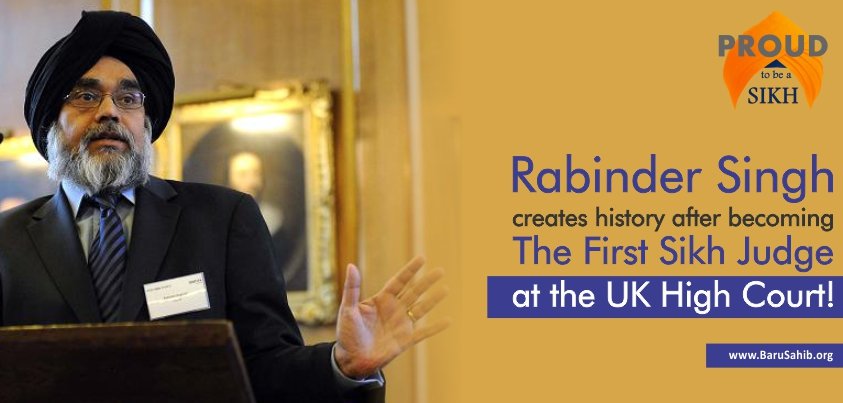
Rabinder Singh creates history after becoming The First Sikh Judge at the UK High Court!

Rabinder Singh QC has created history after becoming the first Sikh to be appointed as a High Court judge. The 47-year-old is set to take up his position on the Queen’s Bench Division (QBD) in October and will preside over cases wearing a turban rather than the traditional judicial wig. Singh is the first male […]

Rabinder Singh QC has created history after becoming the first Sikh to be appointed as a High Court judge.

The 47-year-old is set to take up his position on the Queen’s Bench Division (QBD) in October and will preside over cases wearing a turban rather than the traditional judicial wig.

Singh is the first male from an ethnic background to be made a High Court judge and his appointment comes at a time when diversity in the judiciary is being looked at by a House of Lords select committee.

But his selection is far from being a response to a lack of representation from the BME community.

Singh has been seen as a high caliber appointment and someone who can inspire more members from the ethnic community to aim to get to his level.

A Ministry of Justice spokesperson said,”The appointment of Mr Rabinder Singh QC, a talented and highly respected barrister, to the High Court, represents a real landmark in the drive to create a more diverse judiciary which continues to attract the highest quality candidates.”

Singh was one of the founding members of Matrix Chambers in 2000 and has been known as a staunch defender of human rights. In 2004, he successfully represented human rights group Liberty, in the House of Lords against the indefinite detention without trial of non-UK national suspected of terrorist activities.

A year later, Singh again was successful representing Liberty and the Joint Council for the Welfare of Immigrants in the case against the UK government over the refusal of economic benefits to refugees.

Born in Bristol in 1964, Singh achieved a double first in law at the Trinity College University of Cambridge in 1985 and four years later he was called to the Bar by Lincoln’s Inn and was one of the Junior Counsel to the Crown (A Panel) until he took silk in 2002. He has also been the recipient of a number of awards including being named Barrister of the Year in 2001 by Lawyer magazine.

Singh was also given the award of Human Rights Lawyer of the Year (JUSTICE/Liberty) in 2006 and in 2010 was Human Rights and Public Law Silk of the Year (Chambers Bar Awards).

~ Source: www.obv.org.uk

National women’s 20km walk record holder Khushbir Kaur her way into Rio Olympics!

Three Indian race walkers — Khushbir Kaur, Manish Rawat and Sandeep Kumar — qualified for the Rio Olympics after creditable performances in the IAAF Race Walking Challenge at Rio Maior in Portugal. National women’s 20km walk record holder Khushbir Kaur clocked 1:33:58, better than Rio 2016 qualification time of 1:35, though she finished 13th in […]

Three Indian race walkers — Khushbir Kaur, Manish Rawat and Sandeep Kumar — qualified for the Rio Olympics after creditable performances in the IAAF Race Walking Challenge at Rio Maior in Portugal.

National women’s 20km walk record holder Khushbir Kaur clocked 1:33:58, better than Rio 2016 qualification time of 1:35, though she finished 13th in the race.

In the men’s 20km race walk, Manish Rawat logged a personal best performance to finish in top 10 with a timing of 1:22:50, well above Rio Games qualification time of 1:24.

National 50km race walk record holder Sandeep Kumar also qualified for Rio Games with a 14th-place finish in 1:23:32 though he received one warning.

The third walker in men’s 20km race walk, Devender Singh, missed out on the qualification with 18th place finish in 1:24:57. The fourth walker, Ganpathy Krishnan, finished on 29th place with 1:27:05.

India’s race walk squad were currently training in Rio Maior, Portugal, with the primary objective of Rio 2016 Olympic Games qualification. They took part in the IAAF Race Walking Challenge, also called Rio Maior Race Walking International Grand Prix.

~ Source: www.hindustantimes.com

65 Yr Old Retired Harjinder Singh devotes his Time & Savings to regulate Traffic in Amritsar!

Charanjeet Singh was working with an MNC until an accident forced him to be on a break in Amritsar. When he observed this selfless act of an elderly man, he decided to share this story with us in order to inspire us all and give recognition to an unsung hero. I was on my way […]

Charanjeet Singh was working with an MNC until an accident forced him to be on a break in Amritsar. When he observed this selfless act of an elderly man, he decided to share this story with us in order to inspire us all and give recognition to an unsung hero.

I was on my way to meet one of my friends and I was so frustrated with the traffic at the Crystal Chowk, Queens road (Amritsar). I got stuck at this roundabout for almost 15 minutes because of traffic and to make it worse the traffic lights were not working which made every thing chaotic. Somehow, after about half an hour later, I was able to cross that roundabout. And what was making me even more scared was that I had to get back via this same route after meeting my friend.

And to my surprise when I was coming back all the traffic was smoothly managed even though there was no traffic cop and the traffic lights were still not working. I saw one elderly gentleman guiding the traffic and he was doing it very well.

I parked my car on the side (ensuring it’s away from all the traffic!) and started observing. I was really intrigued and impressed and so eventually I walked upto him and thanked him for what he was doing. And while I was talking to him, the traffic lights resumed working. He introduced himself and offered me a cup of tea. We went to a nearby tea stall and got talking more. His name was Sh. Harjinder Singh, a senior citizen aged 65 years and had retired from the post of a police sub-inspector in August 2009. Ever since, he has been providing his services to regulate traffic! He works selflessly towards reducing the traffic chaos and teaching traffic etiquette to drivers.
I was curious and asked him that since he had retired and this was the time when he could just sit back at home and play with his grandchildren or do any leisurely activity, why would he do all this? And his answer was,

“I had watched civilians working as traffic marshals to manage traffic in some foreign countries on television. It instantly came to my mind that I can also work as a traffic marshal after retirement,” said Harjinder Singh.
More and more people should come forward to reduce the traffic chaos in the city,” he added. “I feel that there is a need to educate school students as they are the future drivers.”

He was very happy and shared his phone number with me and he thanked me for stopping by and acknowledging his efforts.

“It motivates me to save people’s lives from road accidents,” he added.

We still have people in our society who work for the welfare of society. He is 65 and could’ve easily taken a more relaxed path in life. However, he patrols around the city on his bike all day and offers his service wherever it is required. He doesn’t get paid for this job – in fact he uses his retirement savings to contribute towards regulating traffic.

-Shared by Charanjeet Singh
Source: www.thebetterindia.com

His Selfless act comes forth as a unique exemplary to Humanity!

Peter Singh is the man behind the Redevelopment of £200 Million Oriental City of London!

He is property magnate Peter Virdee, managing director of Mayfair-based B&S Property, which bought the site in Colindale after the original owners ran into financial difficulties. The Sikh businessman, who started his career working in his family’s retail firm, built residential care homes before moving into property. He has extensive interests abroad, which he manages […]

He is property magnate Peter Virdee, managing director of Mayfair-based B&S Property, which bought the site in Colindale after the original owners ran into financial difficulties.

The Sikh businessman, who started his career working in his family’s retail firm, built residential care homes before moving into property. He has extensive interests abroad, which he manages with the help of his father, and has been nominated for a Lloyds TSB Asian Jewel commerce award.

Mr Virdee said today he was “absolutely confident” the Oriental City scheme would go ahead despite the economic downturn and property slump, adding: “It would be foolish to say that recent events have had no impact. We are looking at a phased development. The market will be the first part to be constructed so the traders will be the first to return to the site.

“But we will take a wait-and-see approach with the residential component. In the current climate it would be wiser to wait until the housing market recovers before starting construction,” he said.

The site, dubbed the “real Chinatown”, was a shrine for lovers of Oriental food and was home to traders from the Chinese, Japanese, Malay, Thai and Filipino communities.

Plans to redevelop the dilapidated food hall caused uproar, because it would mean the traders moving out while the work was carried out. The traders’ case was backed by both the Commission for Racial Equality and the Chinese government, but the redevelopment proposal was eventually pushed through last March after former mayor Ken Livingstone pledged a £2 million compensation package for the displaced traders. The original owner, Development Securities, was granted planning permission to build a larger market, two major stores, 520 one- and two-bedroom flats and a primary school.

It then sold the site to Mr Virdee’s Mayfair-based B&S in a £68 million deal. The lack of construction activity since last year’s sale had raised fears the project had fallen victim to the credit crunch. However, Mr Virdee told the Standard the scheme is on course and demolition work is due to start imminently.

He said: “We are in ownership of the site and there are no issues regarding financing. Everything is proceeding normally. We’ve signed deals with the contractors and all we’re waiting on is for the final clearance from the council (Barnet). The demolition could start at any time within the next few weeks.”

~ Source: www.standard.co.uk

Making their way to the Wall of Fame, Students of Akal Academy Dhotian Bagged First Position at Karate Competition!

Proving their mettle, the rural students from Akal Academy, Dhotian went on a knock-out spree at the recently held Karate Competition. The students had received an in-house training on Karate skills at the Academy prior to the competition. Around 35 teams participated in the grand event. Students of Akal Academy, Dhotian bagged the first position. […]

Proving their mettle, the rural students from Akal Academy, Dhotian went on a knock-out spree at the recently held Karate Competition. The students had received an in-house training on Karate skills at the Academy prior to the competition.

Around 35 teams participated in the grand event. Students of Akal Academy, Dhotian bagged the first position. They displayed an exceptional display of endurance & power during the championship.

Making their way to the Wall of Fame across at Akal Academies, leaving a loud roar of success, students brought pride to their academy.

Like & Share to be a part of their success!

~ Tapasleen Kaur
~ New Delhi, 18th May ’15

Little Performers of Akal Academy Majri display their talent at the Story Telling Competition!

Story Telling is very important part of early childhood education since it provides the necessary ingredients for pre-schoolers to broaden their imagination. Keeping this in mind Story Telling competition was conducted and the parents of the students were invited over. Students of junior classes participated in the competition, dressed in various attires according to the […]

Story Telling is very important part of early childhood education since it provides the necessary ingredients for pre-schoolers to broaden their imagination. Keeping this in mind Story Telling competition was conducted and the parents of the students were invited over. Students of junior classes participated in the competition, dressed in various attires according to the theme.

It was a very good learning experience for students. It catered to different abilities of the students as they chose stories that suit their own level. Through story-telling, students become more interested in stories and in reading.

Story-telling activity serves as a useful start to develop imaginative thinking, training their public speaking skills as well as arousing students’ interest in English stories. It also develops the habit of reading & trains students to tell a story vividly.

The Principal appreciated the performances of the kids & said “It is important for parents to be here to support their children in order to give them confidence.”

Prizes were presented by the school’s principal according to the performances of the students.

The benefits of a childhood with a healthy focus on telling stories are extensive; storytelling inspires the imagination, encourages thought-processes, the questioning of one’s actions, the development of morality, communication, empathy and compassion. Thus a strong storytelling presence within the early years curriculum harbors wonderful potential for later learning.

Akal Academy makes sure that a strong base is provided to each and every student to lead forward in his academics.

~ Tapasleen Kaur
~ New Delhi, 18th May ’15

Red Bull Features India’s first blade runner, War Veteran Major D. P. Singh!

“First, I put on my shoe then I put on my leg, and then I’m just running.” That’s Major D.P. Singh’s early morning routine. While most of us cite excuses such as body pain, stiff muscles and joint pains; for Major D.P. Singh, with just one working leg, running is a way of life. Major […]

“First, I put on my shoe then I put on my leg, and then I’m just running.”

That’s Major D.P. Singh’s early morning routine. While most of us cite excuses such as body pain, stiff muscles and joint pains; for Major D.P. Singh, with just one working leg, running is a way of life.

Major D.P. Singh was posted on the frontline during the Kargil war. A grenade exploded right next to him and he had to be airlifted to the hospital. To save his life doctors had to amputate his right leg but they couldn’t amputate his courage or his never-say-die attitude. Not only did he manage to get back on his feet, literally, but now he helps other amputees to regain the same confidence and fighting spirit.

We caught up with India’s first blade runner and asked him what keeps him going. This is what he had to say:

After you had the mishap during the war and your leg had to be amputated, when did you first decide that you want to get back to running and not just be satisfied with being able to only walk?

On the same day when the news of amputation was shared with me. Because I had decided that come what may, I won’t compromise on the quality of my life. And when I say, ‘quality of my life’, that includes running. Although, for next 10 years, I couldn’t run. Because for next 10 years, I was trying to find the ways and means to run with a walking leg; at that time I wasn’t wearing the blade. At that time, the longest running stint I did was 100 mt. and that too when intoxicated in the company of friends. *laughs*

Though, I did my first run in 2009.

Before the war (and the amputation) happened, were you going on runs for hobby’s sake or was it only a part of your (army) routine?

Since I was in 8th grade, I was into running, exercises and outdoor activities. But I was never a regular long distance runner. But I did actual long distance running after losing the leg, not before it.

How and why did you get involved with Wings For Life World Run?

It’s a beautiful cause for people who can’t run. I am passionate about this because though I’m able to come out of the dormant life after being through a period where even I wasn’t able to run; I can still understand what’s going through the mind of those people. By getting associated with such a beautiful cause, I think, I can bring some awareness about it. The funds which we collect are used for funding the spinal cord research – ways and means of getting them back on their feet; what more would I need? That is the reason why I got connected with Wings For Life World Run.

What’s your running goal this year?

Although there is not a set goal, I will try to touch 10k mark before the catcher car catches me.

Have you been putting any special training for this?

I’m using this amazing app that they’ve made for Wings For Life World Run. I’ve downloaded it and I’m using it for my daily runs.

Where do you see this initiative going in future?

It’s a very different concept and it’s being liked by people everywhere. Whomsoever I have spoken to have shown interest in it. It has already broken boundaries of countries and continents. I feel it’s only going to go leaps and bounds and will bring all the people together for a cause which is so beautiful. In the future, I feel the research will reach a stage where people who can’t run, will start running.

With respect to India, already there are issues in terms of sportsmen not getting enough facilities and infrastructure to grow. So when it comes to paralympians, what are the challenges that they face?

As you already mentioned, the issues are faced by even normal athletes. So when it comes to paralympians, it’s even worse. And forget about sportsmen, these things are against our culture also. Our culture doesn’t teach that when you call some guest, you ill-treat them. So, if you ask athletes to train at a particular venue but don’t give them good facilities, it’s not right. The people who’re managing such committees, if they’re not doing good work, there needs to be a change. Now-a-days, thanks to the media, there is a lot of awareness; people who’re not doing their job properly, won’t stay in the system for too long. People who’re good and do good work, needs to come forward and join hands for the betterment of everyone.

Change has already been initiated. We just need to be hopeful and remain positive; and I’m sure, in future, things will improve.

Like you said, ‘the change has already been initiated’, so, do you see people’s perspective changing? From thinking of amputees as ‘poor fellow’ to now treating them as normal human beings – has that happened? Has the conception changed among the general population?

Absolutely. There is a big shift in the attitude of people. I’m proud in sharing this news that The Challenging Ones group that I’ve started has 700+ amputees and out of that, more than 70 have started participating in running event in various parts of the country. When people see them doing things that even normal human beings detest, like, running 10k, 21k runs; there is a noticeable change in the opinion of the society. There was time when I used to practice and people used to stare thinking, ‘Who’s this guy running around with a blade?’ Now there’s an attitude change where people know that ‘Okay, these guys can also run. Nothing unusual about it.’ This shift has already started and it’s happening every day.

Can you throw some more light on what you do with the Challenging Ones and how you help people physically as well as mentally?

The Challenging Ones is sort of a support group where amputees from all of the country are connected. Idea is to give them the mindset that possibilities are lying in your mind itself, so please come out and do whatever you want to do. It’s nmot just about running, if you want to play badminton, go swimming or go cycling; anything and everything that you wish to do IS possible – just come out and do it. It’s not a preachy group – it’s more like a handholding group. So, if anyone comes to me and says he wants to run, I will hold his hand and make him cross the finish line. That gives confidence to the person, and once the person gains that confidence, he’ll be on his own. Then he can do whatever he wants to do. That is the agenda with which we work.

One topic we’d like to touch upon is the prosthetics. The blade that you wear, are they available in India or does one only need to import it? Are Indian pharma companies coming forward and making these? Are they cheap enough for a lower middle class, middle class family to buy or only rich can afford it?

As globalization has happened, buying imported products off-the-shelf in India has been possible. There are two major aspects to this:

1. The gadgets made in numbers. Eg: Artificial foot, artificial knee. They are manufactured like cars. They are made in thousands and you can buy anything anywhere.

2. The socket which is worn over the amputated part. This is specific as per the requirement of the person. There has been improvement in this area because of the demand for this has increased and a lot more amputees are now running than ever before. But there is still a lot of scope of improvement in terms of it being more capable of taking wear and tear of the extreme activities.

However, as far as producing these in India is concerned, I don’t think it’s a very prudent thing to do. When someone is already producing it somewhere else, it’s easier to import it or get the technology here and manufacture it, like we do in cars. It’s easier to do that than to reinvent the wheel.

What message would you like to give to others who’re facing the same difficulties who once upon a time used to be physically active but can’t do it anymore?

As I’ve already mentioned before, it’s all in the mind. If you think you want to do it, you will find the ways and means to do it. But often I’ve also seen that it’s not that person but the people around him who forces him to think that he can’t do it. My message to the people would be that you should not get bogged down by what others are telling you; go ahead and do whatever it is that you wish to. It is possible – just dream about it, think about it and do it.

Today, the count of shrapnel in his body is in three-digits but that doesn’t deter him from putting on his blade and going for that morning run. He jokingly refers to himself as “the Ironman.” With the kind of grit and determination he’s shown, it wouldn’t be wrong to call him superhuman.

~ Source: dailysikhupdates.com

Gurdwara in Kathmandu serve Non Stop Guru-ka-Langar since Terror of Earthquakes have struck Nepal!

Gurdwaras in Kathmandu have stood firm on the principles of Guru Nanak Dev Ji even in the hard times of the disaster. The cooking of the Guru-ka-Langgar at one gurdwara in Kathmandu, Nepal, has not stopped since a devastating earthquake struck the mountainous country on April 25. It was a Saturday. Being a local holiday, […]

Gurdwaras in Kathmandu have stood firm on the principles of Guru Nanak Dev Ji even in the hard times of the disaster.

The cooking of the Guru-ka-Langgar at one gurdwara in Kathmandu, Nepal, has not stopped since a devastating earthquake struck the mountainous country on April 25.

It was a Saturday. Being a local holiday, Gurwara Sahib Kupundole (also spelt Kupondole) in Kathmandu was having a programme.

It was a hive of activity with volunteers preparing the Guru-ka-Langgar, the free community kitchen, that is usually prepared at most Sikh places of worship called gurdwaras.

At 11.56am, a massive earthquake measuring 7.8 hit the nation. The gurdwara itself was not damaged, but it soon became the refuge centre for thousands from the neighbourhood.

“We were cooking lunch when this thing happened,” Pritam Singh, president of Gurdwara Sahib Kupundole, told Asia Samachar.
The people who had rushed to the gurdwara for safety and refuge stayed the night as they were either too afraid to return or had nowhere to go after their homes were devastated.

“The cooking continued until today,” he told Asia Samachar when met last week. All in, they were preparing daily meals for about 10,000 people. They had also received assistance from the Amritsar-based Shiromani Gurdwara Parbhandhak Committee (SGPC) and the Punjab Government.

“We put them on vehicles and distribute the Guru-ka-Langar from village to village,” he said, adding that the army had also assisted in distributing the daily hot meals prepared at the gurdwara.

Gurdwaras have happily committed themselves to this important part of their religious faith of serving the homeless!

Dhan Sikhi! Dhan Khalsa!

~ Source: asiasamachar.com