Making their way to the Wall of Fame, Students of Akal Academy Dhotian Bagged First Position at Karate Competition!

Proving their mettle, the rural students from Akal Academy, Dhotian went on a knock-out spree at the recently held Karate Competition. The students had received an in-house training on Karate skills at the Academy prior to the competition. Around 35 teams participated in the grand event. Students of Akal Academy, Dhotian bagged the first position. […]

Proving their mettle, the rural students from Akal Academy, Dhotian went on a knock-out spree at the recently held Karate Competition. The students had received an in-house training on Karate skills at the Academy prior to the competition.

Around 35 teams participated in the grand event. Students of Akal Academy, Dhotian bagged the first position. They displayed an exceptional display of endurance & power during the championship.

Making their way to the Wall of Fame across at Akal Academies, leaving a loud roar of success, students brought pride to their academy.

Like & Share to be a part of their success!

~ Tapasleen Kaur
~ New Delhi, 18th May ’15

Little Performers of Akal Academy Majri display their talent at the Story Telling Competition!

Story Telling is very important part of early childhood education since it provides the necessary ingredients for pre-schoolers to broaden their imagination. Keeping this in mind Story Telling competition was conducted and the parents of the students were invited over. Students of junior classes participated in the competition, dressed in various attires according to the […]

Story Telling is very important part of early childhood education since it provides the necessary ingredients for pre-schoolers to broaden their imagination. Keeping this in mind Story Telling competition was conducted and the parents of the students were invited over. Students of junior classes participated in the competition, dressed in various attires according to the theme.

It was a very good learning experience for students. It catered to different abilities of the students as they chose stories that suit their own level. Through story-telling, students become more interested in stories and in reading.

Story-telling activity serves as a useful start to develop imaginative thinking, training their public speaking skills as well as arousing students’ interest in English stories. It also develops the habit of reading & trains students to tell a story vividly.

The Principal appreciated the performances of the kids & said “It is important for parents to be here to support their children in order to give them confidence.”

Prizes were presented by the school’s principal according to the performances of the students.

The benefits of a childhood with a healthy focus on telling stories are extensive; storytelling inspires the imagination, encourages thought-processes, the questioning of one’s actions, the development of morality, communication, empathy and compassion. Thus a strong storytelling presence within the early years curriculum harbors wonderful potential for later learning.

Akal Academy makes sure that a strong base is provided to each and every student to lead forward in his academics.

~ Tapasleen Kaur
~ New Delhi, 18th May ’15

Red Bull Features India’s first blade runner, War Veteran Major D. P. Singh!

“First, I put on my shoe then I put on my leg, and then I’m just running.” That’s Major D.P. Singh’s early morning routine. While most of us cite excuses such as body pain, stiff muscles and joint pains; for Major D.P. Singh, with just one working leg, running is a way of life. Major […]

“First, I put on my shoe then I put on my leg, and then I’m just running.”

That’s Major D.P. Singh’s early morning routine. While most of us cite excuses such as body pain, stiff muscles and joint pains; for Major D.P. Singh, with just one working leg, running is a way of life.

Major D.P. Singh was posted on the frontline during the Kargil war. A grenade exploded right next to him and he had to be airlifted to the hospital. To save his life doctors had to amputate his right leg but they couldn’t amputate his courage or his never-say-die attitude. Not only did he manage to get back on his feet, literally, but now he helps other amputees to regain the same confidence and fighting spirit.

We caught up with India’s first blade runner and asked him what keeps him going. This is what he had to say:

After you had the mishap during the war and your leg had to be amputated, when did you first decide that you want to get back to running and not just be satisfied with being able to only walk?

On the same day when the news of amputation was shared with me. Because I had decided that come what may, I won’t compromise on the quality of my life. And when I say, ‘quality of my life’, that includes running. Although, for next 10 years, I couldn’t run. Because for next 10 years, I was trying to find the ways and means to run with a walking leg; at that time I wasn’t wearing the blade. At that time, the longest running stint I did was 100 mt. and that too when intoxicated in the company of friends. *laughs*

Though, I did my first run in 2009.

Before the war (and the amputation) happened, were you going on runs for hobby’s sake or was it only a part of your (army) routine?

Since I was in 8th grade, I was into running, exercises and outdoor activities. But I was never a regular long distance runner. But I did actual long distance running after losing the leg, not before it.

How and why did you get involved with Wings For Life World Run?

It’s a beautiful cause for people who can’t run. I am passionate about this because though I’m able to come out of the dormant life after being through a period where even I wasn’t able to run; I can still understand what’s going through the mind of those people. By getting associated with such a beautiful cause, I think, I can bring some awareness about it. The funds which we collect are used for funding the spinal cord research – ways and means of getting them back on their feet; what more would I need? That is the reason why I got connected with Wings For Life World Run.

What’s your running goal this year?

Although there is not a set goal, I will try to touch 10k mark before the catcher car catches me.

Have you been putting any special training for this?

I’m using this amazing app that they’ve made for Wings For Life World Run. I’ve downloaded it and I’m using it for my daily runs.

Where do you see this initiative going in future?

It’s a very different concept and it’s being liked by people everywhere. Whomsoever I have spoken to have shown interest in it. It has already broken boundaries of countries and continents. I feel it’s only going to go leaps and bounds and will bring all the people together for a cause which is so beautiful. In the future, I feel the research will reach a stage where people who can’t run, will start running.

With respect to India, already there are issues in terms of sportsmen not getting enough facilities and infrastructure to grow. So when it comes to paralympians, what are the challenges that they face?

As you already mentioned, the issues are faced by even normal athletes. So when it comes to paralympians, it’s even worse. And forget about sportsmen, these things are against our culture also. Our culture doesn’t teach that when you call some guest, you ill-treat them. So, if you ask athletes to train at a particular venue but don’t give them good facilities, it’s not right. The people who’re managing such committees, if they’re not doing good work, there needs to be a change. Now-a-days, thanks to the media, there is a lot of awareness; people who’re not doing their job properly, won’t stay in the system for too long. People who’re good and do good work, needs to come forward and join hands for the betterment of everyone.

Change has already been initiated. We just need to be hopeful and remain positive; and I’m sure, in future, things will improve.

Like you said, ‘the change has already been initiated’, so, do you see people’s perspective changing? From thinking of amputees as ‘poor fellow’ to now treating them as normal human beings – has that happened? Has the conception changed among the general population?

Absolutely. There is a big shift in the attitude of people. I’m proud in sharing this news that The Challenging Ones group that I’ve started has 700+ amputees and out of that, more than 70 have started participating in running event in various parts of the country. When people see them doing things that even normal human beings detest, like, running 10k, 21k runs; there is a noticeable change in the opinion of the society. There was time when I used to practice and people used to stare thinking, ‘Who’s this guy running around with a blade?’ Now there’s an attitude change where people know that ‘Okay, these guys can also run. Nothing unusual about it.’ This shift has already started and it’s happening every day.

Can you throw some more light on what you do with the Challenging Ones and how you help people physically as well as mentally?

The Challenging Ones is sort of a support group where amputees from all of the country are connected. Idea is to give them the mindset that possibilities are lying in your mind itself, so please come out and do whatever you want to do. It’s nmot just about running, if you want to play badminton, go swimming or go cycling; anything and everything that you wish to do IS possible – just come out and do it. It’s not a preachy group – it’s more like a handholding group. So, if anyone comes to me and says he wants to run, I will hold his hand and make him cross the finish line. That gives confidence to the person, and once the person gains that confidence, he’ll be on his own. Then he can do whatever he wants to do. That is the agenda with which we work.

One topic we’d like to touch upon is the prosthetics. The blade that you wear, are they available in India or does one only need to import it? Are Indian pharma companies coming forward and making these? Are they cheap enough for a lower middle class, middle class family to buy or only rich can afford it?

As globalization has happened, buying imported products off-the-shelf in India has been possible. There are two major aspects to this:

1. The gadgets made in numbers. Eg: Artificial foot, artificial knee. They are manufactured like cars. They are made in thousands and you can buy anything anywhere.

2. The socket which is worn over the amputated part. This is specific as per the requirement of the person. There has been improvement in this area because of the demand for this has increased and a lot more amputees are now running than ever before. But there is still a lot of scope of improvement in terms of it being more capable of taking wear and tear of the extreme activities.

However, as far as producing these in India is concerned, I don’t think it’s a very prudent thing to do. When someone is already producing it somewhere else, it’s easier to import it or get the technology here and manufacture it, like we do in cars. It’s easier to do that than to reinvent the wheel.

What message would you like to give to others who’re facing the same difficulties who once upon a time used to be physically active but can’t do it anymore?

As I’ve already mentioned before, it’s all in the mind. If you think you want to do it, you will find the ways and means to do it. But often I’ve also seen that it’s not that person but the people around him who forces him to think that he can’t do it. My message to the people would be that you should not get bogged down by what others are telling you; go ahead and do whatever it is that you wish to. It is possible – just dream about it, think about it and do it.

Today, the count of shrapnel in his body is in three-digits but that doesn’t deter him from putting on his blade and going for that morning run. He jokingly refers to himself as “the Ironman.” With the kind of grit and determination he’s shown, it wouldn’t be wrong to call him superhuman.

~ Source: dailysikhupdates.com

Gurdwara in Kathmandu serve Non Stop Guru-ka-Langar since Terror of Earthquakes have struck Nepal!

Gurdwaras in Kathmandu have stood firm on the principles of Guru Nanak Dev Ji even in the hard times of the disaster. The cooking of the Guru-ka-Langgar at one gurdwara in Kathmandu, Nepal, has not stopped since a devastating earthquake struck the mountainous country on April 25. It was a Saturday. Being a local holiday, […]

Gurdwaras in Kathmandu have stood firm on the principles of Guru Nanak Dev Ji even in the hard times of the disaster.

The cooking of the Guru-ka-Langgar at one gurdwara in Kathmandu, Nepal, has not stopped since a devastating earthquake struck the mountainous country on April 25.

It was a Saturday. Being a local holiday, Gurwara Sahib Kupundole (also spelt Kupondole) in Kathmandu was having a programme.

It was a hive of activity with volunteers preparing the Guru-ka-Langgar, the free community kitchen, that is usually prepared at most Sikh places of worship called gurdwaras.

At 11.56am, a massive earthquake measuring 7.8 hit the nation. The gurdwara itself was not damaged, but it soon became the refuge centre for thousands from the neighbourhood.

“We were cooking lunch when this thing happened,” Pritam Singh, president of Gurdwara Sahib Kupundole, told Asia Samachar.
The people who had rushed to the gurdwara for safety and refuge stayed the night as they were either too afraid to return or had nowhere to go after their homes were devastated.

“The cooking continued until today,” he told Asia Samachar when met last week. All in, they were preparing daily meals for about 10,000 people. They had also received assistance from the Amritsar-based Shiromani Gurdwara Parbhandhak Committee (SGPC) and the Punjab Government.

“We put them on vehicles and distribute the Guru-ka-Langar from village to village,” he said, adding that the army had also assisted in distributing the daily hot meals prepared at the gurdwara.

Gurdwaras have happily committed themselves to this important part of their religious faith of serving the homeless!

Dhan Sikhi! Dhan Khalsa!

~ Source: asiasamachar.com

Series of Paintings “Raagas & I” inspired by the Raagas of the Sri Guru Granth Sahb Ji by Dr Navjeet Kaur!

The ideal time to recite this raag is in the afternoon. Guru Ram Das ji says… Ang 985: My heart lotus has bloomed forth, I have found my Guru. Meditating on the Guru my doubts and fears have gone away. Intuitively, this painting was to be about the lotus blooming. The Guru guides me…about living […]

The ideal time to recite this raag is in the afternoon.
Guru Ram Das ji says…

Ang 985:
My heart lotus has bloomed forth, I have found my Guru. Meditating on the Guru my doubts and fears have gone away.

Intuitively, this painting was to be about the lotus blooming.
The Guru guides me…about living a God conscious vs a world conscious life.
when I live for the world I live in fear…
Meditating on the Guru and Realizing the presence of the Divine within at all times…. Realizing That I am not alone……it is then that my fears melt and I can lead my best life….
There is a glow that emanates from within the Lotus….the realization of the divine within.
Fear melts ….my spirit blooms.

~ Dr. Navjeet Kaur

Series of Paintings “Raagas & I” inspired by the Raagas of the Sri Guru Granth Sahb Ji by Dr Navjeet Kaur!

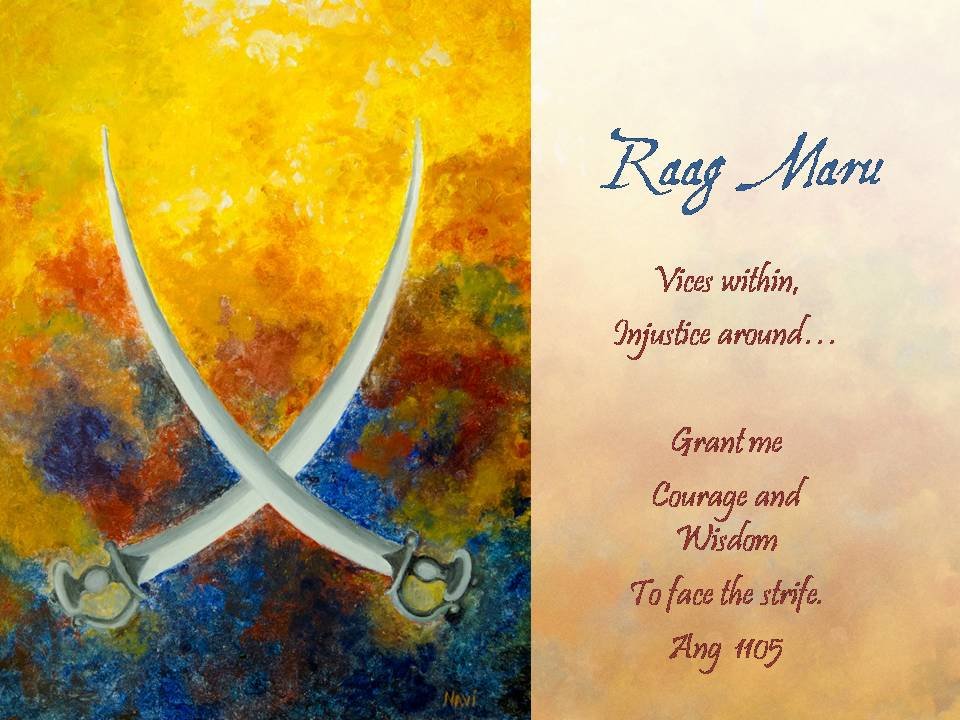
The ideal time to recite this raag is in the evening time. Guru Ram Das Ji asks for Lord’s protection…. Ang 975: the 5 evils rage within …please have mercy on me. Nanak has come to Your sanctuary ….save me, preserve my honor. Let me share my thoughts for this painting…. The thought is about…. […]

The ideal time to recite this raag is in the evening time.
Guru Ram Das Ji asks for Lord’s protection….

Ang 975:
the 5 evils rage within …please have mercy on me.
Nanak has come to Your sanctuary ….save me, preserve my honor.

Let me share my thoughts for this painting….
The thought is about…. seeking the Lord’s protection.
Is there a war? …is it raging within?
Yes…..the biggest battles are those that are waged within.
This war is against the 5 evils within ….that are out of control.
this battle rages on…..
The shield is the Lord giving me protection.
The arrows are meant to subdue the 5 evils.
The choice of colors of the background …suggestive of a battlefield in the evening.

~ Dr. Navjeet Kaur

An epitome of humanity- How the Sikhs article of faith was used to give hope and comfort to an injured child!

A priceless image, a Sikhs article of faith being used to give hope and comfort to a fellow man – is this not the epitome of humanity? This amazing Singh walked out his house after he heard a loud bang. It was the sound of this young boy hit by a car. Harman Singh came […]

A priceless image, a Sikhs article of faith being used to give hope and comfort to a fellow man – is this not the epitome of humanity?

This amazing Singh walked out his house after he heard a loud bang. It was the sound of this young boy hit by a car.

Harman Singh came to help the boy, he took off his turban and used it to support the boy’s neck. This is one of those times to let the world know we are followers of the wonderful Guru Nanak

Our turban is our CROWN. We are Kings.

However a King’s job isn’t to rule his people, his job is to SERVE his people.

The amount of humbleness, love and sincerity shown by this man is indescribable.

Thank you Harman Singh for showing the world who Sikhs are.

~ Tapasleen Kaur

Inspiring the Students of Akal Academy, Theh Kalandar to maintain their Khalsa Roop with Pride!

The issue of Kesh looms large in all the lives of Sikh children. One of the many challenges that Sikhs face is the hostility among the youth for the Turbans. Sikh parents face the challenge of nurturing the child, keeping seeds of Sikhi preserved. Sikh Students also face difficult problems in the society- which impact […]

The issue of Kesh looms large in all the lives of Sikh children. One of the many challenges that Sikhs face is the hostility among the youth for the Turbans. Sikh parents face the challenge of nurturing the child, keeping seeds of Sikhi preserved.

Inspiring the Students of Akal Academy, Theh Kalandar to maintain their Khalsa Roop with Pride!

Sikh Students also face difficult problems in the society- which impact on their self esteem and quality of life. Akal Academies are well aware of the challenges children with Kesh face at schools and thus take proactive steps to ‘arm’ their children with the skills to combat these challenges, and to build their self esteem so they can wear their Kesh and turbans with pride.

Inspiring the Students of Akal Academy, Theh Kalandar to maintain their Khalsa Roop with Pride!

Taking a step forth in this light, Kesh Sambhal & Dastar Bandi Contest was held at Akal Academy, Theh Kalandar. The young participants adorned themselves beautifully with Dastars.

The atmosphere echoed with “Sir Jaaye taa jaave, mera Sikhi Sidak Naa Jaave” making the atmosphere emotional and inspirational.

Inspiring the Students of Akal Academy, Theh Kalandar to maintain their Khalsa Roop with Pride!

Principal graced the ceremony with her inspiring words, “The Sikh turban is not just a piece of cloth, but a symbol, with of hundreds of years of our history and heritage wrapped in it. May it always be a reminder for you to stand up for yourself and others who need help in this world.”

The main Motive of such activities at school is Raising Sikhs of the Future & Grooming an army of Sikh youths according to the Sikh tenets.

Inspiring the Students of Akal Academy, Theh Kalandar to maintain their Khalsa Roop with Pride!

The young children will be given a thorough knowledge of all walks of life including manners and civic sense along with Value based Education at Akal Academy. Thus the upcoming Sikh youths will be shaped as preachers of Guru Khalsa Panth’s thoughts and well equipped with modern education as well.

~ Tapasleen Kaur
~ New Delhi, 15th May ’15

Kaur upholds her Notion of Sewa through Kirtan for Noble Causes – Manika Kaur, The Sikh YouTube Star!

She may not be a household name just yet, but on YouTube Sikh kirtan musician Manika Kaur is a star. One of her recent videos has racked up more than four-and-a-half million views. Not bad for a singer of devotional songs who gives all her proceeds to charity. Geoff Wood reports. ‘Every album I do […]

She may not be a household name just yet, but on YouTube Sikh kirtan musician Manika Kaur is a star. One of her recent videos has racked up more than four-and-a-half million views. Not bad for a singer of devotional songs who gives all her proceeds to charity. Geoff Wood reports.

‘Every album I do is for a cause,’ says Manika Kaur. ‘What I do is kirtan, which is spiritual music, for causes. Kirtan is basically singing spiritual music that’s taken out of the Sikh holy scriptures. I compose music to these verses and then I record them.’

Kaur is a young singer and songwriter who performs shabad kirtan, Sikh hymns and songs of praise usually performed in a Sikh gurdwara or temple.

‘Usually three men [play],’ she says. ‘Two play the harmonium and one of them would play tabla. I would hear these shabads—shabads is basically what I sing, spiritual music—I would hear these shabads at the Sikh temple and just slowly fell in love with it.’

Kaur grew up in Melbourne, where she learned to sing and play the harmonium. Years of practice and a belief in equality gave her the confidence to perform devotional music in public, a practice traditionally done by men.

‘Actually Sikhism is one of the religions that have come out of India that have equality for women,’ she says. ‘If you’re a Sikh woman today you’re equal to your husband.’

Kaur now lives in Dubai, where she recently released her second album of devotional songs, I Bow To You Waheguru, a reference to the Sikh god.

‘In Sikhism we believe in one god and that god has many names. Waheguru, Ram—there are many names for God. The very first thing that you would read when you open the Sikh holy scriptures is Ik Onkar, and that means one god.’

While the songs on I Bow To You Waheguru are based on the Sikh holy scriptures—the Guru Granth Sahib—the music pushes boundaries: no obvious harmoniums here. The album is also bringing Sikhism to a wider and younger audience.

This is Sikh spiritual music for the 21st century, recorded in London with renowned DJ, tabla player and producer Talvin Singh, a pioneer of modern Asian electronic who has worked with Madonna, Bjork and Sun Ra.

‘I have a great manager now and he got in touch with Talvin,’ Kaur tells me.
‘He sent Talvin one of the tracks I have up on YouTube called “Guru Ram Das”. This particular track has four-and-a-half million views on YouTube and I think when Talvin saw it he really understood what direction I was trying to go in.’

That direction could loosely be called Sikh devotional electronica.‘I think a lot of younger people are enjoying this sound of kirtan because they can relate to it. They’ll hear drums or synthesizers in other music that they listen to,’ explains Kaur.

‘I also believe as a Sikh that everything is created by God. Every instrument is created by God. I know we have different people creating instruments but above all of that, beyond all of that, everything is created by God. So why not use all of these instruments, bring them together in such a beautiful way to express love for God?’

Founded in the Punjab region some 500 years ago, Sikhism is one of the youngest of the world’s major religions and music is central to its worship. The first great teacher, Guru Nanak, set the very earliest Sikh scriptures to music in raag form in the late 15th century.

‘We say that Sikhism is a religion, but actually Sikhism is a way of life,’ says Kaur. ‘As a Sikh our religion is humanity. The main core fundamental of Sikhism is truthful living, live a truthful life, earn your earnings … do it honestly. Then Sikhs are required to donate 10 per cent to charity, to do good work.’

The notion of seva—or selfless service—is a tenet that Kaur upholds through her own charity, Kirtan For Causes, and her support for the SOS Initiative.

‘The SOS initiative has been working in Punjab for 10 years trying to place impoverished children into school,’ explains Kaur. ‘Currently we have about 3,000 children being sponsored.‘Kirtan For Causes is my project, just my contribution to this cause. I don’t make any profits for myself. The words that I’m singing talk about this, about living a good life, a higher life, donating your profits, helping the less fortunate. So if I’m going to sing about it I should really make it happen. I should live up to these words that touch my heart.’

~ Source: abc.net.in

Sirhind Fateh Diwas commemorates the victory of Baba Banda Singh Bahadur over Sirhind, 1710

Guru Gobind Singh took the martyrdom of his innocent younger sons Baba Zorawar Singh and Baba Fateh Singh as well as his revered mother Mata Gujri ji at Sirhind in 1704 at the behest of the then Mughal Governor Wazir khan with utmost seriousness and concern. This was the ultimate of Mughal tyranny. After finishing […]

Guru Gobind Singh took the martyrdom of his innocent younger sons Baba Zorawar Singh and Baba Fateh Singh as well as his revered mother Mata Gujri ji at Sirhind in 1704 at the behest of the then Mughal Governor Wazir khan with utmost seriousness and concern. This was the ultimate of Mughal tyranny. After finishing his task at Talwandi Sabo(now in District Bathinda), he headed towards south India in pursuit of Mughal Emperor Aurangzeb to whom he wanted to explain his life’s mission. However, Aurangzeb passed away in 1707, while fighting in the South. Meanwhile Guru Gobind Singh camped at Nanded, which is these days is popularly known as Hazoor Sahib and is situated in Maharashtra.

From there in 1708, he dispatched Madho Dass Bairagi, now popularly known as Banda Singh Bahadur, to Punjab. He was assigned the mission of putting an end to the Mughal tyranny in Punjab. He was handed a ‘ Hukamnama’ by Guru Gobind Singh, desiring his devotees to follow him.

After Baba Banda Singh Bahadur crossed Delhi, Guru Sahib’s ‘ Malwai and ‘ Mujhail’ devotees joined his force in thousands. The force which was so gathered over ran Sonepat, Kaithal, Samana, Shahbad, Kapuri and Chhat Banur. It finallly camped at ChapparChiri, 12 miles from Sirhind. On 12 th of May 1710, Wazir Khan marched to ChapparChiri and was decisively defeated by the Sikhs.

On 14 May 1710, the victorious Sikh force under the leadership of Baba Banda Singh Bahadur took over the control of Sirhind. Hence, this day is known as ‘Fateh Diwas’.

Young District…. with Vast History!

~ Source: fatehgarhsahib.nic.in