
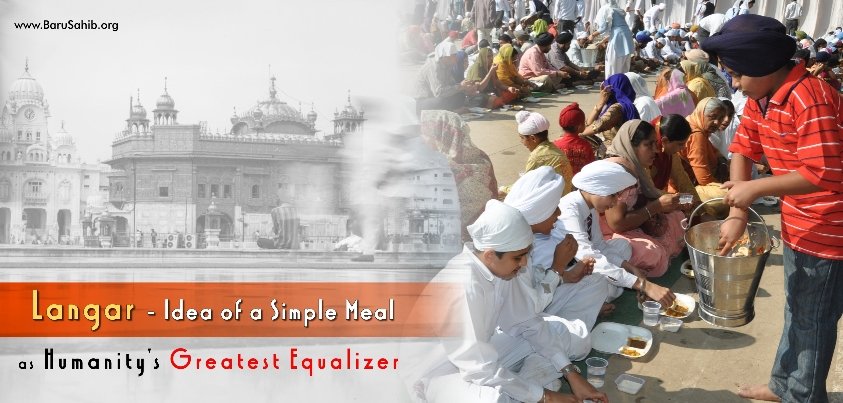
Langar – Idea of a Simple Meal as Humanity’s Greatest Equalizer

I elbow my way past pedestrians, carts and the occasional cow down a narrow road in Amritsar, Punjab. The afternoon sun beats down mercilessly, forcing me to squint. “Maybe it is a bad time to visit” I tell myself. Within minutes however, everything else seems to melt away as my eyes widen to take in […]

I elbow my way past pedestrians, carts and the occasional cow down a narrow road in Amritsar, Punjab. The afternoon sun beats down mercilessly, forcing me to squint. “Maybe it is a bad time to visit” I tell myself.

Within minutes however, everything else seems to melt away as my eyes widen to take in the sheer expanse and grandeur of the structure in front of me. Its minarets and walls glisten with gold and its central dome stands high in majestic glory, sagely surveying the thousands below. Considered the holiest of shrines in the Sikh religion, the Golden Temple is to Sikhs what St. Peter’s Basilica is to Catholics or the Kaaba to Muslims.

I buy a scarf to cover my head. Visitors are expected to cover their heads as a sign of respect. I leave my shoes and collect a token for them at a neatly organised stall, run by volunteers, before washing my feet in a pool of water (again, mandatory) I enter the shrine from one of its four entrances, built to indicate openness to all religions. Inside, the temple complex is massive with a large tank surrounding the temple. Devotees take dips in the holy water, while others mill around the marbled quadrangle with their eyes closed, brows furrowed and palms together, absorbed in their prayers. Despite the crowd, there isn’t the cacophony I had expected, but a revered silence. I am surrounded by European backpackers, newly weds, turbaned Sikh men and families.

One of the tenets of the Sikh religion is the “langar” – A kitchen, where a free meal is served to all visitors every day. This has been the practice since the founding of the Shrine in 1604. Imagine 100,000 people at a sit-down lunch every day! I cynically mutter “Impossible. Got to see this for myself”. Soon, I find myself in a queue approaching the dining hall with a plate and spoon in hand. Volunteers guide the crowd, wash used utensils and keep the place absolutely clean. The hall is lined with hundreds of people seated cross-legged on mats while Sikh men in uniform serve lunch – A simple but tasty vegetarian fare prepared by any visitor who wishes to contribute and serve on that day. My mind tries to calculate the number of rotis (flattened bread) that must be produced for 100,000 people on a daily basis. It is unfathomable.

Having lived and worked in the globalised world where everything must make “logical sense”, I don’t understand why the Sikhs do this. It requires immense planning, costs millions of dollars, no return on investment and… My thoughts are interrupted by a nudge in the ribs. The man sitting next to me, smiles. He is emaciated, wears torn clothes with white plaster stains on his shirt. He asks me where I am from. I tell him. He says I am a long way from home. He is a Hindu and though his family lives far away in another state, he has come to Punjab to make a living as a labourer. “A few more years…” he adds wistfully. In front of me, sits a turbaned gentleman in a business suit, his tie carefully tucked away while he eats. He catches my eye. “First time here?” he enquires in impeccable English. We start talking. He runs several businesses in Canada and visits India every year. “Surely there are Gurudwaras in Toronto?” I ask. “True…. But… It isn’t the same…” he trails off, looking around the hall.

Then it hits me! This is the reason why the Sikhs undertake this immense task – So that people, irrespective of religion, nationality, sex, status, caste or creed may sit down together and partake in a meal. No separate dining areas and no preferential treatment, even if you are the President. Underlying the principles of love and compassion, the founder of Sikhism, Guru Nanak decreed that no person must ever go hungry. Gurudwaras around the world take this seriously. The idea of a simple meal as humanity’s greatest equaliser moves me.

The man next to me wipes his mouth on his shirtsleeve and bids goodbye. He will be back again tomorrow he says. His friends wait for him on the other side of the hall. I wonder if Sikh volunteers at the temple would ever get irritated and consider regulars “freeloaders” My eyes follow the group of labourers as they exit the hall. A sturdy guard at the door flashes them a smile and engages in a quick, familiar chat. My question is answered.

I collect my shoes from an old man who mans the locker facility. I ask him if he works here. “Oh. No” he laughs “I am too old for that! But my wife and I choose to volunteer here 2 days every week” There is pride in his voice. He leans forward “Son, did you eat lunch?”
“Yes”

“Ah. Good” His eyes crinkle in an avuncular smile.

Of course the Golden Temple is a visual treat. Steeped in history, it boasts of beautiful architecture and rare paintings. But it is more than all that. It is not another visit that you merely cross off your travel agenda. It is an experience. It stays with you long after you go back to the world where everything must make economic sense and where there is no such thing as a “free lunch”

JOSHUA KARUNAKARAN

~ Source: thewire.in

Manjinder Kaur – The First SIKH to join US army at the age of 17

Manjinder Kaur was in the Police Academy from freshman year of her high school (9th grade), and from school projects, She found that she loved the idea of being in the military. She joined the United States Army at age 17 (November of 2001), turned 18 in boot camp training, and celebrated her 19th birthday […]

Manjinder Kaur was in the Police Academy from freshman year of her high school (9th grade), and from school projects, She found that she loved the idea of being in the military. She joined the United States Army at age 17 (November of 2001), turned 18 in boot camp training, and celebrated her 19th birthday in Mosul, Iraq.

She was born in Pind Mian-wal Arian, Dist Jalandhar, Punjab. After her father, Charanjeet Singh, filed for them, she came to California at age 6 with her mother, Lakhwinder Kaur and became a citizen shortly after. She has three younger siblings who are born in California.

She grew up in Stockton, California. When the 9/11 attacks happened, her father stopped wearing his turban and started to wear hats and beanies in fear of attacks from people who didn’t know the difference between Indians and Muslim terrorists.

Sharing her views on that, “I love being a Sikh, so I was very upset and decided that I would spread word about my religion to the world and that is why I joined. I watched the twin towers fall in history class on Sept 11- only 12 days before my 17th birthday. I wanted to join right way, but I could not join until I was 17. So, I completed my requirements for the army and signed up two months later, in November 2001. After completing 4 years in police academy during high school, I was ready to go further.”

She was deployed to Iraq from 2003 to 2004. She was part of the first team in the United States Army- “OIF Team One” was our title. From there, She volunteered for many missions without fear. She was chosen to go on many missions with my top leaders because she was Punjabi, she looked like an Iraqi, and many Iraqis respected her .

She shares her experience in Iraq saying “With this in common, many leaders wanted me to go with them. I lost some battle buddies in a fight against the enemies-(they were killed), one was my leader Command Sergeant Major Wilson. I was among several that were injured during combat. Some of the things I did was helping train and teach Iraqi police officers, women, and children, and handled enemy prisoners, and more. “

“After redeploying, I was stationed in Germany. I continued to spread word about being a Sikh and how we are a peaceful religion and the differences between us and Islam. Many soldiers were not happy to meet me at first because they thought I was a Muslim, but when I talked to them about being a Sikh, they started to understand and accept me- but I guess I could say ‘us’ referring to Sikhs as a whole. I am very proud of being blessed so I could spread our religion to many places around the world. I had my Nitnem Gutka Sahib with me when I was in the Army and would do Paatth often, no matter where I was.”

She is now a retired war veteran. She expresses her deep desire to continue to spread knowledge about Sikhism and even did her bit many school and college projects, videos, interviews, and reports on it, especially around Vaisakhi and Gurpurab.

She owns a vegetarian business where we make soaps, oils, lotions, conditioners, body scrubs, foot scrubs, make-up, and many more products perfect for the Sikh community, and especially for the Amritdharis. She has had a passion to serve the community since she was young and she chose to do so by providing products without animal ingredients in them.

On her last not, she shares her message

“I may not be the first Sikh female, but as I’ve researched, I have not found any others that joined before me. I would like to give a benefit of doubt and state that I am confident that I am at least in the top two count.

I am very proud of EVERY Sikh female that enters the United States Armed Forces and would like to one day stand beside them. Nothing would make me more happy than to meet these wonderful women!”

~ Tapasleen Kaur

NOTE- Due to lack to accurate information from the sources, we would like to rectify the information regarding the First SIKH Woman to join US army in our previous post about Ranbir Kaur

We would also like to invite such SIKH personalities to share their achievements so that it acts as a medium to inspire the Youth!

The Great Guru in Mecca!

Glowing countenance, book, staff, mat in hand Blue attired, wooden slippered, braving the sand Accompanied by disciple Mardana, the great Rababi Set forth Baba Nanak to Mecca dressed as a Hajji Mecca the land of Kabah stood imploring the devotees Reaching the city, Baba Nanak rested after daily duties Amazed locals cursed the visitor thus […]

Glowing countenance, book, staff, mat in hand Blue attired, wooden slippered, braving the sand

Accompanied by disciple Mardana, the great Rababi Set forth Baba Nanak to Mecca dressed as a Hajji

Mecca the land of Kabah stood imploring the devotees

Reaching the city, Baba Nanak rested after daily duties

Amazed locals cursed the visitor thus slumbered Feet pointing towards Kabah! He has blundered

The Kazi thus angered, arrived fretting and fuming Kafir your feet point towards the place of praying

Baba Nanak smiled and said politely, “O my brother, Move my feet to a place where is no God but other”.

Show me a house or an abode bereft of His being Show me a soul or an object out of His blessing

Lead me to a place where He is not to be found For I see and feel Him in every nook, corner around

On the feet of the great Guru, the Kazi fell Please guide me, as only truth is what you tell

You showed me the path, the right place of God Indebted I remain to you whole life, my lord

Glory of Nanak spread in Mecca and beyond Devotees came forward for his blessings abound

“Hindu greater or a Muslim”, from hint People inquired “Without noble deeds both will suffer” Nanak inspired.

~ Gurpreet Singh Rana

Nepal Govt pays Homage to Guru Granth Sahib Ji by issuing a Coin!

The Nepalese Govt has released a coin of Rs. 250 with an image of Sri Guru Granth Sahib engraved on it. The release of the coin has been gathering attention from the Sikh community all across the world. Sikh intellectuals and leaders are expressing their appreciation to the Nepal government. In an official email to […]

The Nepalese Govt has released a coin of Rs. 250 with an image of Sri Guru Granth Sahib engraved on it. The release of the coin has been gathering attention from the Sikh community all across the world. Sikh intellectuals and leaders are expressing their appreciation to the Nepal government.

In an official email to the Nepal Government, General Secretary of Sikh Youth Front Bhai Papalpreet Singh said that Sikh masses have no word to express their gratitude to the Nepal Government. “Truly the Government has given deep respect to Sikh religion for which its followers would be thankful forever” he added.

Like & Share to appreciate their respect worthy gesture!

~ Source: Sikh24

Dr Tarlok Singh – First SIKH to lead as the President of the Canadian Society of Agronomy

He was bestowed upon the responsibility of the President of the Canadian Society of Agronomy (CSA) on July 29, 2015. He was the first person of Indian origin and also the first Sikh to head the CSA, a national level scientific Canadian society. Last year, in July, he was unanimously chosen to be the President-Elect […]

He was bestowed upon the responsibility of the President of the Canadian Society of Agronomy (CSA) on July 29, 2015. He was the first person of Indian origin and also the first Sikh to head the CSA, a national level scientific Canadian society. Last year, in July, he was unanimously chosen to be the President-Elect (for which normally elections are held). President-Elect becomes the President after one year and Past President after two years. One has different responsibilities in all the three positions spread over three years.

A Brief biography has been stated here

Dr. Tarlok Singh Director of Research and Business, Thunder Bay Agricultural Research Station (TBARS), Thunder Bay, Ontario, has been heading the TBARS since January 2004. Dr. Sahota has generated a lot of valuable agronomic data. As a result of Dr. Sahota’s research and public outreach, area producers adopted a number of crops/crop varieties and beneficial nutrient management practices, diversified and expanded their operations and initiated new small scale commercial activities such as a stone grinding mill and a canola press to extract edible oil from canola.

Some of the new crops (especially new to the area of his work, which is Thunder Bay, Ontario) include Galega (a perennial forage legume from the Scandinavian countries), berseem, sorghum sudangrass, durum wheat, hard red spring and winter wheats, hard white spring wheat, canola and chickpea. Through his research ne has been able to offer new and higher yielding varieties of spring cereals/and other crops. One year, there were 15 barley varieties grown on Thunder Bay farms; a diversity that was unmatched anywhere else. Dr. Sahota was first to identify deficiencies of secondary and micronutrients such as sulphur, zinc and boron in field crops of Thunder Bay/Ontario. The fertilizer nutrient package along with high yielding crop varieties recommended by Dr. Sahota improved crop production as well as quality of produce cutting down on feed costs by farmers. As a result the prosperity on farms in Thunder Bay is pretty obvious. Glenn Coulter, Intellectual Property Inc. Calgary, Alberta, Canada, an independent consultant hired to look into the long term sustainability of the research station headed by Dr. Sahota commented as follows:

“For a moment, let’s examine the productivity of TBARS. This consultant has had about 45 years’ involvement in agricultural research, either as a scientist or manager of agricultural research, and I can say without hesitation that I have never in my career seen so much productivity from so few on a very limited budget! One only has to look at the summary of findings generated and published during 2014 We find it quite amazing that one full time scientist, two seasonal technicians and some summer help can do this much work implementing projects, conducting analyses, and transferring the results to the agricultural community in such a timely fashion. TBARS provides an extraordinary return on investment!”

Dr. Coulter in his report also mentioned that “When conducting interviews throughout the Thunder Bay community, whether within agricultural agencies, or the larger Thunder Bay community, the consultant was struck by the high level of recognition of the existence of TBARS and to a person*, everyone believes TBARS is doing good work important to the community. There is clearly a desire to see TBARS survive and thrive.”

*This person is none other than Dr. Sahota who because of his innovative research and extension has got a mass recognition!

Originally from a family farm (Village Phalpota, District Jalandhar) from the Punjab State of India, Dr. Sahota has Master’s and Doctorate degrees in Agronomy with distinction, from the famous Punjab Agricultural University Ludhiana, India. Dr. Sahota was selected for the International Course for Development Oriented Research in Agriculture (ICRA), Wageningen, The Netherlands (7 months course meant for young agricultural professionals) through an International competition. He was the only Indian among the 19 participants selected from 16 countries over the Globe.

Dr. Sahota started his career through the ARS in 1977, a national level competitive exam started by the Indian Council of Research in 1976. He was posted at the Central Potato Research Station, Shillong, Meghalaya, where he through his research and extension was able to bridge the gap between the potato yield at the research station and at the farmers’ fields. He has over 35 years experience in agricultural research, extension and development spread over four continents and 11 organizations. Highlights of his career include establishment of a 10101 acre commercially viable contract mint farming program for A. M. Todd Company USA and management of large scale commercial farms in Nigeria, including a fresh produce export project; involving production, grading and packaging of vegetables and fruits at Kano, Nigeria for shipping to London, England. Dr. Sahota served as an elected member of an International Panel for the Second External Review of ICRA, The Netherlands and has worked in multinational and multidisciplinary teams. Dr. Sahota has been an Ontario Certified Crop Advisor in good standing since 2007, has published over 300 research and extension papers and has made over 50 research presentations at the Canadian Society of Agronomy (CSA), Plant Canada, American Society of Agronomy, in addition to several presentations at the farmers’ conferences in Ontario.

Dr. Sahota is a member of the American Society of Agronomy for many years now and has been an Eastern Director of the CSA for two terms before becoming the President Elect of the CSA last year. He is a life member of the Indian Society of Agronomy and Indian Society of Soil Science and has held executive positions in the Indian Scientific Societies.

Since 1993, Dr. Sahota has held senior management positions reporting directly to the board of directors, has headed multimillion dollar projects/divisions and has served on the board of directors of a commercial organization, marketing agricultural inputs. Dr. Sahota was nominated for the CCA Award of Excellence in 2013 and for the Innovative Hero of the Year Award in May 2015. He was selected as one of the seven delegates for a professional visit to Seinajoki, Finland by the City of Thunder Bay in June 2015. Considering Dr. Sahota’s contribution to agricultural research, the Lakehead University, Thunder Bay appointed him as an Adjunct Professor with the Faculty of Natural Resources Management in July 2013. Dr. Sahota has a number of other awards to his credit.

~ Source: www.tbars.net

Beant Singh – ‘Flying Sikh’ sets a New Record in the National Federation Cup!

At the age of 16, Beant Singh has been tipped for big things. Flying Sikh won gold medal in federation cup junior national with new meet record (1:49.9). It was a big achievement that he won a gold in his first international race. An ecstatic Singh reveals his first love being wrestling and he switched […]

At the age of 16, Beant Singh has been tipped for big things. Flying Sikh won gold medal in federation cup junior national with new meet record (1:49.9). It was a big achievement that he won a gold in his first international race.

An ecstatic Singh reveals his first love being wrestling and he switched to athletics just a few years ago.

Beant had won a silver in the National Open Athletics Championships last year at the Jawaharlal Nehru Stadium in New Delhi, his first senior national medal, in 800m with a time of 1:51:08 which was a new national record in the youth category.

The young athlete Beant Singh also won a gold in the Asian Youth Athletics Championships in which his record 1.52.26 was among the fastest times in the world in the youth category.

With big expectations, he dreamt of beating the Indian national record and is motivated to move on that track.

Looking forward to this upcoming Milkha Singh!

The REAL Founder of the Indian National Army- Giani Pritam Singh Ji

Over the years since 1945, there has been an on going controversy about the founding father of the Indian National Army. For he was a civilian, who was the real brains behind the idea of the Azad Hind Fauj, a Giani Pritam Singh Dhillon. He has been mentioned in the early books published about the […]

Over the years since 1945, there has been an on going controversy about the founding father of the Indian National Army. For he was a civilian, who was the real brains behind the idea of the Azad Hind Fauj, a Giani Pritam Singh Dhillon.

He has been mentioned in the early books published about the INA-both in Punjabi and English. But over the years, thanks to a few vested interests, his name has almost disappeared. Even today, Sikh writers miss the point and continue to erroneously claim that Capt. Mohan Singh is the “founder”. Sadly, this just proves the shallow understanding and knowledge of these “writers” and their “research”
Although, I had read his name here and there, it was only in 2005, I first came across a very detailed account about Giani Pritam Singh , in a old book published in Punjabi by Vidhata Singh Tir, in 1949, where a whole chapter was dedicated to the INA. I found this book with a family in Moga, when I visited my ancestral village. It clearly stated that the idea of INA originated from Giani Pritam Singh, who had met with an Intelligence officer of the Japanese Imperial Army and mooted the idea.

image

May I add, as a young child growing up in Kedah, I had heard the name Giani Pritam Singh and some other interesting stories from the old time residents in Kedah.

However, over the years in books and history, his name has almost, but been erased and only two names are repeatedly mentioned, Capt, [later General] Mohan Singh and Chandra Bose, a Bengali Indian freedom worker, who lived in Germany and became the head of the European Indian Freedom League based in Berlin. Prior to that Bose had been involved in the youth wing of Indian National Congress, and escaped to Germany from India in 1940 after his involvement with agitation against the British
Whether by an act of God or mere fate, in 2014, I was in Harmander Sahib, sitting late into the night, when a young lad came and sat next to me, bringing two hot of cups of tea, offered me one, which was a welcome gesture out on a chilly night, on the cold marble floor.

This chance meeting led us to conversation, when finding out I was from Malaysia, he got very excited and said, my baba ji Giani Pritam Singh was in Malaya during the Japani time. He was involved in the Azad Hind fauj, ji. That name stirred my memories and interest. We got chatting, and he turned out to be Giani Pritam Singh Ji’s great grand nephew. That chance meeting revealed a lot of information, and curiosity on both sides. Most of the personal information and photos, I got from Lakhwinder Singh Dhillon, the young man. He has promised to get hold of the diaries, which now are said to be in a Amritsar, Press Office with a Ram Singh Majithia. He has promised to get them for me.

Giani Pritam Singh ji was born on the 18th of November, 1910 in village Nagoke Sarli, District Lyallpur, currently in Pakistan.

image

His father’s name was Sardar Maya Singh, and mother was Mata Fateh Kaur. Pritam Singh, as was the culture then, got married quite young to Bibi Kartar Kaur. They had two children. One son, Prithipal Singh, and a daughter Gursharan Kaur.

He did his early studies in Lyallpur, and then passed out as Giani from Lahore. He then joined the Lyallpur Agricultural College, but left half way to join the Shahid Sikh Missionary College in Lahore to become a Sikh missionary. His wife passed away in 1938.As missionary, and revolutionary his work led him to Bengal. While there he became actively involved with the Indian Independence Movement and Gadher Party. He was instrumental in the failed 1915 mutiny, that he stirred among a Bengal Lancers regiment. The authorities started hunting him. He fled via Burma to Bangkok, in 1919, where a number of Indian revolutionaries from other parts of India were living.
Once in Bangkok, he mingled with the local Sikh community and along with his missionary work began spreading the message of the Gadhar party.

Then he met with Major Fujiwara, head of the Japanese field intelligence section in the region, who had, even before the declaration of war by Japan, reached an agreement of collaboration with The Japanese at Bangkok on 4 December 1941 . It was Giani Pritam Singh’s idea, working with Major Fujiwara, that captured Indian soldiers be asked to join an Indian national army to fight for Indian independence. These plans were started long before the war broke out, among a group of revolutionaries based in Bangkok. His wife passed away in 1938, while he was still in Bangkok

Thus, Capt. Mohan Singh is NOT the founder of INA, but was ONLY the FIRST operational Commander of the INA, accepted the position on Giani Ji and Major Fujimura’s insistence.

The brains behind INA were Major Iwaichi Fujimura and a Giani Pritam Singh Dhillon.

In 1941, Capt Mohan Singh of the 14th Punjab regiment was stationed at the Thai border, in operation Matador, when the Japanese attacked. The 14th Punjab retreated along with the rest of the Allied Forces. Capt Mohan found himself in the jungles of Jitra, as a straggler. There they made an approach through locals to surrender to the Japanese, after they found some leaflets in Punjabi were dropped by the Japanese calling upon British Indian soldiers to surrender, and join the INA to fight the cause of Indian Independence.

At Jitra, Kedah, they were met by Giani Pritam Singh and Major Iwaichi Fujimura in a car that carried an Indian tri-flag along with a Japanese flag. They persuaded Capt Mohan to join the cause of INA. He was one of the most Senior Indian officers in the British indian Army. He agreed to take the operational command. He did NOT find the INA.

Next day, they gathered at Alor Star Gurduara, where the first ardas for the success of the INA and Indian Independence was done. Thus, a very strong element of little known history is attached to Alor Star Gurduara Sahib, that has not been realised nor commemorated or acknowledged by the local community, that a great event took place within it’s grounds.

I attach some historical photos of Giani Pritam Singh and other INA leaders, along with Major Fujimura, attending an all Malaya INA conference in Kuala Lumpur in 1943

The irony is, later an almost nobody from Europe, who worked with German based Indian freedom movement, Chandra Bose stole the show from Mohan Singh, who then went on to steal the role of Giani Pritam Singh, and kept Giani Pritam Singh’s personal diaries, which came into his possession after Giani Ji died in an air crash in Tokyo. Giani JI along with 6 other INA officials had flown from Saigon after a conference to Tokyo, where he died in an air crash accident at the airport, on 24 March 1942
The two children were shipped off to India from Singapore by another INA officer Colonel Niranjan Singh. Giani ji’s role was played down as Capt Mohan Singh took the diary records and did not divulge to the world. Giani Ji’s family was not able to voice the truth.
Like Capt Mohan Singh usurped the role of Giani PRITAM SINGH, the same happened to Capt Mohan Singh, as Chandra Bose, usurped the credit for INA.

As mentioned, writers with shallow knowledge have not pursued the story of Giani Pritam Singh, THE REAL FOUNDER of INA-Giani Pritam Singh Dhillon. Mohan was NOT the founder, just as Chandra Bose, as claimed in recent article derived from wikipaedia.

Kuala Lumpur fell on 11 January 1942 with 3,500 Indian prisoners of war and Singapore on 15 February 1942 with 85,000 troops of whom 45,000 were Indians. Giani Pritam Singh asked for volunteers who would form the Azad Hind Fauj to fight for freeing India from the British yoke, under Capt Mohan Singh’s command. A large number, again mostly Sikhs, came forward. Mohan Singh established his headquarters at Neeson in Singapore with Lt Col. Niranjan Singh Gill as Chief of Staff, LtCol. J. K. Bhonsle as Adjutant and Quarter master General and Lt. Col. A. C. Chatterjee as Director of Medical Services. The Azad Hind Fauj, however, was formally established on 1st September 1942 by which date 40,000 prisoners of war had signed a pledge to join it.

Another notable Sikh name was Colonel Gurbaksh Singh Dhillon.
It is claimed by most current writers that Giani Pritam Singh and Chandra Bose were “friends” is untrue. Records clearly show Giani Ji left India in 1919 and passed away in March 1942, in Tokyo.
Chandra Bose was in India until 1940 and left for Europe. He arrived in Malaya in 1943, after Giani Ji’s demise. They may have heard about each other, but they were not friends.

As I get hold of these Giani Ji’s diaries in near future, we will learn the TRUTH of history, not the “truth” made up by copycat writers.

– by Gurcharan Singh Kulim ~ ChaanPardesi@aol.com

Straight from the Heart – An Ode to Guru Harkrishan Sahib Ji

Great Guru, True Guru Har Krishan jee is the dispeller of sorrow. At the Gurdwara, a happy Baba jee with a shining face, told me how to ask for help. It really helped me – you may like to try it too : Go to the Gurdwara, leave behind your ego, worries and any other […]

Great Guru, True Guru Har Krishan jee is the dispeller of sorrow.
At the Gurdwara, a happy Baba jee with a shining face, told me how to ask for help.
It really helped me – you may like to try it too :
Go to the Gurdwara, leave behind your ego, worries
and any other thoughts that distract your mind.
Close your eyes and with all your heart talk to sweet child-Guru Har Krishan jee.
Say, dear Guru jee I need your help,
I am a mere worm who is full of faults,
but I place everything in front of you
and beg that you give me Your blessings
and save me from the mess I’m in,
like Your gentle touch saved the dying people from the Cholera epidemic.
Do your simran for a while
and feel the blessings pouring from the Guru Granth Sahib jee into your body
and filling you with warmth and wonder and love.
Then carry on doing your simran whilst doing some seva like washing the dishes,
by serving the Guru’s sikhs you are wiping your mind clean of ego.

Manbir Kaur rewarded 1 lac by the Pakistan Govt for her Incredible Feat!

15yr old Manbir Kaur from Nankana Sahib district of Punjab brings laurels to the Entire Sikh Community by securing 1,035 marks out of 1,100 in Secondary School Examination this year. Her achievement is no mean feat in a country where Sikhs comprise only 1% of the population. Pakistan Gurdwara Prabandhak Committee also announced to set […]

15yr old Manbir Kaur from Nankana Sahib district of Punjab brings laurels to the Entire Sikh Community by securing 1,035 marks out of 1,100 in Secondary School Examination this year.

Her achievement is no mean feat in a country where Sikhs comprise only 1% of the population.

Pakistan Gurdwara Prabandhak Committee also announced to set up a fund for brilliant Sikh students and initially donated Rs 1 million for the fund. She has rekindled a new hope to the Sikh Community!

Manbir’s father Giani Prem Singh is the head granthi at Gurdwara Sri Nankana Sahib, some 80 km from Lahore.Their house is not away from Gurdwara Janamasthan, the birth place of Baba Guru Nanak. “The whole family is delighted over her brilliant performance. Manbir used to study 12 hours a day and her hard work paid off,” he said, adding that the Sikh community in the district is proud of his daughter.

More than 200 Sikh families reside in Nankana Sahib. Manbir is mulling to join a private college in Lahore. By virtue of her good marks, she is entitled to a scholarship for both the government and private institutions. Manbir has applied for a pre-medical course as she wants to become a doctor.

~ Source: HindustanTimes

Manbir’s success is not ordinary for she is a true daughter of Guru Nanak dev Ji!

Cisco adds Zorawar Singh to its new CEO Team!

Cisco has named two new executives to the leadership team of new CEO Chuck Robbins. Zorawar Biri Singh is Cisco’s senior vice president and CTO, Platforms and Solutions, and Kevin Bandy is the company’s senior vice president and chief digital officer. Both will report to Robbins. As Cisco’s CTO, Singh will anticipate customer and industry […]

Cisco has named two new executives to the leadership team of new CEO Chuck Robbins.

Zorawar Biri Singh is Cisco’s senior vice president and CTO, Platforms and Solutions, and Kevin Bandy is the company’s senior vice president and chief digital officer. Both will report to Robbins.

As Cisco’s CTO, Singh will anticipate customer and industry transitions, and define the Cisco’s technology strategy, Robbins said in a blog post. He will develop Cisco’s long-term technology roadmap, platforms and architectures, and help set the foundation for our long-term investments.

Singh will also work with Chief Strategy Officer Hilton Romanski to align technology strategy with corporate development priorities. Romanski had been chief technology and strategy officer, taking over for the departed Padmasree Warrior. But Cisco spokespeople say the company always intended to bring in a new CTO and have Romanski focus on strategy.

Previously, Singh was a venture partner at Khosla Ventures, where he focused on enterprise IT software, predictive data analytics, cloud platforms and infrastructure investments. A 24-year industry veteran, Singh spent half his career as an entrepreneur building enterprise focused startups and the other half as a product leader at three companies, Hewlett Packard, IBM and Nortel Networks.

At HP, Singh was senior vice president and general manager of the company’s cloud business, where he oversaw HP’s global cloud portfolio and open source efforts. Prior to HP, Singh led corporate strategy and portfolio solutions as vice president of cloud computing at IBM and served as a member of the executive team that launched IBM’s cloud business unit in 2010.

~ Source: Network World