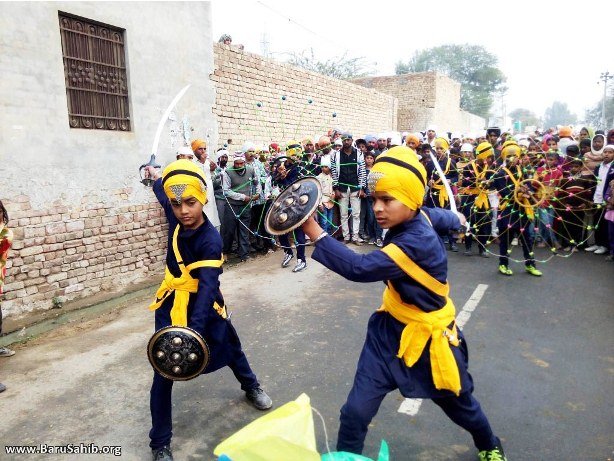
Students of Akal Academy, Theh Kalandhar celebrate Prakash Purab of Guru Gobind Singh Ji

Students of Akal Academy Theh Kalandhar displayed their colours of devotion on the 349th Prakash Purab. Spectacular Gatka Performances displayed by the students was the major attraction for all the devotees. Demonstration of Gatka Skill by youth enthralled the passers-by. Dressed up in their traditional attires, the students chanted religious hymns all along the holy […]

Students of Akal Academy Theh Kalandhar displayed their colours of devotion on the 349th Prakash Purab.

Spectacular Gatka Performances displayed by the students was the major attraction for all the devotees. Demonstration of Gatka Skill by youth enthralled the passers-by. Dressed up in their traditional attires, the students chanted religious hymns all along the holy procession to mark the auspicious day.

The atmosphere was filled with holy vibes and sanctity.

~ Tapasleen Kaur
~ New Delhi, 18th Jan ’16

Rare Footage of Guru Gobind Singh Ji’s Prakash Purab celebrated in 1943!

The last battlefield of the tenth Sikh Guru, shri Guru Gobind Singh sahib, lies in the district’s main city. A huge battle, knowns as Battle of Muktsar, took place between the Mughals and the Sikhs in 1705 where a Gurudwara, Gurudwara Tibbi Sahib, now marks the site.

The district has many historical Gurudwaras including, Darbar Sahib, Shaheedi Gurudwara, and Tibbi Sahib in the main city and many more in the different villages of the district.

A huge fair, known as “Mela Maghi”, is celebrated in January every year at Sri Muktsar Sahib city in the memory of the forty martyrs (liberated ones).

Amardeep Singh’s Travelogue brings the remnants of Sikh legacy in Pakistan to the forefront!

Mr Amardeep Singh, a naturalised Singaporean photographer who has spent one year in Pakistan documenting the “lost heritage” of the Sikh culture. Former high-flying exec sets himself task of documenting a vanishing legacy. To talk to Mr Amardeep Singh is to get a crash course in Sikh history – probably not something one would expect […]

Mr Amardeep Singh, a naturalised Singaporean photographer who has spent one year in Pakistan documenting the “lost heritage” of the Sikh culture.

Former high-flying exec sets himself task of documenting a vanishing legacy.

To talk to Mr Amardeep Singh is to get a crash course in Sikh history – probably not something one would expect from a former high-flying executive in the credit card industry.

The self-professed history buff delves deep into the bloody past of the Sikhs in Pakistan, gradually leading up to why he made his own pilgrimage there two years ago.

That trip culminated in a 500-page book – Lost Heritage: The Sikh Legacy In Pakistan – filled with glossy photographs and historical anecdotes about Sikh heritage sites in the country.

“I grew up with stories of massacres, of how we had fought and all the issues that resulted,” said the 49-year-old father of two daughters, who grew up in India but is now a Singaporean.

“But my dad also always used to talk about the pristine beauty of that land. And… it made an impact in my early childhood days and (created) a desire to actually go there.”

In 1947, the British colonial administration partitioned the Indian sub-continent into two independent states – Hindu-majority India, and Muslim-majority Pakistan.

Millions of non-Muslims were forced to move across the border to India and vice versa, with violence breaking out between the communities.

Mr Amardeep’s parents, who were Sikhs living in Pakistan at the time, were among those caught up in the mass migration. Members of his extended family were killed in the ensuing massacres.

Growing up, Mr Amardeep read extensively about the homeland he had never seen. Later on, during his 21-year career with American Express, he honed his writing and photographic skills.

His job took him from India to Hong Kong and finally, to Singapore in 2001, when he was 35. However, as an Indian citizen – which he was until 2005 – he was unable to secure a tourist visa to visit Pakistan due to the strained ties between both countries.

In 2013, he quit his job here as the company’s Asia Pacific head for revenue management “to do something different” and plunged into full-time history research. A year later, he was in Pakistan.

He recalled the pride he felt when he saw the temples, mansions and forts built by his ancestors. These included an 18th-century fort in Haripur built by Hari Singh Nalwa, then leader of the Sikh Empire’s army, and former Sikh homes in the city of Rawalpindi.

“These guys were living in style,” he said, turning the pages of his book to show pictures of towering gates and painted frescos. “They were at the peak of their civilisation.”

The founder of Sikhism, Guru Nanak, was born about 65km from Lahore (now in Pakistan) in the 15th century. The heart of the Sikh Empire, which rose to power in the late 1700s, was in the Punjab region.

Today, there are only around 20,000 Sikhs in Pakistan, which has a population of 182 million. There are about 13,000 Sikhs in Singapore, as of 2010.

Mr Amardeep felt deep sorrow for the legacy his people had lost. Many buildings he visited were abandoned and crumbling. Others were occupied by hundreds of poor families.

“Some buildings smelled bad and there was excrement all around,” he recalled.

A piece of graffiti scrawled on the wall of an old temple – now used as a storehouse – brought tears to his eyes. It read: “I lost my everything”.

But it was not all bleak.

Mr Amardeep has a picture of a former Sikh temple in the Mansehra region – now a library – whose walls are lined with books. “This is where we would keep our holy scripture, seven or eight decades back,” he said.

Several months later, back in his own library in Singapore, his eyes fell on two 19th-century British travelogues of the Sikh Empire. It was then that the idea to record his journey in the form of a book was born.

“A hundred years from now, none of these places will exist. They are about to fall apart; they won’t last more than 10 to 15 years,” he said.

“If I don’t document it, who’s going to do it?”

Said former Member of Parliament Inderjit Singh: “For Sikhs and Punjabis, there is great emotional attachment to the culture, heritage, and language, even of what was left behind in Pakistan.”

Yet publishers initially told Mr Amardeep that his vision – a 2.6kg, 500-page hardback – was not commercially viable. He began having doubts himself, too.

I started saying to myself: “You’re essentially a credit card industry guy; you’ve never done publishing. What are you trying to do?”

But he pressed on, finding 20 private backers for the self-publishing project, although he declined to reveal how much it cost.

Apart from serving as a visual record of the Sikh heritage, his hope is that it will spur members of the Sikh diaspora around the world to work with the Pakistani government and preserve some elements of their heritage.

“As an individual, I can’t do it,” he said. “I see myself as a catalyst, taking this work across the world, and… hopefully we can save some things.”

Lost Heritage: The Sikh Legacy In Pakistan will be launched in Singapore on Jan 30, at the National University of Singapore Society Kent Ridge Guild House. Those interested in the launch can register at lostheritagebook@gmail.com; the book can also be pre-ordered at lostheritagebook.com.

This article was first published on Jan 11, 2016.

~ Source: AsiaOneNews

Punjabi Poetic Legend Surjit Patar brings Glory of our Mother Tongue to Spotlight

ਮਰ ਰਹੀ ਹੈ ਸਾਡੀ ਭਾਸ਼ਾ I ਕੀ ਏਹਦਾ ਹੀ ਮਰ ਜਾਨੀ ਹੈ ਸਾਡੀ ਭਾਸ਼ਾ ?

Please make sure that you all contribute in preserving our mother tongue Punjabi. Teaching them to your kids will ensure the preservation of the Punjabi culture. It will also help to equip our younger generation with the language skills they need in today’s modern world. Learning Gurmukhi will help them read Guru Granth Sahib and follow the teachings of Guru Sahibs.

Scaffolding Slow Bloomers!

Teacher of Akal Academy, Kajri ‘s Article published in ‘The Progressive Teacher’ expressing concern for ‘SLOW BLOOMERS’ When a child is born, his parents have high expectations from the child that he will be able to hold his own in family, school and society. But not every child meets these expectations. This causes worry and […]

Teacher of Akal Academy, Kajri ‘s Article published in ‘The Progressive Teacher’ expressing concern for ‘SLOW BLOOMERS’

When a child is born, his parents have high expectations from the child that he will be able to hold his own in family, school and society. But not every child meets these expectations. This causes worry and frustration among parents, school administration, and disappoints the child as well along with her teachers.
Not only in our institution but in many other schools, principals, teachers as well as parents have to face the challenges of having children with low academic standing and performance.

Our school, this year as a special initiative has taken up the concerns of children with below average cognitive levels whom we call ‘Slow Bloomers’. The term ‘Slow Bloomers’ in pedagogical sense is used to label children having below average cognitive abilities but whom we cannot classify as disabled learners. Any child having compromised learning outcome in the general classroom setting for a prolonged time not only develops a low esteem towards his/her academics, but for his school system, with fellow learners which subsequently and progressively results in— getting into social and behavioral problems and ultimately forcing parents to hold back the child in the same class, change the school or drop out.

Definition and Prevalence

Nationwide slow learners occupy not more than approximately 10 to 14 percentage of children. Slow learners are the children who have specific learning levels and styles and therefore have special learning needs which arise out of their sensory, intellectual, and psychosomatic or socio cultural diversities and differences. Thus slow learners are not a disabled category but a diagnostic category of children.

Identification of ‘Slow Bloomers’

Identifying children having borderline intelligence must be done on the basis of child’s academic and non academic performance, his learning difficulties in vertical and horizontal levels using the child’s carefully recorded anecdotal evidence, parents’ feedback, and assessing problems in child’s individual learning styles. This helps the teachers at school and parents at home to find ways to support his /her learning at desired pace and strength. However, considering Bloom’s taxonomy of learning domains in the general classroom scenario, the following learning difficulties of the slow learners can be seen –

Difficulties at Cognitive Level

  • They have low mental abilities, cannot write their responses, fail to classify, compare, contrast, etc.
  • They lack problem solving skills, fail to decide, and lag behind others in academic performance.
  • They lack innovation and creativity, find it hard to think critically, are unable to form opinions, and cannot focus on problem areas.
  • They lack appropriateness and exactness, cannot exhibit and justify their opinions, fail to express logically.

Difficulties at Affective Level

  • They skip work, show unpreparedness to given tasks, delay tasks, assignments, do not bother to listen, and lag behind in developing values, hobbies, interests and attitude.
  • They face difficulty in answering questions, respond and communicate.
  • They fail to find value in learning experiences; have negative approach towards learning and schooling.
  • They fail to manage time and information; have low logical sense and opinion; do not easily understand the sequence or pattern of information or instruction provided.

Difficulties at Psychomotor Level

  • They find it difficult to perform curricular or co-curricular activities, lack hand and head coordination.
  • They have extremely poor kinesthetic or tactile skills, fail to communicate through actions and gestures, and cannot learn better with visual aids.
  • They fail to perform in sports, dramatics, recitation and other action related skills.
  • They have low esteem in art and craft, have poor handwriting, and can hurt themselves while using tools, etc.

Misconceptions About Slow Learners

In a traditional Indian school set up there is a common belief among some teachers, administrators as well as parents that children with struggling learning level have very low intelligence and are ‘problem learners’. In fact, the case is opposite. Various researchers, psychologists, and progressive schools working on slow learners have practically proved that through regular and changed teaching-learning tactics even slow learners have shown significant improvement in academics.

Strategies to Help Slow Bloomers

To meet the challenges of learning of the slow learners, in our school we have tagged on comprehensive and integrated teaching–learning plans to mitigate the learning gaps of this group of children. This year our school teachers as well as management have chalked out special interventional pilot programmes and case study projects and strategies to rescue the children from slow learner trap.

Chunking the Curricula and Lessons into Discrete Elements

Working memory of slow learners is small and they cannot easily handle new information. Slightly large or extensive information swamp the sequential working order of their memory. Since they have deficit readiness and background knowledge therefore they need to be taught in small convenient short sessions along with practice on the same information and skills.

In our school, we have divided our programme of study into weekly modules and teachers decide class wise the content to be taught alongside assignments, activities, project work, assessments, etc to be conducted in horizontal and vertical curriculum arrangement.

Develop Core Hobbies

Gardening, drawing, writing poems and stories, dramatisation, sketching, paper folding art (Origami), model making, pottery and many more are engaging and participatory activities in school. A well identified and planned hobby development programme for slow learners as a co-curricular activity provides an effective experiential learning routine, within or outside the school itself.

A hobby can enhance the children’s well-being and can give more meaning to their lives.

Pairing the Learners with Peer Mentoring

In the current educational set up peer mentoring has been seen favourably by educators and pedagogical researchers. A well planned and laid out pairing of the slow learners into smaller groups and observing them with peer mentoring will increase their interest and curiosity. Pairing and peering will have other benefits, like removing peer pressure, instilling spirit of participation, leadership and responsibility, building confidence by doing and getting away from learning inhibitions.

Linking Academic learning to real-world experiences

The terms ‘Learning by doing’, ‘authentic learning’, ‘learning by hands on experience’ are synonymous terms used to describe learning in which learners are actively engaged. Authentic learning typically focuses on real-world problems and find their solutions using role-play, exercises, problem based activities, case studies and through actual participation. The learning environments are inherently multidisciplinary. For example, making a sparrow house, repairing an instrument or tool, making a working model, preparing a balanced diet menu, setting up books in the library, doing survey work in the school or neighborhood.

Use Alternative Testing Options

‘Everybody is a genius but if you judge a fish by its ability to climb a tree it will live its whole life believing it is stupid’, stated Albert Einstein highlighting the need for understanding individual differences. Testing by teachers working on slow bloomers in an alternate setting with fewer distractions and hurdles can ease the stress level of students and remove test anxiety. While testing the learning of slow bloomers the following strategies can do wonders:

  • Drawing and colouring pictures, matching words, figures, sums, etc.
  • Arranging the sequence of events, processes or points based on prompts provided.
  • Drawing or labeling a diagram, finding answers in a given grid, circling the odd or similar items, think and answer, etc.
  • Shortened tests or answer choices. To a student with attention problems, having three possible choices instead of four can make a world of difference.
  • Giving the test during several sessions, with just one page per session, can also lead to less overwhelmed students. l Allow the use of notes during tests or allowing opening books during test (OBT).

I would like all the members of the teaching fraternity to remember that children need their love, patience, compassion and care to blossom. They need your helping hand to grow and fill your school garden with beauty and fragrance. As the ongoing month is just the beginning of the New Year, it is the time to make resolutions, shape our profession and groom ourselves to come up to the expectations of our school, parents and children.

While preparing another set of learning material for our school’s slow bloomers I tried to knit together some words to make this acrostic poem on ‘Slow Bloomer’ –

Supple though stunted but sure to up and set to stand,
Leaning to learn, firm to raise their answering hands,
Offspring of generation next,
striving to do their best,
Willing, to be perfect champs of generation next.
Be their best friend, guide and caretaker,
Love and teach tenderly, be their path maker,
On to them put your best, ignite their minds,
Oblige them to make the song of their brand,
Mar their failures and raise their hopes,
Enlighten their quest to leap for progress,
Raise them up to reap their own success.

~ Ashok Singh Guleria

Ashok Singh Guleria teacher of 19 years standing, is a post- graduate in English Literature. He writes on pedagogical issues and children’s behavioural concerns. Currently, he is the Head of Department of English and Academic coordinator cum Teachers’ Trainer at the Akal Academy Group of Schools, Kajri U.P.


First Time Ever! SIKH Pakistani Ranger participating in the Wagah Border Ceremony!

Making for a historic moment, a Sikh ranger from Pakistan Amarjeet Singh participated in the Retreat Ceremony at Wagah Border.

People from both the sides of the border welcomed the Sikh ranger with a huge round of applause when he came for the ceremony. The surrounding filled with the sound of claps when he shook hands with the Indian ranger.

He is the residence of Nankana Sahib, the holy city of Sikhs situated in Pakistan. He is said to be the first person ever from Sikh community to join the Pakistani army.

The Beating Retreat ceremony is a daily military practice that the security forces of India (Border Security Force) and Pakistan (Pakistan Rangers) have jointly followed since 1959.

The ceremony starts with a blustering parade by the soldiers from both the sides, and ends up in the perfectly coordinated lowering of the two nations’ flags.

It is called the beating retreat border ceremony on the international level. One Jawan (infantryman) stands at attention on each side of the gate. As the sun sets, the iron gates at the border are opened and the two flags are lowered simultaneously.

The flags are folded and the ceremony ends with a retreat that involves a brusque handshake between soldiers from either side, followed by the closing of the gates again. The spectacle of the ceremony attracts many visitors from both sides of the border, as well as international tourists.

Share & Spread this historic moment!

Nestle rolls out an Inspiring Video featuring 104 Yr Old Fauja Singh!

Nestlé, celebrates the incredible spirit of 104-yr-old marathon runner Fauja Singh in an inspiring video #100andRunning.

Nestlé has been celebrating its 100 years in India and as part of its ongoing campaign, has rolled out an inspiring video which features 104-year-old India born British Sikh marathon runner Fauja Singh.

Fondly called the ‘Turbaned Tornado’, Singh is regarded as the oldest marathon runner in the world. The video features the centenarian’s usual day when he straps on his running shoes and goes for the daily run. As the video progresses, viewers are familiariseg d with the achievements of Singh who ran his first marathon at the age of 89. The video features Singh’s relatives proudly sharing the marathon moments he has completed including 100, 200, 400, 800, 1500, 3000 and 5000 meters.

Singh has set five records in 94 minutes. He is a world record holder in his age bracket. His current personal best time for the London Marathon (2003) is six hours, two minutes. His marathon record for age 90-plus is five hours, 40 minutes, at age 92, at the 2003 Toronto Waterfront Marathon. Singh holds the UK record for the 200m, 400m, 800m, and 3000m run in his age group, all records set within a single 94-minute period.

“Happiness is when you are healthy. I run for my happiness. I’m not in it for any money or records,” Singh says.
Posted on the company’s official Facebook page, the video has garnered over 2,000 views and 100 shares within five hours after being uploaded in November.

The 104 year old marathon running legend, Fauja Singh continues to run. Watch the story of his passion for running, fitness and love for the land of his birth, India.#100andRunning.

Lets salute the Indomitable SPIRIT of Mr Fauja Singh!

Tennis Coach of Baru Sahib, GaganDeep Singh Umpires for the Chennai Open 2016!

Having served as a line umpire in seven International Events, Gagandeep was recently chosen for his eighth International Tennis Competition – Chennai Open 2016. He has been working as Tennis coach in Baru Sahib since 2011. He has a coaching experience of 12yrs & an umpiring experience for 8yrs, He has been offering the best […]

Having served as a line umpire in seven International Events, Gagandeep was recently chosen for his eighth International Tennis Competition – Chennai Open 2016.

He has been working as Tennis coach in Baru Sahib since 2011. He has a coaching experience of 12yrs & an umpiring experience for 8yrs, He has been offering the best of his training services & skills to the students of Baru Sahib.

His Personal Training has helped the students to lead in many state level competitions and made them won many trophies & national awards. He works hard along with the students so that they can explore the best out of their potential. Akal Academy Baru Sahib has always had a strong sporting tradition and students enjoy excellent sporting facilities. Students are guided by a team of professional members.

Share & Spread to be a part of this proud moment!

~ Tapasleen Kaur
~ New Delhi, 12th Jan ’16

Boxing Champ, Mandeep Kaur – All Set to become India’s Next Mary Kom!

Mandeep Kaur Won two Gold Medals Women’s World Junior Boxing Championship. 15-year-old Mandeep, who hails from Chakkar village, won gold medal by beating Ireland’s Niamh Earley in the final match by a 3-0 margin. Mandeep was dominant in her category (52 kg) throughout the tournament and registered some thrilling wins. Overall, it was fantastic tourney […]

Mandeep Kaur Won two Gold Medals Women’s World Junior Boxing Championship.

15-year-old Mandeep, who hails from Chakkar village, won gold medal by beating Ireland’s Niamh Earley in the final match by a 3-0 margin. Mandeep was dominant in her category (52 kg) throughout the tournament and registered some thrilling wins.

Overall, it was fantastic tourney for Indian boxers as they pocketed 7 medals in all – three golds, a silver and two bronze.

Mandeep’s father, who is a farmer, was unable to pay for her gloves or training equipment, which eventually led to the Sher-e-Punjab Sports Academy sponsoring her cause. Balwant Singh (the academy in-charge) also praised Mandeep for her achievement and touted as her one to watch out for in the near future.

Daljit Kaur, Mandeep’s mother said to a leading newspaper that Mandeep never missed her practice sessions and started her training sessions from 4 am sharp in the morning everyday.

Mandeep took inspiration from her elder brother (an amateur boxer) to take up the sport, who used to accompany her at the Sher-e-Punjab Sports Academy in Chakkar.

The young girl learnt the tricks of the trade watching her brother practice and followed his footsteps in the sport.

Mandeep who studies humanities (Class 12) at the Government Senior Secondary School, Chakkar, started playing the sport at the age of 7.

Source- DailySikhUpdate

This Joke is on YOU!

A recent Supreme Court petition calling for a ban on Sardar jokes forces us to look at whether the jokes are genuinely all in good jest. The recent petition in the Supreme Court that demands a ban on Sardar jokes might sound unreasonable, but it compels us to question whether these jokes are really just […]

A recent Supreme Court petition calling for a ban on Sardar jokes forces us to look at whether the jokes are genuinely all in good jest.

The recent petition in the Supreme Court that demands a ban on Sardar jokes might sound unreasonable, but it compels us to question whether these jokes are really just spontaneous, harmless fun. Like our fairy-tales, novels and films, jokes are complex narratives. They, too, have deep structures that reflect the geometry of our cultural politics.

Just as Sardars come in a wide variety, so do the jokes about them. There is a genre of Sardar jokes that you never got to hear from Khushwant Singh — and nor will the Supreme Court petition tell you about it. These are the jokes that Jatt Sikhs pass about Bhaapa Sikhs in Punjab. In these mockheroic parodies mimicking the Pakistani dialects of Punjabi that migrant Bhaapas speak, they are taunted for getting drunk on just a pauua (quarter bottle) of liquor and riding their Luna mopeds at the hell-for-leather speed of 10-20 kmph.

A Bhaapa is a Khatri or Arora Sikh, typically a migrant from Pakistan, an urban businessman and a canny trader. While a Jatt is portrayed in popular culture as a sturdy farmer fond of food and drink, brave, generous, crude, naive and reckless, a Bhaapa is stereotyped as a sissy, miserly trader. In Punjab, the Jatts dominate and Bhaapas are too few to count, but Bhaapas outnumber other Sikhs in cities outside Punjab. So the Bhaapas are stereotyped as conservative, sissy and kanjoos in Punjab but as loud, lavish and foolish elsewhere in the country.

This ceases to remain a puzzle once you agree that jokes, especially ethnic and racial ones, are less about the people who figure in them and more about those who tell them. Poles, for instance, are portrayed as stupid in European and American jokes even though Poland was a major centre of mathematical logic. Polish jokes can actually tell you a lot about the European geopolitics of the first half of the 20th century. So what do Sardar jokes tell us?

Most Sardar jokes smear the community with negative qualities (like the oversexed Sardar, scatological Sardar, foolish Sardar and so on). By branding Sardars as ‘irregular’, these jokes make an ‘other’ out of a community that is not afraid to mingle with different communities. Famously outgoing, Sardars readily embrace diversity. Their openness is not wholly welcome in conservative social orders where communities have well-defined divisions. The smear jokes that permanently mark them out as ‘others’ are a means to emphasise boundaries and ward off outsiders who are richer and physically stronger.

After Partition, Punjabi migrants flooded North Indian cities. Being a frontier community, they pushed at the limits when Hindu busineessmen were conservative and accumulative. Sikhs, and also Punjabi Hindu migrants, rose from rags to riches in decades. The stereotype of the goofy Sardar is the ‘other’ constructed by those who were dazzled by the inventive and adventurous enterprise of migrants. If you go out to find the bumbling duo of the Santa-Banta jokes, they will most likely turn out to be brainy businessmen who outsmarted a whole market to build a big business from scratch. In many jokes, the Sardar is in a new locale or an unusual situation or pitted with a technology he fails to figure out. But that does not deter him. He always acts. He fiddles with things. He is curious. He tests boundaries. He never stops short of a new experience. These jokes arise out of an incredulity at the inventive streak a Sardar shows in his enterprise. The jokes reveal the teller’s unwillingness to accept that the Sardar can succeed in his inventive ways.

In the movie Lage Raho Munna Bhai, the Sardar who constructed more floors than he had got permission for, explains, “Banate banate ban gayee (they just kept piling on).” In reality too, Sardars know no limits (although not in the villainous way of Munna Bhai’s Sardar). Having to leave their businesses back in Pakistan, they had nothing to lose by experimenting and improvising. The 12 O’clock Sardar jokes mirror a fear of the aggressive business community who had no interest in preserving the social or economic order symbolised by time. Though there is no clarity on the origin of these jokes, what we definitely know is the unchanging theme — the Sardar will do something foolish or disruptive at a given time.

The time symbolises the quotidian rhythm, the stable order or the status quo which comes under threat of the Sardar. As a pioneer community in a slow, unchanging India, especially in the cities of the Hindi heartland, Sardars were the disruptors who would break out of the snoozy status quo.

The idea that Sardars like the jokes made at their expense caught on with the ascendancy of Giani Zail Singh and Khushwant Singh — both of whom would have found good reason for self-deprecation in their ties with Indira and Sanjay Gandhi. Manmohan Singh changed the story. He too was seen as a rubber stamp of Sonia Gandhi but his academic and professional excellence gave him an aura of autonomy. And he did to India what a Sardar really would: he opened up the economy and encouraged Indian businesses to experiment. Being a Sardar was suddenly no longer a joke.

(Dharminder Kumar is a Delhi-based writer and journalist)

~ Source- Mumbai Mirror