
Major D P Singh – India’s First Blade Runner who was once blown apart by a mortar on the Kargil battlefield!

The army surgeon declared him dead on arrival after being blown by a mortar bomb and sent his wrecked body to a makeshift mortuary. But 25-year-old Major Singh was not ready to die. A mortar bomb had landed close to him on a Himalayan battlefield, during the 1999 Kargil War on the India-Pakistan border. A […]

The army surgeon declared him dead on arrival after being blown by a mortar bomb and sent his wrecked body to a makeshift mortuary. But 25-year-old Major Singh was not ready to die.

A mortar bomb had landed close to him on a Himalayan battlefield, during the 1999 Kargil War on the India-Pakistan border. A mass of bleeding tissue, broken bones and intestines ripped out and his fellow soldiers carried him to the field hospital.

The story of how he wins over death sounds incredible when you see him today, full of vitality

“When I learnt I lost my leg, I told myself that this would be yet another challenge in my life. I just couldn’t get used to the sympathetic glances I used to get from people. After a while, I was desperate to change that,” Singh said.

Now known as the ‘Indian Blade Runner’, he has been running marathons for 16 years.

It was at the mortuary on the mountains that another doctor from the army hospital spotted life in him. The chances of survival for anybody caught within eight yards of a mortar bomb are close to nil. He was embedded with sharapnel all over and his stomach was split wide open. The doctors had no choice but to remove some of his intestines. His leg had to be amputated too. But Major Singh refused to die.

Wafer thin, bedridden and disabled, the Major drew upon the survival instincts and courage that had spurred him to dive to the ground when the bomb landed about a yard and a half from him. Quick thinking had saved his life, but he would now have to learn to live anew.

“This was the start of my second life,” he told YourStory on the sidelines of the India Inclusion Summit in Bangalore. So what if life would never be the same again? It never is anyway. He decided not to think of his battered body as a disability. He looked upon it as a challenge, instead.

He stayed in hospital for almost a year. Hardly anyone believed he would ever walk again. But he thought, “Why just walk? I want to run.”

Major DP Singh’s transformation into the Indian Blade Runner didn’t happen overnight. He was never a runner before the amputation. But, “I wanted to run to inspire myself to go beyond my injuries,” .

Running with his prosthetic leg wasn’t just hard, it was excruciatingly painful. “I refused to crawl. Every time I fell, I took it as a test of perseverance. That way, it is easier to try again,” he recollected.

His first prosthetic limb was better suited for sprints than long distance running. Nevertheless, however agonizing it was, the Major was already running marathons when prosthetics specialists at Hanger Clinic in Oklahoma City chanced upon a video clip of him. They invited him over to fit him with a better prosthetic that allowed him the greater flexibility needed for long distance running.

His goal is to run a full marathon. “When I was injured, I recieved blood from countless people of different castes, creeds and states. With the blood of India running in my veins, I feel I can do everything”, he concludes.

Today, at 39, the Indian Blade Runner has run close to 20 marathons. When he runs, he doesn’t hide his artificial leg. Onlookers often drop their jaws and stare. That doesn’t bother him.

He is also a motivational speaker, inspiring amputees across India. He manages a support group called The Challenging Ones.

“I started this support group to inspire others in a similar predicament. Sports can help build confidence and help overcome the disability,” he said. “People like me are generally called physically challenged. But I believe we are ‘challengers’. The trauma of losing a part of your body is huge. Your family and friends cannot imagine life after amputation. The initial stage where the person realises that s/he has lost a limb is the most difficult. Peer support is crucial.”

His aim is to help amputees find life again. “Make the Challengers break all shackles of dependency and overcome fears of lack of mobility to live as they did earlier. There is no limit,” he says.

~ Source: yourstory

Yuba County Sheriff accommodates Reserve Deputy, Amandeep Singh to practice with his Articles of Faith!

Working for almost a decade, Amandeep Singh never lacked behind in his efforts for Sikhs to become law enforcement officers while still being able to wear the traditional turban and keep an unshorn beard.

Recently Singh, 25, of Yuba City, achieved another milestone and was appointed as the Reserve Deputy with the Yuba County Sheriff’s Department.

As a person practicing Sikhism, he adheres to his articles of faith, which means he wears a turban and has a full beard, as he doesn’t cut any hair off his body which signifies purity and strength for him.

“When I got the phone call saying that I had passed the test and got hired, I was speechless,” Singh said. “I was finally able to start pursuing my dream and the career that I’ve always wanted.”

In 2012, Singh testified at a hearing in support of Assembly Bill 1964, California’s Workplace Religious Freedom Act. The bill passed, and Singh credited the Sikh Coalition for assisting.

Before he was on his current path, he was faced with rejection after rejection which never even once stopped him fro fighting back.

“It brought my morale down, to get rejected over and over again, but I knew it was going to be a long, hard fight,” Amandeep said. “I kept at it.

It is big victory for Sikhs who want to enter into Law Enforcement. Undersheriff Jerry Read said he and the department understand Singh’s desire to become a career law enforcement officer and made concessions to accommodate him.

“We had to modify our hair regulations because we don’t allow facial hair, but we made an exception because of his religion,” said Read. “He understands that it’s a safety concern, so we met in the middle.”

Amandeep, who emigrated from Punjab to America with his parents when he was seven years old, chose a career in law enforcement because he wants to help other people. Singh said he has a turban that’s the same color as the hats Yuba County deputies wear and will tie it in a more compact way to accommodate the department’s safety concerns.

“With the beard, I put gel on it and tie it so if I get into a fight, no one can get at it so I’m not putting any other deputies at risk,” said Singh.

Singh said recently he and the full-time deputy he was riding with stopped for gas, and one of the convenience store clerks recognized him.

“When the clerk recognized me, she got emotional and thanked me for getting the law passed,” Singh said. “She was really appreciative of what I was doing.”

Singh said he was also pleased to hear a couple of other Sikhs in law enforcement benefited from his efforts. “I told myself even if I have to fight for this until I die that I would do it,” he said. Such was his dedication!

It’s very essential to see members of the Sikh faith in law enforcement roles , because until a representation of people belonging to Sikh faith are in that position, You cannot dream of getting such kind of religious freedom.

~ Source: appeal-democrat.com

If you’ve ever cracked Sardar jokes, you’ll feel deeply embarrassed after reading this!

It’s time we tell you how the ’12 baje gaye’ phrase got associated with the Sikhs. If legend is to be believed, the story dates back to the 18th Century when India was invaded by Nader Shah, the Shah of Persia. Nader Shah’s army reached Delhi in March 1739 and a massacre followed. Countless Hindus […]

It’s time we tell you how the ’12 baje gaye’ phrase got associated with the Sikhs.

If legend is to be believed, the story dates back to the 18th Century when India was invaded by Nader Shah, the Shah of Persia. Nader Shah’s army reached Delhi in March 1739 and a massacre followed.

Countless Hindus and Muslims were killed and the women were held captives. When his armies were crossing through Punjab, the Sikhs devised a plan to attack them and free the women. But since Nader Shah’s army was huge as compared to them, they decided to visit his camps only at night and free as many women as they could as stealthily as possible.

They even helped those rescued women return home safely because they knew how important a woman’s dignity was. But over time, the Hindus started referring to this kind gesture in the form of the 12 o’clock joke without even realizing that had it not been for those Sikhs, their women wouldn’t have survived.

They went out of their way to help their brothers.

Source: mensxp.com

Next Time you come across a Sardar Joke, make sure you SHARE this with them!

Students of Akal Academy, Phaphre Bhai ke participate in Green Wave Campaign!

Working towards the noble cause of living in harmony with the Mother Earth, the Eco-Club of Akal Academy, Phaphre Bhai Ke organised a Green wave Campaign sensitizing the students on the value of tree plantation. Students procured saplings from their homes, and planted them in the school compound. They were placed in large clay pots […]

Working towards the noble cause of living in harmony with the Mother Earth, the Eco-Club of Akal Academy, Phaphre Bhai Ke organised a Green wave Campaign sensitizing the students on the value of tree plantation.

Students procured saplings from their homes, and planted them in the school compound. They were placed in large clay pots and freshly dug earth mixed with manure.

The staff members looked on and offer friendly tips to ensure that each sapling was carefully tended.

Students became acquainted with the common names of the saplings like neem, kachnaar, tulsi, jamun, ashwagandha, etc.

It is made sure that the tradition of preserving environment and having eco-friendly activities is well maintained among the students.

Share & Spread to appreciate the efforts put in by these young transformers!

~ Tapasleen Kaur
~ New Delhi, 26th July ’15

From Sikh Kitchen to New Food Bank, Guru Nanak Dev Ji’s Vision spreads WORLDWIDE!

By taking the traditional concept of the “Langar”, or shared meal, out of the Gurdwaras and onto the street, these Sikhs have successfully managed to extend the idea of service globally, spreading its glory worldwide! This April, two Sikh organisations in New Delhi and Amritsar sent food relief to victims in post-earthquake Nepal. Apart from […]

By taking the traditional concept of the “Langar”, or shared meal, out of the Gurdwaras and onto the street, these Sikhs have successfully managed to extend the idea of service globally, spreading its glory worldwide!

This April, two Sikh organisations in New Delhi and Amritsar sent food relief to victims in post-earthquake Nepal. Apart from contributing 25,000 food packets a day each, they sent out teams of cooks and volunteers to set up community kitchens. These served hot meals to over 10,000 people a day.

Meanwhile, in the UK, the homeless are turning to Sikh community kitchens for hot meals as demand for food banks rises.

Meals are offered free, and everything from the buying of the food, to the preparation of the meals, is based on donations.

Spirit of service

The importance of selfless service or “seva” has been emphasised in the lives and teachings of the Sikh gurus. According to Guru Nanak, the founder of the Sikh religion, sharing one’s time and wealth with those in need is the best possible action. The idea of “langar” as a community kitchen was developed by Guru Nanak in his settlement at Kartarpur, now in Pakistan.

Devotees would farm the land before preparing food and sharing the meal. Langar – which refers to the community kitchen as well as the food served – was developed as a practical manifestation of the teachings where devotees were encouraged to work hard and share the fruits of their labour.

Sharing a langar – which includes cooking, serving, eating and cleaning up – emphasised the idea of equality beyond any categorisations of caste, gender, social status, ethnicity, or religion.

The introduction of “langar” into the Oxford English Dictionary in 2008 highlighted that this key tenet of the Sikh tradition had entered mainstream vocabulary. Those who experience langar in gurdwaras for the first time are often amazed at the scale of what is essentially a volunteer effort.

Gurdwaras are playing an important role as food banks, with an estimated 5,000 meals served to non-Sikhs each week by Britain’s 250 gurdwaras. In addition, Sikhs in the diaspora are increasingly making efforts to take langar out of the gurdwara so that it fulfils its core objective of serving the whole community.

In Canada, the Seva Food Bank serves food to low-income families. In Los Angeles, the Khalsa Food Pantry and Khalsa Peace Corps provide meals to the destitute, while the Sikhcess project provides food and clothing to the homeless in a number of local communities across the US.

British Sikhs have established food relief organisations in cities across the UK. The Midland Langar Seva Society in Birmingham, the Kirpa Food Bank in Wolverhampton, Guru Nanak’s Free Kitchen based in Doncaster and Edinburgh, the Bedford Langar project, the Sikh Welfare and Awareness Team (SWAT) based in London and Nishkam Help based in Birmingham and Leeds are some examples.

In addition to contributing to the communities they live in, Sikh charities such as United Sikhs also contribute to humanitarian efforts in different parts of the world as needed. Khalsa Aid, a UK based Sikh charity, which has provided disaster relief in Albania, Turkey, Somalia and Pakistan, made the headlines in 2014 when British Sikhs helped the Thames Valley and Somerset flood victims by delivering sand bags, food and medical supplies to those affected.

Demonstrating values and beliefs

The vision behind much of this food relief lies in the spirit of selfless service. The offering of food to all as a central tenet of the Sikh tradition has meant that Sikhs are often the go-to community for food relief. Indeed, given their non-proselytising nature, Sikhs are able to use langar as a practical demonstration of the values promoted by the Sikh gurus rather than simply talking about their beliefs.

For these Sikhs in diaspora, rather than simply referring to members of a particular ethno-religious group, “community” refers to anyone they engage with at a local, national or even international level. This view extends the idea of langar to the whole world, and allows them to put into practice the ideal of “Sarbat Da Bhalla” or, “working for the betterment of all”.

~ Source: theconversation.com

Beautiful Turbans spruce up kids of Akal Academy, Phaphre Bhaike on Dastar Bandhi Diwas!

Students of Akal Academy, Phaphre Bhaike participated in the Turban Tying Competition on the occasion of Dastar Bandhi Diwas. They partook the long-respected Sikh tradition of tying a turban, affirming their resolve to continue doing what their fathers and grandfathers and many generations before them had done, as a symbol of their Sikh identity. The […]

Students of Akal Academy, Phaphre Bhaike participated in the Turban Tying Competition on the occasion of Dastar Bandhi Diwas.

They partook the long-respected Sikh tradition of tying a turban, affirming their resolve to continue doing what their fathers and grandfathers and many generations before them had done, as a symbol of their Sikh identity.

The atmosphere echoed with “Sir Jaave taa jaave, mera Sikhi Sidak Naa Jaave” making the atmosphere emotional and inspirational.

The students are taught the art of tying a turban. Layer after layer were wrapped, adorning each child with a beautiful crown which they promise to adorn for the rest of their lives.

Such activities are organized to create awareness about relevance of the Turban & maintaining unshorn hair amongst youth.

The judges paid attention to every wrap and crease, and at last the winners were announced. The most beautiful ones were awarded and appreciated by the staff members.

Such competitions are a personal reminder of their faith and firm commitment to Sikhi.

~ Tapasleen kaur
~ New Delhi, 25th July ’15

Jalnidh Kaur – First Turbaned Sikh to win the Most Prestigious Rhodes Scholarship for University of Oxford!

In a rare honour, Jalnidh Kaur, a student from Punjab, has won a Rhodes Scholarship at the University of Oxford. It is the world’s oldest and the most prestigious international graduate scholarship program. The scholarship allows her to pursue her post-graduation at the University of Oxford, UK, and consists of funding of all the tuition […]

In a rare honour, Jalnidh Kaur, a student from Punjab, has won a Rhodes Scholarship at the University of Oxford. It is the world’s oldest and the most prestigious international graduate scholarship program.

The scholarship allows her to pursue her post-graduation at the University of Oxford, UK, and consists of funding of all the tuition fees for two years of post-graduation, air travel, plus a maintenance stipend to cover her boarding and lodging expenses.

The Rhodes Scholarship is given to youth of outstanding intellect, character, leadership, and commitment to service. It supports students who demonstrate a strong propensity to emerge as ‘leaders for the world’s future’.

Jalnidh Kaur has pursued Economics Honours at St Stephen’s College, Delhi. She intended to do an M.Phil. in Economics at the University of Oxford. Montek Singh Ahluwalia and Bill Clinton are but two of the famous recipients of the scholarship in the past.

Jalnidh Kaur, a resident of Ludhiana, Punjab, is the only child in the family. Her father is an Associate Professor at Punjab Agricultural University (PAU), Ludhiana and her mother is a Lecturer at Guru Nanak Girls College, Model Town.

Formerly a student at Guru Nanak Public School, Sarabha Nagar and the Sacred Heart Convent School, Jalnidh will complete her Bachelor of Arts this year. Jalnidh was also honored by the University of Hawaii, USA, with the title of Junior Fellow, the East-West Center.

In addition to formal academic prizes, Jalnidh achieved second prize in the ‘Budding Economist’ Quiz at Confluence National Economics Festival and pioneered the business plan ‘EurekaWow’ which promotes the concept of senior-to-junior knowledge sharing.

Alongside her academic work, Jalnidh founded Éclair, now a country-wide organization with over 100 volunteers offering informal schooling for children living on the streets.

She served as Youth Coordinator for the Punjab division of the Civil Society Against Drugs movement during the Punjab Assembly Elections in 2012.

She is also the author of three books, namely – ‘Divine Pills’, ‘Work is More Fun than Fun’ and ‘Economic History of India’. Longer-term, she would like to help combat the extreme social disparities in the world around her through contributing to value-based interventions based on social science research.

~ Source: Sikhchic

Share & Spread the pride of this Turbaned Kaur all over the WORLD!

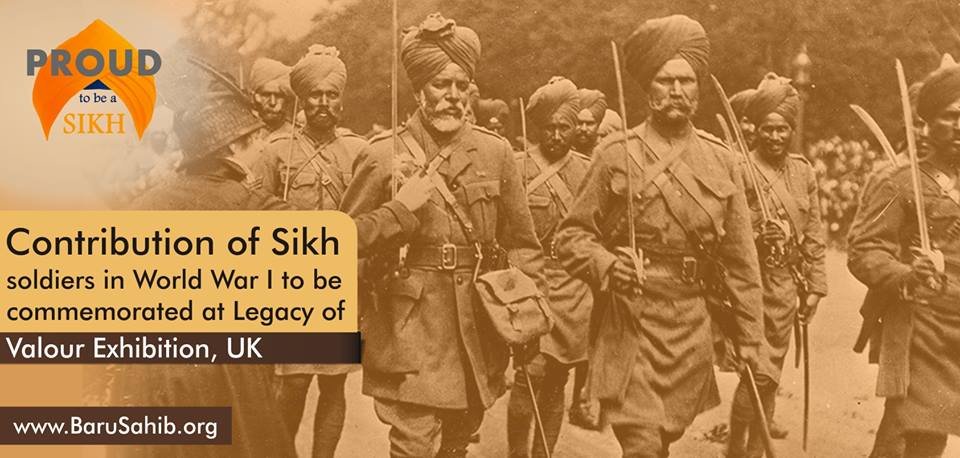
Contribution of Sikh soldiers in Wolrd War I to be commemorated at Legacy of Valour Exhibition, UK

The contribution of Sikh and other Indian soldiers in the First World War will be commemorated at a special exhibition in Reading. Reading residents can acknowledge and appreciate the efforts of more than 1.5 million Indian soldiers who fought for Britain at the Legacy of Valour exhibition between Sunday August 2 and Monday August 31 […]

The contribution of Sikh and other Indian soldiers in the First World War will be commemorated at a special exhibition in Reading.

Reading residents can acknowledge and appreciate the efforts of more than 1.5 million Indian soldiers who fought for Britain at the Legacy of Valour exhibition between Sunday August 2 and Monday August 31 at Reading Town Hall in Blagrave Street, Reading.

The free exhibition will display rare photographs of Indian soldiers, as well as highlighting the connection with Reading Town centre, where many Indians trained as Royal Flying Corps combat pilots.

The display will be opened on Saturday August 1 at a special ceremony by high commissioner of India to the UK Ranjan Mathai and her majesty’s lord lieutenant of Berkshire James Puxley.

Inderpal Dhanjal, Legacy of Valour project leader, said: “India provided Britain with a massive volunteer army in its hour of need. Over 1.5 million Indian soldiers and support personnel, one in six, served during 1914-18, fighting in all major theatres of war.

“The Legacy of Valour exhibition commemorates the remarkable but forgotten contribution of Sikh and other Indian soldiers in the First World War.

.”Legacy of Valour is a heritage project that was launched in October 2014 as part of the First World War centenary, with the aim of getting the Punjabi community living in Reading and Wokingham to learn, understand and share the contribution of Indian soldiers between 1914 and 1918.

The project is funded by the Heritage Lottery Fund and the local Punjabi community. It is also supported by local organizations.

~ Source: getreading.co.uk

Young Athletes of Akal Academy, Salamkhera outperform in Sports & bring pride!

Students of Akal Academy Salamkhera participated in different events organize by Sports Department of Haryana govt. at Block Level which was held at Govt. Sr. Sec. School Bighar. Out of which 24 Boys and 6 Girls displayed exceptional performances and bagged different positions. Football Team won the first position in this event. Principal Mrs. Jaibala […]

Students of Akal Academy Salamkhera participated in different events organize by Sports Department of Haryana govt. at Block Level which was held at Govt. Sr. Sec. School Bighar.

Out of which 24 Boys and 6 Girls displayed exceptional performances and bagged different positions. Football Team won the first position in this event.

Principal Mrs. Jaibala and all Staff members appreciated the hardwork & efforts of these students for their excellent performance.

Like & Share to appreciate the efforts of our young athletes!

~ Tapasleen Kaur
~ New Delhi, 23rd July ’15

Ranbir Kaur – First Sikh woman to Join US Armed Forces & also served in Afghanistan!

Ranbir Kaur was the first Sikh woman to join the US armed forces in 2003. She went on a one-and-a-half-year mission to Afghanistan. She had joined the US National Guard at the age of 17. She was born in Nijjran village of Jalandhar district, Punjab, the young fighter reached the US as a seven-year-old after […]

Ranbir Kaur was the first Sikh woman to join the US armed forces in 2003. She went on a one-and-a-half-year mission to Afghanistan. She had joined the US National Guard at the age of 17.

She was born in Nijjran village of Jalandhar district, Punjab, the young fighter reached the US as a seven-year-old after her father Mahan Singh, pursuing the American dream, secured a green card in 1990.

She was brought up in an isolated town called Earlimart, in California, her brush with the uniform dates back to 2001 when she was a freshman (Grade IX) in high school at Delano, which was the closest city.

In 2003, the daughter of a Sikh grape grower who faced the ire of white supremacists, who posted spam emails terming her recruitment as a means to seek citizenship. However she was already a US citizen, and the young girl set about proving her detractors wrong through hard training.

During the 2005 Katrina hurricane in New Orleans, the devout Sikh was instrumental in the recovery of the Guru Granth Sahib after the New Orleans Gurudwara was submerged.

United Sikhs, an organisation, had sought her assistance and Ranbir got everybody moving after she announced that the living Guru of the Sikhs was under water. Amid random shootings, air force rescue experts David Cruz and Tom Bausmas rescued the Guru Granth Sahib in an operation that lasted 22 hours.

After serving in Afganistan Ranbir was reassigned to Iraq were last year she was injured. She was returned to the States for a four week recovery period. She has returned to complete her tour of duty with her unit in Iraq.

~ Source: DailySikhUpdate