Akal Academy Kajri Holds Science Skill development Workshop!

Sciences and specially Physics chemistry in many schools is being taught since years and since decades it has been taught only through chalk and talk. Science education has reduced to transferring some formulae, equations and statements from the teachers lecture notes to the student. In order to make the teaching of science understandable, perceivable and […]

Sciences and specially Physics chemistry in many schools is being taught since years and since decades it has been taught only through chalk and talk. Science education has reduced to transferring some formulae, equations and statements from the teachers lecture notes to the student. In order to make the teaching of science understandable, perceivable and enjoyable, Akal Academy Kajri under the aegis of Kalgidhar Trust, Baru Sahib and Bharti Bhavan Publications organized two days Science workshop. Akal Academy Gomti, Telipura and Unnao science teachers eagerly participated in the workshop. The resource person on the occasion was Mr. Rakesh Kumar Awasthi.

Akal Academy Kajri Holds Science Skill development Workshop!

The first day of the workshop was dedicated to Strategies and Activities used in teaching of Science. Through demonstrations, and using innovative activities the resource person asked the teachers to use self-designed equipments and tools to enhance learning of concepts.

Baloons, paper toys, water, bottles metal parts can be reshaped and redesigned to make interesting teaching aids. In the concluding session feedback from the teacher was taken and teachers shared and demonstrated their learning experiences.

Akal Academy Kajri Holds Science Skill development Workshop!

The Principal Simran Kaur and Mrs Rangbir Kaur thanked the resource person and participating teachers from all Academies.

The second Day of the workshop was dedicated to the teaching of Chemistry using various tools and techniques. Teachers were thoroughly trained to design various simple experiments from almost all the sections of Physics, namely mechanics, heat and thermodynamics, waves, optics, electricity and magnetism. The session was interactive and all aspects of interpretation and the science to be learnt were freely discussed.

~ Tapasleen Kaur
~ New Delhi, 7th Jan 14′

Degh fateh – The Unsung heroes!

Ever since I can remember, I’ve been sitting on Gurdwara stages with my father – playing tabla, harmonium, or crying in my mother’s lap. Appearing on stage often meant we were constantly under the spotlight and given plenty of attention from sangat. Uncles and aunties frequently came up to me to give compliments on my […]

Ever since I can remember, I’ve been sitting on Gurdwara stages with my father – playing tabla, harmonium, or crying in my mother’s lap. Appearing on stage often meant we were constantly under the spotlight and given plenty of attention from sangat. Uncles and aunties frequently came up to me to give compliments on my tabla playing, since I was so young. Almost everyone knew who we were, and many people would meet or greet me with love because I was the son of a Bhai Sahib. We were constantly given respect by the sangat, due to our being at the forefront of the scene.

But today I would like to focus on someone else. Not the committee members, kathavachaks, or famous Raagis (all whom deserve respect and play vital roles in the Panth and Gurdwara ecosystem). Rather, today I would like to discuss the people who are left in the background. The average Joe (or Jeet) who spends hours doing seva but doesn’t get any fame, respect, or recognition. For the longest time, I took for granted just how complex it was to run the Langar in just one Gurdwara. Countless volunteers joining together to feed the sangat, with no personal gain in mind – now that is true selfless service. Every time I visit the Langar Hall, I see so many different faces – all pegs in this giant wheel, turning and churning to continue the operation of Langar. Just normal, random people, making rotis, washing dishes, rolling dough, setting plates and serving food. People of all ages, from little boys to old women and everyone in between.

Degh fateh - The Unsung heroes!

The sevadaars who serve food in the Langar line are visible to the sangat, but the people washing dishes or cleaning are often hidden in the back. We all eat and put our dishes away, but how often do we think about what happens next? How would the system work without all of these people doing their part? Have we ever stopped and thought, if there weren’t enough volunteers, how would the dishes get washed?

On random days of week, at odd hours of the night, you can find people there, ever ready to serve. It amazes me that there is always someone who sees a pile of dishes and decides to take out his or her time to do something about it. The necessary tasks somehow always gets done, relying on random sevadars to come do them. There are times when no one is taking care of a seva and other times when there are so many volunteers that there is no space to join them! From dumping trash to mopping the floors, the Sikh spirit of seva is still alive. Seeing it always fills me with happiness and inspiration. These are the real heroes, wonderful selfless sevadars without whom the whole system would collapse!

It never fails to amaze me how random and mixed the group of volunteers is. They’re not all amritdhari or even kesadhari. Countless people who don’t fit the typical “Gursikh” image are always doing seva, vacuuming, rolling rugs, being involved and helping out. These people deserve the real praise and recognition. This is not the same as getting time on stage and showing how fancily you can play harmonium, how vocally skilled you are or what bols you can play on a tabla, activities which are usually followed by praise or compliments. In fact, most of the background sevas don’t come with any credit or recognition. There is a reason Guru Gobind Singh Ji told Bhai Nand Lal to wash the dishes of the Khalsa, why Gursikhs often advise us to dust the shoes of Sangat. Sevas like these are meant to keep us humble.

Degh fateh - The Unsung heroes!

Whatever our motivation may be, ego usually tries to poke its head in. That’s why many people try to do seva in private. To be honest, I often face an internal struggle between not wanting anyone to see me while at the same time secretly hoping someone will! It’s tough not to become egotistical once you start doing a lot of seva. Something that is supposed to create a sense of humility can also give rise to more ego. In order for it to be truly fruitful, it is important for seva to be done without ulterior motives or expectation of rewards. It is even more beneficial if one were to do Simran at the same time.

I always wondered, what is the motivation and drive behind it? Why do people do it? And let me tell you, the only way to find out is by trying it yourself. It’s an amazing feeling, standing side by side with a stranger, with the same purpose and goal: to be one of many in this huge effort. No obligations, no expectations. I can say from personal experience that the feeling of peace and contentment you get doing seva is incomparable. Just knowing that you are doing something, however small, is satisfying. The contentment and sense of purpose I get from it is just.. I’ve never felt that anywhere else. And I’ve barely done any seva in my entire life!

Now, getting to the title of this post:

We’re all familiar with the famous Sikh Slogan “Degh Tegh Fateh”. Notice that the word “Degh” comes first. The Degh part is just as important to victory as the sword, or the warrior (sipahi) spirit. This means victory to the “cooking pot”, representing the concept of feeding and serving the community, making sure everyone is well fed in addition to providing protection and being politically victorious.

Over 500 years ago, Guru Nanak Dev Ji made the best investment of all time with only 20 rupees. To this day, that true bargain is paying off for the thousands who are getting fed around the world through the institution of Langar. If that’s not a good deal then I don’t know what is! People in all parts of the world are sitting together like equals and eating meals every single day, for free, all thanks to Dhan Guru Nanak Dev Sahib Ji.

Those who kept the Langars going and kept the Khalsa Army fed played a vital role in our Panth’s history. I say unsung heroes because we tell tales and sing ballads about the bravery and valor of our heroes who wielded the sword, but what about those selfless Sikhs who fed and served the Khalsa? The Sikhs who did seva in the Langar, like Bhai Manjh? Who sacrificed their families, comfort and personal health for the Guru’s institution of Langar? Sikhs like Bhai Taru Singh who gave up their lives for the Khalsa? For the amazing Khalsa Langar, where royalty and highly educated people like Bhai Nand Lal washed away their egos and purified their mind. That same Langar where emperors had to come sit at the same level as common people. Dhan Guru Ka Langar which even the enemy was welcome to come partake in!

It really humbles me to see kids, couples, families, and seniors on random days all cleaning the dishes. The feeling they get upon seeing a pile of unwashed plates, with no one there washing them, that feeling of shared responsibility, that, “Yes, I want to do something, to contribute, to make a difference.” The thought that “I’m willing to stick my hands in a sink full of yellow water and people’s leftovers rather than go home 15 minutes early.” It is very inspiring. It gives me hope. There is something glorious about it.

These are real heroes that we don’t acknowledge. But then again, maybe that’s what makes it special. There is something magical about coming outside and seeing all the shoes arranged in a neat line without knowing who did it. Perhaps recognizing these people and giving them awards would ruin it and take it all away. If you do these sevas, I salute you. If you truly serve, selflessly, I respect you. You are hundreds of times better than me and perhaps many others who preach from stages. And if you don’t, you should try it sometime. It’s an amasingh feeling.

~ Vikram Singh Khalsa
~ sOURCE: http://vikramkhalsa.com/

Sikh-themed float featured at Rose Parade’14 promoting better understanding of Sikh Faith!

Every year on New Year’s Day the Pasadena Rose Parade hits the streets to showcase the history and culture of Southern California and the country at large. This year, for the first time ever, the parade hosted a float that celebrated the important and little-known history of Sikhs in America. In the midst of hate […]

Every year on New Year’s Day the Pasadena Rose Parade hits the streets to showcase the history and culture of Southern California and the country at large. This year, for the first time ever, the parade hosted a float that celebrated the important and little-known history of Sikhs in America. In the midst of hate crimes and verbal attacks, the float told another side of the roughly 125-year history of Sikhs in America. A collaboration of United Sikh Mission, SikhLens, Khalsa Care Foundation, SALDEF and a team of dedicated Sikhs around the country, the float aimed to raise awareness about Sikhism in America, both past and present.

“The theme of this year’s Rose Parade is inspiring American stories,” Rashpal Dhindsa, founder of United Sikh Mission told the Huffington Post. “That is why the Sikh American story was such a great fit for the parade organizers this year.”

The float was modeled after the Stockton Gurdwara, the first Sikh house of worship established in the United States 102 years ago, SALDEF said in a press release. Also included in the design was a cornucopia and a locomotive to represent Sikh laborers and farmers like Didar Singh Bains, known as the ‘Peach King of California’ for growing the largest number of peaches in the country.

The float, with 17,000 multicolored roses and 2,500 gerbera daisies, tells the story of the Sikhs’ 125 years in this country. At the top is a replica of the first gurdwara, or temple, constructed in the U.S. It was built in Stockton in 1912 by immigrants from Indian state of Punjab, where most Sikhs are from.

A railroad engine represents the Sikhs who came to this country to work on the railroads. The red tractor and the peaches, grapes, almonds, cantaloupes and green fields highlight the number of Sikhs in agriculture. On the side of the float are photographs of prominent Sikhs, including one of a man dressed as Captain America. The float design also features giant peaches — the country’s largest peach grower is a Sikh.

Standing on a platform at the front of the 55-foot-long float will be a Sikh serviceman and three police officers, jobs Sikhs still are fighting for because of their turbans and beards. Sitting on a park bench will be doctors, lawyers and Boy Scouts, showing that a turbaned Sikh can be the person next door. At the front, the float says, “Sikh American Journey” in red, white and blue. Another group has started the four-day Sikhlens Art and Film Festival with Chapman University’s Dodge College of Film and Media Arts in Orange, giving scholarships so students can make movies about Sikhs.

The float shows the public that Sikhs are Americans with deep roots in the US. We hope Sikhs will have a float in the Rose Parade every year till everyone knows who we are!

~ Source: http://www.huffingtonpost.com/

Guru Gobind Singh Ji Prakash Diwas celebrated with Religious fervor by students of Akal Academy Bhadaur!

With the blessing of Akal Purakh, Akal Academy Bhadaur celebrated Gurpurab of Shri Guru Gobind Singh ji Maharaj on 5th Jan,2015 with great fervor & devotion. The programme started with divine grace. The congregation started with Nitnem followed by Gurbani vichaar delivered by the principal stressing on imbibing the higher values of life and communal […]

With the blessing of Akal Purakh, Akal Academy Bhadaur celebrated Gurpurab of Shri Guru Gobind Singh ji Maharaj on 5th Jan,2015 with great fervor & devotion. The programme started with divine grace. The congregation started with Nitnem followed by Gurbani vichaar delivered by the principal stressing on imbibing the higher values of life and communal harmony for which Guru Gobind Singh ji strived.

After a short break the students of our Akal Academy along with their teachers recited path of “Sukhmani Sahib” on the school playground. Kavishries and Religious songs were sung by the students expressing their devotion. Kirtan was rendered by students of class 10th followed by Anand Sahib path. Karah Prasad was distributed after divine Ardas. The whole environment was mesmerized with praises of the Great Guru and filled with positively. After the culmination of the congregation, the traditional Guru Ka Langar was served to all the students promoting the feelings of togetherness, fraternity and concern for fellow human beings.

~ Tapasleen Kaur
~ New Delhi, 6th Jan ’14

News Coverage:

Guru Gobind Singh Ji Prakash Diwas celebrated with Religious fervor by students of Akal Academy Bhadaur!

Efforts in making of a Drug-Free & Green Punjab by students of Akal Academy, Mayopatti!

Today the most pressing challenge for humankind is to learn to live in harmony with Mother Earth on a genuinely sustainable basis. Working towards this noble cause, Akal Academy, Mayopatti. under the aegis of The Kalgidhar Trust, Baru sahib organized a tree plantation drive as ‘Environment Degradation’ is emerging as an international challenge before all […]

Today the most pressing challenge for humankind is to learn to live in harmony with Mother Earth on a genuinely sustainable basis.

Working towards this noble cause, Akal Academy, Mayopatti. under the aegis of The Kalgidhar Trust, Baru sahib organized a tree plantation drive as ‘Environment Degradation’ is emerging as an international challenge before all communities of the world and we must plant more trees to save earth’s fragile ecosystem!

Efforts in making of a Drug-Free & Green Punjab by students of  Akal Academy, Mayopatti!

The concerned authorities also conceptualized rallies in an effort to help free the society from the evils of drug & alcohol abuse which are gripping the land Punjab, which, from being a land of the pious, is ironically having its youth crippled at the hands of drug menace, alcohol addiction and losing its ground over true Sikhi rampantly. Students pledged to transform their surroundings green by planting saplings. The students also displayed banners highlighting the need to plant trees to protect the environment. They painted colorful posters to spread the social message all around the surrounding areas.

Efforts in making of a Drug-Free & Green Punjab by students of  Akal Academy, Mayopatti!

The Principal also focused on the motive of curbing drug addiction also created awareness about Free Drug De-addiction centers that are run by the charitable organization “The Kalgidhar Trust” & propagated the message of love towards saving the environment through plantation of trees. She also added “ To foster children’s love and their interaction with nature, we sometimes bring students out and conduct classes in the open”.

Efforts in making of a Drug-Free & Green Punjab by students of  Akal Academy, Mayopatti!

From creating awareness among children about the ill effects of drugs , planting trees, to asking them to get a plant to school from their homes, to carrying out tree plantation awareness rallies around the school, the authorities of Akal Academy are doing everything possible to ensure that the students grow up to form the brighter nation!

Appreciate the efforts of these students propagating the message of social welfare!

~ Tapasleen Kaur
~ New Delhi, 6th Jan ’15

Women safety mobile app ‘Himmat’ launched catering to the safety of Working Woman!

A mobile application of Delhi Police called ‘Himmat,’ which will allow women to send a distress call to police control room and their relatives in case of any emergency, was launched recently. The app will basically cater to employed women who have smartphones and travel alone even late in the night. Pepper spray was also […]

A mobile application of Delhi Police called ‘Himmat,’ which will allow women to send a distress call to police control room and their relatives in case of any emergency, was launched recently. The app will basically cater to employed women who have smartphones and travel alone even late in the night. Pepper spray was also distributed to women and girls were awarded who had successfully completed Delhi Police self-defence programme. Delhi Police’s efforts were lauded to use technology for better policing.

Explaining the work of the app, Delhi Police commissioner BS Bassi said that after downloading the app, a new user has to register with the Delhi Police website by sharing their name, mobile number and that of a minimum of two relatives/friends.

Once the user registers, the user will get a SMS on mobile number given at the time of registration with a download link and registration key. User has to enter this key in the registration window in the application. This is a one-time process.

“In case of an emergency, the user can send an alert by shaking her phone or by pressing the power button/soft button. As soon as the distress button is pressed, it will trigger a 30-second audio and video recording on the phone which will be relayed to the Police Control Room, and the victim will get a call back from the PCR,” said Bassi.

An SMS alert will also be sent to minimum of five friends and relatives of the user and a status will be posted on his Facebook and Twitter timeline which will be connected to the App.

“All the details of the victim, including her location, time will be there in the SMS which will also be transmitted simultaneously by the police control room to the police patrol cars in the area and the local station house officer (SHO) through the Delhi Police cyber highway,” said Bassi.

The police however cautioned people not to misuse the App.

“Himmat application and service are to be used only when there is a threat to Life and Limb. Generating false SOS alerts/ alarms, intentionally/ unintentionally, will lead to cancellation of the registration after 3 such (False SOS alerts) incidents.

The user must report in an email/to support number, if in case they want to re-register and activate the facility. Support number is 011-23490378,” said Bassi.

“This app is currently available on Android platform, since a survey has revealed that most working women use Android based phone. In due course this facility will be extended to other operating systems as well,” said a senior Delhi Police official.

The Home Minister also asked Delhi Police to make the app available on iOS platform so that iPhone users can also use it.

Singh said traditionally Indians are more sensitive to women’s safety issues as women have been worshiped and respected through ancient times in our society.

“Providing self defence training increases self-confidence of girls and this is a good initiative by the Delhi Police which has so far trained more than 14,000 women… Being the national capital, Delhi does not deserve ordinary policing and ordinary police. We need modern policing and and modern police, other states should learn from Delhi Police,” he said.

The Home Minister accepted that the recent spurt in crime against women has caused a “trust deficit” and the image of Delhi Police and also the Home Ministry has taken a beating but he expressed hope that the police are aware of this and efforts are being taken to improve the situation.

Singh also informed that keeping in mind the inadequate representation of women in various police forces. The Home Ministry has issued an advisory to all states that efforts should be made to increase the representation of women to 33 per cent.

“The representation of women in Central Armed Police Forces is also just 1.22 per cent. In the next 2 to 4 years, we want aim to bring it 5 per cent,” he said.

On this occasion, Singh also unveiled an advertisement educating street vendors to report any kind of harassment by police officials on 1064 and 9910641064 on which a complaint in the form of an audio video clip can also be sent.

The Himmat app can be downloaded free of cost from the Delhi Police website – www. delhipolice.nic.in and also from the Google Play Store.
The application also has a help section which has details about how to use each section of the app. Users are requested to follow the instructions there.

It also has ‘Safety Tips section’ and First aid tips for women to help them in times of crisis.

In 2014, 11,000 women have used 100 number facility while 49,717 women have used number 1096, the anti-stalking and obscene calls helpline, and 1410 women have used the women helpline 1091.

~ Source: Economic times

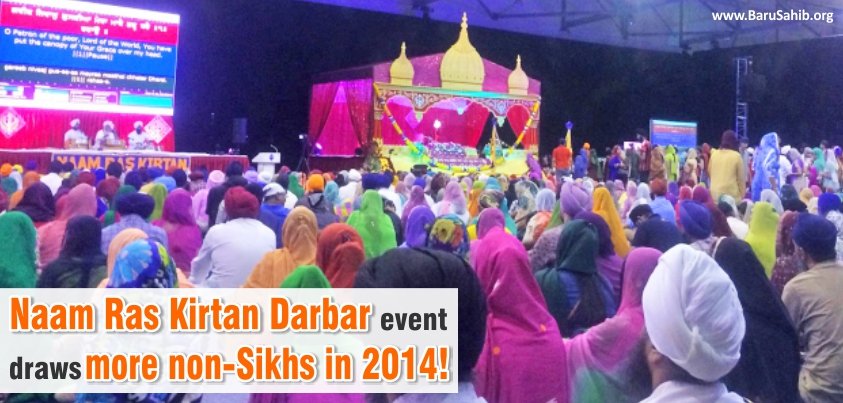
Naam Ras Kirtan Darbar event draws more non-Sikhs in 2014!

Naam ras Kirtan Darbar held at the Singapore Expo Hall from Dec 25 to 28, Naam Ras Kirtan Darbar 2014 brought thousands of people from Singapore and the region to an uplifting experience of blissful kirtan (Sikh traditional music and singing), selfless service, insightful awareness and a delectable spread of vegetarian Punjabi food. Particpants of […]

Naam ras Kirtan Darbar held at the Singapore Expo Hall from Dec 25 to 28, Naam Ras Kirtan Darbar 2014 brought thousands of people from Singapore and the region to an uplifting experience of blissful kirtan (Sikh traditional music and singing), selfless service, insightful awareness and a delectable spread of vegetarian Punjabi food.

Particpants of the biennial event were inspired by the level of selfless service and commitment that members of the congregation displayed as people from all walks of life contributed to the event in their own ways – serving water, manning the shoe counter and ushering, among others.

This year, Naam Ras also saw more non-Sikhs attend the event over the four days as it reached out to leaders and representatives of other faiths and ethnic groups in Singapore. Guests participated in a guided exhibition of Sikh history and heritage as well as a discussion aimed at providing awareness of Sikh values and traditions. Through these channels, Naam Ras displayed the central position that religious and racial understanding and respect play in the ethos and philosophy of Sikhs here, strengthening the community’s bonds within Singapore’s social fabric.
“The Naam Ras Kirtan Darbar was really a learning journey on the Sikh culture and how they practise (their faith),” said Mr Jalaludin Peer Mohamed, secretary of the Radin Mas Inter-Racial and Religious Confidence Circle.

~ Source: http://news.asiaone.com/

Father of Fiber Optics – Dr Narinder Singh who demonstrated the transmission of an image through glass fibers!

What does lasers, fiber optic communications, biomedical instrumentation, solar energy, pollution monitoring and lastly, the Internet all have in common? These inventions would not have been possible without Dr. Narinder Kapany’s scientific contributions to the world of physics. Recognized as the “Father of Fiber Optics” on a global scale, his research in the 1950’s led […]

What does lasers, fiber optic communications, biomedical instrumentation, solar energy, pollution monitoring and lastly, the Internet all have in common? These inventions would not have been possible without Dr. Narinder Kapany’s scientific contributions to the world of physics. Recognized as the “Father of Fiber Optics” on a global scale, his research in the 1950’s led to the development of fiber optics and he was the first person to demonstrate the transmission of an image through a bundle of glass fibers.

Dr. Narinder Kapany, a name that should be synonymous with other great contributors to technology and science like Bill Gates and Steve Jobs, gave the world fiber optics. A brilliant yet humble visionary, who has countless life lessons to offer and an infectious laugh that brings a beaming smile to anyone within earshot.

His dedication and commitment to his research and fellow man has helped shape the very nature of our world today. Without his efforts, the world would have been dull with shades of black, gray and white; instead we see it in a myriad of colors and waves. If you are told to believe something, even though it doesn’t sit right with you, don’t take it for its face value. Go out and try to disprove it. You just may in fact be responsible for the next great invention to affect our lives and change our world for the better.

Furthermore, these fibers are responsible for the transmission of higher bandwidths of information over great distances, in which their applications over the past few decades have revolutionized countless industries, including medical, communications, entertainment, networking and business to name a few. Without his groundbreaking gifts to science, none of this technology would have been invented and the very nature of our world would be dramatically different today. Dr Narinder Singh early pioneering contributions are definitely the key to the success and development of the Internet. This scientific genius hailing from Punjab, India was recognized as one of seven ‘Unsung Heroes’ by Fortune magazine in their ‘Businessman of the Century’ issue in 1999.

He is indeed a man of numerous talents and accomplishments. Throughout his life and career, he has been a scientist, inventor, entrepreneur, business executive, academic scholar, professor, mentor, philanthropist, art collector and an artist himself.

He’s been the recipient of countless awards and recognitions, including ‘The Excellence 2000 Award’ from the USA Pan-Asian American Chamber of Commerce in 1998 and the prestigious Pravasi Bharatiya Samman, which was bestowed by the Indian government and presented by former Prime Minister Atal Bihari Vajpayee in 2004. In addition, He holds over 100 patents and was a member of the National Inventors Council.

Born in Moga, Punjab and raised in Dehradun, Uttarakhand; He had an affinity for science from a young age. It started when he was given a small Kodak camera from his father and was determined to understand its inner workings. Moreover, in his early studies, he was told by a professor that light can only travel in a straight line. He thought to himself, “No, that doesn’t sound right” and took it as a challenge to prove his professor wrong. After obtaining his Bachelor of Science degree from the University of Agra, he says “there wasn’t enough to learn in India at that time so I left for Imperial College in London.” Transitioning from university in India to London was not a difficult feat for him, as he says “I was young and ready to conquer the world!”

His knowledge on technology started in India while working in an ordinance factory, where he learned how to design and manufacture optical instruments. Wanting to learn more about technology at a higher level, His intended goal was to finish his degree at The Imperial College of Science, Technology and Medicine in London and then head back to India to start his own business. The idea of having his own business and being an entrepreneur was something instilled in him from a young age.

While completing his studies, he received a scholarship from The Royal Society of Engineering to do further research into fiber optics. After 18-months and several published articles, He had successfully completed his objective of demonstrating the transmission of light and images through glass fibres. Upon the completion of his work, He presented his findings to his professor and at that point was ready to head back to India.

Another few hats donned by him is that of scholar, author and educator. He has published over 150 scientific papers, written four books on entrepreneurship and optoelectronics and taught at numerous reputable institutions in the State of California, including University of California, Berkeley; Stanford University; and the University of California, Santa Cruz.

Further notable undertakings include many philanthropic contributions to the areas of education and art. In 1967, he created ‘The Sikh Foundation,’ a non-profit and non-political charitable organization dedicated to promoting the culture, heritage and future of Sikhism. “I wanted to provide a platform for our children and other Americans to learn and find out what Sikhism is about.”

It was naturally inherent for him to create The Sikh Foundation because his family has been involved with charity and philanthropy work for decades, as it’s important for them to give back to local and global communities. He remembers his father fondly, and says while living in Dehradun, his father, along with a few friends, created the Guru Nanak Public School to provide free education for children. The school was very popular and what started out as a primary school, soon evolved to a middle and high school to eventually two colleges, one for men and the other for women. His father remained part of the school’s evolution and even at the age of 94, stayed on as an honorary manager of the two colleges.

The Sikh Foundation strives to foster awareness and greater ties between Sikhs and Americans in the 21st century, says Mr Singh and over the last few decades, the Foundation has been involved in a number of initiatives for academic courses and conferences to Sikh art exhibitions and the renovation/conservation of historical Sikh monuments.

Most recently, the Foundation worked with UNESCO to restore the mosque, which Guru Hargobind ji had built in the 1600’s for local Muslims in Punjab. He explains the mosque was “in a decrepit state,” and the Foundation, along with UNESCO, renovated the mosque, and “gave it back to local Muslim leaders in the area to foster cross religious and ethnic ties.”

In keeping with his philanthropic mandate, He has endowed a chair of Sikh Studies, under the name of his mother Kundan Kaur Kapany, at UC Santa Barbara and a chair of Opto-Electronics, and most recently a chair of entrepreneurship, at UC Santa Cruz. Moreover, He has avidly collected Sikh art and artifacts over the last few decades and in 1999, he donated $500,000 US and 100 Sikh artefacts from his personal collection to the Asian Art Museum in San Francisco.

“People didn’t realize there is such a thing as Sikh art, and there is a prodigious amount of this work that the world didn’t realize existed,”He said. “It’s a treat to have this collection and to share the beauty of our culture, not only with our community and youth, but with the world at large.”

His famous quote has always been “The important thing is to be a man of the world, that’s what I have tried to be, and to a small extent succeeded, but I like to do things for people.”

~ Source: http://iseeindia.com/

Thousands attend the Sikh parade at Tauranga commemorating Guru Gobind Singh Ji’s Prakash Purab!

All the colour and some of the cultural traditions of India were on show at the weekend as thousands turned out to take part in the inaugural Tauranga Sikh Parade. The street parade, held on Saturday, was hosted by Tauranga Sikh Sangat Temple and was part of a traditional Indian ritual to mark the birth […]

All the colour and some of the cultural traditions of India were on show at the weekend as thousands turned out to take part in the inaugural Tauranga Sikh Parade. The street parade, held on Saturday, was hosted by Tauranga Sikh Sangat Temple and was part of a traditional Indian ritual to mark the birth of the religion’s revered 10th leader, Guru Gobind Singh.

The 2500-strong crowd made its way along Burrows St and through several Avenues streets before heading back to the Sikh temple to continue the celebrations, which included prayers and free food and drinks for everyone. The parade was led by a group of 10 specially selected men who were carrying swords and sticks and who performed an ancient Indian martial art form called Gatka, giving thanks to their guru. At the start of the procession water was also showered on the roadway to purify the path for a truck carrying the holy book of Sikh followers.

Tauranga MP Simon Bridges and Tauranga City Council member Kevin Clout were honoured guests.Organiser Jasneet Bola said the parade had been conducted several times in Auckland but this was the first time it had been held in Tauranga.

Sikhs from Te Puke, Papamoa, Hamilton, Rotorua and Auckland had also travelled to participate in the event.

“Our community is really, really happy about how everything went, particularly the response from spectators and our invited guests. We were so excited about doing this and everyone chipped in to help fund each part of the service so it wasn’t such a big burden on any one person,” she said.

Ms Bola said the preparations included mixing 70kg of dough to make thousands of japatis, [Indian bread] and decorating two trucks, including the one holding the holy book.

Free food and non-alcoholic drinks were also handed out to spectators along the way, who were also invited to join in the celebrations, she said. “Every person contributed to the parade’s success in some way, and all the many hours of preparation was so worth it. “We definitely plan to host the parade in Tauranga again next year.”

Mr Bridges said the event was a “great display of colour and culture”.

~ Source: BAY OF PLENTY TIMES

#Justin Picture of Tug of War between the students at Akal Academy Dhotian!

Akal Academy Dhotian takes good care of the physical & mental health of its students by engaging them into well-organized sports activities as sports is a compulsory and valued part of the curriculum and is an integral part of a child’s development. Tug of war (rope pulling) is a sport that directly pits two teams […]

Akal Academy Dhotian takes good care of the physical & mental health of its students by engaging them into well-organized sports activities as sports is a compulsory and valued part of the curriculum and is an integral part of a child’s development. Tug of war (rope pulling) is a sport that directly pits two teams against each other in a test of strength.

Each school day contains afternoon sessions lasting approximately one hour each which are devoted to sporting activities. School Programs include inter and intra-school competitive sport, outdoor recreational or adventure sports, fitness, sport development and physical recreation activities. Students are encouraged to participate in a way that suits their interests and abilities. During school sport students will develop a variety of skills that will equip them for lifelong participation in regular sport and recreation activities.

#Justin Picture of Tug of War between the students at Akal Academy Dhotian!

Regular participation in sport and physical activity is associated with a range of physical and mental health benefits both in childhood and adulthood. Active children generally become healthy adults and schools play a key role in contributing to that outcome.

Like & Share to appreciate!