This is what Sikhs look like!

Sikhism is the world’s fifth-largest religion, with roughly 25 million adherent dispersed throughout the globe. The faith teaches that all people are equal before God and should develop their spiritual character through humility, compassion and generosity. Sikhs typically keep their hair uncut as a symbol of unity with God, and men — and some women […]

Sikhism is the world’s fifth-largest religion, with roughly 25 million adherent dispersed throughout the globe. The faith teaches that all people are equal before God and should develop their spiritual character through humility, compassion and generosity. Sikhs typically keep their hair uncut as a symbol of unity with God, and men — and some women — cover their hair with turbans as a mark of faith.

Unfortunately, Sikhs are one of the most misunderstood religious groups in America. Subjected to countless hate crimes and attacks over the years, Sikhs have born the brunt of many Americans’ xenophobia and still manage to promote peace and religious literacy through it all.

HuffPost Religion invited Sikhs on social media to share their depictions of#whatsikhlookslike — putting the power back in Sikhs’ hands to define themselves.

The response revealed a diverse and vibrant community that refuses to be pigeonholed. If you would like to share an image of what Sikh looks like to you, share your photos tagged #whatsikhlookslike with @HuffPostRelig on Twitter.

Source: www.huffingtonpost.com

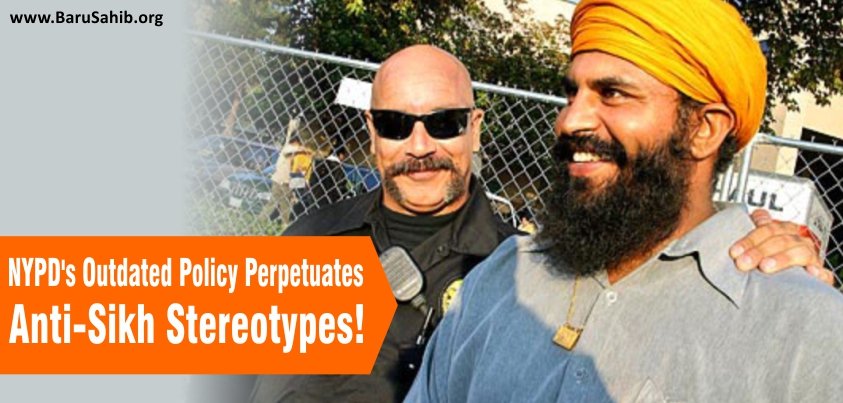
NYPD’s Outdated Policy Perpetuates Anti-Sikh Stereotypes!

For the second time in a month, a Sikh-American was physically assaulted in a reported hate crime in New York City. On July 30, a man in a pickup truck directed hate speech at 29-year-old Sandeep Singh before running him over and dragging his body with his vehicle. On Aug. 7, Jaspreet Singh Batra, a […]

For the second time in a month, a Sikh-American was physically assaulted in a reported hate crime in New York City.
On July 30, a man in a pickup truck directed hate speech at 29-year-old Sandeep Singh before running him over and dragging his body with his vehicle. On Aug. 7, Jaspreet Singh Batra, a medical scientist who was walking with his mother, was attacked by a group of teenagers who shouted racial slurs while punching him in the face and the back of his neck.

Batra’s case bears a striking resemblance to last year’s incident involving Prabhjot Singh, a physician and professor at Columbia University who was chased down by a group of teens shouting “Get Osama!” and “Terrorist!” The attackers fractured Singh’s jaw and dislodged several of his teeth before dispersing.

Sikh Americans, easily identifiable by their uncut hair, turbans and beards, have been disproportionately targeted in hate violence since the 9/11 attacks. Nationwide, there have been more than 700 attacks and discrimination incidents against Sikhs since 9/11, according to the Sikh Coalition, the largest Sikh civil rights organization in the United States. This includes a brutal attack two years ago on a Sikh temple in Oak Creek, Wisconsin, which took the lives of six worshippers.

Despite the national outrage after Oak Creek, Sikhs continue to be targeted in hate crimes. A 2009 report by the Sikh Coalition found that 41 percent of Sikhs in New York City have been called names such as “Osama bin Laden” or “terrorist” and that 9 percent of Sikh adults have been physically assaulted because of their religious identity. (By way of comparison, in 2012, when the national population just topped 300 million, the Federal Bureau of Investigation documented 6,000 hate crimes in the United States — a a rate of 0.002 percent.)

Police departments are too often part of the problem. For instance, the New York Police Department maintains a policy that effectively bars observant Sikhs — who follow the religious mandates of keeping a turban and uncut hair — from serving on its force. They may only serve if they hide their turbans under police hats, which Sikh traditions prohibit.

Of the 500,000 Sikhs living in the United States, tens of thousands call New York City home. The NYPD’s unwillingness to accommodate an important part of its community gives New Yorkers a green light to do the same — and perpetuates the very stereotypes that lead to hate crimes.

Limited victory
In 2001 the NYPD traffic control division fired Amric Singh Rathour for refusing to abandon his turban and uncut beard. His letter of termination cited a provision of the NYPD dress code that requires all traffic enforcement agents to wear a police cap and maintain a beard no longer than one millimeter. While the NYPD maintains this dress policy to ensure uniformity, it fails to consider that the particular appearance it mandates is exclusionary and outdated and has no bearing on an officer’s ability to do his or her job.

“Until our law enforcement agencies fully embrace the populations they serve, they will remain complicit in perpetuating the same negative stereotypes that engender hate crimes.”

The Sikh Coalition took on Rathour’s case, arguing that Sikhs must receive an equal opportunity to serve in the nation’s largest police force. The two sides reached a settlement after two and a half years of litigation. Rathour received his job back, and a policy change now guarantees the right for every Sikh American to serve as a traffic enforcement agent with the NYPD. While Rathour’s victory is significant, the policy change remains limited to the traffic control division; the rest of the department still effectively bars observant Sikhs from joining its ranks.

In a letter this month (PDF) to Mayor Bill de Blasio and Police Commissioner William Bratton that addresses the recent spate of hate crimes, Rep. Joe Crowley, D-N.Y., urged action to keep Sikh Americans safer. One way to do so would be for the NYPD to reconsider its no-turban policy, Crowley said. And it’s true: It would send a message that law enforcement is committed to fully embracing the communities it aims to serve and protect.

Setting an example
As issues of dress code and religious freedom have increasingly come under judicial scrutiny, discriminatory policies have failed to stand up. Over the past several years, law enforcement agencies across the country, including the Metropolitan Police Department in Washington, D.C., and the Milpitas Police Department in California, have voluntarily adopted provisions to allow Sikh Americans to serve without discrimination. Such provisions are also in place in other sizable police forces around the world, including Toronto’s and London’s.
The NYPD certainly has the capacity to modernize its dress code in the name of religious diversity. In June 2012 it fired Fishel Litzman, a Hasidic police cadet, over the length of his beard. He filed a religious discrimination lawsuit, and Federal District Judge Harold Baer upheld his civil rights by ruling in his favor. The NYPD reinstated him with his religious freedom and his beard intact.

Rathour and Litzman challenged the NYPD’s discriminatory policy and successfully won the right to serve in the force without renouncing their religious identities. These victories pave the way for a formal policy change that guarantees religious liberty for Americans of diverse religious backgrounds who wish to serve in the NYPD.
As our nation continues to modernize, our public institutions ought to follow suit. It is time for police forces across the United States — including the NYPD — to follow the examples other departments have set by abandoning their outdated and discriminatory policies. Until our law enforcement agencies fully embrace the populations they serve, they will remain complicit in perpetuating the same negative stereotypes that lead to hate crimes.

Simran Jeet Singh is a Ph.D. candidate in the department of religion at Columbia University. He serves as the senior religion fellow for the Sikh Coalition and as a fellow for the Truman National Security Project.

~ Source: america.aljazeera.com

NYPD’s Outdated Policy Perpetuates Anti-Sikh Stereotypes!

For the second time in a month, a Sikh-American was physically assaulted in a reported hate crime in New York City. On July 30, a man in a pickup truck directed hate speech at 29-year-old Sandeep Singh before running him over and dragging his body with his vehicle. On Aug. 7, Jaspreet Singh Batra, a […]

For the second time in a month, a Sikh-American was physically assaulted in a reported hate crime in New York City.
On July 30, a man in a pickup truck directed hate speech at 29-year-old Sandeep Singh before running him over and dragging his body with his vehicle. On Aug. 7, Jaspreet Singh Batra, a medical scientist who was walking with his mother, was attacked by a group of teenagers who shouted racial slurs while punching him in the face and the back of his neck.

Batra’s case bears a striking resemblance to last year’s incident involving Prabhjot Singh, a physician and professor at Columbia University who was chased down by a group of teens shouting “Get Osama!” and “Terrorist!” The attackers fractured Singh’s jaw and dislodged several of his teeth before dispersing.

Sikh Americans, easily identifiable by their uncut hair, turbans and beards, have been disproportionately targeted in hate violence since the 9/11 attacks. Nationwide, there have been more than 700 attacks and discrimination incidents against Sikhs since 9/11, according to the Sikh Coalition, the largest Sikh civil rights organization in the United States. This includes a brutal attack two years ago on a Sikh temple in Oak Creek, Wisconsin, which took the lives of six worshippers.

Despite the national outrage after Oak Creek, Sikhs continue to be targeted in hate crimes. A 2009 report by the Sikh Coalition found that 41 percent of Sikhs in New York City have been called names such as “Osama bin Laden” or “terrorist” and that 9 percent of Sikh adults have been physically assaulted because of their religious identity. (By way of comparison, in 2012, when the national population just topped 300 million, the Federal Bureau of Investigation documented 6,000 hate crimes in the United States — a a rate of 0.002 percent.)

Police departments are too often part of the problem. For instance, the New York Police Department maintains a policy that effectively bars observant Sikhs — who follow the religious mandates of keeping a turban and uncut hair — from serving on its force. They may only serve if they hide their turbans under police hats, which Sikh traditions prohibit.
Of the 500,000 Sikhs living in the United States, tens of thousands call New York City home. The NYPD’s unwillingness to accommodate an important part of its community gives New Yorkers a green light to do the same — and perpetuates the very stereotypes that lead to hate crimes.

Limited victory

In 2001 the NYPD traffic control division fired Amric Singh Rathour for refusing to abandon his turban and uncut beard. His letter of termination cited a provision of the NYPD dress code that requires all traffic enforcement agents to wear a police cap and maintain a beard no longer than one millimeter. While the NYPD maintains this dress policy to ensure uniformity, it fails to consider that the particular appearance it mandates is exclusionary and outdated and has no bearing on an officer’s ability to do his or her job.
“Until our law enforcement agencies fully embrace the populations they serve, they will remain complicit in perpetuating the same negative stereotypes that engender hate crimes.”

The Sikh Coalition took on Rathour’s case, arguing that Sikhs must receive an equal opportunity to serve in the nation’s largest police force. The two sides reached a settlement after two and a half years of litigation. Rathour received his job back, and a policy change now guarantees the right for every Sikh American to serve as a traffic enforcement agent with the NYPD. While Rathour’s victory is significant, the policy change remains limited to the traffic control division; the rest of the department still effectively bars observant Sikhs from joining its ranks.
In a letter this month (PDF) to Mayor Bill de Blasio and Police Commissioner William Bratton that addresses the recent spate of hate crimes, Rep. Joe Crowley, D-N.Y., urged action to keep Sikh Americans safer. One way to do so would be for the NYPD to reconsider its no-turban policy, Crowley said. And it’s true: It would send a message that law enforcement is committed to fully embracing the communities it aims to serve and protect.

Setting an example

As issues of dress code and religious freedom have increasingly come under judicial scrutiny, discriminatory policies have failed to stand up. Over the past several years, law enforcement agencies across the country, including the Metropolitan Police Department in Washington, D.C., and the Milpitas Police Department in California, have voluntarily adopted provisions to allow Sikh Americans to serve without discrimination. Such provisions are also in place in other sizable police forces around the world, including Toronto’s and London’s.
The NYPD certainly has the capacity to modernize its dress code in the name of religious diversity. In June 2012 it fired Fishel Litzman, a Hasidic police cadet, over the length of his beard. He filed a religious discrimination lawsuit, and Federal District Judge Harold Baer upheld his civil rights by ruling in his favor. The NYPD reinstated him with his religious freedom and his beard intact.
Rathour and Litzman challenged the NYPD’s discriminatory policy and successfully won the right to serve in the force without renouncing their religious identities. These victories pave the way for a formal policy change that guarantees religious liberty for Americans of diverse religious backgrounds who wish to serve in the NYPD.
As our nation continues to modernize, our public institutions ought to follow suit. It is time for police forces across the United States — including the NYPD — to follow the examples other departments have set by abandoning their outdated and discriminatory policies. Until our law enforcement agencies fully embrace the populations they serve, they will remain complicit in perpetuating the same negative stereotypes that lead to hate crimes.
Simran Jeet Singh is a Ph.D. candidate in the department of religion at Columbia University. He serves as the senior religion fellow for the Sikh Coalition and as a fellow for the Truman National Security Project.

The Role of Teacher in shaping Humanity – Baba Iqbal Singh Ji!

The Guru has symbolized the highest virtues in the Indian culture over millennia. Given to choose between the teacher and the Almighty, the disciple has been advised to opt for the teacher because it is the teacher who guides the pupil to the supreme and most sublime power in the universe. The Teacher has always […]

The Guru has symbolized the highest virtues in the Indian culture over millennia. Given to choose between the teacher and the Almighty, the disciple has been advised to opt for the teacher because it is the teacher who guides the pupil to the supreme and most sublime power in the universe.

The Teacher has always been put on the highest pedestal — equivalent to various Sages and Saints of eras gone by. India has been known for its devout faith in the ability and sincerity of the true Guru. Guru Nanak Dev ji reinforced this ancient conviction in the Indian society when it was facing debility and decline. Thanks to Guru Nanak and the following nine Gurus of the Sikh faith, India once again became aware of its roots and eternal values.

So much so that Guru Granth Sahib ji is today revered as a living Guru across the planet. The mortal frame of the 10 Sikh Gurus may not be in our midst today, but the values they espoused, the way of life they fought for and the inter-faith philosophy they propagated continue to serve as a beacon light for mankind. While all this may sound very inspiring, this heritage places a heavy responsibility upon today’s teachers.

Studies, exams and marks obviously matter but the main goal of our teachers should be to create, shape and mould their students into real human beings — men and women who are sensitive to the joys and sorrows of their fellow beings, people who see the light of the Supreme one in every being, a society where each individual is knit with the other through bonds of selfless love… It is not an easy job. But then teachers have always managed to show society the path which is both right and righteous. I hope and pray that they will continue to do so forever.

Iqbal Singh Ji (Baba) signature

~ Iqbal Singh Ji (Baba)

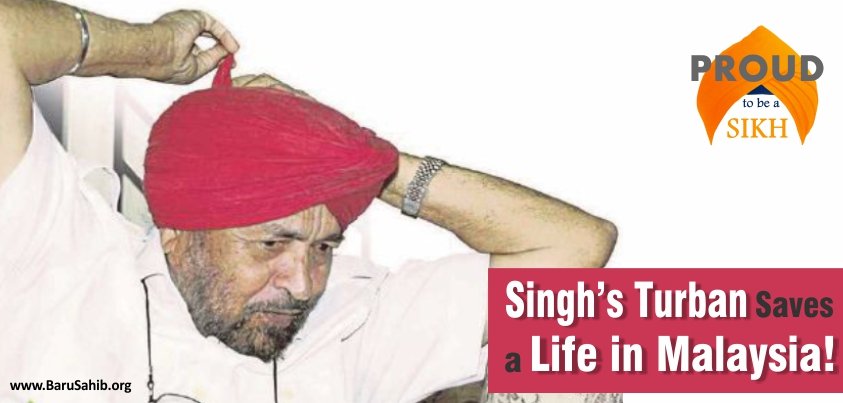
Singh’s Turban Saves a Life in Malaysia!

He remembers vividly that fateful day when he threw his 6m-long turban into a river to pull to safety a Malay teenager, who had fallen into Sungai Kerian near Parit Buntar in Perak. The then constable Sohan Singh Sidhu said he was walking along Sungai Kerian on the evening of Jan 23, 1965, after work. […]

He remembers vividly that fateful day when he threw his 6m-long turban into a river to pull to safety a Malay teenager, who had fallen into Sungai Kerian near Parit Buntar in Perak.

The then constable Sohan Singh Sidhu said he was walking along Sungai Kerian on the evening of Jan 23, 1965, after work.

“As I was taking in the sights, I saw a teenager casting his line into the river to fish. Unfortunately, he fell into the river while doing so.”

Sohan said he dashed to where the teenager fell.

The youngster was bobbing up and down, and struggling to stay afloat.

“As I could not swim, I removed my turban and threw one end of the cloth towards the boy. Thankfully, he grabbed hold of it,” Sohan, 71, said in Taiping, Perak, recently.

After pulling him to safety, Sohan, then 21, gave the teenager a tongue-lashing for endangering his own life.

“I remember him begging me not to tell his parents,” he said, adding that the boy identified himself as Abd Malik.

Sohan said the boy then left and he tied his turban up again, even though it was wet.

“I continued with my walk
before returning to the police quarters.”

He said it was lucky for the boy that his turban was not starched, hence, it could roll out once the pin was removed.

News of the Punjabi policeman saving the Malay boy with his turban spread and pressmen hounded him the next day.

“The reporters came and asked me if it’s okay to publish the news and I said ‘why not’,” he said with a smile.

Sohan became an overnight superstar when news of his quick thinking was splashed in major newspapers on the third day.

“That report drew the attention of my district police chief and the inspector-general of police,” he said, adding that he received a commendation letter three months after the incident.

After Parit Buntar, Sohan was transferred to Rawang in 1966.

He rose up the ranks, from constable to inspector, before retiring as assistant superintendent in 1998.

After his retirement, Sohan was seconded to the Film Censorship Board in Kuala Lumpur for three years. Due to his vast knowledge, the Seremban native also became a human resources manager in a factory in Taiping.

“My children asked me to stop working in 2006,” he said, adding that as time passed, news of him saving the teenager was gradually forgotten as it got overtaken by other events.

“Now, I share it only occasionally during family gatherings,” said the father of two boys and a girl.

Sohan, who is married to Serjeet Kaur, 64, spends his twilight years meeting friends and praying at the gurdwara in the morning.

“I return for lunch before having my afternoon nap.”

Sohan keeps active by going for walks in his neighbourhood in the evenings.

~ Source: NST

Punjab – A Cradle. Now, grave!

Broken hearts float down the Bhakra Main Line canal. Broken by the endless struggle with the land, with the weather, with the creditor. Broken by broken promises, broken by the honour they lost, broken enough to kill themselves. And, at the sluice gate at Khanauri village they slow down, looking up with unseeing eyes. And, […]

Broken hearts float down the Bhakra Main Line canal. Broken by the endless struggle with the land, with the weather, with the creditor. Broken by broken promises, broken by the honour they lost, broken enough to kill themselves. And, at the sluice gate at Khanauri village they slow down, looking up with unseeing eyes. And, from the bridge across the canal, the beating hearts they broke look down upon them.

An outsider driving through Khanauri in Punjab’s Sangrur district will notice only the pretty village, the grain market and the blue-green Sutlej waters rushing down the canal. You need to look closer to see the knot of people at the sluice gate, their brimming eyes scanning the water, waiting for it to deliver their loved ones to them.

Punjab’s prosperity has been a folklore across urban and rural India for decades. Farmers here were among the first to welcome hybrid seeds and chemical fertilisers, which powered the Green Revolution. The expansive canal network around the Bhakra-Nangal dam was ready just in time for the boom. The postcard image of a green and prosperous Punjab was formed around this time. The picture is fading, fading fast.

Farmer suicides in the drought-prone regions of Maharashtra, Andhra Pradesh and Orissa are talked about. But, the lush greenery screens the spate of suicides in Punjab. THE WEEK visited four districts where the death toll is reported to be the highest¯Sangrur, Mansa, Bathinda and Fazilka. The state government is in denial about this trend, though the three recent surveys it commissioned found the main cause¯debts.

The first survey analysed suicide data from three districts up to 2008, and found shocking facts: 1) estimated debt burden on farmers was about Rs9,886 crore, and, 2) almost 58 per cent of the loans came from high-interest, non-institutional lenders. Combined, the surveys found that of the 7,000 confirmed suicides, around 5,000 were debt-related; 79 per cent of the victims were small farmers.

Today, even farmers with holdings under five acres claim to have debts of Rs5 lakh to Rs8 lakh. “With cost of agriculture going up and returns from farm produce becoming lesser, more and more farmers are choosing to end their lives unable to cope up with their debt,” said economist Sukhpal Singh, Punjab Agriculture University (PAU), Ludhiana.

Cost of farm inputs like pesticides, fertilisers and seeds has gone up by 40 to 100 per cent in the past five years, while price of produce has doubled in the same period. In 2010, Sukhpal wrote a paper proving that small- and medium-sized farms were disappearing.

The surveys were coordinated by PAU, assisted by Punjabi University, Patiala, and Guru Nanak Dev University, Amritsar. The more severe three districts were taken up by the first survey (2000-2008). An additional three districts were included in the second survey (2000-2010). Now, a third survey is on, covering 19 of Punjab’s 22 districts; the survey period is 2011-April, 2014. This report is expected to be ready this month.

There is a debate on the number of deaths. “The state’s official figures put farmers’ suicides between 2000 and 2010 at 6,926. But our sample survey found the number to be between 40,000 and 45,000. I wonder what the Central government is waiting for?” asked Sukhdev Singh Kokri Kalan, general secretary, Bharatiya Kisan Union Ekta (Ugrahan).

Sukhpal concedes that the surveys done by the universities have been plagued by shortage of funds at different stages. This has affected door-to-door data collection. Most data was collected from taluk offices and from village headmen.

Misery. Death. Misery.
Punjab does compensate families of farmers who commit suicide, but it is tangled in red tape. The package of Rs2 lakh per family was announced in 2001, but was disbursed only in 2010. Despite the decade-long delay, the amount was not hiked. And, only around 4,000 families have benefited. Many were left out because they could not produce official confirmation of the suicides. Widows of farmers who have committed suicides are allowed a monthly pension of Rs200, but very few are receiving it.

THE WEEK visited families of 14 suicide victims, who had died after 2010. Many families did not have death certificates. And, those families who had one will not benefit because the certificate does not certify the cause of death as being suicide or unnatural.

Computerised death certificates are a rarity; majority are hand-written. According to the Registration of Births and Death Act, 1969, a death certificate must mandatorily have the date, time and cause of death. Most of the certificates THE WEEK examined had just the date.

“No one goes to the police fearing harassment. The local health worker can issue death certificates with the village sarpanch initiating the process,” said Karanjit Singh, sarpanch of Kishangarh village. Kishangarh in Mansa district has among the highest farmer suicide rates in the state; 72 deaths in the past four years.

To compound issues, in the villages, after a farmer dies, his estate is not settled legally. This allows money lenders to step in and attach property towards outstanding loans. In many cases, the property would not be sufficient to cover the debts, leading to harassment of the widow and children.

The Baba Nanak Educational Society (BNES) surveyed four blocks in the fertile Malwa region¯three blocks in Sangrur district and one in Mansa district. The survey reported 2,096 suicides in these blocks, between 2010 and April 2014. In the society’s college¯J.S. Jaijee Degree College, Gurney Kalan¯children of suicide victims are taught free of cost.

“We sought affidavits from village panchayats affirming these suicides. There is no other way to confirm them otherwise,” said Inderjit Singh Jaijee, a BNES trustee and, convenor, Movement Against State Repression (MASR). Studies in Malwa indicate that propensity for suicides is highest among farmhands and owners of small- and medium-sized farms.

Commercial and social pressures, too, contribute to a farmer’s debt. Pressure from commission agents is considerable, say experts. Social pressures include raising dowry for daughters. “Here, dowry is paid according to your land holding. The going rate is Rs1.5 lakh for an acre you hold,” said Yashpal Singh, farmer from Kalachar village, Sangrur district. He attempted suicide twice after his daughter’s marriage.

On July 18, at Mari village in Sangrur district, a middle-aged Bhoora Singh jumped in front of a train at dawn. His wife, Sarbajeet Kaur, said the farmhand had borrowed Rs2.5 lakh for his daughter’s marriage in 2012. In the week after his death, women from Mari, including widows of suicide victims, disrupted rail traffic by blocking the tracks.

Poor and irregular availability of power and water are the other stressors. With the water table falling below 500ft, there is the additional cost of boring deeper and extending the pipeline. “A new borewell costs Rs2.5 lakh and they fall in need of frequent repairs,” said Harpal Singh, farmer from Balran village, where 91 farmers have committed suicide in the past four years. Because of power cuts, farmers run diesel generators for six to eight hours every day to power the pumps.

A fitful monsoon over Punjab has aggravated the water shortage. Faced with a near-drought situation, the state has sought Central assistance. Loss of the paddy crop has been reported from many districts and farmers have been borrowing heavily to replant fields.

The corpse canal
The crowds in Khanauri come from Mansa, Patiala and Sangrur¯the districts through which the canal passes. Three kilometres downstream from the sluice gate is Haryana.

The Khanauri police station, which is only about 800m away from the sluice gate, used to be a quiet place. Not anymore. It now has a register that records the number and details of bodies that wash up at the sluice gate. Most of the bodies that wash up here are those of males aged between 20 and 50 years. The first survey showed that 34.3 per cent of the victims chose canals.

“Around 35 to 40 bodies are caught every month at the gate. A dozen are identified on basis of clothes, possessions and identification marks,” said Kulwant Singh, the havildar on duty.

On the cliff that overlooks the canal is a temple, its walls covered with posters of missing people. A guest house for families of victims was built jointly by the state government and the Sahara Charitable Trust. Food for the grieving families comes from the gurdwara, and merchants from the grain market contribute towards the upkeep of additional rooms for families. The former MP, Vijay Inder Singla of the Congress, had funded two ambulances, which are now being used as hearses. The current MP is comedian Bhagwant Mann of the Aam Aadmi Party.

At Khanauri, divers retrieve the bodies for a fee. “Divers charge according to the position of the deceased in the family. They demanded Rs22,000 to bring up my nephew’s [Sukhwinder, 22] body,” said Maggar Singh from Jagsiri village in Fatehgarh Sahib district.

Vijay Kumar from Lagroi village in Patiala had been in Khanauri for almost a week, looking for his son Lalit Kumar, 23. “We will stay here till we find the body,” he said.

Khanauri residents list the things that would make the ordeal easier for victims’ families¯a morgue, underwater lighting at the sluice gate and government divers. “We are trying everything to help out in these suicide cases,” said Arshdeep Singh Thind, deputy commissioner, Sangrur. “Some of the requests are pending and we are exploring the options of having them done with state or private assistance.”

Jaijee said: “Imagine, if this is the case of one canal in Punjab, what would be happening at other canals? The tendency here is to overlook or devise techniques to allow the bodies to tip over the sluice gates. [On the Haryana side] bodies are dragged around by dogs. Fields there are littered with skeletons of victims as the Haryana Police claims no responsibility over them.”

Dying for honour
Jasbir Singh, farmer and BKU worker from Sangrur, said farmers commit suicide fearing dishonour. “One thing a Punjabi farmer values more than his land is his izzat [honour],” he said. “When that is hurt, they think very little about the family members they leave behind. What they do not understand is that there is no izzat for a farmer in life or for his family even after he is gone.”

Jasbir and other workers of the BKU now counsel farmers who are probable candidates for suicide. Many senior, district-level leaders of the BKU are in jail now, for leading agitations seeking hike in compensation for families of suicide victims.

In Lelkala village, Mansa district, only three widows and two children are left in a family. The patriarch, Sarjit Singh, 60, consumed insecticide and died in 2012. In 2010, he had borrowed Rs6 lakh from commission agents to maintain his four-acre farm. By 2012, the amount had ballooned to Rs8.5 lakh. Dishonoured, he committed suicide.

The dues fell on his eldest son Sukhjinder, 29. He hung himself on a tree in the family’s fields, four months after Sarjit’s death. This June 28, the second son, Nirmal, 30, too, hung himself from a tree. Sarjit’s widow Karnail Kaur choked as she said: “Half our land was sold after [Sarjit] died. The rest is with the moneylender. We do not have enough money to pay even the interest.”

Now, the family is reduced to Karnail; Sukhjinder’s widow Paranjit Kaur and their son Jasprit, 10; and Nirmal’s widow Jasbir Kaur and their son Khushprit, 7. The boys’ education is supported by relatives. “Jasbir has one meal a day and supports us by sewing clothes for neighbours,” said Karnail.

Wasted harvest
The state failing to procure grain is another hurdle faced by farmers. Last year, Punjab did not meet its procurement target of paddy¯12 million tonnes. As the state fails to buy grain, stocks are rotting in farmyards. It is common to see sacks of grain stacked under a tarpaulin. Come monsoon and the sacks rot, spilling the grain and wasting the harvest. Now, markets in Punjab are seeing the arrival of early kharif paddy; opening prices are at par with minimum support prices.

The situation of farmers will improve, promised Suresh Kumar, financial commissioner (development), the highest ranking bureaucrat in the state agriculture ministry. “From what I understand, the trend of suicide among farmers should be declining in the upcoming survey results,” he said. “We have taken a number of measures to reduce non-institutional borrowing, we have increased subsidy on power and support prices have been doubled in the past seven years.

“The state usually pays farm electricity subsidy of Rs1,500 crore and, this year, this figure was close to Rs2,000 crore. We decided to pay an extra Rs600 core to save [paddy worth] Rs30,000 crore. This expenditure will be borne by us, and the benefits will go to the Central government.” The Akali Dal, which rules Punjab, is an ally of the Bharatiya Janata Party, which holds Delhi. Kumar said the state was also training farmers in dairy farming and apiary to improve their income.

Villages for sale
It has been two months after the monsoon showers reached south Punjab, but Fazilka, the new district carved out from Ferozepur, is dry. Eleven villages in the district have put themselves up for sale. The paddy and cotton crops are almost dead. Here, the water table is at 200ft, but the water is laced with chemical salts. Good water lies at 600ft.

Fazilka lies close to the India-Pakistan border, about 30km from the bustling town of Moga. Villagers here have invited bids from industrialists to buy the villages as is. Residents of Khanpur, Shatirvala, Bandiwala, Sidhana, Sawana, Tillanwali and Kerwala have put out banners inviting bids. Price? Settle the debts of residents. Over the past few months, many residents have fled to the cities.

“Ever since the canal water was diverted for political reasons, our fields have been drying up,” said Gurpreet Singh, sarpanch, Shatirvala. “Two years back, the price here used to be Rs20 lakh per acre. Now, no one wants to pay even Rs10 lakh for these dry fields.”

Farmer Maluk Singh said, “Those who can afford [to run 600ft-deep borewells] still have green fields. We do not want to die here. It is better to sell everything and look for a new life in the cities of Rajasthan or Haryana.” Maluk has a loan of Rs18 lakh against his eight acres.

Gurpreet said that despite their protests, the district irrigation department, supported by the police, partially blocked the canal to the area and diverted water.

Ferozepur Deputy Commissioner D.P.S. Kharbanda told THE WEEK that the villagers’ agitation was a “non-serious matter”. “We have provided reverse osmosis water-purifying stations at some of these places and even piped drinking water is being provided at Rs20 per litre,” he said. As Fazilka is yet to get its own commissioner, Ferozepur bureaucrats manage the new district, too.

Hope for Punjab’s farmers and the grieving families now lies in the strong stand taken by the High Court of Punjab and Haryana. The court has asked the state to set up a commission to probe the reasons for suicide of farmers and to suggest steps for prevention. The commission should also frame a policy on disbursement of compensation, the court said.

Debt blow
* Farmers flock to non-institutional money lenders, such as the arthiyas (commission agents), whose interest rates (about 30 per cent) are much higher than banks (about 4 per cent). These lenders are unforgiving and demand full repayment even if the crop fails.

Often termed as “loans for social reasons” in government surveys, borrowing to pay dowry is a prominent reason for high debt among farmers. Depending on the amount of land a farmer in rural Punjab has, he has to pay a dowry of Rs1.5 lakh to Rs3 lakh per acre.

* P rices of all farm inputs, including seeds and fertilisers, have gone up by 40 to 100 per cent throughout the country. But, only a small subsidy for pesticides is borne by the state government.

* The lowering water table compels farmers to extend borewells and the recurring expenditure drives them to debt.

The way out
* Increase the minimum support prices for crops.

* Increase purchase of crops like maize, sugarcane and pulses, or allow private buyers.

* Reduce non-institutional borrowing by farmers with assistance from the Centre.

* Introduce cooperative farming.

Sorry state
According to a recent survey conducted by the Punjab government, Sangrur, Mansa and Bathinda accounted for 1,757 farmer suicides between 2000 and 2008. A second survey reported 6,000 suicides between 2000 to 2010 in Sangrur, Bathinda, Mansa, Moga, Ludhiana and Barnala. A third survey, which includes the above-mentioned districts as well as Faridkot, Muktsar, Patiala, Hoshiarpur, Fatehgarh Sahib, Rupnagar, Ferozepur, Nawanshahr, Mohali, Kapurthala, Tarn Taran, Amritsar and Jalandhar, is underway for the period starting from 2011 to April 2014.

The combined data from the three surveys reports 7,000 suicides, of which 5,000 were debt-related.

The first survey analysed suicide data from three districts up to 2008 and found shocking facts: estimated debt burden on farmers was about Rs9,886 crore in 2008, and almost 58 per cent came from high-interest, non-institutional lenders. Understandably, 79 per cent of the victims were small farmers.

Today, even farmers with holdings under five acres claim to have debts of
Rs5 lakh to Rs8 lakh.

A package of Rs2 lakh per family was announced for the victims’ kin in 2001, but was disbursed only in 2010. Despite the decade-long delay, the amount was not hiked. And, only around 4,000 families have benefited. Many were left out because they could not produce official confirmation of the suicides. A pension of Rs200 was announced for widows of farmers who have committed suicides, but few have started receiving it.

DEATH WISH

Poisoning
The burgeoning costs of farm inputs often push farmers over the edge. Pesticides now cost 30 per cent higher and, at Rs3,500 a litre, are often consumed by farmers, rather than pests.

Drowning
Drowning is the second-most common mode of suicide (after poisoning) even in urban areas such as Patiala.

Hanging
Most cases of farmers hanging themselves usually take place at dawn or dusk.

Trains
Some farmers jump in front of speeding trains to put an end to their misery. These trains, ironically, often carry their grains through the villages of Punjab.

~ Source: http://week.manoramaonline.com/

Report on Inter-House Sports event held at Akal Academy – Bhadaur!

Akal Academy Bhadaur organized “Inter House Sports Event” on 30th August, 2014 in the play ground after Nitnem. It was conducted by Ajay house & Sports Department. The competition was from 3rd on ward upto 8th class. There were 200mtrs. & 100 mtrs. race. Boys & girls both participated in it.
There were two groups of participants:

  1. 3rd to 5th – 1st group
  2. 6th to 8th – 2nd group


First of all Inter-class competition was held then selected students participated in Inter- house competition. Principal Madam appreciated the winners.
Overall house wise result:

1st position- Amul house
2nd position- Ajay house
3rd position – Atul house

‘Hail’ the efforts… Appreciate the little kids in the comment box below…

~ Deeksha Singh
~ New Delhi, 1st Sep ’14

First Prakash Purab of Guru Granth Sahib Ji

The Guru Granth Sahib is more than just a scripture of the Sikhs; for the Sikhs treat this Granth (holy book) as their living perpetual Guru. The Divine Hymns which span 1430 Ang and contains holy words elocuted by 6 Gurus, 18 Saints (Hindus & Muslims) and 11 Bhatts who initially followed their spiritual faith […]

The Guru Granth Sahib is more than just a scripture of the Sikhs; for the Sikhs treat this Granth (holy book) as their living perpetual Guru.

The Divine Hymns which span 1430 Ang and contains holy words elocuted by 6 Gurus, 18 Saints (Hindus & Muslims) and 11 Bhatts who initially followed their spiritual faith according to their caste, creed and religion and later they became enlighetened.

It is important to note that the Name Ram has been incorporated 2533 times, Allah – 46 times and Waheguru only 13 times in the Sri Guru Granth Sahib ji!

The holy book contains an important message for the whole of humanity. After studying the text of this Granth, many have said that the message within this volume provides a solution to all the ills in the world.

For more comments by outsiders about the [[Sri Guru Granth Sahib], see Worldwide Praise for the Guru Granth Sahib
Below are listed the human qualities promoted and endorsed by the Sri Guru Granth Sahib. Read and study these and improve your understanding of the human spirit and the way forward in the world, sometimes referred to as the “ocean of fire”:

The torch for the world

The Sikhs believe that the Guru Granth Sahib provides unique and unequalled guidance and advice for the whole of the human race. It is the torch that will lead humanity out of Kaljug, (the dark era) to a life in peace, tranquillity and spiritual enlightenment for all the nations of the World.

www.deccanherald.com
Guru Granth Sahib transcends creed and caste, cant and convention. It does not belong to the Sikhs alone. It consecrates the sayings of 11 Hindu bhagats and as many bard poets and seven Muslims, along with the teachings of six Sikh gurus. No other religion has included in its holy book the sayings of others, however revered.

Living your life to the highest principles

The SGGS is about living a life of Truth, respect for others; humility; tranquillity, peace, blessings, high moral standards, equality, co-existence, etc. These are qualities which will result in a situation which will take humanity to higher level of living; to a situation where everyone will be proud and humbled at the same time for being part of pure society.

One who follows the teaching of and accept the SGGS as their Guru or Spiritual Guide is called a Sikh. A follower of the teachings of the SGGS is also called a Gurmukh – which literally means “follower of Guru”.

The Dalai Lama said,
We bow to this great Granth, which was compiled 400 years ago. Since then it had been spreading the message of peace and love all over the world. The 21st century is witnessing a revolution in technology and man is improving his skills, but in matters of living and relationships between nations there is a marked degradation. The aim of all religions is to create a good man.

All Peoples of the World are Equal

The Guru Granth Sahib promotes the message of equality of all beings. Discrimination of all types is strictly forbidden. Since Fatherhood of God was the basic Sikh tenet, sisterhood/brotherhood of humans ipso facto became its social corollary. No one was to be reckoned low or high –“Reckon the entire mankind as One” (Akal Ustat, 15.85) was the Guru Gobind Singh’s precept. The Gurus went further than just proclaiming the equality of humans. They established dignity of labour, by making social service (seva) as an important vehicle of spiritual advancement.

“The hands and feet that shun seva are condemnable; actions other than seva are fruitless” (Bhai Gurdas, Varan, XXVII. 10). Begging is taboo for the Sikhs. While bhaktas could live on alms and public charity, not so a Sikh. He is ordained to earn his living by the honest labour of his hands (kirat) and share his earnings with others. It rehearsed in the fifteenth century the ideology of fraternity, equality and liberty. The Gurbani below gives a general idea of the message put forward by the Gurus:

They look upon all with equality, and recognize the Supreme Soul, the Lord, pervading among all.
Those who sing the Praises of the Lord, Har, Har, obtain the supreme status; they are the most exalted and acclaimed people. (2)
(SGGS p446)
The God-conscious being is always unstained, like the sun, which gives its comfort and warmth to all.
The God-conscious being looks upon all alike, like the wind, which blows equally upon the king and the poor beggar.
(SGGS p272)

Sri Guru Granth Sahib promotes the concept of equality by highlighting the fact that we are made of the same flesh, blood and bone and we have the same light of God with us – Soul . Our building bricks are the same:

There is only one breath; all are made of the same clay; the light within all is the same.
The One Light pervades all the many and various beings. This Light intermingles with them, but it is not diluted or obscured.
By Guru’s Grace, I have come to see the One. I am a sacrifice to the True Guru. (3)
(SGGS p96)

Women as Equals

A drastic distinction between the roles of the male and female exists in all the history of modern human societies. Women have grown to accept, not without resentment though, the male-dominated atmosphere of the world. Because people use religious doctrine to define their life styles, religious views in both the East and the West seem to condone, even encourage, the unequal treatment of women.

In the 15th century, Guru Nanak established Sikhism, the first religion to advocate emphatically the equality of all people, especially women. In a continent characterized by severe degradation of women, this bold declaration, along with others, determined to erase the impurities of the Indian society. However, prejudices and injustices based on gender linger even today. (by Valerie Kaur)

SGGS Page 473 Shabad 1748 
“From woman, man is born; within woman, man is conceived; to woman he is engaged and married.
Woman becomes his friend; through woman, the future generations come. When his woman dies, he seeks another woman; to woman he is bound. So why call her bad? From her, kings are born. From woman, woman is born; without woman, there would be no one at all. O Nanak, only the True Lord is without a woman. That mouth which praises the Lord continually is blessed and beautiful. O Nanak, those faces shall be radiant in the Court of the True Lord. (2)”
SGGS Page 604 Shabad 2292 
” The Beloved Himself enjoys every heart; He is contained within every woman and man.
O Nanak, the Beloved is pervading everywhere, but He is hidden; through the Guru, He is revealed. (4,2)”
SGGS Page 223 Shabad 706 
“In the earth and in the sky, I do not see any second. Among all the women and the men, His Light is shining. (3)”

One God for All

Sikhism is strictly monotheistic in its belief. This means that God is believed to be the one and sole Reality in the cosmos, and no god or goddess or power like Satan or Ahirman or any other has reality such as God’s. God alone is worthy of worship, and the highest end of existence, that is mukti or liberation can come through Devotion to God alone. All other worship is false and a waste of the precious gift of this human life. Besides its monotheism, Sikhism also emphasizes another philosophical idea, which is known as monism. Monism is the belief that all that our senses comprehend is only a “vision” or illusion (Maya); ONLY God is the sole “Continuing Reality”. Forms being subject to Time, shall pass away. God’s “Reality” alone is eternal and abiding. Hence behind the shows of things, the spiritual vision is always aware of the “reality of God”. According to this philosophy, the differences created by man’s limited thinking which result in selfishness, egoism and hate are meaningless. Since nothing exists except God; the man of God sees in all beings the reality of God. Some text from the holy Guru Granth Sahib will illustrate this point:

The SGGS tells us that there is only one God and no other:

There is only the One Supreme Lord God; there is no other at all.
Soul and body all belong to Him; whatever pleases His Will comes to pass.
Through the Perfect Guru, one becomes perfect; O Nanak, meditate on the True One. (4,9,79)
(SGGS p45)

Further, it informs us the this One God is merciful, infinite and is everywhere:

God is merciful and infinite. The One and Only is all-pervading.
He Himself is all-in-all. Who else can we speak of? God Himself grants His gifts, and He Himself receives them.
Coming and going are all by the Hukam of Your Will; Your place is steady and unchanging.
Nanak begs for this gift; by Your Grace, Lord, please grant me Your Name. (20,1)
(SGGS p710)

Speak and Live Truthfully

Human beings must be truthful, whether one is Hindu or Muslim or of any other religion. Self-recognition is very important for truthful living. Body impured by falsehood cannot be purified by taking a bath in holy rivers or by visiting holy places. Purity of mind is essential. Impurity of mind leads to many other vices such as anger, lust, attachment, ego, and greed.

If mind is not free from evils then cleansing of the body even million times is useless. Restless mind is unable to get in touch with God’s love. Continuous practice of austerities and penance do not help in acquiring truthful life. One has to earn his living by honest means. Guru Nanak Dev Ji explains in Japji Sahib how to become truthful and how to break the wall of falsehood:

So how can you become truthful? And how can the veil of illusion be torn away?
O Nanak, it is written that you shall obey the Hukam of His Command, and walk in the Way of His Will. ||1|| (sggs Page 1)
The following Shabads reinforce this important message of SGGS:

They see the Truth, and they speak the Truth; their bodies and minds are True.
(SGGS p69)

The One Lord is in his heart. True are his actions; true are his ways. True is his heart;
Truth is what he speaks with his mouth. True is his vision; true is his form. He distributes Truth and he spreads Truth.
One who recognizes the Supreme Lord God as True – O Nanak, that humble being is absorbed into the True One. (8,15)
(SGGS p283)

The true devotees look beautiful in the Darbaar of the Lord`s Court. They speak Truth, and only Truth.
Deep within the nucleus of their heart, is the True Word of the Lord`s Bani. Through the Truth, they understand themselves.
They understand themselves, and so know the True Lord, through their true intuition.
True is the Shabad, and True is its Glory; peace comes only from Truth.
Imbued with Truth, the devotees love the One Lord; they do not love any other.
O Nanak, he alone obtains the True Lord, who has such pre-ordained destiny written upon his forehead. (4,2,3)
(SGGS p769)

In Truth I sit and stand; I eat and speak the Truth.
With Truth in my consciousness, I gather the wealth of Truth, and drink in the sublime essence of Truth.
In the home of Truth, the True Lord protects me; I speak the Words of the Guru`s Teachings with love. (5)
(SGGS p1011)

True is the speech of the Gurmukh; true are the eyes of the Gurmukh. The Gurmukh practices and lives the Truth.
He speaks the Truth forever, day and night, and inspires others to speak the Truth.
(SGGS p1058)
True are the faces and true are the beards, of those who speak the Truth and live the Truth.
The True Word of the Shabad abides in their minds; they are absorbed in the True Guru.
True is their capital, and true is their wealth; they are blessed with the ultimate status.
They hear the Truth, they believe in the Truth; they act and work in the Truth.
They are given a place in the Court of the True Lord; they are absorbed in the True Lord.
O Nanak, without the True Guru, the True Lord is not found. The self-willed manmukhs leave, wandering around lost. (53)
(SGGS p1419)

Control the Five Vices

The SGGS tells us to control our animal instincts of Pride/Ego, Anger/Temper, Greed/Urges, Attachment/Dependency and Lust/Addiction (PAGAL)

SGGS Page 1388 Shabad 5352 
“All virtues are obtained, all fruits and rewards, and the desires of the mind; my hopes have been totally fulfilled.
The Medicine, the Mantra, the Magic Charm, will cure all illnesses and totally take away all pain. Lust, anger, egotism, jealousy and desire are eliminated by chanting the Name of the Lord.”
SGGS Page 81 Shabad 199 
“Taking them by the hand, the Lord has blessed them with His Praises. They no longer have to wander in reincarnation, and they never have to die.
Through the Kind and Compassionate True Guru, I have met the Lord; I have conquered sexual desire, anger and greed. Our Indescribable Lord and Master cannot be described. Nanak is devoted, forever a sacrifice to Him. (5,1,3)”
SGGS Page 1395 Shabad 5390 
“In truth, the True Lord is recognized and realized, when one is lovingly attuned to Him, with one-pointed consciousness.
Lust and anger are brought under control, when the breath does not fly around, wandering restlessly. Dwelling in the land of the Formless Lord, realizing the Hukam of His Command, His contemplative wisdom is attained.”

Live in God’s Hukam

A Sikh or person of God should live and accept the command of God easily and without too much emotional distress. Live in contentment and in Chardikala (positive attitude)

SGGS Page 209 Shabad 657
“Renounce the intellectual cleverness of your mind, O humble servants of the Lord; understanding the Hukam of His Command, peace is found.
Whatever God does, accept that with pleasure; in comfort and in suffering, meditate on Him. (1)”
SGGS Page 253 Shabad 792 
“Shalok:
He wanders around in the four quarters and in the ten directions, according to the dictates of his karma. Pleasure and pain, liberation and reincarnation, O Nanak, come according to one’s pre-ordained destiny. (1)”

Practise Humility, Kindness, Compassion, Love, etc

The necessity of controlling the mind and subduing one’s egoity is repeatedly taught in the Sikh religion. All the virtues such as Truth (Sat), contentment (santokh), Love (Pyar), Compassion/Mercy (daya), Service (seva), Charity (dana), forgiveness (ksama), humility (nimrata), patience (dheerjh), non-attachment (vairagya) and renunciation (taiga), are fundamental constituents of the Sikh religion and ethics. On the other hand, all the major vices or evils that overpower human beings and ruin their religious life, such as anger (krodh), egoism (ahankara), avarice (lobh), lust (kama). Infatuation (moha), sinful acts (papa), pride (man), doubt (duvidha), ownership (mamata), hatred (vair), and hostility (virodh) are condemned. Man is exhorted to eradicate them but certainly not through ascetic self- mortification. Sahaj is attained through tension-free, ethical living, grounded in spirituality.

The fruit of humility is intuitive peace and pleasure. My True Guru has given me this gift. ((1)(Pause))
(SGGS p235)
The God-conscious being shall never perish. The God-conscious being is steeped in humility.
(SGGS p273)
First, is the Lord`s Praise; second, contentment; third, humility, and fourth, giving to charities. Fifth is to hold one`s desires in restraint. These are the five most sublime daily prayers.
(SGGS p1084)
Lacking truth and humility, they shall not be appreciated in the world hereafter.
(SGGS p1245)
Humility is the word, forgiveness is the virtue, and sweet speech is the magic mantra.
Wear these three robes, O sister, and you will captivate your Husband Lord. ((127))
(SGGS p1384)
The armor of self-restraint, truth, contentment and humility can never be pierced.
(SGGS p1397)
He chants and meditates, and practices austerity and good deeds. He keeps to the Dharma, with faith, humility and contentment.
(SGGS p1411)
And if you do not practise humility, truth, abstinence or self-discipline then what is in store for you:
You do not practice truth, abstinence, self-discipline or humility; the ghost within your skeleton has turned to dry wood…..
When the Messenger of Death grabs you by your hair, you will be punished. You are unconscious, and have fallen into Death`s mouth. ((3))
(SGGS p906)

~ Source: Sikhiwiki.com

The Turbanator: Devout Sikh wears the world’s largest turban that takes him six hours to put on and weighs 100lb

Meet devout Sikh Avtar Singh Mauni – the proud owner of the world’s largest turban.

The holy man says his extra large headgear weighs a hefty 100lb and measures a staggering 645m (2,115 feet) when unwrapped – the same length as 13 Olympic-sized swimming pools.

The Turbanator: Devout Sikh wears the world's largest turban that takes him six hours to put on and weighs 100lb The 60-year-old has been regularly adding to it for the past 16 years and it now takes him up to six hours to get it on.

‘I just keep putting on the cloth from top to bottom one layer at a time just like you would lay the storeys of a building.

‘On the rare times I don’t have my turban on I keep getting this feeling of being incomplete, that some part of me is missing. I get afraid that I may fall and I keep wondering “have I lost something, where is my turban?”‘

He added: ‘Until the time I have no more have strength in my limbs I will carry this turban on my head.’

Most other Sikhs wear turbans that measure between five and seven metres, but Mr Mauni, from Patiala, in the Punjab, has decided to take it to a whole new level.

The length of the cloth is yet to be officially verified but if proved correct it would overtake current Guinness World Record holder, Major Singh, whose turban measured 400m.

To break the record, Mr Mauni says he took the length up in stages from 150m to 250m, 365m and finally a shocking 645m.

He says the purple and orange cloth alone weighs 66lb but with the addition of decorative ornaments tips the scales at a whopping 100lb.

In full attire, Mr Mauni also carries a sword and heavy bangles, which weigh an additional 87lb.

The height and width of his bulbous headgear makes entering doorways extremely difficult and getting into a car is impossible.

So Mr Mauni rides a motorcycle on his regular pilgrimages across the Punjab.

Not surprisingly he has become something of a celebrity – but the attention is not always welcome.

‘When I go out a huge crowd gathers around me. Some are amazed beyond belief and tell me “you are great for carrying such a large turban. You must have been blessed with lots of energy”,’ said Mr Mauni, who belongs to the prestigious warrior order of Sikhs, known as Nihangs.

‘But sometimes all they want is to take a picture, so I loudly tell them to stop. After all it takes me hours to put on my turban and all they want is to take a quick picture and then run away.’

However, his efforts are impressing many in the Sikh community.

Gurpreet Singh, who affectionately refers to Mr Mauni as Babaji – which means grandfather – says the giant turban has helped reawaken love for their religion among younger people.

He said: ‘These days many Sikh children choose to cut their hair and have forgotten to wear turbans. But Babaji remind us of its importance, which is very good.

‘The Sikh community can learn a lot from him and our children can learn that they should grow their hair and wear a turban.’

~ Source: TED THORNHILL FOR MAILONLINE

Petition seeking Sikh women Pillion Riders Exempted from Wearing Helmets has WON!

Wearing helmets for women riding pillion on a two-wheeler is now mandatory in the national Capital, though Sikh women have been exempted, with the Government amending the rule 115 of Delhi Motor Vehicles Rules, 1993. “Wearing helmets is now mandatory for women pillion riders in Delhi. However, Sikh women have been keept out of its […]

Wearing helmets for women riding pillion on a two-wheeler is now mandatory in the national Capital, though Sikh women have been exempted, with the Government amending the rule 115 of Delhi Motor Vehicles Rules, 1993.

“Wearing helmets is now mandatory for women pillion riders in Delhi. However, Sikh women have been keept out of its ambit on religious grounds,” said a top transport department official. Lt Governor Najeeb Jung had also given the go ahead to this proposal making helmets mandatory for all women pillion riders, except Sikh women.

According to transport department, In Delhi alone, a total number of 576 two wheeler riders lost their lives during 2012. The main risk factor for motorized 2 wheeler users is the non-use of helmets and head injuries are the major cause of death, injury and disability among them. Many of these head injuries could have been prevented or their severity reduced through the use of helmets.

“As per the directions of LG, wearing helmets will not be mandatory for Sikh women riding pillion on two-wheelers. Delhi Government has amendended the rule 115 of Delhi Motor Vehicles Rules, 1993,” the official said.

In 1998, the Delhi government had made wearing helmets mandatory for all pillion riders, but following objections from the people belonging to Sikh community, it had to amend the Delhi Motor Vehicle Rules, 1993 in June 1999 and made it optional for women.

After getting recommendations from the traffic police, Delhi Commission of Women and NGOs working for road safety, Transport department decided to make helmets mandatory for women pillion riders. On May 2 this year, transport department had invited suggestions from the general public on this issue after getting goahead from L-G.

During suggestions, some Muslim groups also demanded the same relief for burqa-clad women riding pillion in the capital.

~ Source: http://www.dnaindia.com/