
Ex Students of Akal Academy perform Dhadi Jatha Kirtan – Nasuro Mannsur, Guru Gobind Singh!

About the mesmerizing Kirtan – Bhai Nand Lall, a shopkeeper from Jammu and a very learned scholar came to meet Guru Gobind Singh at Anandpur Sahib in The Panjab. Bhai Nand Lall Ji became a great devotee of Guru Sahib and penned many compositions about Guru Ji.

This is a very beautiful and emotional composition in great tribute to the Lord Of The Falcons by Bhai Nand Lall Ji is in the Persian Language.

The actual words of this Respected composition are as follows:

Guru Gobind Singh Ji is the helper of others
Guru Gobind Singh Ji has the help of God(105)

Guru Gobind Singh Ji is the treasurer of God
Guru Gobind Singh Ji is bestower of merciful gifts (106)

Guru Gobind Singh Ji knows God well
Guru Gobind Singh Ji is the emperor of emperors (107)

Guru Gobind Singh Ji is the king of both worlds
Guru Gobind Singh Ji is the warrior who gives life to enemies (108)

Guru Gobind Singh Ji is the giver of great gifts
Guru Gobind Singh Ji tells the secrets of God (109)

Guru Gobind Singh Ji puts a veil over everyone’s sins
Guru Gobind Singh Ji is a cloud of mercy (110)

Guru Gobind Singh Ji is accepted out of the accepted
Guru Gobind Singh Ji has reached God (111)

Guru Gobind Singh Ji is a river of divine knowledge
Guru Gobind Singh Ji is a sea of God’s gifts (112)

Guru Gobind Singh Ji is beloved of God
Guru Gobind Singh Ji is a lover of God (113)

Guru Gobind Singh Ji is an expert with the sword
Guru Gobind Singh Ji knows the secrets of every heart (114)

Guru Gobind Singh Ji is the master of the crown
Guru Gobind Singh Ji has God’s shade over Him (115)

Guru Gobind Singh Ji is the treasurer of all God’s treasures
Guru Gobind Singh Ji is the cure for all pain (116)

Guru Gobind Singh Ji is the master of the world
Guru Gobind Singh Ji is unequalled in both worlds (117)

Guru Gobind Singh Ji is praised by God Himself
Guru Gobind Singh Ji has many great virtues (118)

Guru Gobind Singh Ji has very important people falling at His feet
Guru Gobind Singh Ji gives instruction to even demi-gods (119)

Guru Gobind Singh Ji is praised by accepted ones
Guru Gobind Singh Ji knows what is in everyone’s heart (120)

Guru Gobind Singh Ji’s feet are kissed by the heavens
Guru Gobind Singh Ji’s drum sounds in both worlds (121)

Guru Gobind Singh Ji has the three loks(worlds) under Him
Guru Gobind Singh Ji has the stamp of His command all over the world (122)

Sudas is the servant of Guru Gobind Singh Ji
Guru Gobind Singh Ji slows down the zealous energy of enemies (123)

Guru Gobind Singh Ji is holy and free from enemity
Guru Gobind Singh Ji is a mirror who shows the true God (124)

Guru Gobind Singh Ji understands the true God
Guru Gobind Singh Ji is a king and a saint as-well (125)

Guru Gobind Singh Ji is kind, merciful and wise
Guru Gobind Singh Ji is the giver who gives great gifts (126)

Guru Gobind Singh Ji is the giver of givers
Guru Gobind Singh Ji is the merciful of merciful (127)

Guru Gobind Singh Ji kindly gives gifts to those who give
Guru Gobind Singh Ji gives to beneficient people (128)

Guru Gobind Singh Ji is forever sound and steady
Guru Gobind Singh Ji is beautiful and blessed (129)

Guru Gobind Singh Ji is blessed by God
Guru Gobind Singh Ji is a wonder of the timeless being’s light (130)

Those who’ve listened to the name of Guru Gobind Singh Ji
Have seen God with the grace of Guru Gobind Singh Ji (131)

Guru Gobind Singh Ji is a picture of virtues
Guru Gobind Singh Ji has become one with supernatural powers (132)

Those who’ve sung the praises of Guru Gobind Singh Ji
Have been kindly blessed by Guru Gobind Singh Ji (133)

Those who have had a sight of Guru Gobind Singh Ji
Have become intoxicated in the passage of Guru Gobind Singh Ji (134)

Those who have kissed the dust of Guru Gobind Singh Ji’s feet
Have been kindly blesed by Guru Gobind Singh Ji (135)

Guru Gobind Singh Ji is the doer of all actions
Guru Gobind Singh Ji is the helper of the weak (136)

Everyone does homage to Guru Gobind Singh Ji
Guru Gobind Singh Ji is the embodiment of all kindness (137)

Guru Gobind Singh Ji is the chief all leaders
Guru Gobind Singh Ji is the highest of the high (138)

Great demi-gods are servants of Guru Gobind Singh Ji
They sing the praises of Guru Gobind Singh Ji (139)

Eminent goddesses are under the order of Guru Gobind Singh Ji
They are the servants of Guru Gobind Singh Ji (140)

Nature has the utmost respect for Guru Gobind Singh Ji
Guru Gobind Singh Ji is the servant of God (141)

The nine cosmos (khand) are the dust of Guru Gobind Singh Ji’s feet
They are the wise servants of Guru Gobind Singh Ji (142)

The highest throne is beneath Guru Gobind Singh Ji
Guru Gobind Singh Ji has God’s court within His reach (143)

Guru Gobind Singh Ji is excellent in all virtues
Guru Gobind Singh Ji is the permanent leader (144)

Guru Gobind Singh Ji gives light to the world
All bodies and souls have blossomed from Guru Gobind Singh Ji (145)

Guru Gobind Singh Ji’s advancement is improving two-fold every day
Guru Gobind Singh Ji is the beauty of all king’s thrones (146)

Guru Gobind Singh Ji is the helper in both worlds
Guru Gobind Singh Ji is the sight of every eye (147)

Guru Gobind Singh Ji has the whole creation in His command
Guru Gobind Singh Ji’s praise is the highest of all (148)

Both worlds are the army of Guru Gobind Singh Ji
Everyone is in the protection of Guru Gobind Singh Ji (149)

Guru Gobind Singh Ji is the giver of givers
Guru Gobind Singh Ji achieves victory everywhere (150)

Guru Gobind Singh Ji is of excellent conduct
Guru Gobind Singh Ji is the soul in every body (151)

Guru Gobind Singh Ji is very loving and affectionate
Guru Gobind Singh Ji is the light in every eye (152)

Guru Gobind Singh Ji is the giver of daily food to everyone
Guru Gobind Singh Ji showers the grace of God (153)

Even the stars are the beggars of Guru Gobind Singh Ji
They are the servants of Guru Gobind Singh Ji’s darbar (154)

The five elements praise Guru Gobind Singh Ji
The seven spiritual guides are a sacrifice unto Guru Gobind Singh Ji (155)

Guru Gobind Singh Ji has His hand on both worlds
Guru Gobind Singh Ji owns everything high and low (156)

Nand Lal is the slave-dog of Guru Gobind Singh Ji
Nand Lal is aiming for the name of Guru Gobind Singh Ji (157)

I am lower than the dogs of Guru Gobind Singh Ji
I peck the small pieces in the dishes of Guru Gobind Singh Ji (158)

I am a beggar of Guru Gobind Singh Ji
For the holy dust of the feet of Guru Gobind Singh Ji (159)

Source – http://www.sikharchives.com/?p=1060
Keep Connected. Stay Blessed!

‘Share’ to let your family and friends across social media and Youtube indulge in mesmerizing Kirtan!

Pool of Life: The Autobiography of a Punjabi Agony Aunt ~ Book Review!

Review By – Dr Ishtiaq Ahmed It all started in and around Rawalpindi… It has been a sheer pleasure to read the autobiography of Kailash Puri, written largely in Punjabi and rendered into very readable English by Professor Emeritus Eleanor Nesbitt. We learn that Kailash was born in Arya Mohalla, Rawalpindi, just next to Gordon College. […]

Review By – Dr Ishtiaq Ahmed

It all started in and around Rawalpindi…

It has been a sheer pleasure to read the autobiography of Kailash Puri, written largely in Punjabi and rendered into very readable English by Professor Emeritus Eleanor Nesbitt. We learn that Kailash was born in Arya Mohalla, Rawalpindi, just next to Gordon College. Being the fifth daughter in a family of Khatri Sikhs who longed for a son, her parents ironically named her Veerawali (sister of brothers)! She adopted her penname, Kailash, later in life when she began writing. The Puris, like millions of other refugees, had to run for their lives at the time of partition in 1947 and to begin life again from scratch in India. It so happens that one of my current students at the Lahore University of Management Sciences (LUMS) Nimra Zulfiqar’s family shifted to Arya Mohalla from Ludhiana and Jullundur in 1947. So, the partition saga continues to bring forth strange coincidences, connections and associations.

Although born in Rawalpindi, Kailash always felt that her roots were in the ancestral village of Kallar (now called Kallar Syedan) some 25 miles from the city. I visited Kallar in December 2004 for fieldwork on my Punjab book. In 1947, it escaped largely unscathed raids by Muslim mobs because the Sikhs and Hindus could find refuge in the large fortress-like building of the direct descendants of Guru Nanak, the Babas or Bedis. However, the Sikh and Hindu inhabitants of the nearby village of Thamali were almost wiped out.

Chapters one to five tell the story of the first phase of her life. Her father, Sohan Singh Puri, was a businessman. He built a home in Lahore as well and so the family stayed in both Rawalpindi and in Dharampura, Lahore. Like Parkash Tandon’s Punjabi Century, the portrayal of the social and cultural life of the old Punjab is done with great skill and absolute honesty. Although a believing Sikh, she deftly lays bare the dead weight of traditional life permeated by superstitions. A Puri boy, Gopal, a talented scientist, saw her, found her pretty and wanted to marry her. It was a proposal that contravened the rules of consanguinity applicable to Hindu and Sikh marriage because Kailash and Gopal belonged to the same ‘Puri Gotra’ (clan) within the Khatri caste. Intrigues and jealousies came into play and typically a villain reminiscent of Kado Langa of Heer fame, a close relative, Sunder Singh, tried his best to subvert the match but Gopal’s resolve prevailed and her parents agreed to the marriage.

Gopal Singh Puri secured a scholarship to do a second PhD in London in 1945 (presumably after the war). Kailash joined him later. They lived on a tight budget in a small room in very austere conditions but the English landlord and landlady proved to be extremely kind and considerate. Also, the shopkeepers and other English people they met were courteous and sympathetic. Their first child, Shaminder, was born in London in October 1947. Later, two girls Kiren (1950) and Risham (1956) were also born.

The Puris returned to India in 1948. Kailash’s parents had settled in Dehra Dun, where after some struggle Gopal found a job as forest ecologist and technical secretary to the Indian Council of Ecological Research at Dehra Dun. Intrigues and plots hatched by jealous colleagues and superiors made life difficult. When an opportunity arose, Gopal accepted a posting in Pune, Maharashtra. Here Kailash began her writing career — first as a columnist on cookery. Encouraged by Gurbaksh Singh, the editor of Preetlari (once a favourite of pre-partition Punjab leftists), she launched the first Punjabi language magazine for women.

The family went to Africa in 1961 where Gopal taught at Nigerian and Ghanian universities. The author once again impresses the reader with vivid and frank depictions of political, social and cultural life in West Africa. The presentations are done with sympathy and genuine curiosity to learn and understand. We learn that African women are quite enterprising and even those from the elite try to make an income by selling petty goods.

The last part of the book tells the story of the Puris arriving in the UK around 1966. An uphill task of finding work in a very different UK begins. By that time, thousands of people from the Indian subcontinent, mostly Punjabi Sikhs, Muslims and Hindus, were already there. The culture clashes and shocks experienced by the host society and the immigrants had replaced the friendly attitude that Kailash experienced on her first stay in that country. Even with all his outstanding qualifications, Gopal had great difficulty in finding a job. Kailesh also had to struggle hard but got a break in Southall but then the family moved to Liverpool where they have been settled since.

However, all along, even in the most adverse circumstances, she continued writing and expanding the ambit of her expertise from cookery to family affairs, sexual relations and other related problems. She calls herself an ‘agony aunt’ and that is a very appropriate description. People consulted her on all the typical problems that ensue once the cultural framework of the home country is no longer applicable and traditional life can no longer be reproduced as before. That she achieved such authority and status without any formal university education speaks a lot for her native intelligence and ability to learn and develop.

The most touching chapter is the one on Kailash and Gopal’s visit to Pakistan. It confirms an urge all Punjabis uprooted from their roots have felt — to revisit, at least once, their roots. Finally, in 1983, an old world, long abandoned but never forgotten came back to life. The home at Dharampura was in ruins but both in Arya Mohalla and especially in Kallar the old buildings were still there and of course they met people who remembered their families. They were offered hospitality by those who lived in their old homes.

Kailash Puri’s autobiography is a must read for those trying to make sense of physical migrations and concomitant social and intellectual transformations that have wrought the lives of Punjabis from the 1940s onwards.

Source –  www.dailytimes.com.pk

A Believer – S. Daljit Singh donates his Fortune on behalf of Late Ms. Daphne May to the Social Causes of The Kalgidhar Trust!

It’s not how much we give but how much love we put into giving, there is nothing better than donating for the causes that brings about a change – A Positive Change! Having a firm faith and respect for the Noble Causes being undertaken by The Kalgidhar Society – Baru Sahib, Sr. Daljit Singh made […]

It’s not how much we give but how much love we put into giving, there is nothing better than donating for the causes that brings about a change – A Positive Change! Having a firm faith and respect for the Noble Causes being undertaken by The Kalgidhar Society – Baru Sahib, Sr. Daljit Singh made a decision to Donate all the fortune that he received inheritance from Ms. Dapne’s Estate!

Ms. Daphne, an independent and spirited woman, who believed in Equality, Fairness, a very generous and life long socialist. She was a longtime member of Amnesty International and worked for them one day in a week for 12 years as a volunteer. Such was her persona that her life inspired Sr. Daljit Singh so much so that he planned to donate all the fortune he got inherited from Ms. Daphne, he in turn donated the whole amount to The Kalgidhar Trust – Baru Sahib.

Hail the efforts! Dhan Sikhi. Dhan Khalsa!

~ Deeksha Singh
~ New Delhi, 21st, June ’14

Sikh Women Pillion Riders Exempted From Wearing Helmets

Delhi Sikh Gurdwara Management Committee had written to Najeeb Jung asking him to exempt Sikh women from wearing helmets as it would hurt their religious sentiments. Sikh women pillion riders will be exempted from wearing helmets in the capital. A notification in this regard is likely to be issued this week. The decision comes after […]

Delhi Sikh Gurdwara Management Committee had written to Najeeb Jung asking him to exempt Sikh women from wearing helmets as it would hurt their religious sentiments.

Sikh women pillion riders will be exempted from wearing helmets in the capital. A notification in this regard is likely to be issued this week. The decision comes after the Sikh community strongly objected to the Transport department’s move of making helmets mandatory for all women pillion riders.

The Transport department had issued a gazette notification inviting public suggestions and objections in the matter.

“We received several objections from the Sikh community over the decision. This made us decide to exempt Sikh women from the rule,’’ a Transport department official said.

Delhi Sikh Gurdwara Management Committee had written to Lt-Governor Najeeb Jung asking him to exempt Sikh women from wearing helmets as it would hurt their religious sentiments.

While making a case for compulsory-helmet rule for all women pillion riders, the Transport department had cited the risk involved in case of accidents. “The move was prompted due to increasing number of accidents on city roads. Helmets will go a long way in saving lives,’’ a Transport official said.

However, the Delhi High Court, in January this year, had dismissed a PIL seeking directions to the government to make helmets mandatory for pillion riders. The court said the government will decide on who has to wear helmets. The government had been delaying a decision in the matter due to opposition from the Sikh community.

Necessary amendments will be made in the Delhi Motor Vehicles Rules to implement the rule.

———————————

Related Article:

No helmets: 63 women killed in two-wheeler accidents last year
57 of them were riding pillion; exemption in law allows women to ride without helmets
Delhi_2430247b (68K)The rule that makes helmets optional for women on two-wheelers,to ?respect religious sentiments? of a few,appears to be having a drastic effect on fatalities in accidents.

According to recent figures released by the Delhi traffic police,the number of women who died as they didn?t wear helmets has gone up to 63 in 2013,against 42 in 2012. Of the 63 who died,only six women were riding the two-wheelers,the rest (57) were pillion riders.

In spite of efforts by police to raise awareness among women,the figure is on the rise. ?Of 561 fatal two-wheeler accidents reported this year,63 were women. The figure is on the rise each passing year just because women are being given the privilege to not abide by the law. This is akin to allowing people to die on roads,? Additional Commissioner of Police (Traffic) Anil Shukla said.

Since the law has given women an option to ignore what is ?essential? for one?s safety,even the law enforcers cannot do much,as the women cannot be fined or booked for it,? a senior traffic officer said.

We can just request them and make them aware. We cannot force them to wear helmets as we do not have the power to do so. It does not count as a violation,? the officer said.

Women usually sit sideways on a two-wheeler,which makes them more vulnerable to accidents,as there is a huge possibility of tipping over and hitting the ground even before the rider. As they do not wear helmets,they are more likely to get a head injury. All women who lost their lives in accidents reported last year did so due to severe head injuries. These lives could have been saved if these women had been wearing helmets,? he said.

According to police,if it is essential for a rider to have a helmet strapped,it is equally essential for the pillion rider,irrespective of their gender.

We had requested to make wearing of helmets mandatory for everyone but the decision was not taken in our favour,keeping in mind the religious sentiment of a section. Security had nothing do with religion and the two should not be related. Awareness should be spread related to it,before this becomes a dangerous a trend,? he said.

Source: indianexpress.com

One of the volunteers with The Kalgidhar Trust, Baru Sahib – started a petition on the same and had its own effect in bringing about a change in the thought process of the masses.

You may still sign the petition here – http://www.change.org/petitions/smt-nutan-guha-biswas-don-t-make-helmets-mandatory-for-sikh-women-on-pillion-riding

Lahore heritage mesmerises Sikh Yatris on a fully guided Tour of the Royal Train Project

THE mesmerising and unique blend of culture and heritage of Lahore is so beautiful that one cannot forget the memories since long and wants to come again and again to witness this prospering city. These views were expressed by a delegation of a 27-member Sikh Yatrees who visited various historical buildings within the Walled City […]

THE mesmerising and unique blend of culture and heritage of Lahore is so beautiful that one cannot forget the memories since long and wants to come again and again to witness this prospering city.

These views were expressed by a delegation of a 27-member Sikh Yatrees who visited various historical buildings within the Walled City of Lahore on Monday. The Sikh Yatrees were given a fully guided tour of the Royal Trail project by the Walled City Lahore Authority (WCLA).

The Yatries said by visiting the historical city of Lahore, they are able to witness the ancient Sikh and Mughal eras’ buildings besides witnessing the rich culture of Lahore. They said the well preserved Royal Trail area has increased the beauty of the walled city. The delegates visited various important places of Royal Trail such as Shahi Hamam, Gali Surhan Singh, Phoolon Wali Gali, Koocha Gurbarchian, Haveli Bejnath, Chitta Gate and Wazir Khan Mosque.

Officials of WCLA were accompanying the Sikh Yatrees and told them that the project was started in association with the World Bank with the objectives of preserving the culture and heritage of the city along with providing modern living facilities to the residents of the Walled City of Lahore. The delegates opined that the project would promote domestic as well as international tourism in Lahore and could bring economic prosperity among the residents of the Walled City area.

Ajoob Singh, a Sikh Yataree from Amritsar said he was very glad to visit the place of his ancestors. He said he was astonished to see the recently restored Royal Trail area. “Before coming to Lahore I can’t imagine that Sikh era havelies are kept so well,” he said adding he and his fellow delegates are thankful to the Punjab government as well as the WCLA for taking steps for the betterment and preservation of Sikh heritage. The Sikh Yataries showed special interest in the beautiful structures with ornamental architecture of the walled city. The delegation was told that the Royal Trail connects along many of the heritage monuments like Shahi Hamam, Masjid Wazir Khan, Sonehri Masjid and Begum Shahi Masjid. This path is the same that was once followed by the Mughal and Sikh Emperors when they came from Delhi to Lahore.

Gurmej Singh, a resident of Ferozpur, said he cannot imagine that there will be any authority in Lahore which is providing fully guided tours to tourists. He said during the entire tour of the walled city, which he terms as the Lahore’s heart, he was feeling himself in a secure and safe environment and it is just like being home. He said he has taken many photographs and will share with his friends and family in India and will ask them to visit the Walled City of Lahore once in a lifetime.

Javed, the tour guide of the WCLA, said at this time we need to showcase the right image of Pakistan.

~ Source: http://www.thenews.com.pk/

Sikh-Canadians Shine in Ontario Election!

Canada’s Province of Ontario went to the polls last week and the voters have brought in, after a long hiatus, a majority government. The win by Kathleen Wynne and her Liberal Party is notable in a number of ways, not the least being that the government side of the parliament benches will boast four Sikh-Canadian […]

Canada’s Province of Ontario went to the polls last week and the voters have brought in, after a long hiatus, a majority government.

The win by Kathleen Wynne and her Liberal Party is notable in a number of ways, not the least being that the government side of the parliament benches will boast four Sikh-Canadian Members of Parliament out of 59 — that is, almost 7% of the governing party.

In addition to the four, a fifth Sikh-Canadian was re-elected for the New Democratic Party (“NDP”), bringing the total number of Sikh-Canadian MPPs in Ontario new Parliament to five out of a total of 107 — which is almost 5% of the province’s lawmakers.

The following are the five MPPs:

LIBERAL

  1. Amrit Kaur Mangat, Mississauga – Brampton South
  2. Harinder Kaur Malhi, Brampton – Springdale
  3. Harinder Singh Takhar, Mississauga – Erindale
  4. Vic Singh Dhillon, Brampton West


NDP

  1. Jagmeet Singh, Bramalea – Gore – Malton


Equally notable in this election is the fact that Kathleen Wynne is the first woman to be elected as Premier in Ontario.

And, to the credit of Ontario’s electorate, neither her gender nor the fact that she is a lesbian and openly campaigned with her partner by her side, played any part in her electibility.

~ Source – http://sikhchic.com/

6 Benefits of using a Wooden Comb – Kanga!

All Sikhs who have taken Amrit were commanded by Guru Gobind Singh at the Baisakhi Amrit Sanchar in 1699 to wear a small comb called a Kanga at all times. This was one of five articles of faith, collectively called Kakars that form the external visible symbols to clearly and outwardly display ones commitment and […]

All Sikhs who have taken Amrit were commanded by Guru Gobind Singh at the Baisakhi Amrit Sanchar in 1699 to wear a small comb called a Kanga at all times. This was one of five articles of faith, collectively called Kakars that form the external visible symbols to clearly and outwardly display ones commitment and dedication to the order (Hukam) of the tenth master and become a member of Khalsa.

The Kanga is an article that allows the Sikh to care for his or her unshorn long hair called Kesh. The Kanga is usually tucked in front of the “Rishi Knot” and tied under the turban to help in keeping the rishi knot firm and in place. It is to be used twice daily to comb and keep the hair in a disentangled and tidy condition. It represents the importance of discipline and cleanliness to the Sikh way of life and is used to keep the hair healthy, clean, shining and tangle-free.

The Kanga is placed at the most highest place of the body, above the dasam duar. As it is made of wood it controls the electrical impulses running through the kesh and helps the wearer refrain from being angry.

Seven reasons why a wooden comb is beneficial for hair include:

  1. Wood does not create static electricity, which prevents loss of energy in the hair.
  2. If you comb your hair and scalp front to back, back to front, and then to the right and left several times, it will refresh you, no matter how long your hair is. All the tiredness of your day will be gone.
  3. For women, it is said that using this technique to comb the hair twice a day can help maintain youth, a healthy menstrual cycle, and good eyesight.
  4.  Wooden bristles gently massage the scalp and move natural oils through the hair. This aids in blood circulation, excess sebum absorption and helps in removal of hair impurities.
  5. Massaging the scalp helps in hair growth and stimulate acupressure points.
  6. When exposed to a blow dryer, the brush stays cool because wood does not conduct heat. When hair is wet the wooden bristles glide easily through the tangles.


~ Source – http://www.sikh24.com/

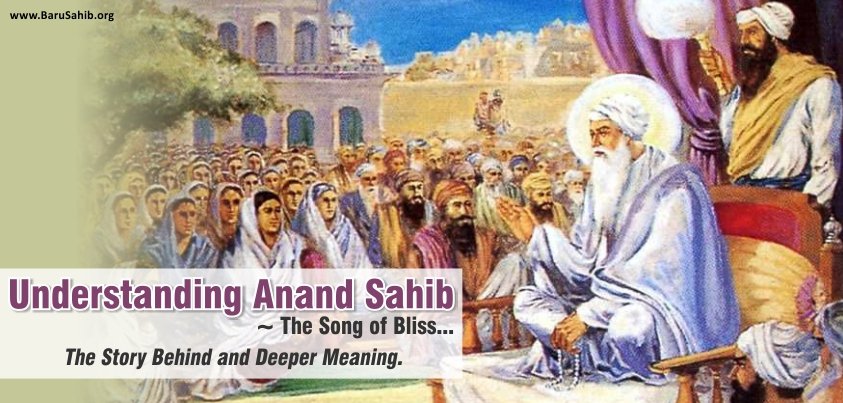
Understanding Anand Sahib – The Story of Bliss…

There is a great story about how the Anand Sahib, by Guru Amar Das ji, came to be written. It is said that, during Guru Amar Das ji’s time, there was a very old yogi who had spent years and years in isolation and deep meditation. But as the yogi was coming to the end […]

There is a great story about how the Anand Sahib, by Guru Amar Das ji, came to be written. It is said that, during Guru Amar Das ji’s time, there was a very old yogi who had spent years and years in isolation and deep meditation. But as the yogi was coming to the end of his life, he realized that he was missing something. That he still hadn’t “got it.”

The old yogi had heard of a very old wise man, who was deeply respected and honored. This wise man was Guru Amar Das ji, the third Guru of the Sikhs. The yogi decided to visit Guru Amar Das ji and see if the Guru could solve his dilemma.

In audience with Guru Amar Das ji, and after paying the proper respects, the yogi described his frustration with his practice and then asked very simply, “Oh kind and wise Guru, will you teach me how to just live life?”

Guru Amar Das nodded. “Leave this body,” he told the yogi. “And be reborn in my family. Then come to me and I will teach you how to live.”

The yogi took his leave of the Guru. Soon after, in obedience to the Guru’s command, the yogi sat in meditation and left his body. In due time, the wife of Guru Amar Das ji’s son Mohri gave birth to a grandson. When Guru Amar Das heard of the birth of the child, he knew that the yogi’s soul had been reborn. Immediately, he called for the child to be brought to him even though the traditional time of sequestering the infant with the mother had not yet passed.

As soon as his grandson was in his presence, Guru Amar Das ji sang the Anand Sahib – the Song of Bliss. When he was done singing, the Guru named the child Anand.

What, then, is the Anand Sahib? How did Guru Amar Das ji respond to the yogi’s prayer to understand how to live life? There is an old tradition that says that each pauree, or step, of the Anand Sahib gives the essential lesson to the soul for that particular year of life. So the first Pauree, or verse, relates to the child’s first year of life. The 2nd pauree or verse is for the 2nd year of life. And so on.

Step by step, year by year, all the way until the 40th year. If the lessons are learned year after year, then a person can develop his or her personality in a very spiritual and conscious way. The mind becomes thoroughly trained to support the soul’s reality in the midst of daily life.

But if some step is missed along the way, that person still has the rest of his or her life to meditate upon the Anand Sahib and to learn it.

In the weeks and months ahead, my prayer is to write a series of columns that highlight each Pauree of the Anand Sahib and how it relates to the soul’s lesson for that particular year of life. My hope is that this series will be of interest and spark some good dialogue among all of those who read it.

Back before British rule in India, the entire Anand Sahib, from the 1st through the 40th Paurees, were read before the hukam was taken. It is said that the Anand Sahib in its completeness gave the Sikhs their unique power and strength.

By looking at this Bani, verse by verse, we can perhaps rediscover what the Sikhs of old once knew.

Please leave a comment and let me know if this sounds interesting to you.

With Divine Light,

Ek Ong Kaar Kaur

~ Source: http://www.sikhnet.com/

Main Source of this Sakhi: Mehma Parkash Granth by Sroop Dass Bhalla

The Sacred Tree at Gurdwara Shri Nanak-Matta Sahib

During third Udassi Shri Guru Nanak Dev Ji sat under dead and dried Pipal tree. With divine touch of Guru Sahib Pipal tree came to life again. When Sidh’s saw this, they felt jealous. They used their powers and tried to lift the Pipal tree under which Guru Sahib was sitting on the ground. When […]

During third Udassi Shri Guru Nanak Dev Ji sat under dead and dried Pipal tree. With divine touch of Guru Sahib Pipal tree came to life again. When Sidh’s saw this, they felt jealous. They used their powers and tried to lift the Pipal tree under which Guru Sahib was sitting on the ground. When the tree had risen by a few feet, Guru Sahib simply placed his hand on it and it stopped rising. The same tree can be seen in the Gurudwara Sahib Premises.

The weather being cold, Bhai Mardana asked the Sidhs for some fire. However, they refused to help him. The yogis, instead, taunted him and told him that he should go and ask his Guru Sahib who was with him. At this, Shri Guru Nanak Dev Ji looked at a pile of firewood nearby and it instantly ignited. Bhai Mardana was thus able to keep warm and enjoy the fire. Suddenly, the weather changed for the worse and it began to rain. As a result, the fires lit by the yogis were extinguished but the one lit by Guru Sahib was not affected at all.

Then the yogis dig a little place and made a child to sit in there and covered it. They asked the child that whenever they will ask whose land is this, he should reply, “Sidhan di” ( Of the Yogis). The next morning, they all gathered together and called Guru Sahib for a religious discussion. Then in the front of Guru Sahib when they asked twice whose land is this, the child replied “Sidhan di”. But when Guru Sahib asked whose land is this, there was a reply Nanak Mata, Nanak Mata, Nanak Mata, and the yogis then realized their mistake and fell at the feet of Guru Sahib. Guru Sahib explained to the yogis the path of true meditation and salvation.

Later Baba Almast Ji was taking care of this place. But again the Gorakh Matts harassed Baba Almast Ji, had thrown him out and captured this place. They renamed it as Gorakhmat. Sidhs also set fire to Pipal Tree. Baba Almast Ji sent message to Shri Guru Hargobind Sahib Ji at Darolli Bhai. On request of Baba Almast Ji, Shri Guru Hargobind Sahib Ji came to this place and sprinkled some water on the pipal tree and made it live again. The pipal tree at some parts can be felt as burnt.

Gurudwara Sahib is 45 km from Rudarpur, 11 km from Sitarganj. 500 km from Chandigarh and is situated in the Distt, Udham Singh Nagar, Uttrakhand.

~ Source – http://www.historicalgurudwaras.com/

Calling out loud – Admissions Now Open for B.Sc and M.Sc – Nursing!

At – AKAL COLLEGE OF NURSING, BARU SAHIB In pursuit of permanent peace and brotherhood (P.O Baru Sahib (via Rajgarh) Distt. Sirmour, HP) ADMISSIONS OPEN-2014 B. SC. NURSING (INC Code-1303001) 60 Seats (30 State Quota Seats only for Himachali Bonafide, 30 Management Quota Seats) M. Sc. Nursing (ODIC Code1304001) 20 Seats (Medical Surgical-10 Seats, Obsterical […]

At – AKAL COLLEGE OF NURSING, BARU SAHIB
In pursuit of permanent peace and brotherhood
(P.O Baru Sahib (via Rajgarh) Distt. Sirmour, HP)

ADMISSIONS OPEN-2014

B. SC. NURSING (INC Code-1303001) 60 Seats
(30 State Quota Seats only for Himachali Bonafide, 30 Management Quota Seats)

M. Sc. Nursing (ODIC Code1304001) 20 Seats
(Medical Surgical-10 Seats, Obsterical & Gynacological Nursing.-05 Seats, Paediatric Nursing-05 Seats)

Important Information –

  • Female Candidates 17-35 years old can apply.
  • 10+2 passed with Physics, Chemistry, Biology& English Subjects can apply.
  • Candidates should have passed B. Sc. Nursing (Basic or Post basic)* one year experience (teaching/clinical) after graduation.

Application forms can be downloaded from website: http://www.eternaluniversity.edu.in/

ENTRANCE TEST ON 22nd JUNE, 2014

Email: acn.barusahib6@gmail.com & acn@eternaluniversity.edu.in
Call us: 09816441158, 08894518634, 09816838805