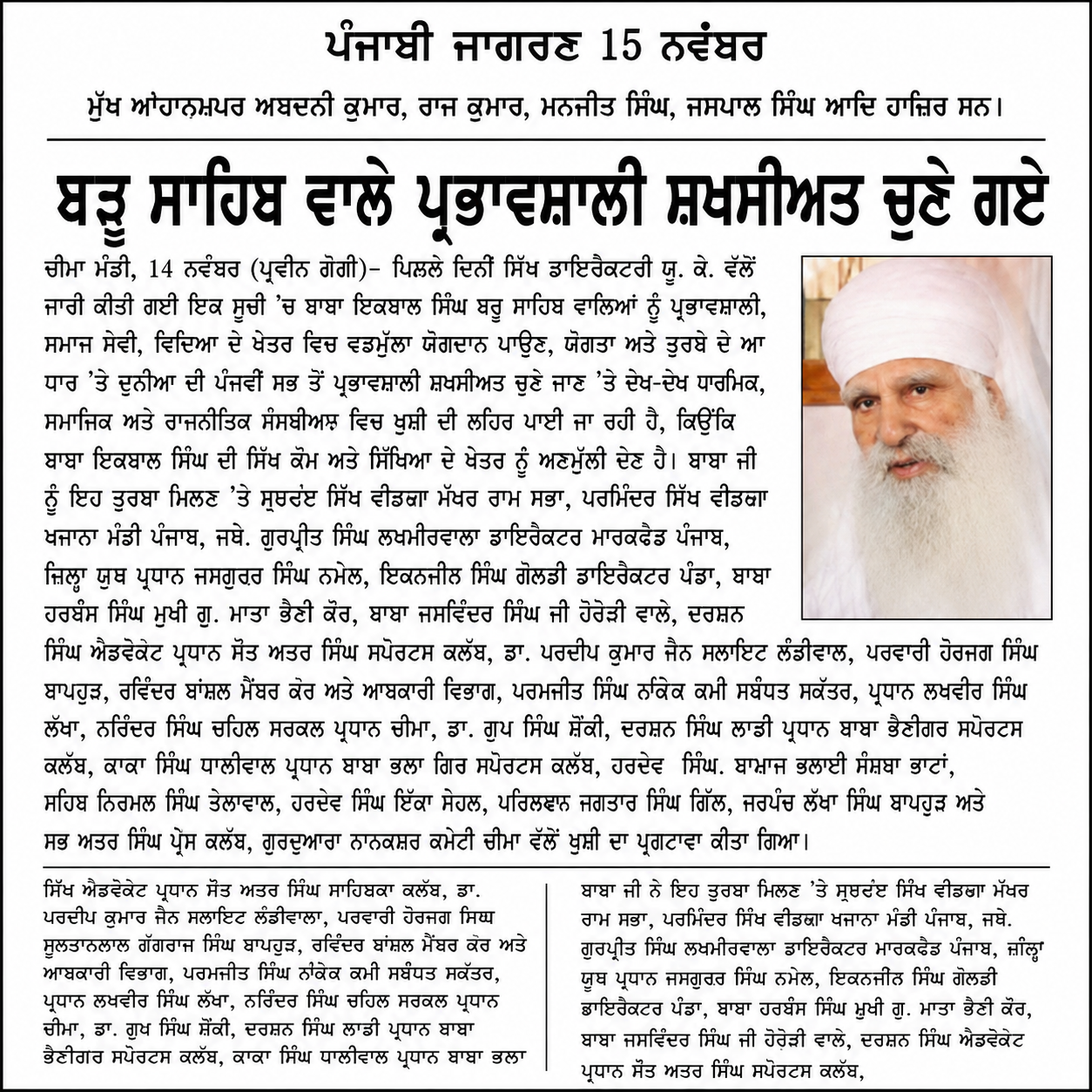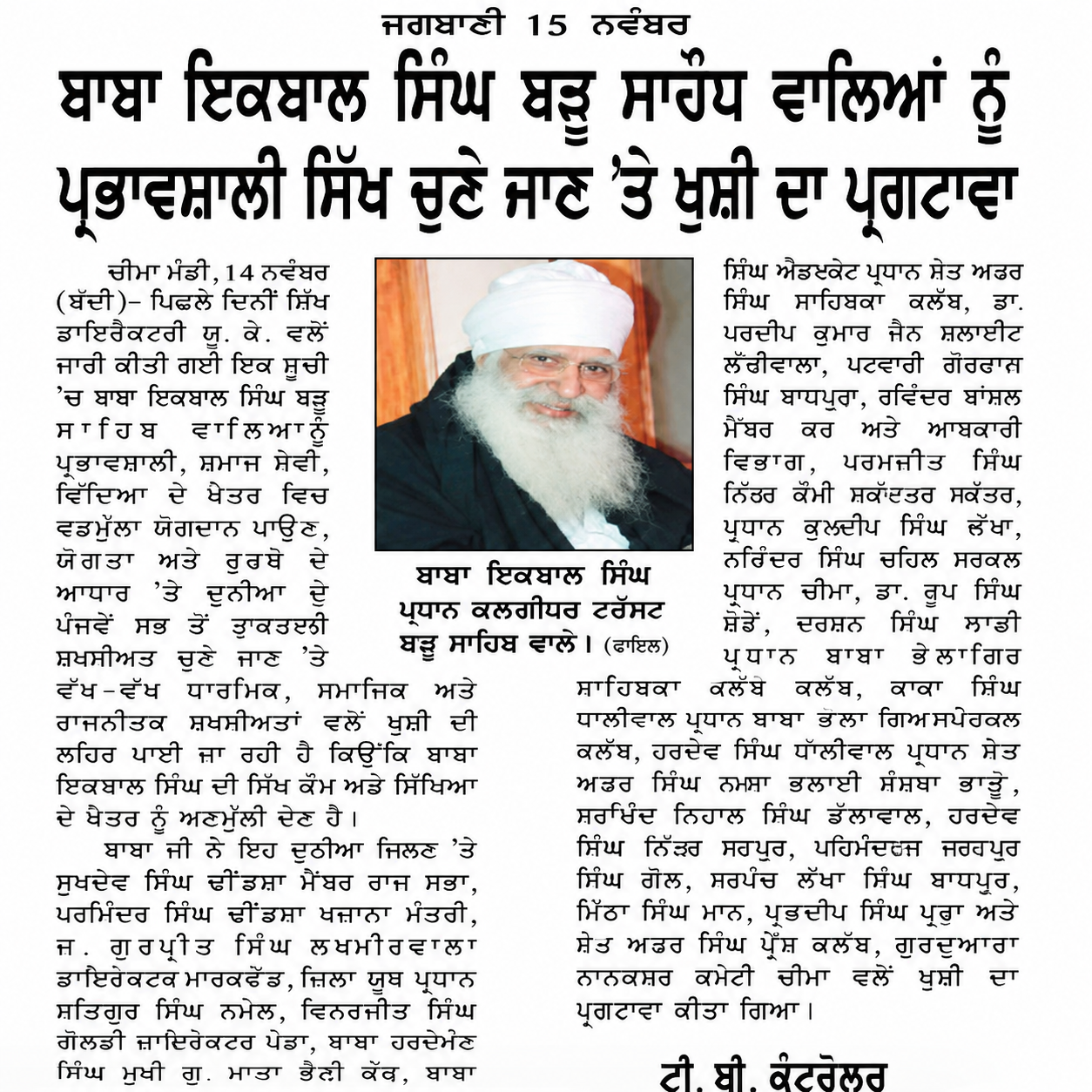

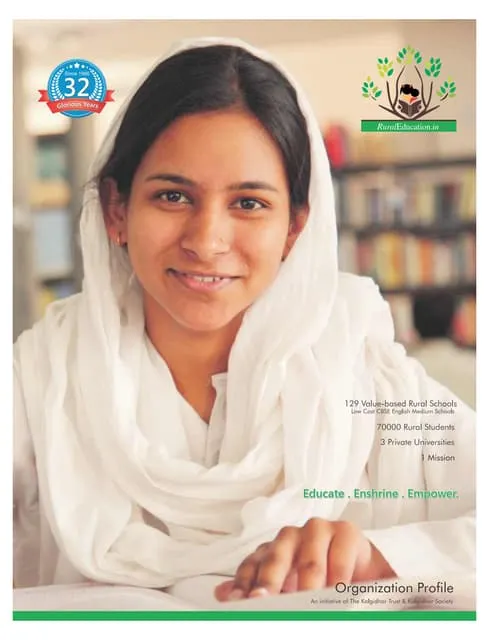
Kalgidhar Trust Achieves 92% Women Employment

Kalgidhar Trust: 92% of Women Find Employment Through Education

Baru Sahib, Himachal Pradesh: On International Women’s Day 2021, The Kalgidhar Trust received recognition for its remarkable contribution to women’s empowerment through education. Reports highlighted that the Trust’s network of Akal Academies formed the only chain of rural schools in North India led almost entirely by women principals, demonstrating how women-led educational institutions can transform rural communities.

Founded by Sant Baba Iqbal Singh Ji, The Kalgidhar Trust has spent nearly four decades creating educational opportunities for children from rural and economically weaker families. Its philosophy extends beyond academic excellence by empowering women to become educators, administrators and community leaders capable of inspiring future generations.

Today, the Trust operates 130 CBSE-affiliated Akal Academies, educating more than 75,000 students across Punjab, Haryana, Himachal Pradesh, Rajasthan and Uttar Pradesh. Alongside Akal University and Eternal University, these institutions continue to advance the Trust’s mission of providing value-based education while creating leadership opportunities for women.


Quick Answer

The Kalgidhar Trust has built one of India’s most distinctive rural education models by placing women in leadership roles across its schools. Recognised during International Women’s Day 2021, the Trust reported employment outcomes of up to 92% for women within its institutions, demonstrating how education and women’s leadership together create lasting social transformation.


Key Facts

  • Organisation: The Kalgidhar Trust, Baru Sahib
  • Founded: 1986
  • Founder: Sant Baba Iqbal Singh Ji
  • Schools: 130 CBSE-affiliated Akal Academies
  • Students: 75,000+ across North India
  • Women’s Leadership: One of the largest rural school networks led by women principals
  • Employment: Up to 92% employment outcomes reported within its institutions

Women Leading Rural Education

The Kalgidhar Trust has consistently believed that empowering women is one of the most effective ways to strengthen families and uplift society. This belief has shaped the organisation’s educational philosophy since the first Akal Academy opened at Baru Sahib in 1986.

Among the earliest volunteers was Dr. Neelam Kaur, who became the first woman principal after joining the Trust alongside her husband, Dr. Devinder Singh. Her leadership established a model that continues today, with women heading many of the Trust’s educational institutions.

Rather than treating women as participants alone, the Trust entrusted them with leading schools, mentoring teachers and shaping educational standards. Their dedication has contributed significantly to strong academic outcomes while fostering caring, disciplined and value-based learning environments.

The recognition received during International Women’s Day 2021 highlighted how this unique leadership model has become an example for rural education across India. It demonstrates that when women are trusted to lead, schools become stronger, students flourish and communities prosper.


The Vision of Sant Baba Iqbal Singh Ji

The philosophy behind this achievement traces directly to the vision of Sant Baba Iqbal Singh Ji. After retiring as Director of Agriculture, Government of Himachal Pradesh, in 1986, Baba Ji dedicated his life to transforming rural India through education rooted in character, discipline and service.

Beginning with just five students at Baru Sahib, he believed every child deserved access to quality education regardless of financial background, geography or social status. He also recognised that empowering women educators would create a lasting impact extending far beyond the classroom.

Over the decades, this vision evolved into one of North India’s largest rural education movements, combining academic excellence with values and leadership development.


From One School to 130 Akal Academies

Today, The Kalgidhar Trust operates 130 CBSE-affiliated Akal Academies educating more than 75,000 students across five northern states.

The majority of students come from rural and farming families, where access to quality education has traditionally been limited. Through modern classrooms, STEM education, robotics laboratories, digital learning platforms and experienced educators, students receive opportunities comparable to the finest urban schools.

Thousands of graduates have gone on to become doctors, engineers, teachers, researchers, entrepreneurs, defence personnel and civil servants while remaining connected to the values instilled during their education.


Women’s Empowerment as a Core Philosophy

For The Kalgidhar Trust, empowering women has never been viewed as a separate initiative—it is woven into the very foundation of the organisation. Sant Baba Iqbal Singh Ji believed that educating and empowering women creates a ripple effect that strengthens families, improves children’s education and accelerates rural development.

This philosophy has guided every stage of the Trust’s growth. Women have been encouraged not only to teach but also to lead schools, mentor future educators and manage educational institutions serving thousands of students. Their leadership has helped create nurturing learning environments where academic excellence is balanced with compassion, discipline and character development.

By investing in women as educational leaders, The Kalgidhar Trust has demonstrated that sustainable social change begins with empowering those who shape future generations.


Eternal University: Advancing Women’s Higher Education

The Trust’s commitment to women extends beyond school education through the establishment of Eternal University, a residential university dedicated to women’s higher education at Baru Sahib.

Eternal University offers programmes in science, engineering, nursing, education, agriculture and allied disciplines, enabling young women from rural and economically weaker backgrounds to pursue higher education in a safe, value-based environment.

Many graduates have gone on to become researchers, educators, healthcare professionals, entrepreneurs and administrators, contributing to the social and economic development of their communities while inspiring the next generation of young women.


Creating Career Opportunities for Women

Reports highlighting employment outcomes of up to 92% for women within the Trust’s institutions demonstrate the practical impact of its educational philosophy. By combining academic excellence with professional development and leadership opportunities, the organisation has created meaningful careers for thousands of women.

Women associated with the Trust serve in diverse roles including principals, teachers, professors, researchers, administrators, healthcare professionals and institutional leaders. Their success reflects the Trust’s belief that education should empower individuals to become financially independent while contributing positively to society.

For many rural women, these opportunities have transformed not only their own lives but also the future of their families and communities.


Value-Based Education That Builds Character

Academic achievement remains an important objective across every Akal Academy, but The Kalgidhar Trust believes education must also develop integrity, compassion and social responsibility.

Students participate in leadership programmes, sports, cultural activities, environmental awareness campaigns, community service and spiritual learning alongside their academic studies. This holistic approach helps children develop confidence, resilience and ethical decision-making skills that prepare them for success in every aspect of life.

The result is an educational model that produces capable professionals while nurturing responsible citizens committed to serving society.


Supporting Rural Development Through Education

The Kalgidhar Trust’s mission extends well beyond classrooms. Through education, healthcare, scholarships, educational sponsorships, women empowerment programmes and community development initiatives, the organisation works to improve the overall quality of life across rural North India.

Its institutions have become centres of learning and community engagement where families come together around a shared vision of education, equality and social progress. Thousands of first-generation learners have gained opportunities that were previously unavailable within their villages.

This integrated approach has enabled the Trust to create lasting social impact while preserving the cultural and ethical values that remain central to its educational philosophy.


Combating Drug Abuse Through Education

Recognising the growing challenge of substance abuse affecting parts of Punjab and neighbouring regions, The Kalgidhar Trust believes education offers one of the most effective long-term solutions.

Students are encouraged to engage in sports, cultural programmes, leadership activities, environmental initiatives and community service that provide purpose, discipline and self-confidence. These experiences help young people make informed decisions while encouraging healthy lifestyles rooted in strong moral values.

By combining education with awareness and character building, the Trust continues to contribute towards creating healthier families, stronger communities and a brighter future for rural youth.


More Than Schools—Centres of Community Transformation

Across North India, The Kalgidhar Trust’s institutions have evolved into far more than educational campuses. They serve as centres of community development where education, healthcare, environmental awareness, leadership and social responsibility come together to create lasting change.

Students are encouraged to participate in sports, cultural programmes, volunteer activities, environmental campaigns and community service alongside their academic studies. This holistic approach helps young people become confident, compassionate and socially responsible citizens capable of contributing positively to society.

For rural families, Akal Academies represent hope, opportunity and progress. They provide access to world-class education while preserving cultural heritage, moral values and a spirit of selfless service.


A Legacy of Women’s Leadership That Continues Today

Nearly four decades after Sant Baba Iqbal Singh Ji established the first school at Baru Sahib, his vision continues to inspire thousands of educators and students across India.

Today, The Kalgidhar Trust educates more than 75,000 students through 130 CBSE-affiliated Akal Academies, supported by Akal University, Eternal University, healthcare initiatives, educational sponsorships and community development programmes.

The Trust’s commitment to women remains one of its defining strengths. By placing women in leadership positions, promoting girls’ education and creating meaningful employment opportunities, the organisation has demonstrated that investing in women strengthens families, schools and society as a whole.

The reported employment outcomes of up to 92% for women within its institutions stand as a testament to the Trust’s long-term commitment to empowerment through education.


Frequently Asked Questions (FAQs)

Why is The Kalgidhar Trust recognised for women’s empowerment?

The Kalgidhar Trust is recognised for creating one of North India’s largest rural education networks led predominantly by women principals while promoting girls’ education, women’s leadership and professional employment opportunities.

What does the reported 92% employment rate refer to?

Reports highlighted employment outcomes of up to 92% for women within the Trust’s institutions, reflecting the organisation’s commitment to education, professional development and women’s empowerment.

Who founded The Kalgidhar Trust?

The Kalgidhar Trust was established under the visionary leadership of Sant Baba Iqbal Singh Ji, who dedicated his life to transforming rural India through value-based education after retiring as Director of Agriculture, Government of Himachal Pradesh.

How many schools does The Kalgidhar Trust operate today?

Today, The Kalgidhar Trust operates 130 CBSE-affiliated Akal Academies educating more than 75,000 students across Punjab, Haryana, Himachal Pradesh, Rajasthan and Uttar Pradesh.

What is Eternal University?

Eternal University is the Trust’s residential university dedicated to women’s higher education, providing quality academic programmes and leadership opportunities for young women from rural communities.

What makes Akal Academies different?

Akal Academies combine academic excellence with value-based education, leadership, discipline, environmental awareness, sports, community service and spiritual development to nurture well-rounded individuals.


Related Resources


References

  • Official records of The Kalgidhar Trust, Baru Sahib
  • International Women’s Day 2021 media coverage
  • Akal Academy institutional records
  • Eternal University official publications
  • Akal University official publications
  • Historical archives of The Kalgidhar Trust and Kalgidhar Society

Conclusion

The Kalgidhar Trust’s approach to women’s empowerment demonstrates that education is one of the most effective tools for social transformation. By creating leadership opportunities for women, promoting girls’ education and establishing institutions rooted in compassion, equality and service, the Trust has built a model that continues to inspire rural communities across North India.

From a single classroom with five students in 1986 to a network of 130 Akal Academies educating more than 75,000 students, the vision of Sant Baba Iqbal Singh Ji continues to flourish. Through value-based education, women-led leadership and community development, The Kalgidhar Trust remains committed to empowering future generations and building a stronger, more inclusive India.
Free Education for Farmers’ Children Since 2020

Kalgidhar Trust Offers Free Education to Farmers’ Children

Baru Sahib, Himachal Pradesh: In December 2020, The Kalgidhar Trust announced a compassionate initiative to provide free education up to the secondary level for children of farmers who lost their lives during the farmers’ agitation. The announcement reflected the Trust’s unwavering belief that no child should lose access to education because of financial hardship or family tragedy.

Founded by Sant Baba Iqbal Singh Ji, The Kalgidhar Trust has spent nearly four decades transforming rural communities through value-based education. The initiative was not a one-time charitable announcement but a continuation of the Trust’s long-standing mission to ensure every child—regardless of social or economic circumstances—has the opportunity to receive quality education.

Today, the educational movement established at Baru Sahib serves more than 75,000 students through 130 CBSE-affiliated Akal Academies, alongside Akal University, Eternal University, healthcare initiatives and community development programmes. Supporting children from farming families has always remained central to its mission.

Quick Answer

In December 2020, The Kalgidhar Trust announced free education up to the secondary level for children of farmers who lost their lives during the farmers’ agitation. The initiative reaffirmed the Trust’s commitment to ensuring that financial hardship never prevents a child from receiving quality, value-based education.

Key Facts

  • Announcement: December 2020
  • Initiative: Free education for children of deceased farmers
  • Organisation: The Kalgidhar Trust, Baru Sahib
  • Beneficiaries: Children of affected farming families
  • Coverage: 130 CBSE-affiliated Akal Academies across North India
  • Mission: Ensure no child is deprived of education because of financial hardship

Standing with Farming Families During Difficult Times

The decision to provide free education came at a time when many farming families were facing immense emotional and financial challenges. For children who had lost a parent, continuing their education often became uncertain. Recognising this reality, The Kalgidhar Trust stepped forward with a commitment to remove educational expenses and ensure that every affected child could continue learning with dignity.

The initiative reflected the organisation’s belief that education is the strongest foundation for rebuilding lives. Rather than allowing tragedy to interrupt a child’s future, the Trust chose to provide stability, opportunity and hope through uninterrupted access to schooling.

For rural communities, this was more than financial assistance. It was a message of solidarity that reaffirmed the Trust’s deep connection with farming families who have long formed the backbone of the Akal Academy community.


A Commitment Rooted in Decades of Service

The free education initiative was a natural extension of work that The Kalgidhar Trust had already been carrying out for decades. Even before this announcement, the organisation was supporting thousands of children from economically weaker families through scholarships, sponsorships and fee assistance across its network of rural schools.

Rather than responding only during times of crisis, the Trust has consistently invested in long-term educational opportunities for underserved communities. Children from farming families, first-generation learners and economically disadvantaged households have remained at the heart of its mission since the first Akal Academy opened.

This long-standing commitment reflects the organisation’s conviction that education is the most sustainable solution to poverty, inequality and social transformation.

The Vision of Sant Baba Iqbal Singh Ji

The philosophy behind this initiative traces directly to the vision of Sant Baba Iqbal Singh Ji. After retiring as Director of Agriculture, Government of Himachal Pradesh, in 1986, Baba Ji chose a path of selfless service by dedicating his life to rural education.

He began with just five students in a modest classroom at Baru Sahib. His dream was simple yet transformative—to ensure that children living in villages received the same educational opportunities as those in India’s largest cities while remaining firmly rooted in values, discipline and service.

Over the decades, this vision evolved into one of India’s largest rural education movements, empowering generations of children through affordable, value-based education.


From One Classroom to 130 Akal Academies

Today, The Kalgidhar Trust operates 130 CBSE-affiliated Akal Academies educating more than 75,000 students across Punjab, Haryana, Himachal Pradesh, Rajasthan and Uttar Pradesh.

The schools primarily serve rural and agricultural communities where access to quality education has traditionally been limited. Thousands of graduates have become doctors, engineers, scientists, teachers, entrepreneurs, defence personnel and civil servants, demonstrating the transformative power of quality education.

Modern classrooms, STEM education, robotics laboratories, digital learning, experienced faculty and holistic development programmes ensure that rural students receive educational opportunities comparable to the best institutions in urban India.


Education Rooted in Values

While academic excellence has always remained a priority, The Kalgidhar Trust believes that education must extend far beyond textbooks and examinations. Every Akal Academy follows a value-based educational philosophy that nurtures the intellect, character and spirit together.

Students are encouraged to develop honesty, compassion, discipline, leadership, environmental responsibility and a lifelong commitment to serving society. This balanced approach ensures that graduates are not only academically accomplished but also prepared to become responsible citizens capable of making meaningful contributions to their communities.

For farming families, this educational model offers something unique—an environment where children receive modern scientific education without losing touch with ethical values, cultural heritage and social responsibility.

Supporting Rural Communities Beyond the Classroom

The Kalgidhar Trust has always viewed education as part of a broader mission of rural development. Alongside schools, the organisation continues to invest in scholarships, healthcare, educational sponsorships, women empowerment programmes and community welfare initiatives that improve the quality of life in villages across North India.

The announcement of free education for children of farmers reflected this broader philosophy. It demonstrated that the Trust’s commitment extends beyond classroom learning to supporting families during moments of hardship, ensuring that children can continue pursuing their dreams regardless of changing circumstances.

This people-first approach has helped build lasting trust within rural communities, many of whom have remained closely connected with the Trust for generations.


Empowering Girls Through Education

Women’s education has remained one of the defining priorities of The Kalgidhar Trust since its inception. Sant Baba Iqbal Singh Ji firmly believed that educating a girl transforms not only one life but an entire family and future generations.

Today, many Akal Academies are led by accomplished women principals, making the organisation one of the largest rural school networks in North India managed predominantly by women educational leaders. The Trust further strengthened this vision through the establishment of Eternal University, a pioneering institution dedicated to expanding higher education opportunities for women.

Thousands of young women from rural communities have gone on to become teachers, doctors, engineers, researchers, entrepreneurs and administrators, creating a powerful cycle of empowerment that continues to inspire future generations.


Building Drug-Free Communities Through Education

One of the long-term social objectives of The Kalgidhar Trust has been addressing the growing challenge of substance abuse through education. Rather than focusing only on rehabilitation, the organisation believes the most sustainable solution lies in prevention by providing children with purpose, discipline and opportunities for personal growth.

Students participate in sports, leadership programmes, cultural activities, environmental initiatives, community service and spiritual learning alongside academics. These experiences help develop confidence, resilience and responsible decision-making while encouraging young people to lead healthy, meaningful lives.

By creating educational environments rooted in values and positive engagement, the Trust continues to contribute towards building stronger families and healthier rural communities.


More Than Schools—Centres of Community Transformation

Across the villages it serves, The Kalgidhar Trust’s institutions have become much more than places of learning. They function as centres of community development where education, healthcare, environmental awareness, leadership and social responsibility come together.

Families see Akal Academies not only as schools but as institutions that nurture future leaders capable of contributing positively to society. Students are encouraged to participate in volunteer activities, cultural programmes, sports, environmental conservation and initiatives that strengthen community life.

The announcement of free education for children of farmers who lost their lives during the farmers’ agitation perfectly reflects this philosophy. It demonstrates that education is not merely about academic achievement—it is about standing beside communities during their greatest moments of need.


A Legacy of Compassion That Continues Today

More than three decades after Sant Baba Iqbal Singh Ji welcomed five students into a modest classroom at Baru Sahib, his vision continues to transform lives every single day. What began as a small educational initiative has evolved into one of India’s largest value-based rural education movements.

Today, The Kalgidhar Trust educates more than 75,000 students through 130 CBSE-affiliated Akal Academies, supported by Akal University, Eternal University, healthcare initiatives, educational sponsorships, women empowerment programmes and community development projects.

The announcement offering free education to children of farmers was not simply an act of generosity. It reflected the Trust’s founding philosophy—that every child deserves access to quality education regardless of financial circumstances, personal tragedy or social background.

As India continues its journey towards inclusive development, The Kalgidhar Trust remains committed to ensuring that education becomes a pathway to dignity, opportunity and lasting social transformation. Every child educated today represents another step towards stronger families, empowered villages and a brighter future for rural India.


Frequently Asked Questions (FAQs)

Did The Kalgidhar Trust offer free education to farmers’ children?

Yes. In December 2020, The Kalgidhar Trust announced free education up to the secondary level for children of farmers who lost their lives during the farmers’ agitation, ensuring that financial hardship would not interrupt their education.

Why did The Kalgidhar Trust launch this initiative?

The initiative was introduced to support families facing unexpected loss while reinforcing the Trust’s long-standing mission of making quality education accessible to every child, particularly those from rural and economically weaker backgrounds.

Who founded The Kalgidhar Trust?

The Kalgidhar Trust was established under the visionary leadership of Sant Baba Iqbal Singh Ji, who dedicated his life to transforming rural India through value-based education and humanitarian service.

How many schools does The Kalgidhar Trust operate today?

Today, The Kalgidhar Trust operates 130 CBSE-affiliated Akal Academies educating more than 75,000 students across Punjab, Haryana, Himachal Pradesh, Rajasthan and Uttar Pradesh.

Does The Kalgidhar Trust continue to support financially weaker families?

Yes. Through scholarships, educational sponsorships, fee concessions and donor-supported programmes, The Kalgidhar Trust continues to help children from economically weaker families receive quality education across its network of Akal Academies.

What makes Akal Academies unique?

Akal Academies combine academic excellence with character building, leadership, discipline, environmental responsibility, community service and value-based education, enabling students to become capable professionals and responsible citizens.


Related Resources


References

  • Official records of The Kalgidhar Trust, Baru Sahib
  • Official announcement regarding the free education initiative (December 2020)
  • Akal Academy institutional records
  • Akal University, Talwandi Sabo
  • Eternal University, Baru Sahib
  • Historical publications and archives of The Kalgidhar Trust

Conclusion

The Kalgidhar Trust’s decision to provide free education for children of farmers who lost their lives during the farmers’ agitation reflects nearly four decades of service to rural India. More than an educational initiative, it represents the organisation’s enduring belief that compassion and education must go hand in hand.

By standing with farming families during times of hardship, the Trust reaffirmed the vision of Sant Baba Iqbal Singh Ji—that no child should ever be deprived of education because of financial circumstances. Today, through its 130 Akal Academies and allied institutions, The Kalgidhar Trust continues to empower rural communities, nurture future leaders and transform lives through value-based education, ensuring that hope, opportunity and learning remain accessible to every child.

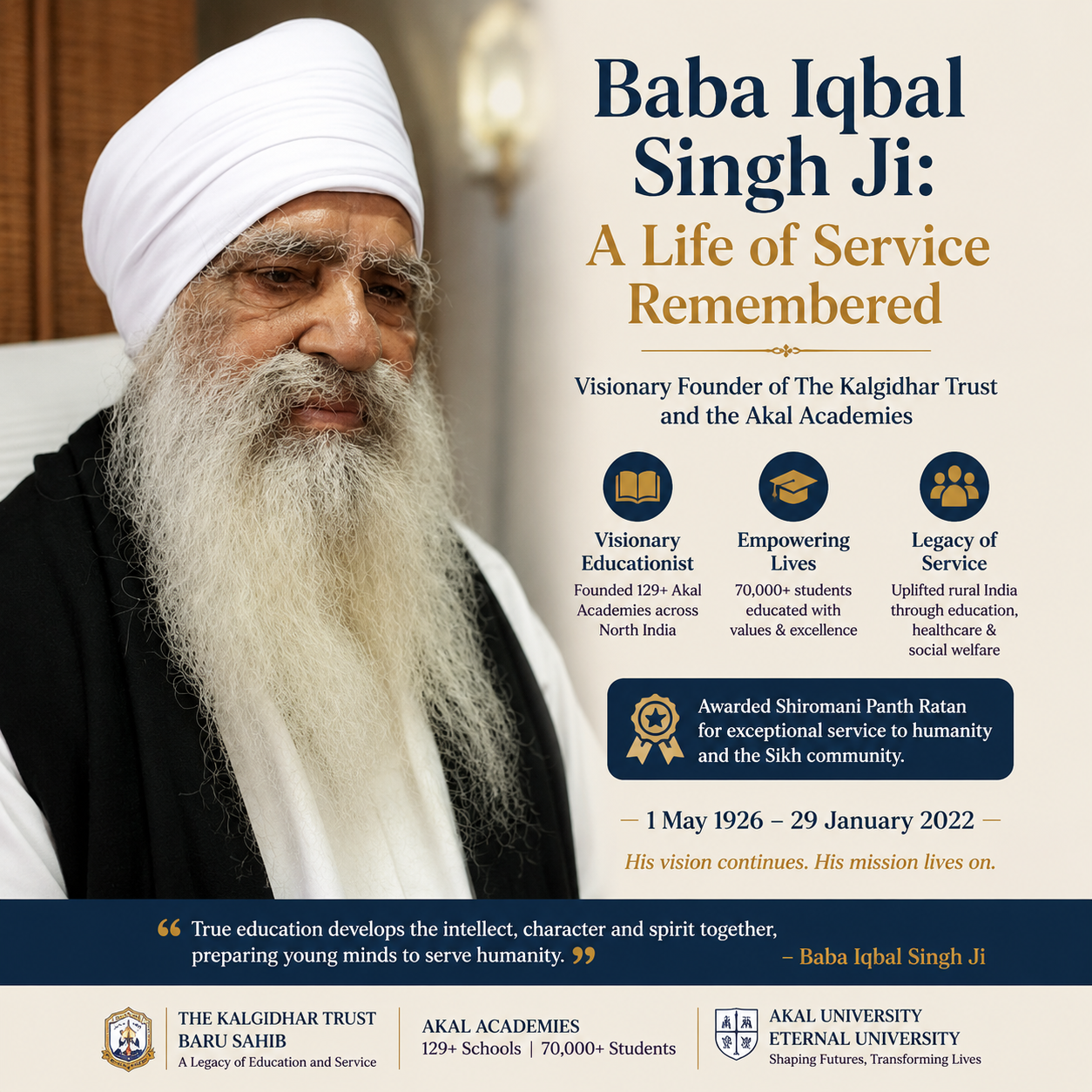
Baba Iqbal Singh Ji: A Life of Service Remembered

Baba Iqbal Singh Ji: A Life of Service Remembered

Baru Sahib, Himachal Pradesh: The passing of Sant Baba Iqbal Singh Ji on 29 January 2022 marked the end of an extraordinary chapter in India’s educational and humanitarian history. Revered as the visionary founder of The Kalgidhar Trust and the driving force behind one of North India’s largest rural education movements, Baba Ji devoted more than five decades of his life to transforming villages through value-based education.

At the age of 96, he left behind not merely institutions but a living movement that continues to educate more than 75,000 students through 130 CBSE-affiliated Akal Academies, alongside Akal University, Eternal University, healthcare initiatives and numerous rural development programmes. His vision continues to inspire educators, volunteers, philanthropists and communities across India and around the world.

Just days before his passing, the Government of India announced the Padma Shri, one of the nation’s highest civilian honours, recognising his lifelong contribution to education, healthcare and social service. The award reflected what millions already knew—that Sant Baba Iqbal Singh Ji had dedicated his entire life to empowering humanity through education.


A Nation Pays Tribute

The news of Baba Ji’s passing was received with profound sorrow across India. Tributes poured in from political leaders, educationists, religious institutions and countless former students whose lives had been transformed by his vision.

President Ram Nath Kovind expressed condolences, acknowledging Baba Ji’s immense contribution to education and society. Prime Minister Narendra Modi remembered him as a remarkable humanitarian whose lifelong efforts empowered rural youth through education and social service.

For thousands who had personally witnessed his humility, compassion and unwavering commitment to public welfare, these tributes reflected a lifetime spent serving others rather than seeking recognition.


Born to Serve

Sant Baba Iqbal Singh Ji was born as Iqbal Singh Kingra on 1 May 1926 in Bharyal Lehri village of Gurdaspur district, Punjab.

His academic journey began with studies in agricultural sciences at the University of Agriculture, Faisalabad, graduating in 1949 before completing postgraduate studies in agriculture. His educational background eventually led him into public service, where he built a distinguished career within the Himachal Pradesh Government.

As Director of Agriculture, Government of Himachal Pradesh, Baba Ji gained deep insight into the realities of rural India. While agriculture remained central to village life, he realised that the greatest investment any nation could make was not merely in crops or infrastructure, but in educating its children.

This understanding would later become the foundation of one of India’s most influential educational movements.


Retirement Became the Beginning of a Greater Mission

When Baba Ji retired from government service in 1986, many expected him to enjoy a peaceful retirement after decades of distinguished public service. Instead, retirement became the beginning of his life’s greatest mission.

Inspired by the teachings of Sant Attar Singh Ji Maharaj, he moved to the peaceful valley of Baru Sahib in Himachal Pradesh with a simple but transformative vision—to provide world-class education to children living in rural India while nurturing moral values, discipline and spirituality.

He began with a single classroom and only five students.

There were no grand buildings, no vast financial resources and no certainty that the experiment would succeed. What existed was unwavering faith that every child deserved the opportunity to receive quality education regardless of social or economic background.


From One Classroom to 130 Akal Academies

Few educational journeys in India have witnessed growth as remarkable as the one initiated by Sant Baba Iqbal Singh Ji.

Over the following decades, that modest classroom evolved into a network of 130 CBSE-affiliated Akal Academies educating more than 75,000 students across Punjab, Haryana, Himachal Pradesh, Rajasthan and Uttar Pradesh.

The schools were intentionally established in villages and underserved regions where access to quality English-medium education remained limited. Thousands of students studying in these institutions became the first members of their families to complete school, pursue university education and enter professional careers.

Today, Akal Academy alumni serve as doctors, engineers, scientists, teachers, entrepreneurs, defence officers, civil servants and researchers across India and abroad—living examples of Baba Ji’s belief that education can transform entire generations.


Education Beyond Academics

For Sant Baba Iqbal Singh Ji, education was never confined to textbooks and examinations. He believed that true learning must develop the intellect, character and spirit together.

Every institution established under The Kalgidhar Trust reflects this philosophy. Alongside academic excellence, students are encouraged to develop honesty, compassion, discipline, leadership, environmental responsibility and a lifelong commitment to serving society.

This holistic educational approach has become one of the defining characteristics of the Akal Academy system and continues to distinguish it among rural educational institutions across India.


Empowering the Most Underserved

The educational movement founded by Baba Ji has always focused on those who need it most. Children from economically weaker families, first-generation learners and students from remote villages have remained at the centre of The Kalgidhar Trust’s mission.

Through scholarships, donor-supported educational assistance and community partnerships, thousands of children continue to receive opportunities that might otherwise have remained beyond their reach.

For many rural families, education at an Akal Academy represents not merely schooling but the possibility of changing the destiny of future generations.


A Champion of Women’s Education

Long before women’s empowerment became a national priority, Sant Baba Iqbal Singh Ji recognised that educating girls creates stronger families and stronger societies.

Today, many Akal Academies are led by women principals, making the network one of the few large rural school systems in North India where women play a central leadership role. His vision was further strengthened through the establishment of Eternal University, a pioneering institution dedicated to expanding higher education opportunities for women.

Thousands of young women from rural backgrounds have since pursued careers in education, healthcare, research, engineering, administration and entrepreneurship because of opportunities created through Baba Ji’s vision.


Building Universities for Future Generations

As the first generation of Akal Academy students completed their schooling, Sant Baba Iqbal Singh Ji recognised the need to provide equally high-quality opportunities for higher education. His vision therefore expanded beyond schools to create institutions that would enable rural students to continue their academic journey without compromising the values that had shaped them.

Today, that vision lives through Akal University at Talwandi Sabo, Punjab, and Eternal University at Baru Sahib, Himachal Pradesh. Together, these universities offer undergraduate, postgraduate and doctoral programmes across science, agriculture, engineering, management, humanities, nursing, health sciences and emerging technologies while continuing to promote ethics, research and community service.

The universities stand as a natural extension of Baba Ji’s lifelong belief that education should empower individuals from childhood through higher learning, enabling them to become capable professionals and responsible citizens.


Fighting the Drug Menace Through Education

One of Sant Baba Iqbal Singh Ji’s deepest concerns was the growing drug menace affecting many rural communities, particularly in Punjab. Rather than viewing addiction solely as a law enforcement or healthcare challenge, he believed the most effective long-term solution was preventive education.

Every Akal Academy was designed to nurture children with purpose, discipline, confidence and moral values. Students were encouraged to participate in sports, community service, cultural activities and spiritual learning alongside academics, helping them develop resilience and positive life goals.

This philosophy continues to guide The Kalgidhar Trust’s educational initiatives today. By investing in children before they become vulnerable to addiction, the institutions help build healthier families and stronger communities.


A Life of Simplicity and Selfless Service

Despite leading one of India’s largest rural educational movements, Sant Baba Iqbal Singh Ji remained remarkably humble. Those who met him remember not his achievements but his simplicity, compassion and personal discipline.

He devoted his life to serving society rather than seeking recognition. Awards and honours never altered his commitment to educating children from villages and economically weaker families. Even as the institutions expanded across multiple states, Baba Ji continued to lead with humility, inspiring thousands of teachers, volunteers, donors and community leaders.

His leadership demonstrated that true success is measured not by personal accomplishments but by the positive impact created in the lives of others.


The Padma Shri: National Recognition for a Lifetime of Service

In January 2022, the Government of India announced the Padma Shri, one of the nation’s highest civilian honours, recognising Sant Baba Iqbal Singh Ji’s exceptional contribution to education, healthcare and social service.

Although Baba Ji passed away shortly before the honour could be formally conferred, the announcement reflected national recognition of a lifetime dedicated to transforming rural India through education.

For millions of students, alumni and well-wishers, however, his greatest award remains the generations of young people whose lives continue to be transformed through the institutions he established.


A Legacy That Lives On

Sant Baba Iqbal Singh Ji may no longer be physically present, but his vision continues to shape the future of rural India every single day. Today, more than 75,000 students study in 130 Akal Academies, supported by Akal University, Eternal University, healthcare institutions, women empowerment programmes and community development initiatives established under The Kalgidhar Trust.

Thousands of alumni now serve as doctors, engineers, teachers, researchers, entrepreneurs, defence personnel and civil servants across India and around the world. Each success story reflects Baba Ji’s enduring belief that education is the most powerful instrument for social transformation.

What began with five students in a single classroom has become one of India’s most inspiring educational movements. His legacy is not measured by buildings alone but by the countless lives transformed through knowledge, values and service.


Frequently Asked Questions (FAQs)

Who was Sant Baba Iqbal Singh Ji?

Sant Baba Iqbal Singh Ji was a renowned educationist, humanitarian and founder of The Kalgidhar Trust, whose vision established 130 Akal Academies and transformed rural education across North India.

When did Sant Baba Iqbal Singh Ji pass away?

He passed away on 29 January 2022 at Baru Sahib, Himachal Pradesh, at the age of 96.

What was the Padma Shri awarded to Sant Baba Iqbal Singh Ji for?

The Government of India announced the Padma Shri in January 2022 in recognition of his lifelong contribution to education, healthcare and social service.

How many schools are part of The Kalgidhar Trust today?

Today, The Kalgidhar Trust operates 130 CBSE-affiliated Akal Academies educating more than 75,000 students across five northern states.

What is Sant Baba Iqbal Singh Ji’s greatest legacy?

His greatest legacy is creating one of India’s largest value-based rural education movements, empowering generations of students through quality education, character development and community service.


Related Resources


References

  • Official records of The Kalgidhar Trust, Baru Sahib
  • Government of India – Padma Awards 2022
  • Akal Academy institutional records
  • Akal University, Talwandi Sabo
  • Eternal University, Baru Sahib
  • Historical publications of The Kalgidhar Trust

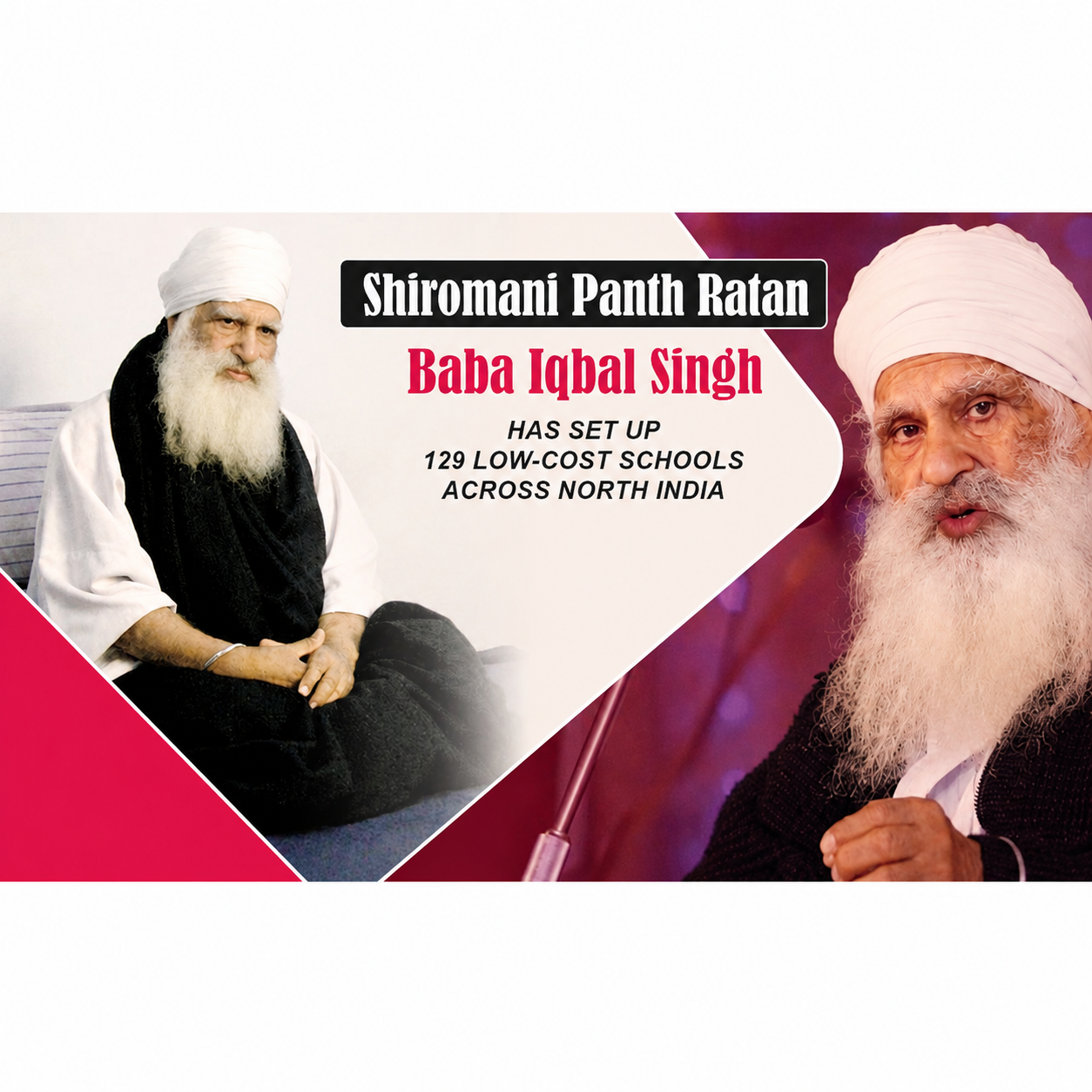
Sant Baba Iqbal Singh Ji: Shiromani Panth Ratan

Sant Baba Iqbal Singh Ji: The Visionary Behind 130 Akal Academies Transforming Rural Education in India

Few individuals have transformed rural education in India as profoundly as Sant Baba Iqbal Singh Ji. Widely regarded as one of the most influential Sikh educationists of modern times, he dedicated his life to proving that quality education should never depend on where a child is born or the financial circumstances of their family.

What began as a single classroom with just five students in the serene Himalayan valley of Baru Sahib has today grown into one of India’s largest rural education movements. Through The Kalgidhar Trust, his vision now reaches more than 75,000 students studying in 130 CBSE-affiliated Akal Academies across Punjab, Haryana, Himachal Pradesh, Rajasthan and Uttar Pradesh.

His legacy extends far beyond schools. Under his leadership, the movement expanded to include Akal University, Eternal University, healthcare institutions, women empowerment initiatives and numerous community development programmes, all united by one philosophy—education that develops the intellect, strengthens character and inspires selfless service.


From Director of Agriculture to Nation Builder

Before becoming one of India’s most respected education reformers, Sant Baba Iqbal Singh Ji served as the Director of Agriculture, Government of Himachal Pradesh. Throughout his distinguished public service career, he witnessed the realities of rural India—communities rich in potential but deprived of quality educational opportunities.

Rather than accepting this as inevitable, he envisioned education as the most powerful tool for breaking the cycles of poverty, unemployment, social inequality and addiction. He believed that lasting rural development could never be achieved merely through infrastructure or welfare schemes. True transformation would come only by educating children with knowledge, values and purpose.

After retiring in 1986, he chose not a life of comfort but one of complete dedication to society. He moved to Baru Sahib with a dream that many believed impossible—to create world-class educational institutions in the villages of North India while preserving India’s rich moral and spiritual heritage.


One Classroom. Five Students. A Movement Begins.

Every great institution has humble beginnings.

For Sant Baba Iqbal Singh Ji, the journey started with a small classroom and only five students. There were no grand campuses, no extensive resources and no promise of rapid expansion. There was only a deep conviction that rural children deserved opportunities equal to those available anywhere in the country.

His educational philosophy was revolutionary in its simplicity. Academic excellence alone was not enough. Education had to nurture the mind, body and spirit, producing individuals who were intellectually capable, morally grounded and committed to serving humanity.

The school welcomed children from farming families and remote villages where quality English-medium education remained virtually inaccessible. Parents who had never imagined sending their children to modern schools found an institution that combined affordability with exceptional educational standards.

What began in a single room gradually earned the trust of surrounding communities. Year after year, the number of students increased, new schools were established and the vision expanded without ever compromising its founding principles.


Building One of India’s Largest Rural Education Networks

Today, that modest beginning has evolved into a remarkable educational ecosystem comprising 130 CBSE-affiliated Akal Academies educating more than 75,000 students across five northern states.

Each academy reflects Baba Ji’s belief that every child—regardless of economic background—deserves access to modern education combined with timeless values. While students excel in science, mathematics, technology, languages and sports, equal emphasis is placed on honesty, discipline, humility, compassion and leadership.

The majority of students come from rural and agricultural communities. For thousands of families, an Akal Academy education has created opportunities that previous generations could scarcely imagine. Many graduates have become doctors, engineers, teachers, scientists, entrepreneurs, defence personnel, civil servants and researchers, returning to contribute positively to society.

Over the years, the institutions have continuously embraced innovation. Smart classrooms, digital learning, robotics, science laboratories, career guidance, international collaborations and technology-enabled education have ensured that students in villages receive opportunities comparable to those in metropolitan schools.


Education That Builds Character

One of Sant Baba Iqbal Singh Ji’s greatest contributions to Indian education is his unwavering commitment to value-based learning.

He often emphasised that education should produce not merely successful professionals but responsible human beings. Academic achievement without integrity, compassion and service, he believed, could never create a better society.

This philosophy continues to guide every institution established under The Kalgidhar Trust. Students participate in community service, environmental initiatives, leadership programmes, spiritual reflection and ethical learning alongside rigorous academic education.

The result is a holistic educational model where students graduate not only with qualifications but also with the confidence, discipline and values required to become responsible citizens and compassionate leaders.


Empowering Rural India Through Education

For Sant Baba Iqbal Singh Ji, education was never intended to benefit only individual students. Every educated child represented the possibility of transforming an entire family and, eventually, an entire village.

The Trust therefore places particular emphasis on supporting first-generation learners, economically weaker families and children living in underserved rural communities. Scholarships, donor-supported initiatives and community partnerships ensure that financial hardship never becomes a barrier to education.

Today, thousands of students receiving educational assistance across the Akal Academy network stand as living proof of Baba Ji’s conviction that education remains the most sustainable solution to poverty and inequality.


Championing Women’s Education

Sant Baba Iqbal Singh Ji firmly believed that educating a girl transforms generations. Long before women’s education became a national priority, he recognised that empowering daughters would strengthen families, communities and the nation itself.

Today, many Akal Academies are led by accomplished women principals, while Eternal University at Baru Sahib continues this vision as India’s first private women’s university in Himachal Pradesh. Thousands of young women from rural backgrounds have pursued higher education and professional careers because of opportunities created through this educational movement.

Whether in classrooms, leadership positions or research institutions, women continue to play a central role in carrying forward Baba Ji’s vision of an equitable and empowered society.


Fighting the Drug Menace Through Education

One of the defining themes of Sant Baba Iqbal Singh Ji’s life was his conviction that education is the most effective long-term response to drug addiction. Rather than treating addiction only after it takes hold, he believed society must prevent it by nurturing young minds with purpose, discipline and hope.

Across Punjab and neighbouring states, where substance abuse has affected countless families, the Akal Academy model offers a positive alternative. Students are encouraged to excel academically while participating in sports, community service, leadership programmes and value-based education that develops confidence, resilience and moral responsibility.

Baba Ji often viewed every child entering an Akal Academy as another young life being guided towards opportunity instead of despair. His educational philosophy continues to demonstrate that investing in children is one of the most sustainable ways to build healthier communities and a stronger nation.


From Schools to Universities: A Complete Educational Ecosystem

As the first generations of Akal Academy students graduated, Sant Baba Iqbal Singh Ji realised that quality education should not end with school. To provide a continuous pathway for higher learning, he expanded the mission beyond primary and secondary education.

Today, that vision includes Akal University at Talwandi Sabo, Punjab, and Eternal University at Baru Sahib, Himachal Pradesh. Together, these institutions offer undergraduate, postgraduate and doctoral programmes across science, agriculture, management, engineering, humanities, health sciences and emerging technologies.

By creating this integrated educational ecosystem, Baba Ji ensured that students from rural backgrounds could pursue world-class education without compromising the values that had guided them throughout their schooling.


Recognition Through the Shiromani Panth Ratan Honour

On 8 July 2018, Sant Baba Iqbal Singh Ji was honoured with the prestigious title of Shiromani Panth Ratan at Takht Sri Harmandir Ji, Patna Sahib. The honour recognised his extraordinary contribution to education, humanitarian service and the upliftment of society through decades of selfless dedication.

While awards acknowledge remarkable achievement, Baba Ji’s greatest recognition has always been the lives transformed through education. Every graduate who becomes a responsible citizen, every family lifted through learning and every village empowered through opportunity reflects the true success of his life’s work.


A Legacy That Continues to Transform Lives

Although Sant Baba Iqbal Singh Ji left behind an extraordinary institutional legacy, his greatest achievement lies in creating a movement capable of growing beyond any one individual. Today, The Kalgidhar Trust continues to expand the mission he began with only five students more than three decades ago.

The organisation now serves more than 75,000 students through 130 Akal Academies, supported by universities, healthcare initiatives, women empowerment programmes, environmental sustainability projects and numerous community outreach activities.

Thousands of alumni now serve society as doctors, engineers, researchers, teachers, entrepreneurs, civil servants, defence personnel and professionals across India and abroad. Many remain deeply connected to the values they learned as students—integrity, humility, compassion and service.

The journey from one classroom to 130 Akal Academies illustrates a timeless principle: lasting change begins with a single act of commitment. Sant Baba Iqbal Singh Ji did not set out to build an educational empire; he simply set out to educate children. The trust earned through that mission allowed the movement to grow naturally into one of India’s largest rural education initiatives.


Why Sant Baba Iqbal Singh Ji’s Vision Matters Today

In an era when educational inequality continues to challenge rural communities, Sant Baba Iqbal Singh Ji’s model offers an enduring blueprint for sustainable development. His institutions prove that academic excellence, affordability, ethical values and social responsibility can coexist to create lasting impact.

Today, the educational movement continues to evolve through digital classrooms, artificial intelligence, STEM education, renewable energy initiatives, international collaborations and research-driven learning while remaining faithful to its founding philosophy of nurturing compassionate and responsible citizens.

More than three decades after a single classroom welcomed its first five students, Sant Baba Iqbal Singh Ji’s vision continues to inspire educators, philanthropists, volunteers and policymakers across the world. His legacy lives on not only in institutions, but in every child whose life has been transformed through education.


Frequently Asked Questions (FAQs)

Who was Sant Baba Iqbal Singh Ji?

Sant Baba Iqbal Singh Ji was an eminent educationist, humanitarian, spiritual leader and founder of The Kalgidhar Trust’s rural education movement. His vision transformed a small school at Baru Sahib into one of India’s largest networks of rural educational institutions.

How many schools did Sant Baba Iqbal Singh Ji establish?

Today, his vision has grown into 130 CBSE-affiliated Akal Academies educating more than 75,000 students across Punjab, Haryana, Himachal Pradesh, Rajasthan and Uttar Pradesh.

What is The Kalgidhar Trust?

The Kalgidhar Trust is a charitable organisation headquartered at Baru Sahib that operates Akal Academies, Akal University, Eternal University, healthcare institutions, women empowerment initiatives and numerous rural development programmes.

Why is Sant Baba Iqbal Singh Ji known for value-based education?

He believed education should develop the intellect, character and spirit together. His institutions combine academic excellence with ethics, discipline, leadership and community service to create responsible citizens.

What honour did Sant Baba Iqbal Singh Ji receive?

He was conferred the prestigious Shiromani Panth Ratan title on 8 July 2018 in recognition of his exceptional contribution to education, humanitarian service and society.


Related Resources


References

  • Official records of The Kalgidhar Trust, Baru Sahib
  • Akal Academies – Institutional Information
  • Akal University, Talwandi Sabo
  • Eternal University, Baru Sahib
  • Official records relating to the Shiromani Panth Ratan honour
  • Historical archives and publications of The Kalgidhar Trust

Akal Academy Reeth Kheri Tops Patiala CBSE Class 12 Board Exams

Akal Academy Reeth Kheri Tops Patiala CBSE Class 12 Board Exams

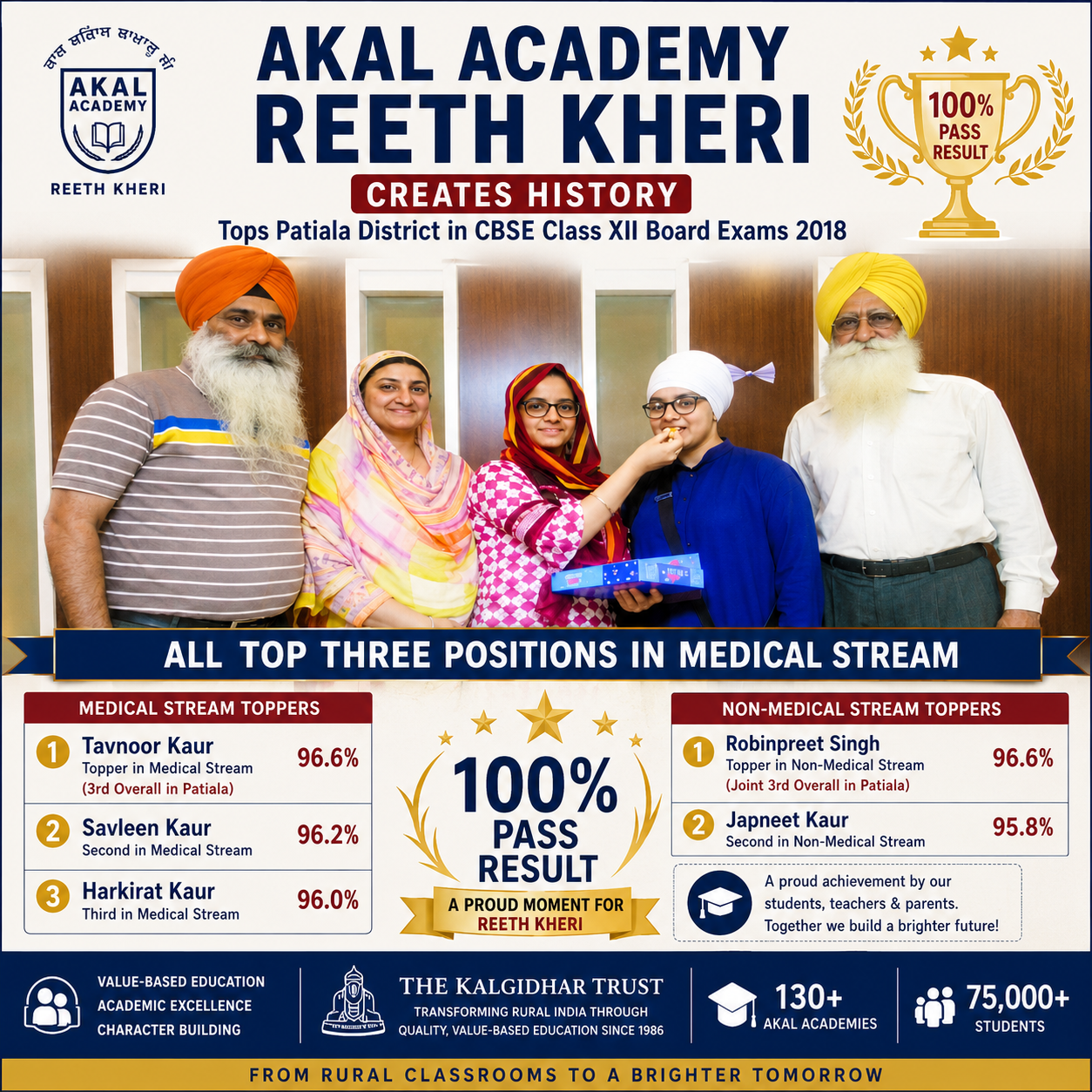
Akal Academy Reeth Kheri, a rural CBSE-affiliated school operated by The Kalgidhar Trust, achieved an extraordinary milestone in the CBSE Class XII Board Examinations 2018 by securing the top positions in both the Medical and Non-Medical science streams across Patiala district. The academy recorded a remarkable 100% pass percentage, reinforcing its reputation as one of Punjab’s leading institutions for value-based education.

Competing with some of the region’s best-known urban schools, Akal Academy Reeth Kheri demonstrated that students from rural backgrounds can achieve academic excellence when provided with quality education, dedicated teachers and a nurturing environment. The outstanding board examination results reflected years of consistent academic preparation and holistic student development.

The achievement received appreciation from educators, parents and the local community, further strengthening the Trust’s belief that education rooted in values and discipline can transform rural India.

Outstanding Performance in the Medical Stream

The academy dominated the Medical stream by securing all three top positions in Patiala district.

  • Tavnoor Kaur scored 96.6%, becoming the Medical Stream Topper and securing the third overall position in Patiala district.
  • Savleen Kaur achieved 96.2%, securing second place in the Medical stream.
  • Harkirat Kaur scored 96.0%, securing the third position.

For a single rural school to produce the top three students in an entire district is an exceptional accomplishment. The results reflected not only the dedication of the students but also the continuous support provided by teachers, parents and the school management.

Top Results in the Non-Medical Stream

The academy continued its remarkable performance in the Non-Medical stream as well.

  • Robinpreet Singh secured the top position with 96.6%, jointly ranking among Patiala district’s highest-performing students.
  • Japneet Kaur followed closely with an outstanding 95.8%.

The success across both science streams demonstrated the academy’s academic consistency rather than isolated individual achievements. It reflected a systematic approach to teaching, mentoring and student development that has become the hallmark of Akal Academies.

100% Pass Result Reflects Academic Excellence

Every student appearing from Akal Academy Reeth Kheri successfully cleared the CBSE Class XII Board Examination, resulting in a 100% pass percentage. Such results are achieved through disciplined academic planning, continuous assessments, experienced faculty and personalised attention given to every student.

The academy’s educational philosophy extends beyond examination preparation. Students are encouraged to develop analytical thinking, communication skills, leadership qualities and moral values alongside academic excellence, preparing them for success in higher education and professional careers.

A Testament to Value-Based Education

The exceptional performance of Akal Academy Reeth Kheri reflects the educational philosophy of The Kalgidhar Trust, which believes that academic excellence and character development must go hand in hand. Rather than focusing solely on examination scores, the Trust encourages students to develop integrity, discipline, compassion and leadership qualities that prepare them for lifelong success.

Founded under the visionary leadership of Baba Iqbal Singh Ji, the Trust has consistently demonstrated that students from rural communities can compete with and outperform their urban counterparts when provided with quality education, modern infrastructure and dedicated mentorship.

The remarkable CBSE results achieved by Akal Academy Reeth Kheri are a reflection of this holistic educational model, where students receive individual attention while being encouraged to strive for excellence in academics, sports, cultural activities and community service.

Teachers Behind the Success

Outstanding academic achievements are built upon the commitment of experienced teachers who guide students throughout their educational journey. At Akal Academy Reeth Kheri, faculty members work closely with every student through regular assessments, doubt-clearing sessions and personalised mentoring to ensure continuous academic progress.

The academy’s teaching methodology combines conceptual learning with disciplined study habits, enabling students to perform confidently in the highly competitive CBSE Board Examinations. Parents and the local community also play an important role by supporting students throughout their preparation.

The success of the 2018 batch stands as a tribute to the dedication of the school’s teachers, administrators and families who collectively contributed to creating an environment where students could realise their full potential.

Breaking the Myth About Rural Education

Akal Academy Reeth Kheri’s district-topping performance challenges the long-held perception that quality education is available only in major cities. The academy proved that rural schools can deliver world-class academic outcomes when supported by strong educational values, qualified educators and modern learning practices.

Students from farming families and economically modest backgrounds demonstrated that talent exists everywhere. With the right opportunities and guidance, rural students can achieve academic excellence and compete successfully at the highest levels.

This achievement continues to inspire students across the Akal Academies network and encourages parents to place greater confidence in rural educational institutions committed to excellence.

The Growing Legacy of Akal Academies

Beginning with just five students at Baru Sahib in 1986, Baba Iqbal Singh Ji’s educational mission has evolved into one of India’s largest rural education movements. Today, The Kalgidhar Trust operates 130 CBSE-affiliated Akal Academies across five northern states, educating more than 75,000 students.

In addition to school education, the Trust also manages Akal University at Talwandi Sabo and Eternal University at Baru Sahib, extending opportunities for higher education and research while continuing its commitment to value-based learning.

Year after year, students from Akal Academies continue to achieve excellent results in CBSE examinations, competitive entrance tests, sports and extracurricular activities, reflecting the strength of a consistent educational philosophy built on academic excellence and ethical values.

Empowering the Next Generation

The achievements of Tavnoor Kaur, Savleen Kaur, Harkirat Kaur, Robinpreet Singh and Japneet Kaur continue to inspire younger students across the Akal Academies network. Their success demonstrates that determination, disciplined study and quality education can overcome geographical and economic barriers.

For thousands of rural children studying at Akal Academies today, these toppers serve as role models, encouraging them to pursue excellence while remaining committed to the values of humility, service and lifelong learning that define The Kalgidhar Trust’s educational mission.

Building Rural Leaders Through Education

The success of Akal Academy Reeth Kheri extends far beyond examination scores. It reflects an educational philosophy that nurtures confident, responsible and compassionate individuals who are prepared to contribute positively to society. Alongside academic achievement, students are encouraged to develop leadership skills, ethical values, environmental awareness and a commitment to community service.

This balanced approach has become the defining characteristic of the Akal Academies network. By combining modern education with value-based learning, the schools prepare students not only for university admissions but also for meaningful careers and responsible citizenship.

Many Akal Academy alumni have gone on to become doctors, engineers, educators, entrepreneurs, researchers and civil servants, carrying forward the values they learned during their school years.

A Model for Educational Excellence

The remarkable achievements of Akal Academy Reeth Kheri demonstrate that educational excellence is not determined by geography but by vision, commitment and quality teaching. The academy’s 100% pass result and district-topping performances provide strong evidence that rural schools can compete with the very best institutions in the country.

The Kalgidhar Trust continues to invest in modern classrooms, qualified faculty, digital learning resources and holistic student development, ensuring that children from rural communities receive educational opportunities equal to those available in metropolitan cities.

These consistent achievements have established the Trust as one of India’s leading organisations dedicated to rural education and social transformation through learning.


Quick Answer

Akal Academy Reeth Kheri achieved a 100% pass rate in the CBSE Class XII Board Examinations 2018 and dominated Patiala district by securing the top three positions in the Medical stream. Robinpreet Singh topped the Non-Medical stream, while Tavnoor Kaur, Savleen Kaur and Harkirat Kaur led the Medical stream, demonstrating The Kalgidhar Trust’s success in delivering quality value-based education in rural India.


Frequently Asked Questions

Why is Akal Academy Reeth Kheri’s CBSE result significant?

The academy achieved a 100% pass percentage and secured the top three positions in the Medical stream while also producing the district topper in the Non-Medical stream, making it one of the best-performing schools in Patiala district.

Who were the top-performing students?

Tavnoor Kaur (96.6%), Savleen Kaur (96.2%), Harkirat Kaur (96.0%), Robinpreet Singh (96.6%) and Japneet Kaur (95.8%) were among the academy’s highest scorers in the 2018 CBSE Class XII Board Examinations.

Who operates Akal Academy Reeth Kheri?

Akal Academy Reeth Kheri is managed by The Kalgidhar Trust, which operates 130 CBSE-affiliated Akal Academies across five northern states.

What makes Akal Academies different?

Akal Academies combine academic excellence with value-based education, leadership development, discipline, spirituality and community service to nurture well-rounded individuals.

How many students study in Akal Academies today?

More than 75,000 students study across 130 Akal Academies run by The Kalgidhar Trust, making it one of North India’s largest rural education networks.


Related Resources


References

  • CBSE Class XII Board Examination Results 2018
  • Akal Academy Reeth Kheri Official Academic Records
  • The Kalgidhar Trust – Educational Initiatives
  • Official School Achievement Reports

The outstanding performance of Akal Academy Reeth Kheri in the CBSE Class XII Board Examinations 2018 stands as a powerful example of what value-based education can achieve. By securing a 100% pass percentage and producing district toppers across both Medical and Non-Medical streams, the academy reaffirmed The Kalgidhar Trust’s mission of providing world-class education to rural children. Today, this legacy continues across 130 Akal Academies, where more than 75,000 students are empowered through academic excellence, strong moral values and holistic development.

Former PM Manmohan Singh Launches Baba Iqbal Singh Ji’s Book

Manmohan Singh Launches Baba Iqbal Singh Ji’s Book on Value-Based Education

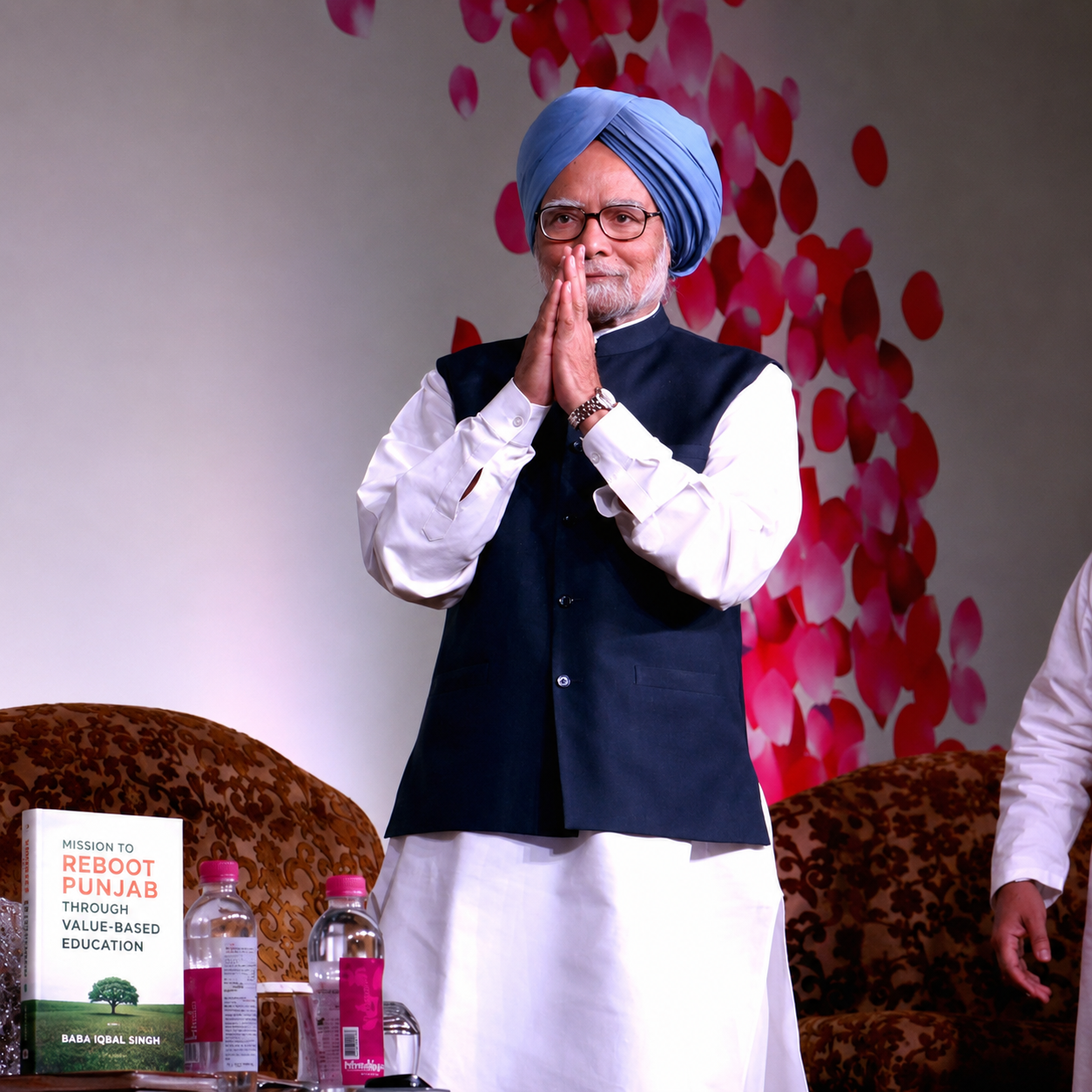
Former Prime Minister Dr. Manmohan Singh officially launched “Mission to Reboot Punjab Through Value-Based Education”, authored by Baba Iqbal Singh Ji, on 8 April 2017 in New Delhi. The event marked a significant milestone for The Kalgidhar Trust, bringing national attention to its mission of transforming rural India through value-based education.

The book launch attracted distinguished guests from the fields of education, industry and public service, including Sunil Kant Munjal, Chairman of Hero Corporate Service. The presence of Dr. Manmohan Singh, one of India’s most respected economists and former Prime Minister, highlighted the growing recognition of Baba Iqbal Singh Ji’s educational vision and its impact on rural development.

More than the release of a book, the occasion celebrated a movement that has empowered thousands of children through quality education, moral values and community service. It also reinforced the importance of education as the foundation for rebuilding society.

A Vision to Reboot Punjab Through Education

Mission to Reboot Punjab Through Value-Based Education presents Baba Iqbal Singh Ji’s lifelong belief that lasting social transformation begins in the classroom. The book explains how value-based education can address many of the challenges affecting Punjab, including youth unemployment, drug abuse, school dropouts and migration.

Rather than focusing solely on academic achievement, Baba Iqbal Singh Ji advocates an educational model that develops knowledge, character, leadership and spiritual values together. His philosophy is based on preparing students to become responsible citizens who contribute positively to society.

The book also documents decades of grassroots work undertaken through The Kalgidhar Trust, demonstrating how educational institutions can become centres of social transformation in rural communities.

National Recognition for The Kalgidhar Trust

The participation of Dr. Manmohan Singh gave the event national significance. Throughout his public life, Dr. Singh has consistently emphasised education as the foundation of economic development and social mobility. His presence at the launch reflected an appreciation of the work being carried out by Baba Iqbal Singh Ji and The Kalgidhar Trust.

The launch introduced policymakers, educators, researchers and social leaders to an educational model that had quietly transformed thousands of lives across rural North India. It also encouraged wider discussions on how value-based education can contribute to long-term social and economic progress.

The event demonstrated that successful educational models developed in rural India deserve national attention and can serve as examples for similar initiatives across the country.

From Five Students to a Nationwide Educational Movement

The philosophy presented in the book is rooted in Baba Iqbal Singh Ji’s own life’s work. After retiring as Director of Agriculture in Himachal Pradesh, he established the first Akal Academy at Baru Sahib in 1986 with just five students.

Over the following decades, this modest beginning evolved into one of India’s largest rural education movements. Today, The Kalgidhar Trust operates 130 CBSE-affiliated Akal Academies across five northern states, educating more than 75,000 students, many of whom come from farming families and economically disadvantaged backgrounds.

The organisation has also established Akal University at Talwandi Sabo and Eternal University at Baru Sahib, extending its commitment to quality higher education and research while remaining firmly rooted in the principles of value-based learning.

Education as a Tool for Social Change

The central message of Mission to Reboot Punjab Through Value-Based Education is that education should prepare students not only for careers but also for responsible citizenship. Baba Iqbal Singh Ji argues that academic excellence must be supported by ethical values, compassion, discipline and service to humanity.

This philosophy continues to guide every institution established by The Kalgidhar Trust. Students are encouraged to excel academically while also developing leadership qualities, environmental responsibility, cultural awareness and a commitment to serving society.

The New Delhi book launch helped bring this educational philosophy into the national spotlight, encouraging educators and policymakers to explore value-based education as a practical model for sustainable social development.


Related Resources


References

  • Official Book Launch Ceremony – New Delhi (8 April 2017)
  • Mission to Reboot Punjab Through Value-Based Education by Baba Iqbal Singh Ji
  • The Kalgidhar Trust – Official Publications
  • Akal Academies – Educational Initiatives and Rural Development Programmes

The launch of Mission to Reboot Punjab Through Value-Based Education by former Prime Minister Dr. Manmohan Singh marked a defining moment in the journey of The Kalgidhar Trust. It recognised Baba Iqbal Singh Ji’s decades-long commitment to transforming rural India through education rooted in academic excellence, ethical values and selfless service. Today, that vision continues to inspire more than 75,000 students studying across 130 Akal Academies, along with Akal University and Eternal University, carrying forward a mission that began with just five students at Baru Sahib.

Baba Iqbal Singh Book: 1 Vision for Interfaith Harmony

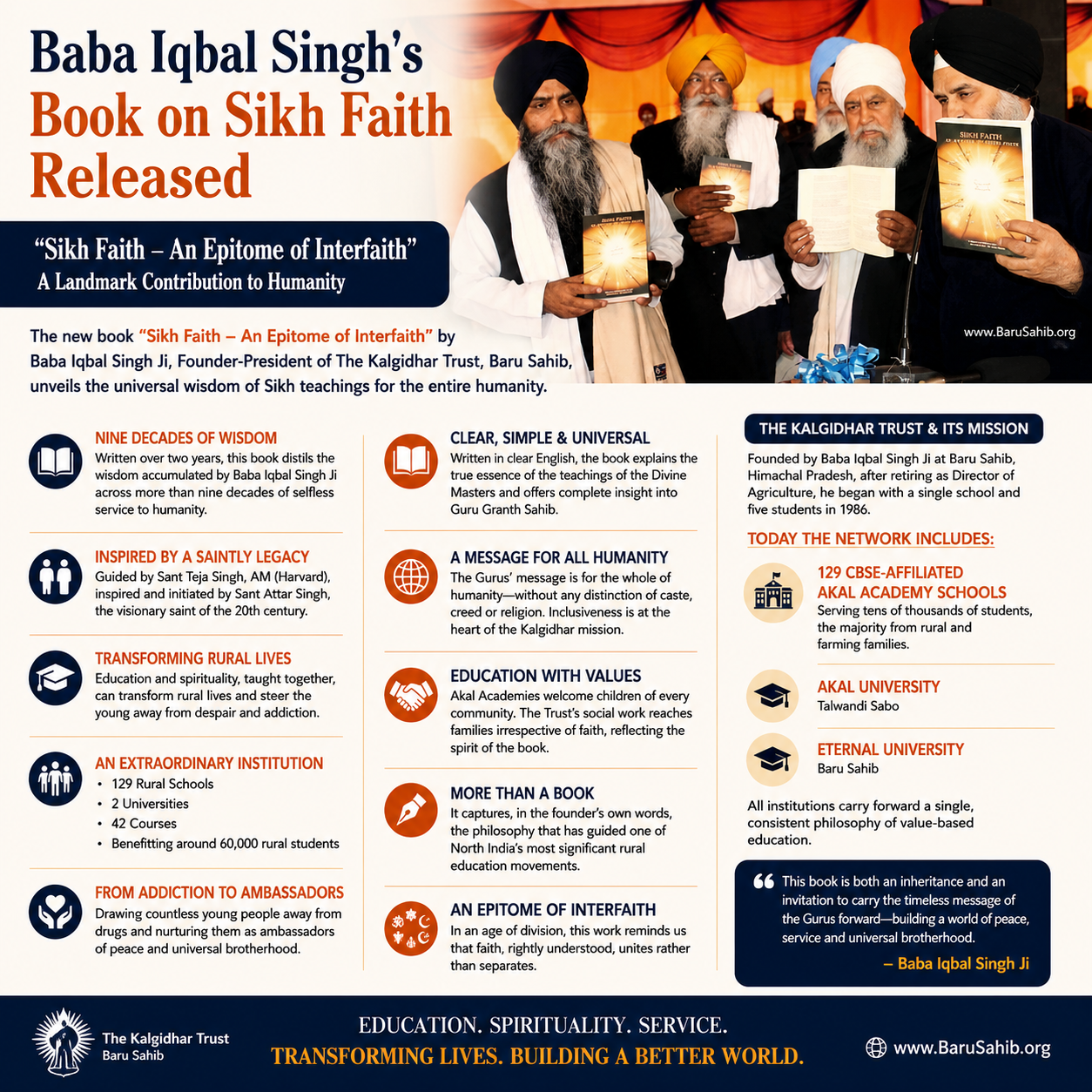
Baba Iqbal Singh Ji’s Book on Sikh Faith Released

Baba Iqbal Singh book Sikh Faith – An Epitome of Interfaith represents one of the most significant literary contributions by the Founder-President of The Kalgidhar Trust, Baru Sahib. More than simply a publication, the book captures over nine decades of spiritual wisdom, educational leadership and humanitarian service dedicated to uplifting society through the timeless teachings of Sikhism.

Written over nearly two years despite an exceptionally demanding schedule of educational responsibilities, national travel and community service, the book reflects Baba Iqbal Singh Ji’s lifelong mission of making Sikh philosophy understandable and relevant for readers of every background. It distils the principles that guided one of India’s largest rural education movements into a practical and accessible guide for modern society.

Unlike many theological works written for scholars, Sikh Faith – An Epitome of Interfaith is designed for ordinary readers seeking a deeper understanding of Sikh teachings and their relevance in today’s interconnected world. Through simple language and practical examples, Baba Iqbal Singh Ji explains how the teachings of Guru Granth Sahib offer universal guidance for building peaceful families, compassionate communities and responsible global citizens.

A Book Inspired by a Great Spiritual Legacy

The inspiration behind the Baba Iqbal Singh book can be traced to the spiritual lineage of Sant Attar Singh Ji and Sant Teja Singh Ji, AM (Harvard). Sant Attar Singh envisioned an education system where academic excellence would always be accompanied by moral character and spiritual development. His disciple, Sant Teja Singh Ji, carried this vision across the world while demonstrating that modern education and spiritual wisdom could complement one another.

Baba Iqbal Singh Ji inherited this remarkable tradition and transformed it into a practical educational movement. The same philosophy that inspired the establishment of schools, universities and humanitarian initiatives also forms the intellectual foundation of Sikh Faith – An Epitome of Interfaith. Readers therefore encounter not merely religious discussion but the lived experience of a leader who spent decades applying these teachings to real-world challenges.

Understanding Sikhism Through Simple Language

One of the book’s greatest strengths is its accessibility. Rather than using highly technical religious language, Baba Iqbal Singh Ji presents Sikh philosophy in clear, concise English that can be understood by students, educators, parents and readers from different faith traditions.

The book explores the universal message contained within Guru Granth Sahib, demonstrating how Sikh teachings encourage compassion, equality, humility, service and respect for all humanity. These principles are presented not as abstract ideals but as practical values that individuals can apply in everyday life, regardless of profession, nationality or religion.

This approach makes the publication particularly valuable for readers seeking an authentic introduction to Sikh philosophy without requiring prior theological knowledge. It also supports interfaith dialogue by presenting Sikhism as a universal message of peace, coexistence and mutual respect.

The Meaning Behind “An Epitome of Interfaith”

The title itself reflects the central message of the book. Baba Iqbal Singh Ji explains that the Gurus’ teachings transcend religious boundaries and speak directly to the shared values of humanity. The concept of interfaith is therefore not presented as compromise between religions but as recognition of the universal truths that unite people across cultures and beliefs.

Throughout the publication, readers discover that Guru Granth Sahib encourages understanding rather than division, service rather than conflict and compassion rather than discrimination. These timeless teachings remain highly relevant in today’s increasingly interconnected world, where dialogue and mutual respect are more important than ever.

The Educational Philosophy Behind the Book

The publication also reflects the educational philosophy that has guided The Kalgidhar Trust for decades. Baba Iqbal Singh Ji consistently believed that education should develop both intellectual ability and moral character. Schools should prepare students not only for successful careers but also for responsible citizenship and meaningful service to society.

This philosophy became the foundation upon which the Trust established its extensive network of educational institutions. The same principles explained in the book continue shaping classrooms where students learn academic excellence alongside honesty, discipline, compassion and leadership.

For readers already familiar with the educational work of Baru Sahib, the book provides valuable insight into the philosophy that inspired every institution built under Baba Ji’s guidance. It serves as both a spiritual reflection and a practical explanation of the values that continue influencing thousands of students every year.

From Baru Sahib to a Global Educational Movement

The philosophy presented in the Baba Iqbal Singh book is not merely theoretical. It has been implemented through one of India’s largest value-based educational movements established by The Kalgidhar Trust at Baru Sahib.

After retiring as Director of Agriculture in Himachal Pradesh, Baba Iqbal Singh Ji dedicated himself to building an educational system that could transform rural India through quality education rooted in ethics and spirituality. Beginning with just a handful of students in 1986, this mission has grown into a remarkable network of institutions serving children from villages across North India.

Today, The Kalgidhar Trust operates more than 129 CBSE-affiliated Akal Academy schools along with Akal University, Eternal University, teacher education programmes, healthcare initiatives and numerous social welfare projects. Together, these institutions educate tens of thousands of students while promoting the values explained throughout Sikh Faith – An Epitome of Interfaith.

Education and Spirituality Working Together

One of the book’s central messages is that education and spirituality should complement one another. Baba Iqbal Singh Ji believed that academic success alone cannot build a peaceful society unless it is supported by compassion, integrity, humility and service.

This educational philosophy distinguishes the institutions established by The Kalgidhar Trust. Students study mathematics, science, technology, languages and modern subjects while simultaneously learning ethical leadership, environmental responsibility, social service and respect for humanity.

Rather than viewing spiritual education as separate from modern learning, Baba Ji demonstrated that both can work together to produce capable professionals who also become responsible citizens.

A Practical Guide to Sikh Philosophy

Unlike traditional theological books intended primarily for scholars, Sikh Faith – An Epitome of Interfaith serves as a practical guide for everyday readers. The book answers many common questions about Sikh beliefs, values and traditions while explaining how Guru Granth Sahib offers timeless guidance applicable to contemporary life.

Readers discover how Sikh teachings encourage equality, gender respect, honest living, selfless service, humility and universal brotherhood. These values are illustrated through practical examples that demonstrate how spirituality can influence everyday decisions at home, in education and within society.

The accessible writing style also makes the publication suitable for students, teachers, researchers and interfaith readers interested in understanding Sikhism through authentic interpretation rather than stereotypes or misconceptions.

Promoting Interfaith Understanding

The title An Epitome of Interfaith reflects Baba Iqbal Singh Ji’s conviction that true faith brings people together rather than dividing them. Throughout the book, readers encounter the universal teachings of the Sikh Gurus, who consistently emphasised equality, compassion and respect for every individual regardless of religion, nationality or social background.

This message has particular significance in today’s increasingly interconnected world. The publication encourages readers to recognise shared human values while appreciating religious diversity, making it a valuable resource for educators, community leaders and anyone interested in promoting peaceful coexistence.

Extending the Mission Beyond the Classroom

The publication also expands the educational mission of Baru Sahib beyond the physical classroom. While thousands of students benefit directly from Akal Academy schools and the Trust’s universities, the book enables readers worldwide to engage with the same philosophy that has shaped these institutions.

Parents, teachers, researchers, policymakers and international readers can better understand why value-based education has become central to The Kalgidhar Trust’s work. In many ways, the book serves as the written expression of principles that have guided the organisation’s educational achievements for decades.

A Lasting Contribution to Sikh Literature

The Baba Iqbal Singh book stands as both a literary and educational contribution to Sikh scholarship. Rather than focusing solely on historical events, it explains how Sikh teachings remain relevant in addressing modern challenges including social division, addiction, declining moral values and the need for ethical leadership.

Its publication preserves Baba Iqbal Singh Ji’s reflections for future generations while providing an accessible resource for readers seeking a balanced understanding of Sikh philosophy. As interest in interfaith dialogue and value-based education continues growing worldwide, the book remains increasingly relevant.

For supporters of The Kalgidhar Trust and Baru Sahib, Sikh Faith – An Epitome of Interfaith is more than a publication. It is a written record of the principles that inspired one of India’s most influential rural educational movements and continue shaping thousands of lives every year.


Why This Book Continues to Matter Today

The Baba Iqbal Singh book remains highly relevant because it addresses timeless questions about education, faith, ethics and humanity. While societies continue to advance technologically, the need for compassion, integrity and responsible leadership has never been greater. Sikh Faith – An Epitome of Interfaith reminds readers that spiritual wisdom and modern progress can coexist and strengthen one another.

The book also serves as an enduring record of the philosophy behind the educational institutions established by Baba Iqbal Singh Ji. Readers gain insight into the principles that inspired one of India’s most influential rural education movements and understand how value-based education can contribute to social transformation.


Frequently Asked Questions

What is Sikh Faith – An Epitome of Interfaith?

It is a book written by Baba Iqbal Singh Ji that explains the universal teachings of Sikhism, the philosophy of Guru Granth Sahib and the importance of interfaith harmony in simple, accessible language.

Who wrote the book?

The book was written by Baba Iqbal Singh Ji, Founder-President of The Kalgidhar Trust, Baru Sahib, after decades of educational, spiritual and humanitarian service.

Why is the book important?

The publication presents Sikh philosophy in a practical way while promoting values such as compassion, equality, service, ethical leadership and universal brotherhood. It also documents the philosophy behind The Kalgidhar Trust’s educational mission.

Who should read this book?

The book is suitable for students, educators, researchers, parents, members of the Sikh community and readers of every faith interested in understanding Sikh teachings and interfaith dialogue.

How does the book relate to The Kalgidhar Trust?

The values explained throughout the book form the educational foundation of The Kalgidhar Trust, Akal Academy schools, Akal University and Eternal University, where value-based education continues transforming rural communities.


Related Resources


References


Conclusion

The Baba Iqbal Singh book, Sikh Faith – An Epitome of Interfaith, represents far more than a publication on Sikh philosophy. It captures the lifelong vision of an educationist, humanitarian and spiritual leader who dedicated his life to combining academic excellence with moral values and selfless service.

Drawing upon the teachings of Guru Granth Sahib and the spiritual legacy of Sant Attar Singh Ji and Sant Teja Singh Ji, the book explains how faith can unite humanity while inspiring ethical leadership, compassion and lifelong learning. Written in clear language for readers of every background, it continues introducing new generations to the universal message of Sikhism.

For supporters of The Kalgidhar Trust, students of Akal Academy institutions and readers interested in value-based education, the publication offers an authentic understanding of the principles that shaped one of India’s largest rural educational movements. It stands as a lasting contribution to Sikh literature and an enduring reminder that education achieves its highest purpose when guided by wisdom, humility and service to humanity.


This article has been prepared to document the publication of Sikh Faith – An Epitome of Interfaith by Baba Iqbal Singh Ji and to preserve the educational, historical and literary significance of the work for researchers, educators, students and future generations.

Punjabi Jagran Highlights Baba Iqbal Singh Ji’s Honour

Punjabi Jagran Highlights Baba Iqbal Singh Ji’s Global Recognition

Punjabi Jagran Baba Iqbal Singh Ji coverage recorded a proud milestone for Punjab’s educational and Sikh communities when the leading Punjabi daily reported that Baba Iqbal Singh Ji of Baru Sahib had been recognised among the world’s five most influential Sikhs in the inaugural Sikh 100 Ranking published by Sikh Directory UK. The newspaper presented the honour as recognition of a lifetime dedicated to education, social service and community leadership rather than individual acclaim.

Published in its 15 November edition, Punjabi Jagran reported that the announcement sparked celebrations throughout Punjab. Religious organisations, educational institutions, social bodies and political leaders welcomed the recognition, describing Baba Iqbal Singh Ji’s contribution to society as invaluable. For readers across the region, the news represented more than an international ranking—it was an acknowledgement of decades of quiet service devoted to transforming rural education.

According to the newspaper, the international recognition was awarded after evaluating influence, contribution to education, humanitarian service, leadership and public standing. Baba Iqbal Singh Ji’s inclusion among the world’s Top Five Sikhs demonstrated that meaningful social impact can earn global respect while remaining firmly rooted in local communities.

Why Punjabi Jagran Covered This Historic Achievement

Punjabi Jagran highlighted that Baba Iqbal Singh Ji’s work extended far beyond the boundaries of a traditional educational institution. Through visionary leadership and unwavering commitment to service, he established an educational movement that enabled thousands of children from rural and economically disadvantaged families to access quality English-medium education without compromising their cultural and spiritual values.

The newspaper explained that the honour reflected years of dedication to building institutions that focused equally on academic excellence, ethical values and character development. Unlike awards recognising temporary achievements, the Sikh 100 Ranking celebrated sustained contribution and measurable impact on society.

For Punjabi Jagran readers, the story reinforced the belief that education remains one of the most powerful instruments for social transformation. Baba Iqbal Singh Ji’s recognition illustrated how a life devoted to serving others could receive appreciation at the international level while continuing to inspire communities at home.

Community Leaders Welcome the Honour

The report described widespread happiness among religious, social and political organisations after the announcement. Leaders from different backgrounds congratulated Baba Iqbal Singh Ji, recognising his lifelong commitment to educational reform and humanitarian service.

Punjabi Jagran specifically mentioned congratulatory messages from Rajya Sabha Member Sukhdev Singh Dhindsa, Punjab Finance Minister Parminder Singh Dhindsa and several respected community leaders, directors, village sarpanches, sports club representatives and social workers from the Sangrur and Cheema region.

The broad range of well-wishers demonstrated that Baba Ji’s influence reached every section of society. His work was appreciated not only within educational circles but also among public representatives and community organisations that had witnessed the positive impact of his institutions over many years.

The Importance of the Sikh 100 Ranking

The Sikh 100 Ranking, published by Sikh Directory UK, was introduced as one of the first comprehensive international rankings recognising influential Sikh personalities across the world. The selection process considered multiple dimensions of leadership, including influence, effectiveness, contribution to society, integrity, achievements and long-term public impact.

For Baba Iqbal Singh Ji, this recognition acknowledged decades of educational leadership rather than a single accomplishment. It recognised the institutions he established, the students whose lives were transformed and the communities strengthened through access to value-based education.

From Baru Sahib to International Recognition

Although the honour received international attention, its roots lay in the peaceful surroundings of Baru Sahib. After retiring as Director of Agriculture in Himachal Pradesh, Baba Iqbal Singh Ji dedicated his life to building an educational movement that combined academic excellence with moral and spiritual values.

Beginning with a single institution, his vision gradually evolved into one of North India’s largest rural education initiatives. This remarkable journey demonstrated that transformative leadership begins with a clear purpose and a lifelong commitment to serving humanity.

Punjabi Jagran’s coverage therefore celebrated more than an individual achievement. It recognised the success of an educational philosophy that continues to empower students through knowledge, discipline, compassion and service.

From a Single School to a National Educational Movement

The recognition highlighted in Punjabi Jagran Baba Iqbal Singh Ji coverage cannot be understood without appreciating the extraordinary educational journey that began at Baru Sahib in Himachal Pradesh. After retiring as the Director of Agriculture, Baba Iqbal Singh Ji dedicated the next phase of his life to building an educational system that would empower rural children through knowledge, discipline and values.

Inspired by the vision of Sant Attar Singh Ji and Sant Teja Singh Ji, Baba Iqbal Singh Ji believed that education should shape the complete personality of a child. Academic excellence, ethical conduct, spiritual awareness and service to humanity became the four pillars of the educational philosophy that later guided every institution established under The Kalgidhar Trust.

What began as a single educational initiative gradually expanded into one of India’s largest charitable rural education movements. Today, the institutions established under his leadership continue transforming the lives of students who otherwise might never have received access to quality education.

Expanding Educational Opportunities Across Rural India

One of Baba Iqbal Singh Ji’s greatest achievements has been making quality education accessible to children living in villages and remote communities. Rather than concentrating educational institutions only in major cities, he focused on rural regions where educational opportunities were often limited.

Through the network of Akal Academy schools, thousands of students from farming families and economically disadvantaged backgrounds receive modern English-medium education while remaining connected to their cultural roots and moral values.

The schools combine science, mathematics, technology, languages and digital learning with character education, environmental awareness, discipline and community service. This balanced approach has helped students excel academically while developing into responsible citizens capable of contributing positively to society.

Punjabi Jagran’s report recognised that this educational model had become an inspiration for educators and communities throughout Punjab and neighbouring states.

The Kalgidhar Trust’s Lasting Contribution

The international recognition reported by Punjabi Jagran also reflects the broader contribution of The Kalgidhar Trust to India’s educational landscape. Under Baba Iqbal Singh Ji’s leadership, the Trust developed schools, universities, teacher education programmes, healthcare initiatives and social welfare projects that collectively serve thousands of families every year.

These institutions have become recognised for maintaining high academic standards while preserving values of honesty, compassion, equality and selfless service. The Trust’s mission demonstrates that educational excellence and ethical leadership can grow together rather than exist separately.

Students graduating from these institutions have gone on to pursue successful careers in engineering, medicine, agriculture, research, civil services, defence, entrepreneurship and higher education. Many continue contributing to society through community service inspired by the values they learned during their education.

Value-Based Education That Continues to Inspire

Baba Iqbal Singh Ji consistently emphasised that true education extends beyond textbooks and examinations. He believed schools should prepare students not only for employment but also for leadership, responsibility and lifelong service.

This philosophy remains central to every institution established under The Kalgidhar Trust. Students are encouraged to develop critical thinking, compassion, integrity, discipline and respect for all communities while achieving academic excellence.

Punjabi Jagran’s coverage highlighted that these values were among the reasons Baba Iqbal Singh Ji earned international recognition. His educational vision created institutions capable of producing both successful professionals and responsible human beings.

Why Global Recognition Was Well Deserved

The Sikh 100 Ranking recognised individuals whose influence produced meaningful and measurable benefits for society. Baba Iqbal Singh Ji’s inclusion among the world’s five most influential Sikhs reflected decades of sustained educational leadership rather than temporary public recognition.

His contribution can be measured through thousands of students educated, rural communities empowered, educational institutions established and opportunities created for future generations. These achievements continue expanding long after the original recognition was announced.

For Punjabi Jagran readers, the honour demonstrated that genuine influence is created through consistent service rather than publicity. Baba Ji’s work stands as an example of how one person’s vision can transform entire communities through education.

A Legacy That Continues Through Future Generations

The educational mission initiated by Baba Iqbal Singh Ji continues inspiring students, teachers, researchers and social leaders across India. Every new academic session welcomes another generation of learners into institutions built upon the principles of knowledge, humility and service.

The international recognition reported by Punjabi Jagran therefore represents more than a historical achievement. It continues reminding society that lasting progress begins with education rooted in values and guided by a commitment to improving the lives of others.

As new generations graduate from institutions established under his vision, Baba Iqbal Singh Ji’s legacy continues to grow—proving that the greatest measure of leadership is the positive impact left on future generations.


Why Punjabi Jagran’s Coverage Still Matters Today

Punjabi Jagran Baba Iqbal Singh Ji coverage remains an important historical reference because it documents both the international recognition and the overwhelming response from Punjab’s educational, social and religious communities. While international rankings acknowledge achievement, regional newspapers preserve how communities celebrated those milestones, making such reports valuable records for researchers and future generations.

The newspaper demonstrated that Baba Iqbal Singh Ji’s influence extended well beyond education. Community leaders, public representatives and citizens viewed the honour as recognition of a lifetime devoted to serving humanity through knowledge, compassion and institution building. The report reflected the pride felt across Punjab as one of its most respected educationists received global acknowledgement.

Today, these newspaper archives continue helping historians, educators and researchers understand how Baba Iqbal Singh Ji’s educational movement gained recognition both nationally and internationally.

What Makes This Recognition Unique?

Unlike awards based primarily on popularity or public visibility, the Sikh 100 Ranking evaluated measurable contribution, leadership, influence, effectiveness and long-term social impact. Baba Iqbal Singh Ji’s inclusion among the world’s five most influential Sikhs recognised decades of educational reform, humanitarian service and institution building.

The honour also highlighted the importance of value-based education as a powerful force for social transformation. Baba Ji demonstrated that educational institutions rooted in ethics, compassion and excellence can influence society far beyond the classroom.

For Punjabi Jagran readers, the recognition served as proof that quiet, selfless service can earn worldwide respect while continuing to inspire local communities.


Frequently Asked Questions

Why did Punjabi Jagran report Baba Iqbal Singh Ji’s recognition?

Punjabi Jagran reported the story after Baba Iqbal Singh Ji was recognised among the world’s five most influential Sikhs in the Sikh 100 Ranking published by Sikh Directory UK. The newspaper also highlighted the widespread celebrations across Punjab following the announcement.

What is the Sikh 100 Ranking?

The Sikh 100 Ranking is an international publication released by Sikh Directory UK. It recognises influential Sikh personalities based on leadership, contribution to society, public influence, achievements and long-term impact.

Why was Baba Iqbal Singh Ji selected?

He was recognised for his lifelong contribution to rural education, value-based learning, humanitarian service and institution building through The Kalgidhar Trust and its educational initiatives.

What is The Kalgidhar Trust?

The Kalgidhar Trust is a charitable educational organisation founded at Baru Sahib. It operates educational institutions and social initiatives dedicated to expanding quality education, ethical leadership and rural development.

Why is Punjabi Jagran’s report historically important?

The report preserves an important public record of Baba Iqbal Singh Ji’s international recognition while documenting the appreciation expressed by Punjab’s educational, social and political leadership.


Related Resources


References

  • Punjabi Jagran Newspaper – Published 15 November (Historical Newspaper Archive).
  • Sikh Directory UK – Sikh 100 Ranking.
  • The Kalgidhar Trust – Educational initiatives and institutional history.

Conclusion

Punjabi Jagran Baba Iqbal Singh Ji coverage recorded a defining moment in the history of rural education by highlighting his recognition among the world’s five most influential Sikhs. The newspaper celebrated not only an international honour but also the values of education, humility and service that shaped Baba Ji’s lifelong mission.

By documenting the enthusiastic response from religious organisations, community leaders and public representatives, Punjabi Jagran preserved an authentic historical account of how Punjab celebrated one of its most respected educationists. The report illustrates that genuine leadership is measured not by titles or publicity but by the positive impact created in the lives of others.

Today, the article continues serving as an important historical record within the wider archive of newspaper coverage documenting Baba Iqbal Singh Ji’s remarkable legacy. It reminds readers that quality education rooted in ethical values remains one of the strongest foundations for building stronger communities and a better future.


This article has been prepared as part of the historical media archive documenting newspaper coverage of Baba Iqbal Singh Ji’s international recognition. It expands upon the original published report with additional historical context for educational, archival and research purposes while preserving the factual essence of the news coverage.

Jagbani Highlights Baba Iqbal Singh Ji’s Global Recognition

Jagbani Highlights Baba Iqbal Singh Ji’s Global Recognition

Jagbani Baba Iqbal Singh Ji coverage captured a proud moment for Punjab’s educational and Sikh communities when the widely read Punjabi daily reported that Baba Iqbal Singh Ji of Baru Sahib had been recognised among the world’s five most influential Sikhs in the internationally acclaimed Sikh 100 Ranking published by Sikh Directory UK. The report celebrated not only an international honour but also the lifelong dedication of an educator whose work transformed opportunities for thousands of rural children across northern India.

Published in its 15 November edition, Jagbani described how the announcement generated widespread appreciation throughout Punjab. Religious institutions, educational organisations, social groups and public representatives welcomed the recognition, viewing it as a tribute to decades of selfless service rather than a personal achievement alone. The newspaper presented the story as one of collective pride for communities that had witnessed the remarkable growth of Baba Iqbal Singh Ji’s educational mission.

The report explained that Baba Iqbal Singh Ji earned his position among the world’s Top 5 Sikhs because of his exceptional contribution to education, humanitarian service, leadership and social development. Unlike honours based on popularity or public image, the Sikh 100 Ranking recognised measurable contribution, sustained influence and meaningful impact on society.

A Recognition Built on Service Rather Than Publicity

Jagbani highlighted that Baba Iqbal Singh Ji’s international recognition reflected a lifetime devoted to serving humanity through education. His leadership was never defined by public campaigns or personal recognition. Instead, he concentrated on creating educational opportunities for children from villages where access to quality English-medium education remained limited.

For readers across Punjab, the story demonstrated how quiet, consistent service could earn worldwide respect. Baba Ji’s work showed that lasting influence is created through institutions, values and opportunities that continue benefiting society long after individual achievements have faded.

The newspaper emphasised that his educational movement had become a source of hope for rural families seeking quality education combined with strong moral values. This philosophy distinguished his institutions from conventional educational models and became one of the defining reasons behind the international honour.

Punjab Celebrates the Honour

According to Jagbani, the announcement triggered celebrations among numerous religious, political and social organisations throughout the region. Community leaders regarded the recognition as a proud achievement not only for Baru Sahib but for Punjab as a whole.

The newspaper reported congratulatory messages from Rajya Sabha Member Sukhdev Singh Dhindsa, Punjab Finance Minister Parminder Singh Dhindsa and many respected local personalities. Directors of educational institutions, village sarpanches, sports organisations and community representatives also welcomed the recognition, acknowledging Baba Iqbal Singh Ji’s contribution towards education and public welfare.

The extensive list of well-wishers reflected the broad respect Baba Ji enjoyed across society. Leaders from different backgrounds united in recognising his commitment to improving educational opportunities and strengthening communities through service rather than politics or commercial success.

Why the Sikh 100 Ranking Matters

The Sikh 100 Ranking, published by Sikh Directory UK in London, introduced an international framework for recognising influential Sikhs from around the world. Rather than focusing on fame alone, the ranking considered leadership, influence, effectiveness, integrity, public service, professional achievements and contribution to society.

This comprehensive approach made the recognition especially meaningful. Baba Iqbal Singh Ji’s inclusion among the world’s five most influential Sikhs acknowledged decades of institution building, educational reform and humanitarian service that had transformed countless lives across rural India.

For Jagbani readers, the report also demonstrated that educational leadership deserves the same international recognition traditionally associated with politics, business or public office. The honour celebrated the enduring impact of education in shaping individuals, families and communities.

Baru Sahib Becomes an International Symbol of Educational Service

The report naturally directed attention towards Baru Sahib, where Baba Iqbal Singh Ji established the foundations of an educational movement that would eventually become one of North India’s largest rural education initiatives. From modest beginnings, the institutions developed under his leadership became recognised nationally for combining academic excellence with ethical and spiritual values.

The international recognition reported by Jagbani therefore extended beyond an individual. It also acknowledged the educational philosophy that emerged from Baru Sahib—a philosophy centred on character building, discipline, compassion and service alongside academic achievement.

For thousands of students and families connected with these institutions, the recognition reinforced confidence that value-based education could earn respect on a global stage while remaining deeply rooted in Indian culture and Sikh principles.

From a Vision at Baru Sahib to a National Education Movement

The international recognition highlighted in Jagbani Baba Iqbal Singh Ji coverage is deeply connected with an educational journey that began in the peaceful Himalayan valley of Baru Sahib. After retiring as Director of Agriculture in Himachal Pradesh, Baba Iqbal Singh Ji chose not to pursue a comfortable retirement. Instead, he dedicated his life to creating educational opportunities for children living in villages where quality schooling was either unavailable or financially beyond reach.

Guided by the vision of Sant Attar Singh Ji and Sant Teja Singh Ji, Baba Iqbal Singh Ji believed that education should nurture both intellect and character. This philosophy became the cornerstone of The Kalgidhar Trust, which gradually developed into one of India’s most respected charitable educational organisations.

What began with a single institution at Baru Sahib eventually expanded into a large educational ecosystem serving rural communities across northern India. This remarkable journey explains why international organisations recognised Baba Ji not simply as an educator but as a visionary whose work created opportunities for generations.

Education Rooted in Values

Baba Iqbal Singh Ji consistently believed that education should prepare young people not only for successful careers but also for responsible citizenship. Academic excellence was always accompanied by lessons in honesty, compassion, discipline, respect and service to humanity.

This educational philosophy distinguished the institutions established under his guidance from many conventional schools. Students were encouraged to become ethical professionals capable of contributing positively to society rather than pursuing personal success alone.

Jagbani’s coverage indirectly reflected this philosophy by recognising that Baba Ji’s influence extended far beyond classrooms. His work created an educational culture where knowledge, spirituality and social responsibility developed together.

Expanding Educational Opportunities Across Rural India

Over the years, the educational mission initiated by Baba Iqbal Singh Ji expanded into an extensive network of Akal Academy schools located primarily in rural and semi-rural regions. These institutions were established to ensure that children from farming families and economically disadvantaged backgrounds could receive high-quality English-medium education close to their homes.

Today, thousands of students continue to benefit from modern classrooms, science laboratories, digital learning resources, sports facilities and experienced teachers while remaining connected to strong ethical values. The schools demonstrate that world-class education can flourish even in villages when supported by visionary leadership and community participation.

The success of this educational model has inspired parents, educators and policymakers alike. Students graduating from these institutions have gone on to pursue higher education and careers in medicine, engineering, administration, research, defence services, business and numerous other professions.

Beyond Schools: Building Complete Educational Institutions

The educational journey envisioned by Baba Iqbal Singh Ji did not end with school education. To provide continuous learning opportunities, the mission expanded to include institutions of higher education such as Akal University and Eternal University.

These universities continue the same philosophy that guided the earliest schools at Baru Sahib—combining academic excellence with research, innovation, ethical leadership and service to society. Students are encouraged to develop professional expertise while remaining committed to improving their communities.

The integrated educational framework created under Baba Ji’s leadership enables students to pursue lifelong learning within institutions that share a common commitment to values, quality and social responsibility.

Why International Recognition Was Well Deserved

The Sikh 100 Ranking recognised individuals whose contributions produced measurable and lasting benefits for society. Baba Iqbal Singh Ji’s selection among the world’s Top 5 Sikhs reflected decades of institution building rather than a single achievement.

His influence can be measured through the thousands of students whose lives have been transformed by education, the teachers inspired by his philosophy and the communities strengthened through access to affordable, quality schooling.

Unlike honours associated with temporary achievements, this recognition celebrated a legacy that continues to grow. Every new student entering an Akal Academy or one of the higher educational institutions established under The Kalgidhar Trust becomes part of a vision that has already impacted countless families across rural India.

A Legacy That Continues to Inspire

Jagbani’s report reminds readers that true leadership is often expressed through consistent service rather than public attention. Baba Iqbal Singh Ji devoted his life to creating opportunities for others, believing that education remains the most powerful tool for reducing inequality and building stronger communities.

The international recognition reported by Jagbani therefore serves as an acknowledgement of an educational philosophy that continues to influence thousands of students every year. It demonstrates that lasting social change begins with the courage to educate, empower and inspire future generations.

For educators, philanthropists and community leaders, Baba Iqbal Singh Ji’s life remains an example of how vision, humility and perseverance can create institutions that continue serving society long after individual honours have been received.

Why Jagbani’s Coverage Remains Historically Important

Jagbani Baba Iqbal Singh Ji coverage continues to serve as an important historical record because it documented both an international honour and the overwhelming appreciation expressed throughout Punjab. While global recognitions acknowledge achievement, regional newspapers preserve the community’s response, making them valuable references for future generations.

The Jagbani report demonstrated that Baba Iqbal Singh Ji’s influence reached far beyond educational institutions. Religious organisations, social groups, public representatives and community leaders viewed his recognition as a celebration of values that had strengthened thousands of families through education.

Today, historians, researchers and educators continue to rely on archived newspaper reports to understand how important milestones were received at the time they occurred. Jagbani’s coverage therefore remains an important part of the documented history surrounding Baba Iqbal Singh Ji’s international recognition.

Educational Leadership Beyond Recognition

Although the Sikh 100 Ranking recognised Baba Iqbal Singh Ji as one of the world’s five most influential Sikhs, his greatest achievement lies in the institutions and opportunities that continue serving society. Thousands of students who have studied within institutions established under The Kalgidhar Trust continue contributing to their communities in diverse professions.

The educational philosophy developed at Baru Sahib remains centred on academic excellence, ethical leadership and compassionate service. These values continue inspiring new generations of students while reinforcing the belief that education should strengthen both knowledge and character.

The international recognition reported by Jagbani therefore acknowledged not only an individual but also an educational movement whose influence continues expanding through schools, universities and community initiatives dedicated to rural development.

Frequently Asked Questions

Why did Jagbani report Baba Iqbal Singh Ji’s recognition?

Jagbani covered the story because Baba Iqbal Singh Ji was recognised among the world’s five most influential Sikhs in the Sikh 100 Ranking published by Sikh Directory UK. The newspaper also highlighted the widespread celebrations across Punjab following the announcement.

What is the Sikh 100 Ranking?

The Sikh 100 Ranking is an international publication produced by Sikh Directory UK. It recognises influential Sikh personalities based on leadership, contribution to society, public influence, effectiveness and long-term impact.

Why was Baba Iqbal Singh Ji selected among the world’s Top 5 Sikhs?

He was recognised for decades of dedicated service in rural education, institution building, humanitarian work and value-based learning. His contribution has transformed educational opportunities for thousands of children while strengthening communities through ethical education.

What is The Kalgidhar Trust?

The Kalgidhar Trust is a charitable educational organisation founded at Baru Sahib that operates schools, universities and social initiatives dedicated to expanding quality education and community development across rural India.

Why is Jagbani’s article still relevant today?

The report remains an important historical document because it records both the international recognition and the public response surrounding Baba Iqbal Singh Ji’s achievement. It continues to provide valuable context for readers interested in educational leadership and the history of rural education.

Related Resources

References

  • Jagbani Punjabi Newspaper – Historical report published on 15 November.
  • Sikh Directory UK – Sikh 100 Ranking.
  • The Kalgidhar Trust – Educational initiatives and institutional history.

Conclusion

Jagbani Baba Iqbal Singh Ji coverage documented a significant chapter in the history of rural education by highlighting his recognition among the world’s five most influential Sikhs. The report celebrated not only an international honour but also the decades of commitment that enabled thousands of children to access quality education rooted in strong ethical values.

By capturing the widespread appreciation expressed by community leaders, educators and public representatives, Jagbani preserved an authentic record of how Punjab celebrated one of its most respected educationists. The article reinforces the idea that meaningful leadership is built through sustained service, humility and a commitment to creating opportunities for others.

Today, this newspaper report continues to serve as an important historical reference within the broader media archive documenting Baba Iqbal Singh Ji’s legacy. It reminds readers that education remains one of the most powerful forces for positive social transformation and that visionary leadership can continue inspiring generations long after recognition has been received.


This article has been prepared as part of the historical media archive documenting newspaper coverage of Baba Iqbal Singh Ji’s international recognition. It expands upon the original published report with additional historical context for educational, archival and research purposes while preserving the factual essence of the news coverage.

Dainik Bhaskar Highlights Baba Iqbal Singh Ji’s Honour

Dainik Bhaskar Reports Baba Iqbal Singh Ji’s Global Recognition

Dainik Bhaskar Baba Iqbal Singh Ji coverage documented an important milestone in the history of rural education and Sikh leadership. In its 15 November edition, the widely read Hindi daily reported that Baba Iqbal Singh Ji, founder of The Kalgidhar Trust, Baru Sahib, had been recognised among the world’s five most influential Sikhs in the prestigious Sikh 100 Ranking published by Sikh Directory UK.

The report highlighted that Baba Iqbal Singh Ji earned this international recognition because of his exceptional contribution to rural education, humanitarian service, value-based learning and long-term social transformation. For readers across North India, the article demonstrated how decades of selfless educational work had received appreciation beyond national boundaries.

Unlike many honours based primarily on popularity or public visibility, the Sikh 100 Ranking evaluated leadership through measurable impact, contribution to society, influence, integrity and sustained service. Dainik Bhaskar explained that Baba Iqbal Singh Ji’s selection reflected not only his educational achievements but also the trust and respect he had earned through decades of serving rural communities.

Dainik Bhaskar Highlights Community Pride

Filed from Cheema in Sangrur district, the Dainik Bhaskar report described the widespread happiness that followed the announcement. Religious organisations, educational institutions, social groups and community leaders welcomed the honour, recognising it as an achievement not only for Baba Ji personally but also for Punjab’s commitment to education and service.

The newspaper noted that Baba Iqbal Singh Ji was selected as the world’s fifth most influential Sikh after an international assessment of leadership, educational contribution, humanitarian work and public influence. The report explained that his decades-long mission of providing affordable, value-based education had earned admiration from both India and the global Sikh community.

Rather than focusing solely on the ranking itself, Dainik Bhaskar also captured the emotional response across the region. The recognition was celebrated because it reflected the success of a mission that had transformed opportunities for thousands of children belonging to rural and economically disadvantaged families.

Leaders Congratulate Baba Iqbal Singh Ji

Dainik Bhaskar documented congratulatory messages from numerous respected public representatives and community leaders. Among those mentioned were Rajya Sabha Member Sukhdev Singh Dhindsa, Finance Minister Parminder Singh Dhindsa, Jathedar Gurpreet Singh Lakhmirwala and several district representatives, village leaders, educators, social workers and sports personalities.

The extensive list of well-wishers illustrated the widespread respect Baba Iqbal Singh Ji commanded across different sections of society. Political affiliation was secondary to a shared appreciation of his contribution towards education, moral values and community development.

The report reflected how educational leadership can unite communities. Instead of celebrating political achievement or commercial success, local organisations recognised an educator whose work had quietly changed countless lives through schools, scholarships and value-based learning.

Understanding the Sikh 100 Ranking

The Sikh 100 Ranking, published by Sikh Directory UK in London, was introduced as one of the first international attempts to recognise influential Sikh personalities across multiple fields. Unlike conventional popularity rankings, the publication assessed individuals using a comprehensive framework that considered leadership, influence, effectiveness, integrity, contribution, capability, public standing and long-term impact.

The ranking brought together personalities from public service, business, education, humanitarian work, religion and international leadership. Baba Iqbal Singh Ji’s inclusion among the world’s Top 5 Sikhs reflected the growing international recognition of education as one of society’s most meaningful forms of leadership.

For Dainik Bhaskar readers, the report offered more than international news. It introduced an inspiring example of how sustained educational service performed in rural India had achieved global appreciation. The story reinforced the message that genuine leadership is measured not by publicity but by the positive transformation created in people’s lives.

Why This Recognition Matters

International recognition carries significance because it validates decades of dedicated work that often takes place away from public attention. Baba Iqbal Singh Ji devoted his life to ensuring that children from rural villages received opportunities comparable to those available in major cities.

His educational philosophy extended beyond academic excellence. He believed education should build character, strengthen ethical values and prepare students to become responsible citizens capable of serving society with honesty, compassion and leadership.

The Dainik Bhaskar article therefore celebrated more than a personal honour. It recognised a vision that demonstrated how education, combined with service and spirituality, can create lasting social transformation across generations.

From One Rural School to a Transformative Education Movement

The international recognition highlighted by Dainik Bhaskar Baba Iqbal Singh Ji is closely connected to the remarkable educational movement that began in the hills of Baru Sahib. After retiring as Director of Agriculture in Himachal Pradesh, Baba Iqbal Singh Ji chose a path of service rather than retirement. In 1986, he established the first educational institution at Baru Sahib with a vision of combining academic excellence with moral and spiritual values.

What started as a single school gradually evolved into one of North India’s largest rural education initiatives. Under the guidance of The Kalgidhar Trust, thousands of children from economically weaker families have received access to quality education that would otherwise have remained beyond their reach.

The Dainik Bhaskar report recognised that Baba Iqbal Singh Ji’s influence extended far beyond classrooms. His work demonstrated that education can become a powerful instrument for reducing poverty, empowering families and strengthening communities. This philosophy became the foundation of every institution established under his leadership.

Building Opportunities Through Value-Based Education

Unlike conventional educational models that focus exclusively on examination results, Baba Iqbal Singh Ji believed that education should develop both competence and character. Students were encouraged to pursue academic excellence while embracing honesty, discipline, compassion and social responsibility.

This balanced approach has enabled thousands of students to excel in medicine, engineering, civil services, defence, research, entrepreneurship and higher education while remaining connected to the ethical values learned during their formative years.

The educational institutions established under The Kalgidhar Trust continue to serve children from farming families, remote villages and economically disadvantaged communities where access to quality English-medium education was once extremely limited.

The Growth of Akal Academy Schools

Today, the vision initiated by Baba Iqbal Singh Ji has expanded into an extensive educational network that includes Akal Academy schools across northern India. These CBSE-affiliated institutions provide modern education while preserving cultural values and encouraging holistic development.

The schools combine science, mathematics, technology, languages, sports and extracurricular activities with value-based education that nurtures leadership, responsibility and respect for humanity. This distinctive educational model has attracted appreciation from parents, educators and policymakers alike.

Many students who were the first in their families to attend an English-medium school have gone on to achieve remarkable academic success. Their accomplishments reflect the lasting impact of an educational philosophy that places equal importance on knowledge and character.

Higher Education and Lifelong Learning

The educational ecosystem envisioned by Baba Iqbal Singh Ji extends beyond school education. Institutions such as Akal University and Eternal University continue this mission by providing quality higher education, research opportunities and professional development for students from diverse backgrounds.

These universities prepare graduates for careers in science, agriculture, management, healthcare, technology and social sciences while maintaining a strong commitment to ethics, sustainability and community service.

The integrated educational model created under Baba Iqbal Singh Ji’s leadership enables students to pursue learning from primary school through postgraduate education within institutions that share a common commitment to excellence and values.

Education as a Tool for Social Transformation

The significance of Baba Iqbal Singh Ji’s recognition becomes even clearer when viewed through the social impact of his work. Education was never treated merely as a means of obtaining employment. Instead, it was regarded as a foundation for building stronger families, healthier communities and responsible citizens.

Thousands of rural children who once faced limited educational opportunities have been able to pursue professional careers while contributing positively to society. The institutions established under The Kalgidhar Trust continue to inspire confidence among parents seeking affordable, high-quality education rooted in ethical principles.

This long-term impact explains why international observers considered Baba Iqbal Singh Ji among the world’s most influential Sikhs. His contribution cannot be measured solely by the number of schools established but by the countless lives transformed through education, guidance and service.

Recognition That Reflects Lasting Impact

The honour reported by Dainik Bhaskar represented more than an international ranking. It acknowledged decades of consistent work dedicated to improving educational opportunities for children who might otherwise have remained excluded from quality learning.

The recognition also demonstrated that meaningful leadership often develops quietly through sustained commitment rather than public attention. Baba Iqbal Singh Ji remained focused on expanding educational access, strengthening institutions and serving society without seeking personal recognition.

For educators, policymakers and community leaders, his example continues to illustrate how one vision can inspire institutions that benefit generations of students. The values of service, integrity and educational excellence remain central to the continuing work of The Kalgidhar Trust and its institutions.

Why Dainik Bhaskar’s Coverage Remains Historically Important

The Dainik Bhaskar Baba Iqbal Singh Ji report continues to hold historical significance because it documented not only an international honour but also the response of communities that had witnessed decades of educational transformation. By recording the celebrations across Punjab, the newspaper preserved an authentic account of how educational leadership was appreciated alongside achievements in politics, business and public service.

Historical newspaper reports become increasingly valuable with time because they capture public sentiment at the moment an important event occurs. Dainik Bhaskar’s coverage therefore serves as an important archival reference for researchers, educators and readers interested in the evolution of value-based education and Sikh leadership.

The article also highlighted that true influence is measured not merely by recognition but by the lasting impact created in the lives of others. Baba Iqbal Singh Ji’s educational movement continues to inspire thousands of students, teachers and families, making this recognition relevant long after its original publication.

Frequently Asked Questions

Why did Dainik Bhaskar report Baba Iqbal Singh Ji’s recognition?

Dainik Bhaskar covered the story because Baba Iqbal Singh Ji was recognised among the world’s five most influential Sikhs in the Sikh 100 Ranking published by Sikh Directory UK. The newspaper also highlighted the widespread celebrations across Punjab following the announcement.

What is the Sikh 100 Ranking?

The Sikh 100 Ranking is an international publication developed by Sikh Directory UK. It recognises influential Sikh personalities based on leadership, contribution to society, public influence, achievements and long-term impact.

Why was Baba Iqbal Singh Ji selected among the Top 5 Sikhs?

He was recognised for his lifelong contribution to rural education, institution building, humanitarian service and value-based learning. His educational vision has positively influenced thousands of students and communities across northern India.

What is The Kalgidhar Trust?

The Kalgidhar Trust is a charitable organisation founded at Baru Sahib that promotes value-based education through schools, universities and community initiatives dedicated to serving rural India.

Why is this newspaper article still relevant?

The Dainik Bhaskar report remains an important historical document because it records how national media recognised Baba Iqbal Singh Ji’s international honour and how communities across Punjab celebrated his contribution to education and social service.

Related Resources

References

Conclusion

Dainik Bhaskar Baba Iqbal Singh Ji coverage documented an important milestone in the history of educational leadership by highlighting his recognition among the world’s five most influential Sikhs. The newspaper presented this achievement not only as an international honour but also as a reflection of decades devoted to expanding educational opportunities, strengthening rural communities and promoting value-based learning.

The report captured the widespread appreciation expressed by educators, community leaders and public representatives, demonstrating that Baba Iqbal Singh Ji’s work had earned respect across different sections of society. His recognition reaffirmed the belief that genuine influence is built through sustained service, integrity and a commitment to improving the lives of others.

Today, this historical newspaper coverage continues to preserve an important chapter in the legacy of Baba Iqbal Singh Ji and the educational movement established through The Kalgidhar Trust. It remains a valuable reference for readers seeking to understand how education, humanitarian service and visionary leadership received international recognition while inspiring future generations to continue the mission of building a more compassionate and educated society.


This article forms part of the historical media archive documenting newspaper coverage of Baba Iqbal Singh Ji’s international recognition. The content expands upon the original news report for educational, archival and research purposes while preserving the factual context of the published coverage.