
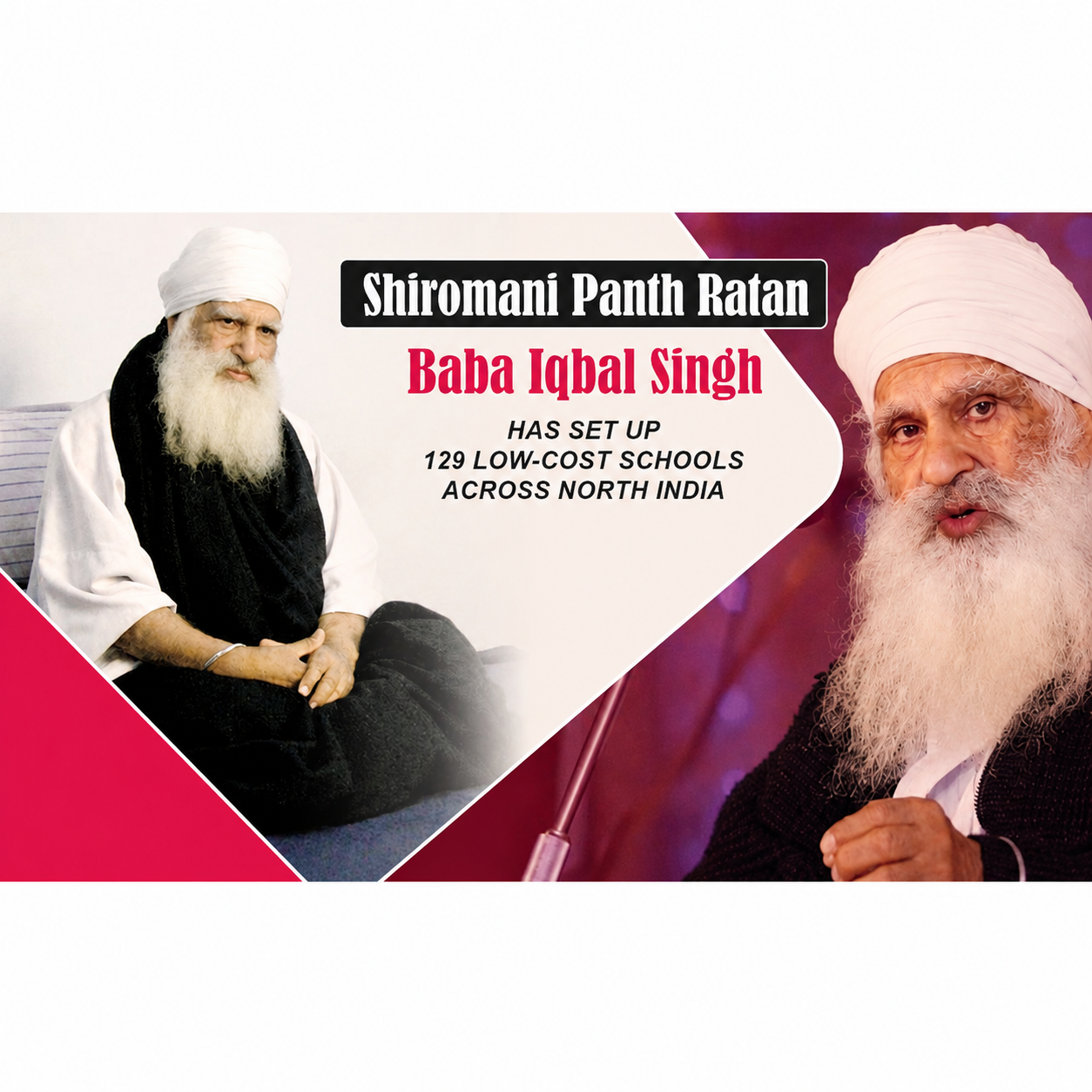
Sant Baba Iqbal Singh Ji: Shiromani Panth Ratan
Sant Baba Iqbal Singh Ji: The Visionary Behind 130 Akal Academies Transforming Rural Education in India
Few individuals have transformed rural education in India as profoundly as Sant Baba Iqbal Singh Ji. Widely regarded as one of the most influential Sikh educationists of modern times, he dedicated his life to proving that quality education should never depend on where a child is born or the financial circumstances of their family.
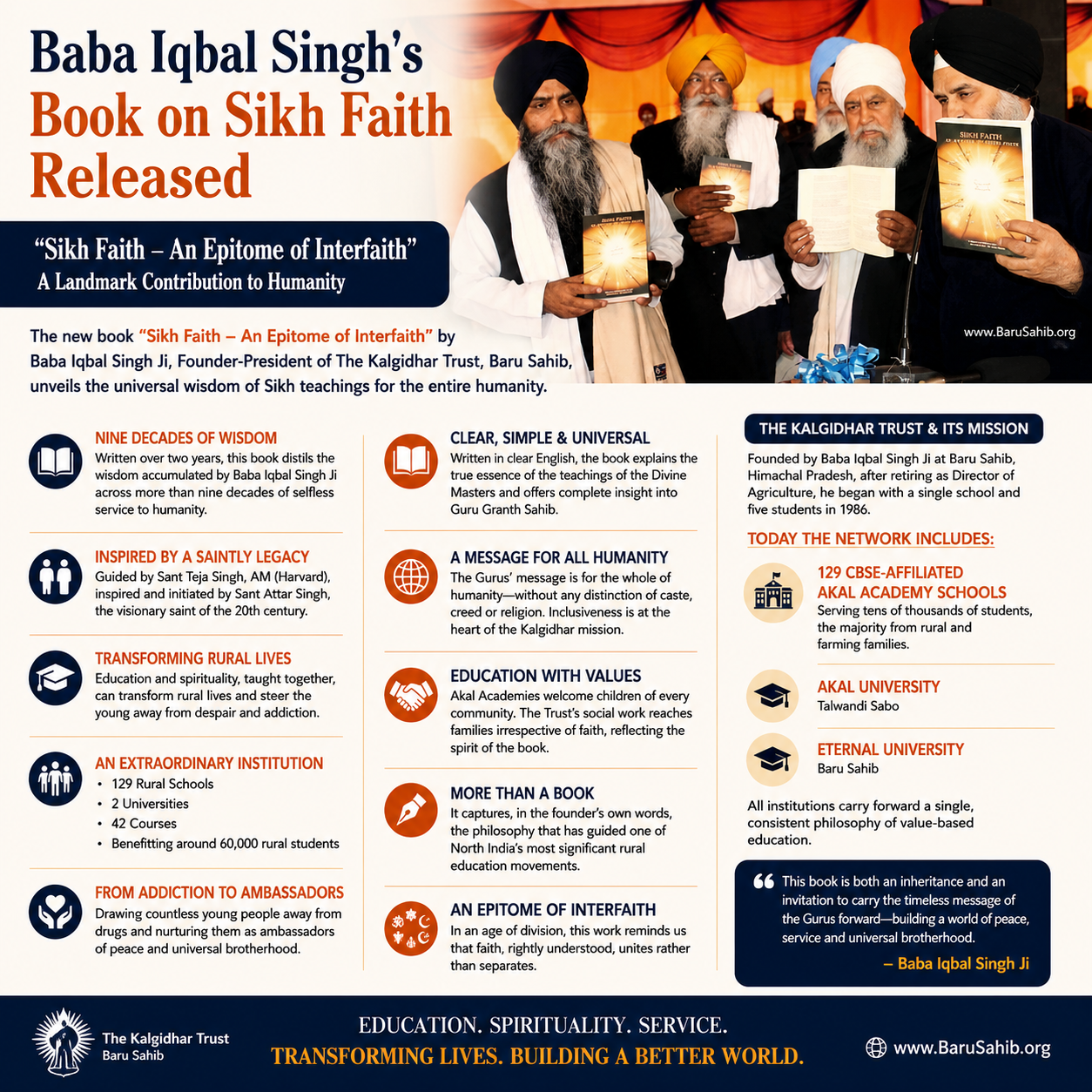
What began as a single classroom with just five students in the serene Himalayan valley of Baru Sahib has today grown into one of India’s largest rural education movements. Through The Kalgidhar Trust, his vision now reaches more than 75,000 students studying in 130 CBSE-affiliated Akal Academies across Punjab, Haryana, Himachal Pradesh, Rajasthan and Uttar Pradesh.
His legacy extends far beyond schools. Under his leadership, the movement expanded to include Akal University, Eternal University, healthcare institutions, women empowerment initiatives and numerous community development programmes, all united by one philosophy—education that develops the intellect, strengthens character and inspires selfless service.
From Director of Agriculture to Nation Builder
Before becoming one of India’s most respected education reformers, Sant Baba Iqbal Singh Ji served as the Director of Agriculture, Government of Himachal Pradesh. Throughout his distinguished public service career, he witnessed the realities of rural India—communities rich in potential but deprived of quality educational opportunities.
Rather than accepting this as inevitable, he envisioned education as the most powerful tool for breaking the cycles of poverty, unemployment, social inequality and addiction. He believed that lasting rural development could never be achieved merely through infrastructure or welfare schemes. True transformation would come only by educating children with knowledge, values and purpose.
After retiring in 1986, he chose not a life of comfort but one of complete dedication to society. He moved to Baru Sahib with a dream that many believed impossible—to create world-class educational institutions in the villages of North India while preserving India’s rich moral and spiritual heritage.
One Classroom. Five Students. A Movement Begins.
Every great institution has humble beginnings.
For Sant Baba Iqbal Singh Ji, the journey started with a small classroom and only five students. There were no grand campuses, no extensive resources and no promise of rapid expansion. There was only a deep conviction that rural children deserved opportunities equal to those available anywhere in the country.
His educational philosophy was revolutionary in its simplicity. Academic excellence alone was not enough. Education had to nurture the mind, body and spirit, producing individuals who were intellectually capable, morally grounded and committed to serving humanity.
The school welcomed children from farming families and remote villages where quality English-medium education remained virtually inaccessible. Parents who had never imagined sending their children to modern schools found an institution that combined affordability with exceptional educational standards.
What began in a single room gradually earned the trust of surrounding communities. Year after year, the number of students increased, new schools were established and the vision expanded without ever compromising its founding principles.
Building One of India’s Largest Rural Education Networks
Today, that modest beginning has evolved into a remarkable educational ecosystem comprising 130 CBSE-affiliated Akal Academies educating more than 75,000 students across five northern states.
Each academy reflects Baba Ji’s belief that every child—regardless of economic background—deserves access to modern education combined with timeless values. While students excel in science, mathematics, technology, languages and sports, equal emphasis is placed on honesty, discipline, humility, compassion and leadership.
The majority of students come from rural and agricultural communities. For thousands of families, an Akal Academy education has created opportunities that previous generations could scarcely imagine. Many graduates have become doctors, engineers, teachers, scientists, entrepreneurs, defence personnel, civil servants and researchers, returning to contribute positively to society.
Over the years, the institutions have continuously embraced innovation. Smart classrooms, digital learning, robotics, science laboratories, career guidance, international collaborations and technology-enabled education have ensured that students in villages receive opportunities comparable to those in metropolitan schools.
Education That Builds Character
One of Sant Baba Iqbal Singh Ji’s greatest contributions to Indian education is his unwavering commitment to value-based learning.
He often emphasised that education should produce not merely successful professionals but responsible human beings. Academic achievement without integrity, compassion and service, he believed, could never create a better society.
This philosophy continues to guide every institution established under The Kalgidhar Trust. Students participate in community service, environmental initiatives, leadership programmes, spiritual reflection and ethical learning alongside rigorous academic education.
The result is a holistic educational model where students graduate not only with qualifications but also with the confidence, discipline and values required to become responsible citizens and compassionate leaders.
Empowering Rural India Through Education
For Sant Baba Iqbal Singh Ji, education was never intended to benefit only individual students. Every educated child represented the possibility of transforming an entire family and, eventually, an entire village.
The Trust therefore places particular emphasis on supporting first-generation learners, economically weaker families and children living in underserved rural communities. Scholarships, donor-supported initiatives and community partnerships ensure that financial hardship never becomes a barrier to education.
Today, thousands of students receiving educational assistance across the Akal Academy network stand as living proof of Baba Ji’s conviction that education remains the most sustainable solution to poverty and inequality.
Championing Women’s Education
Sant Baba Iqbal Singh Ji firmly believed that educating a girl transforms generations. Long before women’s education became a national priority, he recognised that empowering daughters would strengthen families, communities and the nation itself.
Today, many Akal Academies are led by accomplished women principals, while Eternal University at Baru Sahib continues this vision as India’s first private women’s university in Himachal Pradesh. Thousands of young women from rural backgrounds have pursued higher education and professional careers because of opportunities created through this educational movement.
Whether in classrooms, leadership positions or research institutions, women continue to play a central role in carrying forward Baba Ji’s vision of an equitable and empowered society.
Fighting the Drug Menace Through Education
One of the defining themes of Sant Baba Iqbal Singh Ji’s life was his conviction that education is the most effective long-term response to drug addiction. Rather than treating addiction only after it takes hold, he believed society must prevent it by nurturing young minds with purpose, discipline and hope.
Across Punjab and neighbouring states, where substance abuse has affected countless families, the Akal Academy model offers a positive alternative. Students are encouraged to excel academically while participating in sports, community service, leadership programmes and value-based education that develops confidence, resilience and moral responsibility.
Baba Ji often viewed every child entering an Akal Academy as another young life being guided towards opportunity instead of despair. His educational philosophy continues to demonstrate that investing in children is one of the most sustainable ways to build healthier communities and a stronger nation.
From Schools to Universities: A Complete Educational Ecosystem
As the first generations of Akal Academy students graduated, Sant Baba Iqbal Singh Ji realised that quality education should not end with school. To provide a continuous pathway for higher learning, he expanded the mission beyond primary and secondary education.
Today, that vision includes Akal University at Talwandi Sabo, Punjab, and Eternal University at Baru Sahib, Himachal Pradesh. Together, these institutions offer undergraduate, postgraduate and doctoral programmes across science, agriculture, management, engineering, humanities, health sciences and emerging technologies.
By creating this integrated educational ecosystem, Baba Ji ensured that students from rural backgrounds could pursue world-class education without compromising the values that had guided them throughout their schooling.
Recognition Through the Shiromani Panth Ratan Honour
On 8 July 2018, Sant Baba Iqbal Singh Ji was honoured with the prestigious title of Shiromani Panth Ratan at Takht Sri Harmandir Ji, Patna Sahib. The honour recognised his extraordinary contribution to education, humanitarian service and the upliftment of society through decades of selfless dedication.
While awards acknowledge remarkable achievement, Baba Ji’s greatest recognition has always been the lives transformed through education. Every graduate who becomes a responsible citizen, every family lifted through learning and every village empowered through opportunity reflects the true success of his life’s work.
A Legacy That Continues to Transform Lives
Although Sant Baba Iqbal Singh Ji left behind an extraordinary institutional legacy, his greatest achievement lies in creating a movement capable of growing beyond any one individual. Today, The Kalgidhar Trust continues to expand the mission he began with only five students more than three decades ago.
The organisation now serves more than 75,000 students through 130 Akal Academies, supported by universities, healthcare initiatives, women empowerment programmes, environmental sustainability projects and numerous community outreach activities.
Thousands of alumni now serve society as doctors, engineers, researchers, teachers, entrepreneurs, civil servants, defence personnel and professionals across India and abroad. Many remain deeply connected to the values they learned as students—integrity, humility, compassion and service.
The journey from one classroom to 130 Akal Academies illustrates a timeless principle: lasting change begins with a single act of commitment. Sant Baba Iqbal Singh Ji did not set out to build an educational empire; he simply set out to educate children. The trust earned through that mission allowed the movement to grow naturally into one of India’s largest rural education initiatives.
Why Sant Baba Iqbal Singh Ji’s Vision Matters Today
In an era when educational inequality continues to challenge rural communities, Sant Baba Iqbal Singh Ji’s model offers an enduring blueprint for sustainable development. His institutions prove that academic excellence, affordability, ethical values and social responsibility can coexist to create lasting impact.
Today, the educational movement continues to evolve through digital classrooms, artificial intelligence, STEM education, renewable energy initiatives, international collaborations and research-driven learning while remaining faithful to its founding philosophy of nurturing compassionate and responsible citizens.
More than three decades after a single classroom welcomed its first five students, Sant Baba Iqbal Singh Ji’s vision continues to inspire educators, philanthropists, volunteers and policymakers across the world. His legacy lives on not only in institutions, but in every child whose life has been transformed through education.
Frequently Asked Questions (FAQs)
Who was Sant Baba Iqbal Singh Ji?
Sant Baba Iqbal Singh Ji was an eminent educationist, humanitarian, spiritual leader and founder of The Kalgidhar Trust’s rural education movement. His vision transformed a small school at Baru Sahib into one of India’s largest networks of rural educational institutions.
How many schools did Sant Baba Iqbal Singh Ji establish?
Today, his vision has grown into 130 CBSE-affiliated Akal Academies educating more than 75,000 students across Punjab, Haryana, Himachal Pradesh, Rajasthan and Uttar Pradesh.
What is The Kalgidhar Trust?
The Kalgidhar Trust is a charitable organisation headquartered at Baru Sahib that operates Akal Academies, Akal University, Eternal University, healthcare institutions, women empowerment initiatives and numerous rural development programmes.
Why is Sant Baba Iqbal Singh Ji known for value-based education?
He believed education should develop the intellect, character and spirit together. His institutions combine academic excellence with ethics, discipline, leadership and community service to create responsible citizens.
What honour did Sant Baba Iqbal Singh Ji receive?
He was conferred the prestigious Shiromani Panth Ratan title on 8 July 2018 in recognition of his exceptional contribution to education, humanitarian service and society.
Related Resources
- The Kalgidhar Trust
- Akal Academies
- Akal University
- Eternal University
- Educate To Save
- CSRforChange
- Media Coverage
References
- Official records of The Kalgidhar Trust, Baru Sahib
- Akal Academies – Institutional Information
- Akal University, Talwandi Sabo
- Eternal University, Baru Sahib
- Official records relating to the Shiromani Panth Ratan honour
- Historical archives and publications of The Kalgidhar Trust