

Kalgidhar Trust Achieves 92% Women Employment

Kalgidhar Trust: 92% of Women Find Employment Through Education

Baru Sahib, Himachal Pradesh: On International Women’s Day 2021, The Kalgidhar Trust received recognition for its remarkable contribution to women’s empowerment through education. Reports highlighted that the Trust’s network of Akal Academies formed the only chain of rural schools in North India led almost entirely by women principals, demonstrating how women-led educational institutions can transform rural communities.

Founded by Sant Baba Iqbal Singh Ji, The Kalgidhar Trust has spent nearly four decades creating educational opportunities for children from rural and economically weaker families. Its philosophy extends beyond academic excellence by empowering women to become educators, administrators and community leaders capable of inspiring future generations.

Today, the Trust operates 130 CBSE-affiliated Akal Academies, educating more than 75,000 students across Punjab, Haryana, Himachal Pradesh, Rajasthan and Uttar Pradesh. Alongside Akal University and Eternal University, these institutions continue to advance the Trust’s mission of providing value-based education while creating leadership opportunities for women.


Quick Answer

The Kalgidhar Trust has built one of India’s most distinctive rural education models by placing women in leadership roles across its schools. Recognised during International Women’s Day 2021, the Trust reported employment outcomes of up to 92% for women within its institutions, demonstrating how education and women’s leadership together create lasting social transformation.


Key Facts

  • Organisation: The Kalgidhar Trust, Baru Sahib
  • Founded: 1986
  • Founder: Sant Baba Iqbal Singh Ji
  • Schools: 130 CBSE-affiliated Akal Academies
  • Students: 75,000+ across North India
  • Women’s Leadership: One of the largest rural school networks led by women principals
  • Employment: Up to 92% employment outcomes reported within its institutions

Women Leading Rural Education

The Kalgidhar Trust has consistently believed that empowering women is one of the most effective ways to strengthen families and uplift society. This belief has shaped the organisation’s educational philosophy since the first Akal Academy opened at Baru Sahib in 1986.

Among the earliest volunteers was Dr. Neelam Kaur, who became the first woman principal after joining the Trust alongside her husband, Dr. Devinder Singh. Her leadership established a model that continues today, with women heading many of the Trust’s educational institutions.

Rather than treating women as participants alone, the Trust entrusted them with leading schools, mentoring teachers and shaping educational standards. Their dedication has contributed significantly to strong academic outcomes while fostering caring, disciplined and value-based learning environments.

The recognition received during International Women’s Day 2021 highlighted how this unique leadership model has become an example for rural education across India. It demonstrates that when women are trusted to lead, schools become stronger, students flourish and communities prosper.


The Vision of Sant Baba Iqbal Singh Ji

The philosophy behind this achievement traces directly to the vision of Sant Baba Iqbal Singh Ji. After retiring as Director of Agriculture, Government of Himachal Pradesh, in 1986, Baba Ji dedicated his life to transforming rural India through education rooted in character, discipline and service.

Beginning with just five students at Baru Sahib, he believed every child deserved access to quality education regardless of financial background, geography or social status. He also recognised that empowering women educators would create a lasting impact extending far beyond the classroom.

Over the decades, this vision evolved into one of North India’s largest rural education movements, combining academic excellence with values and leadership development.


From One School to 130 Akal Academies

Today, The Kalgidhar Trust operates 130 CBSE-affiliated Akal Academies educating more than 75,000 students across five northern states.

The majority of students come from rural and farming families, where access to quality education has traditionally been limited. Through modern classrooms, STEM education, robotics laboratories, digital learning platforms and experienced educators, students receive opportunities comparable to the finest urban schools.

Thousands of graduates have gone on to become doctors, engineers, teachers, researchers, entrepreneurs, defence personnel and civil servants while remaining connected to the values instilled during their education.


Women’s Empowerment as a Core Philosophy

For The Kalgidhar Trust, empowering women has never been viewed as a separate initiative—it is woven into the very foundation of the organisation. Sant Baba Iqbal Singh Ji believed that educating and empowering women creates a ripple effect that strengthens families, improves children’s education and accelerates rural development.

This philosophy has guided every stage of the Trust’s growth. Women have been encouraged not only to teach but also to lead schools, mentor future educators and manage educational institutions serving thousands of students. Their leadership has helped create nurturing learning environments where academic excellence is balanced with compassion, discipline and character development.

By investing in women as educational leaders, The Kalgidhar Trust has demonstrated that sustainable social change begins with empowering those who shape future generations.


Eternal University: Advancing Women’s Higher Education

The Trust’s commitment to women extends beyond school education through the establishment of Eternal University, a residential university dedicated to women’s higher education at Baru Sahib.

Eternal University offers programmes in science, engineering, nursing, education, agriculture and allied disciplines, enabling young women from rural and economically weaker backgrounds to pursue higher education in a safe, value-based environment.

Many graduates have gone on to become researchers, educators, healthcare professionals, entrepreneurs and administrators, contributing to the social and economic development of their communities while inspiring the next generation of young women.


Creating Career Opportunities for Women

Reports highlighting employment outcomes of up to 92% for women within the Trust’s institutions demonstrate the practical impact of its educational philosophy. By combining academic excellence with professional development and leadership opportunities, the organisation has created meaningful careers for thousands of women.

Women associated with the Trust serve in diverse roles including principals, teachers, professors, researchers, administrators, healthcare professionals and institutional leaders. Their success reflects the Trust’s belief that education should empower individuals to become financially independent while contributing positively to society.

For many rural women, these opportunities have transformed not only their own lives but also the future of their families and communities.


Value-Based Education That Builds Character

Academic achievement remains an important objective across every Akal Academy, but The Kalgidhar Trust believes education must also develop integrity, compassion and social responsibility.

Students participate in leadership programmes, sports, cultural activities, environmental awareness campaigns, community service and spiritual learning alongside their academic studies. This holistic approach helps children develop confidence, resilience and ethical decision-making skills that prepare them for success in every aspect of life.

The result is an educational model that produces capable professionals while nurturing responsible citizens committed to serving society.


Supporting Rural Development Through Education

The Kalgidhar Trust’s mission extends well beyond classrooms. Through education, healthcare, scholarships, educational sponsorships, women empowerment programmes and community development initiatives, the organisation works to improve the overall quality of life across rural North India.

Its institutions have become centres of learning and community engagement where families come together around a shared vision of education, equality and social progress. Thousands of first-generation learners have gained opportunities that were previously unavailable within their villages.

This integrated approach has enabled the Trust to create lasting social impact while preserving the cultural and ethical values that remain central to its educational philosophy.


Combating Drug Abuse Through Education

Recognising the growing challenge of substance abuse affecting parts of Punjab and neighbouring regions, The Kalgidhar Trust believes education offers one of the most effective long-term solutions.

Students are encouraged to engage in sports, cultural programmes, leadership activities, environmental initiatives and community service that provide purpose, discipline and self-confidence. These experiences help young people make informed decisions while encouraging healthy lifestyles rooted in strong moral values.

By combining education with awareness and character building, the Trust continues to contribute towards creating healthier families, stronger communities and a brighter future for rural youth.


More Than Schools—Centres of Community Transformation

Across North India, The Kalgidhar Trust’s institutions have evolved into far more than educational campuses. They serve as centres of community development where education, healthcare, environmental awareness, leadership and social responsibility come together to create lasting change.

Students are encouraged to participate in sports, cultural programmes, volunteer activities, environmental campaigns and community service alongside their academic studies. This holistic approach helps young people become confident, compassionate and socially responsible citizens capable of contributing positively to society.

For rural families, Akal Academies represent hope, opportunity and progress. They provide access to world-class education while preserving cultural heritage, moral values and a spirit of selfless service.


A Legacy of Women’s Leadership That Continues Today

Nearly four decades after Sant Baba Iqbal Singh Ji established the first school at Baru Sahib, his vision continues to inspire thousands of educators and students across India.

Today, The Kalgidhar Trust educates more than 75,000 students through 130 CBSE-affiliated Akal Academies, supported by Akal University, Eternal University, healthcare initiatives, educational sponsorships and community development programmes.

The Trust’s commitment to women remains one of its defining strengths. By placing women in leadership positions, promoting girls’ education and creating meaningful employment opportunities, the organisation has demonstrated that investing in women strengthens families, schools and society as a whole.

The reported employment outcomes of up to 92% for women within its institutions stand as a testament to the Trust’s long-term commitment to empowerment through education.


Frequently Asked Questions (FAQs)

Why is The Kalgidhar Trust recognised for women’s empowerment?

The Kalgidhar Trust is recognised for creating one of North India’s largest rural education networks led predominantly by women principals while promoting girls’ education, women’s leadership and professional employment opportunities.

What does the reported 92% employment rate refer to?

Reports highlighted employment outcomes of up to 92% for women within the Trust’s institutions, reflecting the organisation’s commitment to education, professional development and women’s empowerment.

Who founded The Kalgidhar Trust?

The Kalgidhar Trust was established under the visionary leadership of Sant Baba Iqbal Singh Ji, who dedicated his life to transforming rural India through value-based education after retiring as Director of Agriculture, Government of Himachal Pradesh.

How many schools does The Kalgidhar Trust operate today?

Today, The Kalgidhar Trust operates 130 CBSE-affiliated Akal Academies educating more than 75,000 students across Punjab, Haryana, Himachal Pradesh, Rajasthan and Uttar Pradesh.

What is Eternal University?

Eternal University is the Trust’s residential university dedicated to women’s higher education, providing quality academic programmes and leadership opportunities for young women from rural communities.

What makes Akal Academies different?

Akal Academies combine academic excellence with value-based education, leadership, discipline, environmental awareness, sports, community service and spiritual development to nurture well-rounded individuals.


Related Resources


References

  • Official records of The Kalgidhar Trust, Baru Sahib
  • International Women’s Day 2021 media coverage
  • Akal Academy institutional records
  • Eternal University official publications
  • Akal University official publications
  • Historical archives of The Kalgidhar Trust and Kalgidhar Society

Conclusion

The Kalgidhar Trust’s approach to women’s empowerment demonstrates that education is one of the most effective tools for social transformation. By creating leadership opportunities for women, promoting girls’ education and establishing institutions rooted in compassion, equality and service, the Trust has built a model that continues to inspire rural communities across North India.

From a single classroom with five students in 1986 to a network of 130 Akal Academies educating more than 75,000 students, the vision of Sant Baba Iqbal Singh Ji continues to flourish. Through value-based education, women-led leadership and community development, The Kalgidhar Trust remains committed to empowering future generations and building a stronger, more inclusive India.
Free Education for Farmers’ Children Since 2020

Kalgidhar Trust Offers Free Education to Farmers’ Children

Baru Sahib, Himachal Pradesh: In December 2020, The Kalgidhar Trust announced a compassionate initiative to provide free education up to the secondary level for children of farmers who lost their lives during the farmers’ agitation. The announcement reflected the Trust’s unwavering belief that no child should lose access to education because of financial hardship or family tragedy.

Founded by Sant Baba Iqbal Singh Ji, The Kalgidhar Trust has spent nearly four decades transforming rural communities through value-based education. The initiative was not a one-time charitable announcement but a continuation of the Trust’s long-standing mission to ensure every child—regardless of social or economic circumstances—has the opportunity to receive quality education.

Today, the educational movement established at Baru Sahib serves more than 75,000 students through 130 CBSE-affiliated Akal Academies, alongside Akal University, Eternal University, healthcare initiatives and community development programmes. Supporting children from farming families has always remained central to its mission.

Quick Answer

In December 2020, The Kalgidhar Trust announced free education up to the secondary level for children of farmers who lost their lives during the farmers’ agitation. The initiative reaffirmed the Trust’s commitment to ensuring that financial hardship never prevents a child from receiving quality, value-based education.

Key Facts

  • Announcement: December 2020
  • Initiative: Free education for children of deceased farmers
  • Organisation: The Kalgidhar Trust, Baru Sahib
  • Beneficiaries: Children of affected farming families
  • Coverage: 130 CBSE-affiliated Akal Academies across North India
  • Mission: Ensure no child is deprived of education because of financial hardship

Standing with Farming Families During Difficult Times

The decision to provide free education came at a time when many farming families were facing immense emotional and financial challenges. For children who had lost a parent, continuing their education often became uncertain. Recognising this reality, The Kalgidhar Trust stepped forward with a commitment to remove educational expenses and ensure that every affected child could continue learning with dignity.

The initiative reflected the organisation’s belief that education is the strongest foundation for rebuilding lives. Rather than allowing tragedy to interrupt a child’s future, the Trust chose to provide stability, opportunity and hope through uninterrupted access to schooling.

For rural communities, this was more than financial assistance. It was a message of solidarity that reaffirmed the Trust’s deep connection with farming families who have long formed the backbone of the Akal Academy community.


A Commitment Rooted in Decades of Service

The free education initiative was a natural extension of work that The Kalgidhar Trust had already been carrying out for decades. Even before this announcement, the organisation was supporting thousands of children from economically weaker families through scholarships, sponsorships and fee assistance across its network of rural schools.

Rather than responding only during times of crisis, the Trust has consistently invested in long-term educational opportunities for underserved communities. Children from farming families, first-generation learners and economically disadvantaged households have remained at the heart of its mission since the first Akal Academy opened.

This long-standing commitment reflects the organisation’s conviction that education is the most sustainable solution to poverty, inequality and social transformation.

The Vision of Sant Baba Iqbal Singh Ji

The philosophy behind this initiative traces directly to the vision of Sant Baba Iqbal Singh Ji. After retiring as Director of Agriculture, Government of Himachal Pradesh, in 1986, Baba Ji chose a path of selfless service by dedicating his life to rural education.

He began with just five students in a modest classroom at Baru Sahib. His dream was simple yet transformative—to ensure that children living in villages received the same educational opportunities as those in India’s largest cities while remaining firmly rooted in values, discipline and service.

Over the decades, this vision evolved into one of India’s largest rural education movements, empowering generations of children through affordable, value-based education.


From One Classroom to 130 Akal Academies

Today, The Kalgidhar Trust operates 130 CBSE-affiliated Akal Academies educating more than 75,000 students across Punjab, Haryana, Himachal Pradesh, Rajasthan and Uttar Pradesh.

The schools primarily serve rural and agricultural communities where access to quality education has traditionally been limited. Thousands of graduates have become doctors, engineers, scientists, teachers, entrepreneurs, defence personnel and civil servants, demonstrating the transformative power of quality education.

Modern classrooms, STEM education, robotics laboratories, digital learning, experienced faculty and holistic development programmes ensure that rural students receive educational opportunities comparable to the best institutions in urban India.


Education Rooted in Values

While academic excellence has always remained a priority, The Kalgidhar Trust believes that education must extend far beyond textbooks and examinations. Every Akal Academy follows a value-based educational philosophy that nurtures the intellect, character and spirit together.

Students are encouraged to develop honesty, compassion, discipline, leadership, environmental responsibility and a lifelong commitment to serving society. This balanced approach ensures that graduates are not only academically accomplished but also prepared to become responsible citizens capable of making meaningful contributions to their communities.

For farming families, this educational model offers something unique—an environment where children receive modern scientific education without losing touch with ethical values, cultural heritage and social responsibility.

Supporting Rural Communities Beyond the Classroom

The Kalgidhar Trust has always viewed education as part of a broader mission of rural development. Alongside schools, the organisation continues to invest in scholarships, healthcare, educational sponsorships, women empowerment programmes and community welfare initiatives that improve the quality of life in villages across North India.

The announcement of free education for children of farmers reflected this broader philosophy. It demonstrated that the Trust’s commitment extends beyond classroom learning to supporting families during moments of hardship, ensuring that children can continue pursuing their dreams regardless of changing circumstances.

This people-first approach has helped build lasting trust within rural communities, many of whom have remained closely connected with the Trust for generations.


Empowering Girls Through Education

Women’s education has remained one of the defining priorities of The Kalgidhar Trust since its inception. Sant Baba Iqbal Singh Ji firmly believed that educating a girl transforms not only one life but an entire family and future generations.

Today, many Akal Academies are led by accomplished women principals, making the organisation one of the largest rural school networks in North India managed predominantly by women educational leaders. The Trust further strengthened this vision through the establishment of Eternal University, a pioneering institution dedicated to expanding higher education opportunities for women.

Thousands of young women from rural communities have gone on to become teachers, doctors, engineers, researchers, entrepreneurs and administrators, creating a powerful cycle of empowerment that continues to inspire future generations.


Building Drug-Free Communities Through Education

One of the long-term social objectives of The Kalgidhar Trust has been addressing the growing challenge of substance abuse through education. Rather than focusing only on rehabilitation, the organisation believes the most sustainable solution lies in prevention by providing children with purpose, discipline and opportunities for personal growth.

Students participate in sports, leadership programmes, cultural activities, environmental initiatives, community service and spiritual learning alongside academics. These experiences help develop confidence, resilience and responsible decision-making while encouraging young people to lead healthy, meaningful lives.

By creating educational environments rooted in values and positive engagement, the Trust continues to contribute towards building stronger families and healthier rural communities.


More Than Schools—Centres of Community Transformation

Across the villages it serves, The Kalgidhar Trust’s institutions have become much more than places of learning. They function as centres of community development where education, healthcare, environmental awareness, leadership and social responsibility come together.

Families see Akal Academies not only as schools but as institutions that nurture future leaders capable of contributing positively to society. Students are encouraged to participate in volunteer activities, cultural programmes, sports, environmental conservation and initiatives that strengthen community life.

The announcement of free education for children of farmers who lost their lives during the farmers’ agitation perfectly reflects this philosophy. It demonstrates that education is not merely about academic achievement—it is about standing beside communities during their greatest moments of need.


A Legacy of Compassion That Continues Today

More than three decades after Sant Baba Iqbal Singh Ji welcomed five students into a modest classroom at Baru Sahib, his vision continues to transform lives every single day. What began as a small educational initiative has evolved into one of India’s largest value-based rural education movements.

Today, The Kalgidhar Trust educates more than 75,000 students through 130 CBSE-affiliated Akal Academies, supported by Akal University, Eternal University, healthcare initiatives, educational sponsorships, women empowerment programmes and community development projects.

The announcement offering free education to children of farmers was not simply an act of generosity. It reflected the Trust’s founding philosophy—that every child deserves access to quality education regardless of financial circumstances, personal tragedy or social background.

As India continues its journey towards inclusive development, The Kalgidhar Trust remains committed to ensuring that education becomes a pathway to dignity, opportunity and lasting social transformation. Every child educated today represents another step towards stronger families, empowered villages and a brighter future for rural India.


Frequently Asked Questions (FAQs)

Did The Kalgidhar Trust offer free education to farmers’ children?

Yes. In December 2020, The Kalgidhar Trust announced free education up to the secondary level for children of farmers who lost their lives during the farmers’ agitation, ensuring that financial hardship would not interrupt their education.

Why did The Kalgidhar Trust launch this initiative?

The initiative was introduced to support families facing unexpected loss while reinforcing the Trust’s long-standing mission of making quality education accessible to every child, particularly those from rural and economically weaker backgrounds.

Who founded The Kalgidhar Trust?

The Kalgidhar Trust was established under the visionary leadership of Sant Baba Iqbal Singh Ji, who dedicated his life to transforming rural India through value-based education and humanitarian service.

How many schools does The Kalgidhar Trust operate today?

Today, The Kalgidhar Trust operates 130 CBSE-affiliated Akal Academies educating more than 75,000 students across Punjab, Haryana, Himachal Pradesh, Rajasthan and Uttar Pradesh.

Does The Kalgidhar Trust continue to support financially weaker families?

Yes. Through scholarships, educational sponsorships, fee concessions and donor-supported programmes, The Kalgidhar Trust continues to help children from economically weaker families receive quality education across its network of Akal Academies.

What makes Akal Academies unique?

Akal Academies combine academic excellence with character building, leadership, discipline, environmental responsibility, community service and value-based education, enabling students to become capable professionals and responsible citizens.


Related Resources


References

  • Official records of The Kalgidhar Trust, Baru Sahib
  • Official announcement regarding the free education initiative (December 2020)
  • Akal Academy institutional records
  • Akal University, Talwandi Sabo
  • Eternal University, Baru Sahib
  • Historical publications and archives of The Kalgidhar Trust

Conclusion

The Kalgidhar Trust’s decision to provide free education for children of farmers who lost their lives during the farmers’ agitation reflects nearly four decades of service to rural India. More than an educational initiative, it represents the organisation’s enduring belief that compassion and education must go hand in hand.

By standing with farming families during times of hardship, the Trust reaffirmed the vision of Sant Baba Iqbal Singh Ji—that no child should ever be deprived of education because of financial circumstances. Today, through its 130 Akal Academies and allied institutions, The Kalgidhar Trust continues to empower rural communities, nurture future leaders and transform lives through value-based education, ensuring that hope, opportunity and learning remain accessible to every child.

Akal University’s 1.2 MW Solar Plant Powers Sustainable Education

Akal University’s 1.2 MW Solar Plant Powers Sustainable Education and Sets a Benchmark for Rural Institutions in Punjab

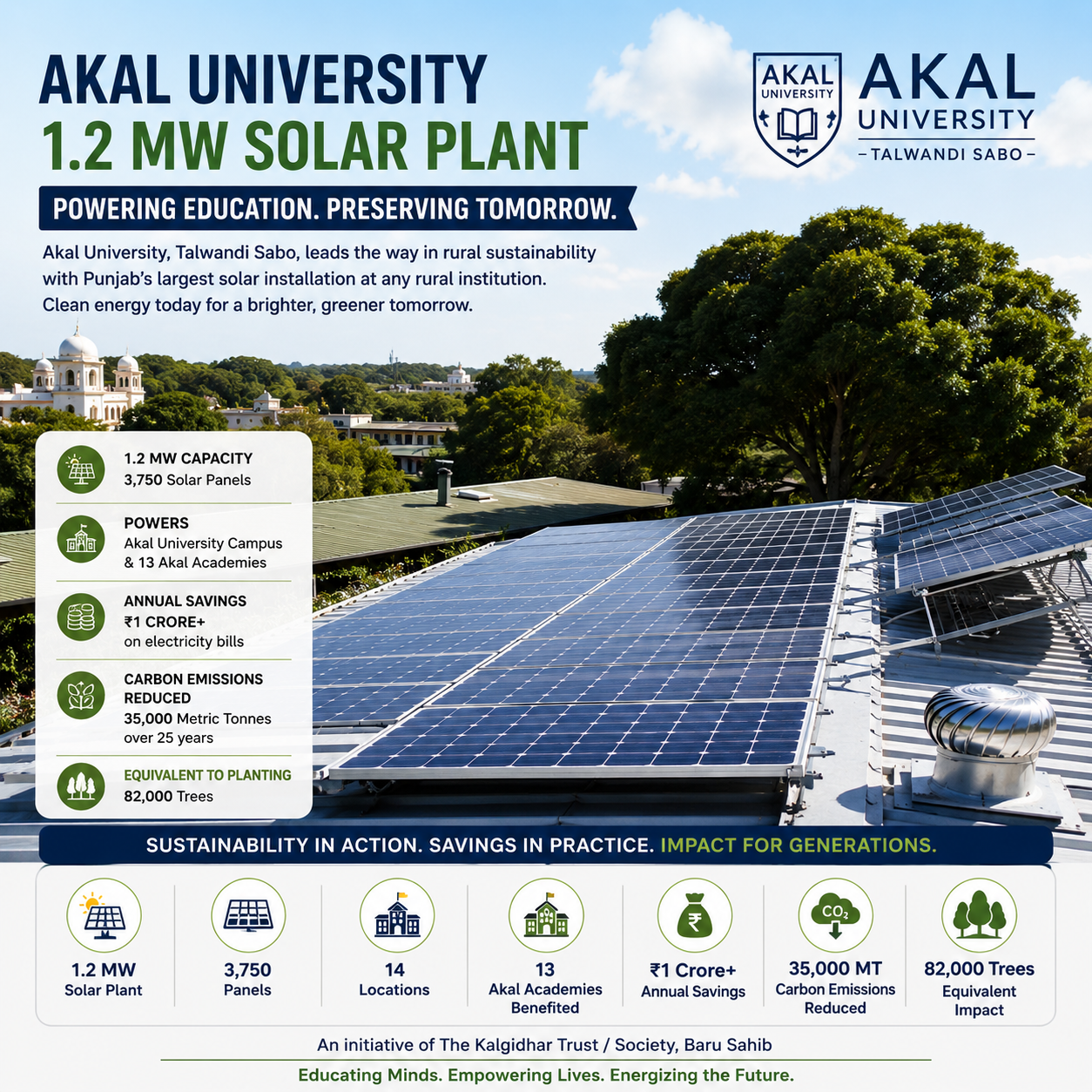
Talwandi Sabo, Bathinda, Punjab: Demonstrating how educational institutions can become leaders in environmental stewardship, Akal University has commissioned a landmark 1.2 MW solar power plant at its Talwandi Sabo campus, creating the largest solar installation at any rural educational institution in Punjab. The ambitious renewable energy project reflects the long-standing commitment of The Kalgidhar Trust towards integrating sustainability with quality education while building environmentally responsible campuses for future generations.

Designed to meet nearly 80 percent of the University’s electricity requirements while simultaneously supplying clean energy to 13 nearby Akal Academies, the project represents far more than an infrastructure upgrade. It demonstrates how educational institutions can become active contributors to India’s renewable energy mission while reducing operational costs and investing savings directly into student welfare, scholarships and academic development.

Constructed at a total investment of approximately ₹5.2 crore, including a subsidy of ₹1.7 crore from the Ministry of New and Renewable Energy (MNRE), the solar installation consists of nearly 3,750 photovoltaic panels strategically installed across 14 locations covering nearly 1.2 lakh square feet within the university campus. The project establishes Akal University as a pioneer among rural higher education institutions embracing clean energy at a meaningful scale.


Harnessing Solar Energy to Strengthen Rural Education

The commissioning of the solar power plant marks a significant milestone in Akal University’s journey towards becoming a self-reliant and environmentally sustainable campus. By producing a substantial portion of its own electricity through renewable sources, the University has reduced its dependence on conventional power while creating a resilient energy infrastructure capable of supporting thousands of students and academic activities throughout the year.

The project aligns perfectly with India’s growing emphasis on renewable energy adoption and sustainable development. As universities increasingly seek environmentally responsible solutions to rising energy costs, Akal University’s investment demonstrates that rural institutions can lead innovation rather than simply follow it.

Unlike many symbolic sustainability initiatives, the University’s solar project has been designed to carry a significant share of the campus energy demand. Every unit of clean electricity generated reduces dependence on fossil fuels while lowering operational expenses that can instead be invested in improving educational opportunities.

Largest Solar Installation at a Rural Educational Institution in Punjab

The scale of the project makes it one of the most remarkable renewable energy initiatives undertaken by an educational institution in northern India. With an installed capacity of 1.2 MW, the solar power plant is capable of meeting approximately four-fifths of Akal University’s electricity requirements while extending its benefits beyond the campus by supplying power to thirteen Akal Academies located across the region.

This shared infrastructure model reflects the philosophy of The Kalgidhar Trust, where resources are developed not merely for one institution but for an interconnected educational ecosystem. Clean energy generated at Talwandi Sabo supports schools serving rural communities, multiplying both the environmental and financial benefits of the investment.

Rather than constructing an isolated demonstration project, the Trust created a renewable energy infrastructure capable of delivering measurable impact across multiple campuses. This collaborative approach strengthens educational institutions while reducing recurring operational expenses throughout the network.


Reducing Carbon Emissions Through Clean Energy

The environmental impact of the project extends well beyond the boundaries of the University campus. According to project estimates prepared by solar consultant J.P. Singh, the installation is expected to reduce nearly 35,000 metric tonnes of carbon emissions during its estimated operational life of twenty-five years.

To better understand this impact, experts estimate that the reduction is broadly equivalent to planting approximately 82,000 mature trees. For an educational institution dedicated to shaping future generations, this contribution goes beyond statistics—it transforms the campus itself into a living demonstration of climate responsibility.

Students pursuing science, engineering, environmental studies and other disciplines have the opportunity to observe renewable energy technologies operating in real-world conditions every day. Sustainability is therefore experienced not only through classroom discussions but also through the University’s own infrastructure, creating a culture where environmental awareness becomes part of daily life.

As climate change continues to reshape public policy and economic priorities worldwide, educational institutions have an important role in preparing future leaders who understand both the scientific and practical dimensions of sustainable development. Akal University’s solar initiative reinforces that responsibility through meaningful action rather than symbolic commitment.


Investing Savings Back into Education

The solar power project also delivers substantial financial benefits that directly support the University’s educational mission. Annual savings on electricity expenditure are projected to exceed ₹1 crore, creating additional resources that can be redirected towards scholarships, faculty development, research facilities, digital learning infrastructure and student support programmes.

For a not-for-profit institution, every rupee saved through renewable energy becomes an opportunity to strengthen educational quality. Lower utility costs allow greater investment in laboratories, classrooms, libraries and student services without increasing financial pressure on learners and their families.

This economic sustainability is one of the strongest arguments in favour of renewable energy adoption within educational institutions. Rather than viewing solar infrastructure merely as an environmental initiative, Akal University demonstrates how clean energy becomes a strategic investment capable of supporting academic excellence for decades.

The project therefore represents a rare convergence of environmental responsibility, financial prudence and educational advancement, creating lasting value that benefits both present and future generations of students.


National Recognition for Forward-Looking Leadership

The solar power plant was inaugurated in the presence of distinguished dignitaries, including the Managing Director of the Solar Energy Corporation of India (SECI), who praised the project as an outstanding example of visionary planning by The Kalgidhar Society. The ceremony also witnessed the presence of noted environmentalist Baba Balbir Singh Seechewal, Dr. Davinder Singh, Secretary of The Kalgidhar Society, and Dr. Gurmail Singh, Vice Chancellor of Akal University.

During the inauguration, the project received appreciation for demonstrating that rural educational institutions can successfully undertake large-scale renewable energy initiatives comparable to those implemented by major universities and corporate campuses. The installation serves as evidence that sustainability and educational excellence can advance together when institutions adopt long-term strategic thinking.

A Living Laboratory for Sustainable Development

Beyond generating electricity, the solar plant has transformed the University campus into a practical learning environment where students gain first-hand exposure to renewable energy technologies. Engineering, environmental science and management students can observe the planning, operation and long-term benefits of clean energy systems while connecting classroom knowledge with real-world applications.

By integrating sustainability into campus infrastructure, Akal University reinforces the idea that education should prepare students not only for professional success but also for responsible citizenship. The project encourages learners to appreciate the relationship between technological innovation, environmental conservation and social responsibility—principles that are increasingly essential in the twenty-first century.

The Kalgidhar Trust’s Vision: Education, Sustainability and Social Transformation

The solar power project is a natural extension of the philosophy that has guided The Kalgidhar Trust since its inception. Founded by the visionary educationist Sant Baba Iqbal Singh Ji, the Trust has consistently believed that educational institutions should serve as centres of academic excellence while simultaneously promoting social responsibility, environmental stewardship and ethical leadership.

After retiring as Director of Agriculture in Himachal Pradesh, Sant Baba Iqbal Singh Ji dedicated his life to transforming rural education. Beginning with just five students at Baru Sahib in 1986, his vision has grown into one of India’s largest rural education movements, providing quality education to children from villages who otherwise had limited access to modern educational opportunities.

Today, the Trust operates 130 CBSE-affiliated Akal Academies educating more than 75,000 students across Punjab, Haryana, Himachal Pradesh, Rajasthan and Uttar Pradesh. The educational ecosystem also includes Akal University at Talwandi Sabo and Eternal University at Baru Sahib, both dedicated to delivering value-based higher education while promoting research, innovation and community service.


Powering a Network of Rural Schools

One of the most distinctive features of the solar initiative is its ability to extend benefits beyond the university campus. Instead of serving only Akal University, the electricity generated by the solar plant is shared with 13 nearby Akal Academies, reducing energy costs across multiple educational institutions.

This shared-energy model reflects the Trust’s collaborative approach towards educational development. By investing in common infrastructure, the organisation ensures that resources benefit a larger community rather than remaining confined to a single campus.

The resulting savings strengthen school operations while allowing greater investment in classrooms, laboratories, digital learning resources, teacher development and scholarships for deserving students from economically weaker families.

Such a model demonstrates how renewable energy can directly contribute to educational quality while making institutions more financially resilient over the long term.


Creating Environmentally Responsible Campuses

Educational institutions influence society not only through teaching but also through the values they demonstrate. By investing in renewable energy infrastructure, Akal University has transformed its campus into a living example of environmental responsibility.

Students witness sustainability in practice every day. Thousands of solar panels silently generate clean electricity while reducing dependence on conventional energy sources, encouraging students to understand the importance of resource conservation through experience rather than theory alone.

This practical exposure develops environmental awareness among future professionals, scientists, engineers, educators and entrepreneurs who will play important roles in building a more sustainable society.

As conversations around climate change become increasingly important across the world, initiatives such as this prepare students to think critically about renewable technologies and sustainable development practices.


Supporting Women, Rural Communities and First-Generation Learners

The renewable energy initiative also complements the broader educational mission of The Kalgidhar Trust. For decades, the organisation has focused on reaching children from farming families, economically disadvantaged backgrounds and remote rural communities where access to quality education has traditionally been limited.

Particular emphasis has been placed on empowering girls through education. The Akal Academies constitute one of North India’s largest rural school networks led predominantly by women principals, while Eternal University was established as a residential university dedicated to women’s education and empowerment.

By reducing operational expenses through renewable energy, institutions can devote additional resources towards scholarships, infrastructure improvements and student welfare initiatives that strengthen educational opportunities for these communities.


A Replicable Model for Educational Institutions

As India continues expanding its renewable energy capacity, Akal University’s solar project offers an inspiring example for universities, colleges and schools across the country. The initiative demonstrates that investments in clean energy are not merely environmentally responsible—they also create measurable financial returns that directly support educational development.

Annual savings exceeding ₹1 crore illustrate how sustainability can strengthen institutional finances while reducing dependence on rising electricity costs. Over time, these savings create opportunities for continuous investment in academic excellence, research facilities and student support programmes.

Educational institutions seeking to balance environmental responsibility with financial sustainability can look towards Akal University’s model as evidence that renewable energy is both practical and economically viable.


Driving India’s Sustainable Future Through Education

India’s transition towards renewable energy depends not only on government policies and industrial investments but also on educational institutions willing to demonstrate sustainable practices at scale. Akal University’s solar power project contributes to this national effort by proving that rural campuses can successfully implement advanced renewable energy infrastructure while continuing to deliver high-quality education.

The project represents an investment in future generations—reducing carbon emissions, lowering operational costs and creating environmentally conscious campuses that prepare students for an increasingly sustainability-focused world.

By combining innovation, environmental responsibility and value-based education, Akal University continues to strengthen its position as one of North India’s leading institutions committed to holistic development and nation-building.


Frequently Asked Questions

Why is Akal University’s solar plant significant?

The 1.2 MW solar power plant is one of the largest renewable energy installations at any rural educational institution in Punjab. It supplies nearly 80% of the University’s electricity while supporting 13 Akal Academies.

How much did the solar project cost?

The project was developed at a cost of approximately ₹5.2 crore, including a subsidy of ₹1.7 crore provided by the Ministry of New and Renewable Energy (MNRE).

How many solar panels have been installed?

The installation comprises approximately 3,750 solar panels spread across 14 locations covering nearly 1.2 lakh square feet within the university campus.

What environmental benefits does the project provide?

The solar plant is expected to reduce around 35,000 metric tonnes of carbon emissions over 25 years, equivalent to planting nearly 82,000 trees.

Who operates Akal University?

Akal University is managed by The Kalgidhar Trust, which also operates 130 Akal Academies and Eternal University.


Related Resources


References

  • Akal University Official Project Information
  • The Kalgidhar Trust
  • Ministry of New and Renewable Energy (MNRE)
  • Solar Energy Corporation of India (SECI)
  • Official Renewable Energy Project Records

Navbharat Times: Baba Iqbal Singh Ji in Sikh 100 Ranking

Navbharat Times Baba Iqbal Singh Ji Coverage Brings National Attention to Sikh 100 Honour

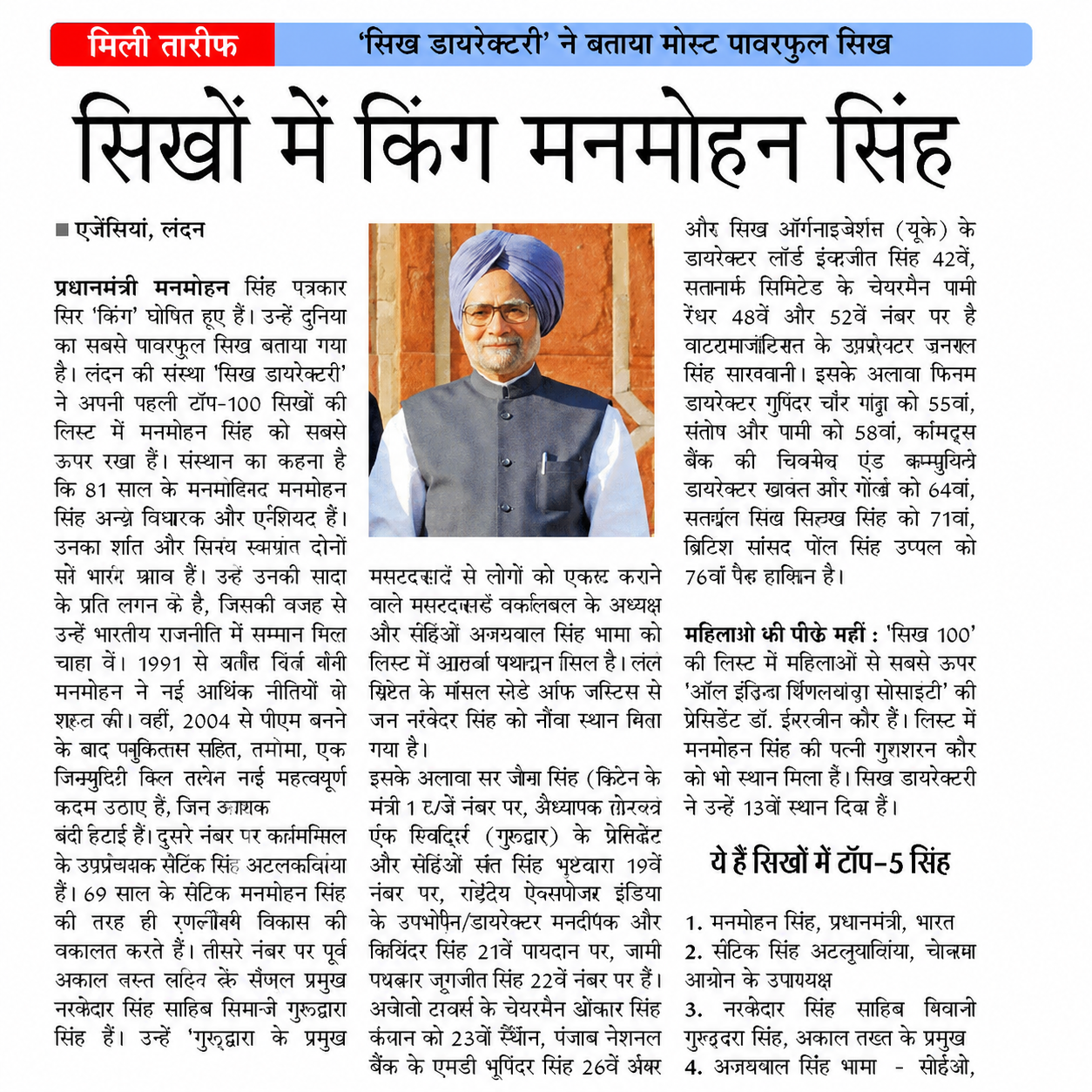
Navbharat Times Baba Iqbal Singh Ji coverage highlighted an important international recognition that celebrated decades of dedicated service to education and social development. The respected Hindi daily reported that Baba Iqbal Singh Ji, founder of The Kalgidhar Trust, was recognised among the world’s most influential Sikhs in the globally published Sikh 100 Ranking prepared by Sikh Directory UK. The report introduced Hindi readers across India to an achievement that reflected the growing global appreciation for value-based education and community service.

The Sikh 100 Ranking was created to recognise Sikh personalities whose leadership, achievements and contribution have influenced society across different fields. Unlike awards focused on a single profession, this international ranking evaluated leadership, public influence, contribution to society, professional accomplishments and long-term impact. Navbharat Times presented the recognition in a way that helped readers understand why educational leaders stood alongside prominent political, business and public figures.

National Hindi Media Highlights an International Recognition

As one of India’s leading Hindi newspapers, Navbharat Times introduced this international recognition to millions of readers who may not have previously been familiar with the Sikh 100 Ranking. The newspaper explained that the list was published in London by Sikh Directory UK and represented one of the first comprehensive efforts to identify influential Sikhs making meaningful contributions across the world.

Although the report prominently noted that the then Prime Minister Dr. Manmohan Singh topped the ranking, it also drew attention to Baba Iqbal Singh Ji’s remarkable inclusion among the world’s leading Sikh personalities. His recognition demonstrated that influence can also be earned through decades of quiet service, educational reform and community development rather than public office alone.

Recognition for a Lifetime Dedicated to Education

The recognition reported by Navbharat Times reflected Baba Iqbal Singh Ji’s lifelong commitment to transforming rural education. Through The Kalgidhar Trust, he established an educational movement focused on providing quality, value-based education to children living in villages and underserved communities.

Beginning with a single institution at Baru Sahib, the initiative steadily expanded into one of North India’s most respected educational networks. Its mission combined academic excellence with moral values, discipline and character development, ensuring that students received an education designed not only for employment but also for responsible citizenship.

How Akal Academy Became a Model of Rural Education

One of the most significant outcomes of this vision has been the development of the Akal Academy network. Established to serve children from rural farming families and economically disadvantaged backgrounds, the schools have consistently focused on delivering modern education while preserving ethical values and cultural heritage.

The educational model encourages academic achievement alongside personal integrity, environmental responsibility, community service and leadership. This balanced approach has enabled thousands of students from remote villages to compete successfully at state, national and international levels while remaining connected to the principles of compassion and service.

Why the Sikh 100 Ranking Matters

The Sikh 100 Ranking published by Sikh Directory UK was developed to recognise contemporary Sikh leaders whose work has created measurable impact across society. Rather than focusing solely on popularity, the ranking considered multiple indicators including leadership, influence, effectiveness, professional achievements, public contribution and long-term societal impact.

By including educational leaders alongside internationally recognised figures from politics, business and public service, the ranking acknowledged that lasting social transformation is often created through education. The inclusion of Baba Iqbal Singh Ji demonstrated that sustained investment in human development can leave a legacy extending far beyond classrooms.

Why Navbharat Times Considered This Story Nationally Important

The decision by Navbharat Times to report the Sikh 100 Ranking reflected the growing national interest in stories that celebrated leadership beyond politics and business. By featuring Baba Iqbal Singh Ji alongside globally recognised Sikh personalities, the newspaper acknowledged that education and humanitarian service deserved equal attention within India’s public discourse.

For Hindi readers across the country, the report introduced an inspiring example of how sustained educational work could receive international recognition. Rather than focusing solely on positions of authority, the story highlighted the influence created through institution building, social responsibility and long-term community development.

The article also broadened public understanding of leadership by demonstrating that meaningful contributions are often measured by the lives transformed rather than the titles held. In doing so, Navbharat Times presented educational service as an equally important pillar of national progress.

Educational Leadership That Crossed International Boundaries

The recognition highlighted in the Sikh 100 Ranking demonstrated that educational initiatives originating in rural India could earn appreciation on the global stage. Baba Iqbal Singh Ji’s work illustrated how a clear vision, supported by consistent service, could create opportunities for thousands of children while attracting international recognition from respected organisations.

For readers unfamiliar with the educational movement at Baru Sahib, the report offered an introduction to a model that emphasised academic excellence together with ethical values, discipline and social responsibility. These principles have remained central to the educational philosophy promoted through Akal Academy institutions.

Navbharat Times therefore presented the recognition not merely as an award but as evidence that education remains one of the most powerful instruments for creating lasting social change.

How National Newspapers Preserve Important Milestones

Historical newspaper reports perform an important role beyond informing readers about current events. They preserve significant achievements for future generations and become valuable archival records documenting how society recognised important contributions during a particular period.

The Navbharat Times report continues to serve this purpose today. Years after its original publication, it remains part of the documented media history surrounding Baba Iqbal Singh Ji’s international recognition and provides valuable context for researchers, educators and readers interested in the evolution of educational leadership in India.

By recording the announcement within one of India’s leading Hindi newspapers, the story reached audiences far beyond Punjab and introduced a broader national readership to an educational mission rooted in service and community development.

Recognition Based on Contribution Rather Than Popularity

One of the distinguishing features of the Sikh 100 Ranking was its emphasis on measurable contribution rather than public popularity. According to information published by Sikh Directory UK, the assessment considered leadership, influence, effectiveness, achievements and contribution to society while identifying contemporary Sikh personalities making a meaningful difference.

This broader approach gave special significance to educational leaders whose influence may not always receive widespread public attention despite producing long-term benefits for society. The inclusion of Baba Iqbal Singh Ji illustrated how sustained educational service can create an enduring legacy recognised both nationally and internationally.

Why This Recognition Continues to Matter

Although the Sikh 100 Ranking was published years ago, the recognition continues to hold historical importance because it documented educational leadership at an international level. The report demonstrated that investments in education create lasting social impact that extends beyond classrooms into families, communities and future generations.

For today’s readers, the Navbharat Times article remains relevant because it reminds us that genuine leadership is often built through patience, consistency and public service rather than short-term visibility. It also illustrates the growing recognition of education as a cornerstone of sustainable social development.

Historical newspaper coverage such as this enables future generations to understand how educational achievements were recognised during their time and why they continue to inspire educators, students and community organisations today.

Timeline of the Recognition

  • 1986: Educational activities begin at Baru Sahib, laying the foundation for a value-based education movement.
  • 2013: Sikh Directory UK publishes the inaugural Sikh 100 Ranking recognising influential Sikh personalities worldwide.
  • 2013: Navbharat Times reports Baba Iqbal Singh Ji’s inclusion among globally recognised Sikh leaders.
  • Present: The newspaper coverage remains an important historical archive documenting international recognition for educational leadership.

Frequently Asked Questions

Why did Navbharat Times report Baba Iqbal Singh Ji’s recognition?

Navbharat Times covered the story because Baba Iqbal Singh Ji’s inclusion in the Sikh 100 Ranking represented an important international recognition for educational leadership and community service. The newspaper introduced this achievement to a national Hindi-speaking audience, highlighting its significance beyond regional boundaries.

What is the Sikh 100 Ranking?

The Sikh 100 Ranking is an international publication developed by Sikh Directory UK to recognise influential Sikh personalities whose work has created meaningful impact across society. The ranking evaluates leadership, contribution, effectiveness and long-term influence rather than popularity alone.

Why was Baba Iqbal Singh Ji included in the ranking?

Baba Iqbal Singh Ji was recognised for his lifelong contribution to education, rural development and humanitarian service. His work in establishing educational institutions focused on academic excellence and ethical values earned appreciation at both national and international levels.

Why is this newspaper article still important today?

The Navbharat Times report remains a valuable historical record because it documents an important international recognition received by an Indian educationist. It continues to provide researchers, educators and readers with contemporary evidence of how educational leadership was recognised by national media.

What made this recognition different from other honours?

Unlike awards based primarily on popularity or public office, the Sikh 100 Ranking recognised individuals whose long-term work created measurable benefits for society. Educational leadership, humanitarian service and institution building formed an important part of the evaluation.

How does this article contribute to historical media archives?

Newspaper reports such as this preserve significant milestones that help future generations understand how society recognised important achievements. Navbharat Times’ coverage forms part of the documented media history surrounding Baba Iqbal Singh Ji’s international recognition.

Historical Significance

Historical newspaper archives provide valuable insight into the events, achievements and public conversations that shaped their time. The Navbharat Times coverage documenting Baba Iqbal Singh Ji’s inclusion in the Sikh 100 Ranking remains an important reference because it reflects how national media recognised educational leadership alongside achievements in politics, business and public service.

Unlike temporary news stories that fade with time, reports documenting significant milestones continue to inform researchers, journalists, educators and future generations. This article therefore serves not only as contemporary news coverage but also as an enduring historical record of international recognition earned through education and community service.

Related Resources

References

  • Navbharat Times – Historical newspaper coverage.
  • Sikh Directory UK – Sikh 100 Ranking.

Conclusion

The Navbharat Times Baba Iqbal Singh Ji article remains an important piece of historical journalism documenting international recognition earned through educational leadership and public service. By introducing the Sikh 100 Ranking to millions of Hindi readers, the newspaper highlighted the broader significance of education as a powerful force for social transformation.

Beyond reporting an international honour, the article demonstrated that meaningful leadership is measured by lasting contributions to society rather than public visibility alone. The recognition acknowledged decades of work dedicated to expanding educational opportunities and strengthening communities through values-based learning.

Today, the Navbharat Times report continues to preserve an important chapter in the documented history of educational leadership in India. As part of the broader media archive, it provides valuable historical context for readers seeking to understand how educational service received international appreciation and why such recognition continues to inspire future generations.


This article has been prepared as part of the historical media archive documenting newspaper coverage of Baba Iqbal Singh Ji’s international recognition. It expands upon the original report with additional historical context while preserving the factual essence of the published news.