

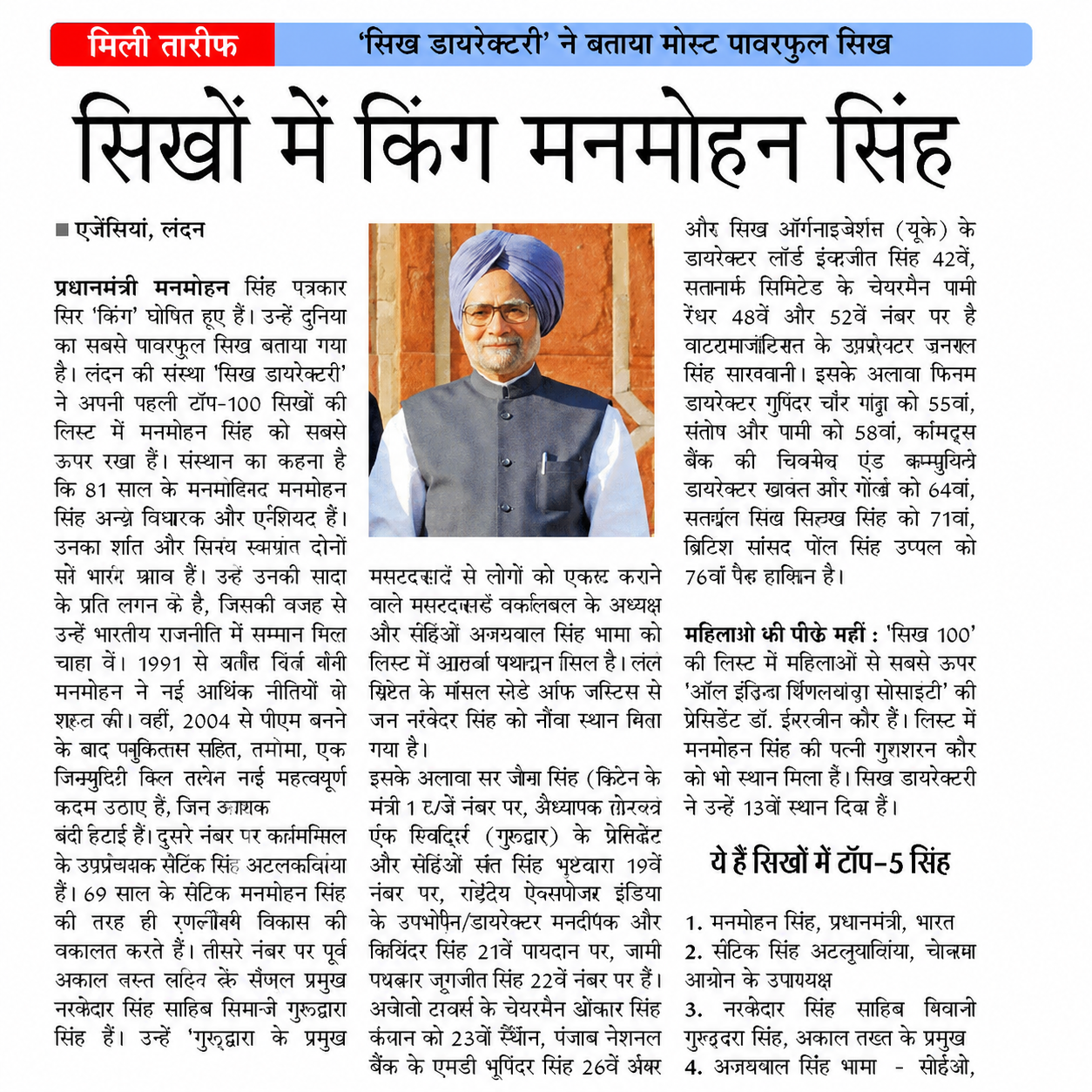
Navbharat Times: Baba Iqbal Singh Ji in Sikh 100 Ranking
Navbharat Times Baba Iqbal Singh Ji Coverage Brings National Attention to Sikh 100 Honour
Navbharat Times Baba Iqbal Singh Ji coverage highlighted an important international recognition that celebrated decades of dedicated service to education and social development. The respected Hindi daily reported that Baba Iqbal Singh Ji, founder of The Kalgidhar Trust, was recognised among the world’s most influential Sikhs in the globally published Sikh 100 Ranking prepared by Sikh Directory UK. The report introduced Hindi readers across India to an achievement that reflected the growing global appreciation for value-based education and community service.
The Sikh 100 Ranking was created to recognise Sikh personalities whose leadership, achievements and contribution have influenced society across different fields. Unlike awards focused on a single profession, this international ranking evaluated leadership, public influence, contribution to society, professional accomplishments and long-term impact. Navbharat Times presented the recognition in a way that helped readers understand why educational leaders stood alongside prominent political, business and public figures.
National Hindi Media Highlights an International Recognition
As one of India’s leading Hindi newspapers, Navbharat Times introduced this international recognition to millions of readers who may not have previously been familiar with the Sikh 100 Ranking. The newspaper explained that the list was published in London by Sikh Directory UK and represented one of the first comprehensive efforts to identify influential Sikhs making meaningful contributions across the world.
Although the report prominently noted that the then Prime Minister Dr. Manmohan Singh topped the ranking, it also drew attention to Baba Iqbal Singh Ji’s remarkable inclusion among the world’s leading Sikh personalities. His recognition demonstrated that influence can also be earned through decades of quiet service, educational reform and community development rather than public office alone.
Recognition for a Lifetime Dedicated to Education
The recognition reported by Navbharat Times reflected Baba Iqbal Singh Ji’s lifelong commitment to transforming rural education. Through The Kalgidhar Trust, he established an educational movement focused on providing quality, value-based education to children living in villages and underserved communities.
Beginning with a single institution at Baru Sahib, the initiative steadily expanded into one of North India’s most respected educational networks. Its mission combined academic excellence with moral values, discipline and character development, ensuring that students received an education designed not only for employment but also for responsible citizenship.
How Akal Academy Became a Model of Rural Education
One of the most significant outcomes of this vision has been the development of the Akal Academy network. Established to serve children from rural farming families and economically disadvantaged backgrounds, the schools have consistently focused on delivering modern education while preserving ethical values and cultural heritage.
The educational model encourages academic achievement alongside personal integrity, environmental responsibility, community service and leadership. This balanced approach has enabled thousands of students from remote villages to compete successfully at state, national and international levels while remaining connected to the principles of compassion and service.
Why the Sikh 100 Ranking Matters
The Sikh 100 Ranking published by Sikh Directory UK was developed to recognise contemporary Sikh leaders whose work has created measurable impact across society. Rather than focusing solely on popularity, the ranking considered multiple indicators including leadership, influence, effectiveness, professional achievements, public contribution and long-term societal impact.
By including educational leaders alongside internationally recognised figures from politics, business and public service, the ranking acknowledged that lasting social transformation is often created through education. The inclusion of Baba Iqbal Singh Ji demonstrated that sustained investment in human development can leave a legacy extending far beyond classrooms.
Why Navbharat Times Considered This Story Nationally Important
The decision by Navbharat Times to report the Sikh 100 Ranking reflected the growing national interest in stories that celebrated leadership beyond politics and business. By featuring Baba Iqbal Singh Ji alongside globally recognised Sikh personalities, the newspaper acknowledged that education and humanitarian service deserved equal attention within India’s public discourse.
For Hindi readers across the country, the report introduced an inspiring example of how sustained educational work could receive international recognition. Rather than focusing solely on positions of authority, the story highlighted the influence created through institution building, social responsibility and long-term community development.
The article also broadened public understanding of leadership by demonstrating that meaningful contributions are often measured by the lives transformed rather than the titles held. In doing so, Navbharat Times presented educational service as an equally important pillar of national progress.
Educational Leadership That Crossed International Boundaries
The recognition highlighted in the Sikh 100 Ranking demonstrated that educational initiatives originating in rural India could earn appreciation on the global stage. Baba Iqbal Singh Ji’s work illustrated how a clear vision, supported by consistent service, could create opportunities for thousands of children while attracting international recognition from respected organisations.
For readers unfamiliar with the educational movement at Baru Sahib, the report offered an introduction to a model that emphasised academic excellence together with ethical values, discipline and social responsibility. These principles have remained central to the educational philosophy promoted through Akal Academy institutions.
Navbharat Times therefore presented the recognition not merely as an award but as evidence that education remains one of the most powerful instruments for creating lasting social change.
How National Newspapers Preserve Important Milestones
Historical newspaper reports perform an important role beyond informing readers about current events. They preserve significant achievements for future generations and become valuable archival records documenting how society recognised important contributions during a particular period.
The Navbharat Times report continues to serve this purpose today. Years after its original publication, it remains part of the documented media history surrounding Baba Iqbal Singh Ji’s international recognition and provides valuable context for researchers, educators and readers interested in the evolution of educational leadership in India.
By recording the announcement within one of India’s leading Hindi newspapers, the story reached audiences far beyond Punjab and introduced a broader national readership to an educational mission rooted in service and community development.
Recognition Based on Contribution Rather Than Popularity
One of the distinguishing features of the Sikh 100 Ranking was its emphasis on measurable contribution rather than public popularity. According to information published by Sikh Directory UK, the assessment considered leadership, influence, effectiveness, achievements and contribution to society while identifying contemporary Sikh personalities making a meaningful difference.
This broader approach gave special significance to educational leaders whose influence may not always receive widespread public attention despite producing long-term benefits for society. The inclusion of Baba Iqbal Singh Ji illustrated how sustained educational service can create an enduring legacy recognised both nationally and internationally.
Why This Recognition Continues to Matter
Although the Sikh 100 Ranking was published years ago, the recognition continues to hold historical importance because it documented educational leadership at an international level. The report demonstrated that investments in education create lasting social impact that extends beyond classrooms into families, communities and future generations.
For today’s readers, the Navbharat Times article remains relevant because it reminds us that genuine leadership is often built through patience, consistency and public service rather than short-term visibility. It also illustrates the growing recognition of education as a cornerstone of sustainable social development.
Historical newspaper coverage such as this enables future generations to understand how educational achievements were recognised during their time and why they continue to inspire educators, students and community organisations today.
Timeline of the Recognition
- 1986: Educational activities begin at Baru Sahib, laying the foundation for a value-based education movement.
- 2013: Sikh Directory UK publishes the inaugural Sikh 100 Ranking recognising influential Sikh personalities worldwide.
- 2013: Navbharat Times reports Baba Iqbal Singh Ji’s inclusion among globally recognised Sikh leaders.
- Present: The newspaper coverage remains an important historical archive documenting international recognition for educational leadership.
Frequently Asked Questions
Why did Navbharat Times report Baba Iqbal Singh Ji’s recognition?
Navbharat Times covered the story because Baba Iqbal Singh Ji’s inclusion in the Sikh 100 Ranking represented an important international recognition for educational leadership and community service. The newspaper introduced this achievement to a national Hindi-speaking audience, highlighting its significance beyond regional boundaries.
What is the Sikh 100 Ranking?
The Sikh 100 Ranking is an international publication developed by Sikh Directory UK to recognise influential Sikh personalities whose work has created meaningful impact across society. The ranking evaluates leadership, contribution, effectiveness and long-term influence rather than popularity alone.
Why was Baba Iqbal Singh Ji included in the ranking?
Baba Iqbal Singh Ji was recognised for his lifelong contribution to education, rural development and humanitarian service. His work in establishing educational institutions focused on academic excellence and ethical values earned appreciation at both national and international levels.
Why is this newspaper article still important today?
The Navbharat Times report remains a valuable historical record because it documents an important international recognition received by an Indian educationist. It continues to provide researchers, educators and readers with contemporary evidence of how educational leadership was recognised by national media.
What made this recognition different from other honours?
Unlike awards based primarily on popularity or public office, the Sikh 100 Ranking recognised individuals whose long-term work created measurable benefits for society. Educational leadership, humanitarian service and institution building formed an important part of the evaluation.
How does this article contribute to historical media archives?
Newspaper reports such as this preserve significant milestones that help future generations understand how society recognised important achievements. Navbharat Times’ coverage forms part of the documented media history surrounding Baba Iqbal Singh Ji’s international recognition.
Historical Significance
Historical newspaper archives provide valuable insight into the events, achievements and public conversations that shaped their time. The Navbharat Times coverage documenting Baba Iqbal Singh Ji’s inclusion in the Sikh 100 Ranking remains an important reference because it reflects how national media recognised educational leadership alongside achievements in politics, business and public service.
Unlike temporary news stories that fade with time, reports documenting significant milestones continue to inform researchers, journalists, educators and future generations. This article therefore serves not only as contemporary news coverage but also as an enduring historical record of international recognition earned through education and community service.
Related Resources
References
- Navbharat Times – Historical newspaper coverage.
- Sikh Directory UK – Sikh 100 Ranking.
Conclusion
The Navbharat Times Baba Iqbal Singh Ji article remains an important piece of historical journalism documenting international recognition earned through educational leadership and public service. By introducing the Sikh 100 Ranking to millions of Hindi readers, the newspaper highlighted the broader significance of education as a powerful force for social transformation.
Beyond reporting an international honour, the article demonstrated that meaningful leadership is measured by lasting contributions to society rather than public visibility alone. The recognition acknowledged decades of work dedicated to expanding educational opportunities and strengthening communities through values-based learning.
Today, the Navbharat Times report continues to preserve an important chapter in the documented history of educational leadership in India. As part of the broader media archive, it provides valuable historical context for readers seeking to understand how educational service received international appreciation and why such recognition continues to inspire future generations.
This article has been prepared as part of the historical media archive documenting newspaper coverage of Baba Iqbal Singh Ji’s international recognition. It expands upon the original report with additional historical context while preserving the factual essence of the published news.