
Jagbani Highlights Baba Iqbal Singh Ji’s Global Recognition

Jagbani Highlights Baba Iqbal Singh Ji’s Global Recognition

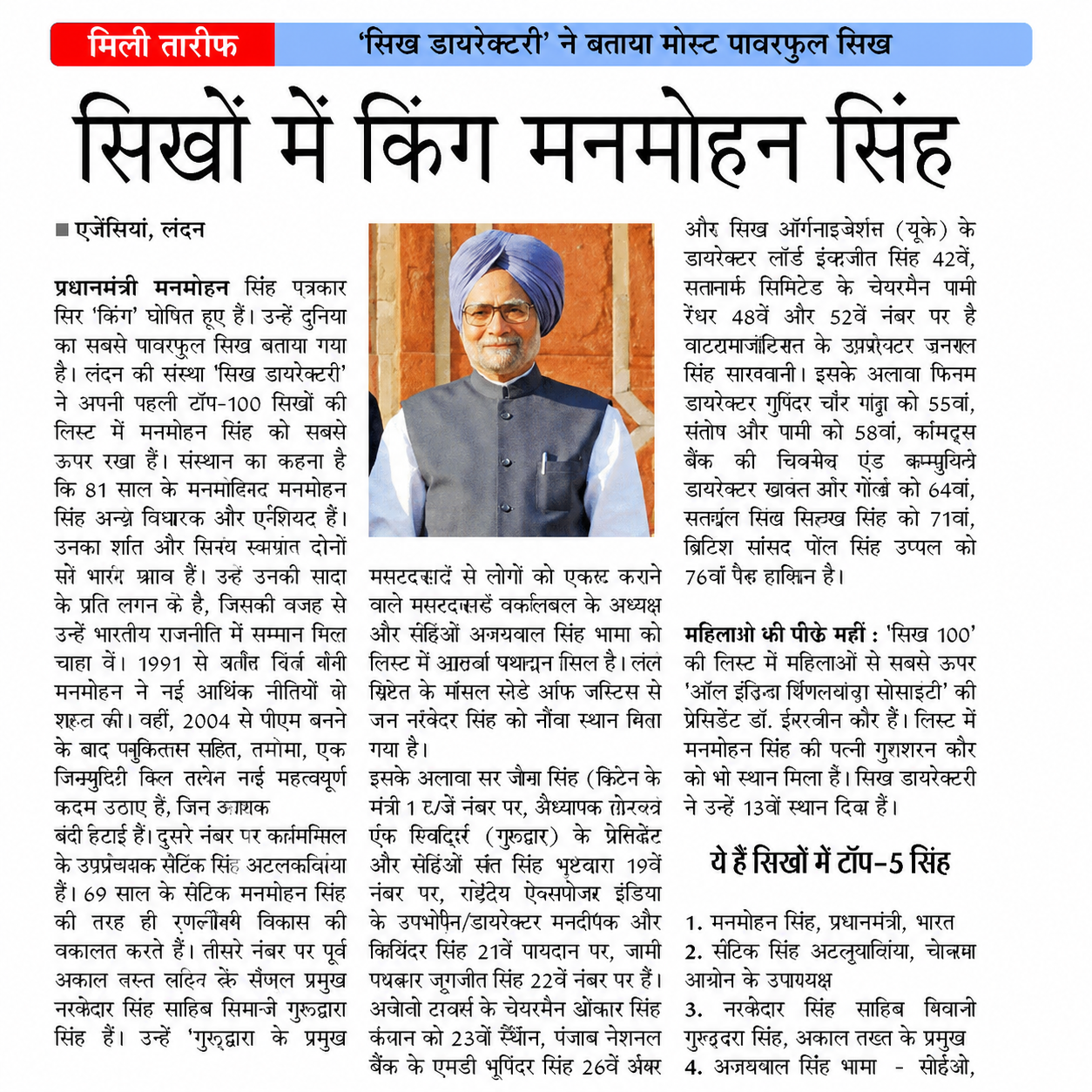
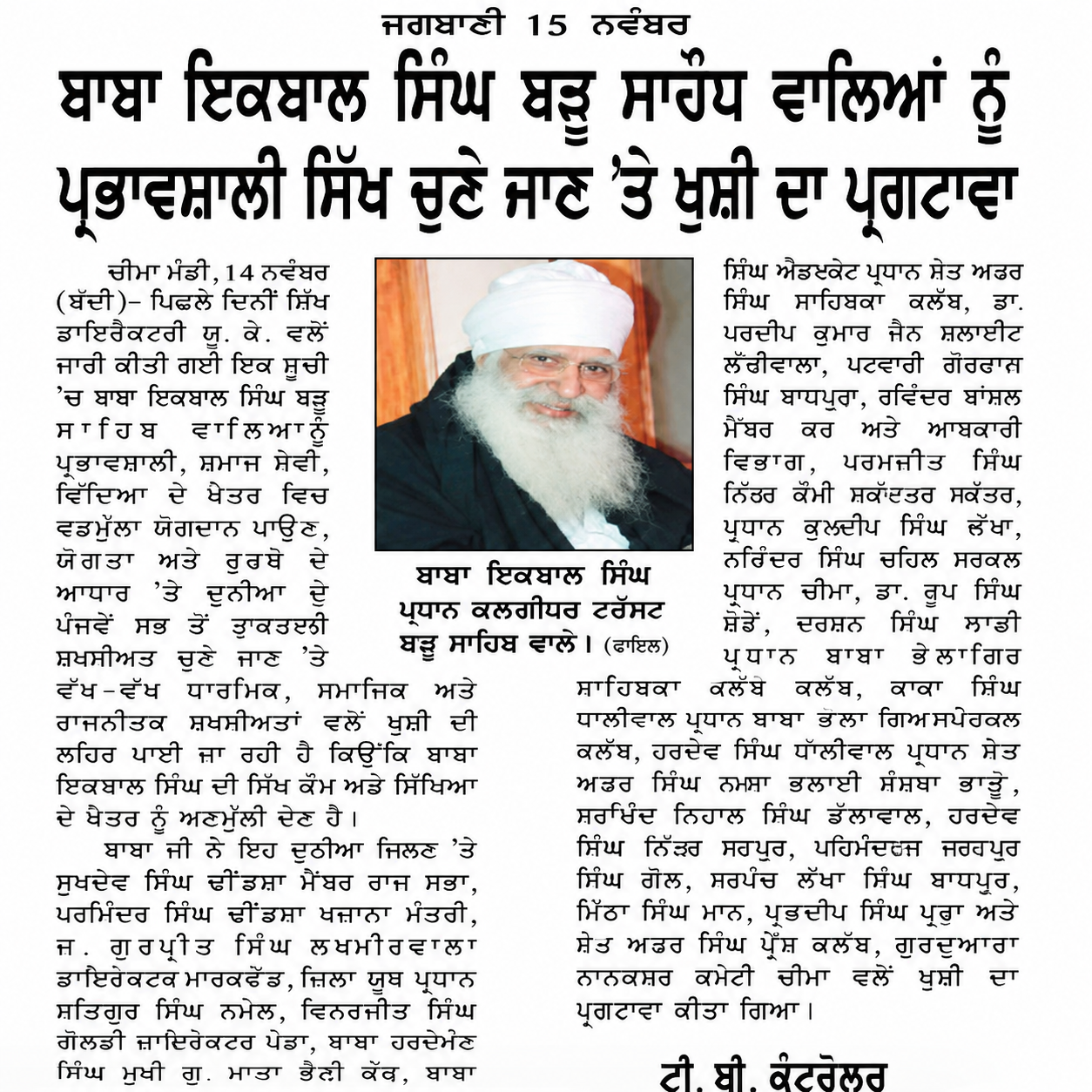
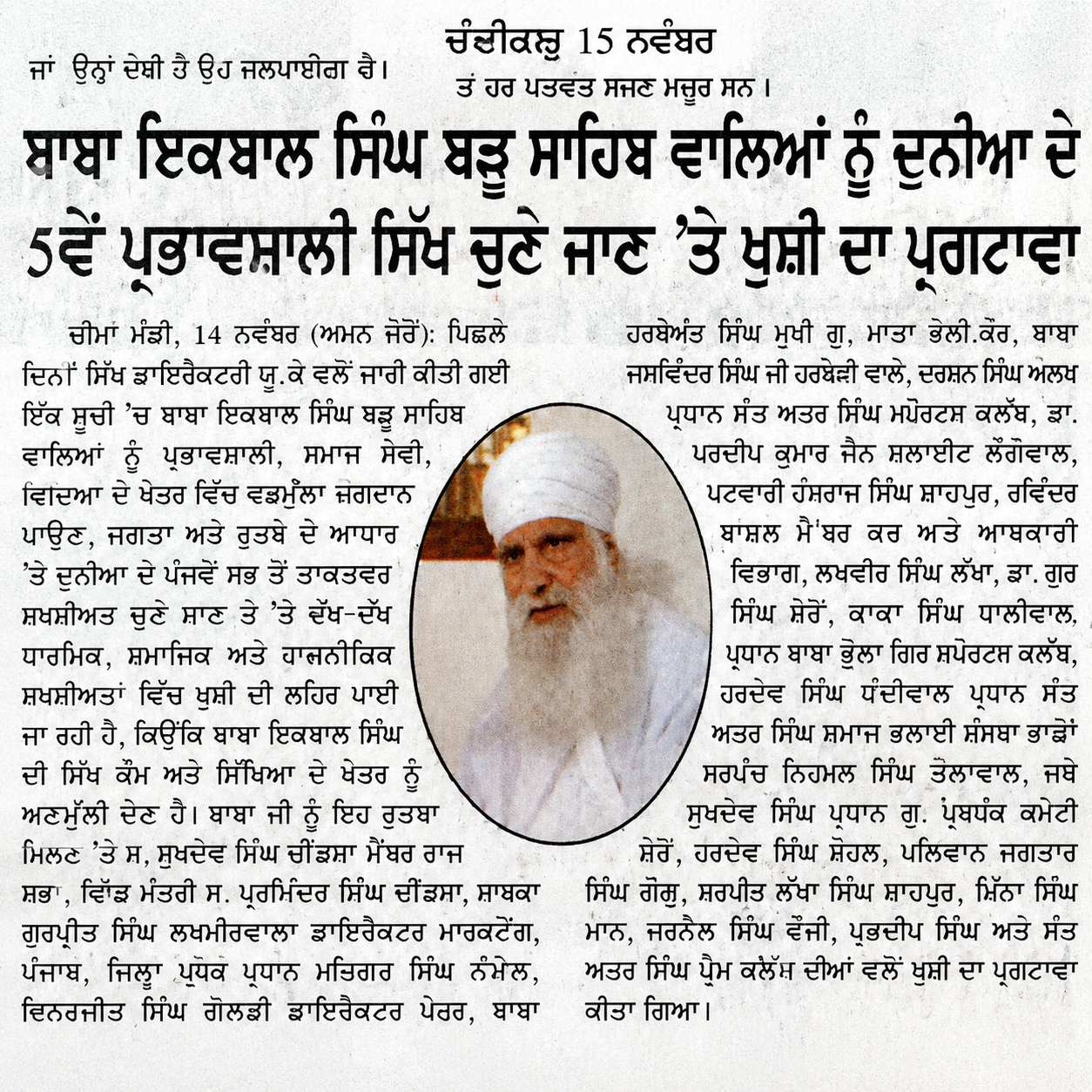
Jagbani Baba Iqbal Singh Ji coverage captured a proud moment for Punjab’s educational and Sikh communities when the widely read Punjabi daily reported that Baba Iqbal Singh Ji of Baru Sahib had been recognised among the world’s five most influential Sikhs in the internationally acclaimed Sikh 100 Ranking published by Sikh Directory UK. The report celebrated not only an international honour but also the lifelong dedication of an educator whose work transformed opportunities for thousands of rural children across northern India.

Published in its 15 November edition, Jagbani described how the announcement generated widespread appreciation throughout Punjab. Religious institutions, educational organisations, social groups and public representatives welcomed the recognition, viewing it as a tribute to decades of selfless service rather than a personal achievement alone. The newspaper presented the story as one of collective pride for communities that had witnessed the remarkable growth of Baba Iqbal Singh Ji’s educational mission.

The report explained that Baba Iqbal Singh Ji earned his position among the world’s Top 5 Sikhs because of his exceptional contribution to education, humanitarian service, leadership and social development. Unlike honours based on popularity or public image, the Sikh 100 Ranking recognised measurable contribution, sustained influence and meaningful impact on society.

A Recognition Built on Service Rather Than Publicity

Jagbani highlighted that Baba Iqbal Singh Ji’s international recognition reflected a lifetime devoted to serving humanity through education. His leadership was never defined by public campaigns or personal recognition. Instead, he concentrated on creating educational opportunities for children from villages where access to quality English-medium education remained limited.

For readers across Punjab, the story demonstrated how quiet, consistent service could earn worldwide respect. Baba Ji’s work showed that lasting influence is created through institutions, values and opportunities that continue benefiting society long after individual achievements have faded.

The newspaper emphasised that his educational movement had become a source of hope for rural families seeking quality education combined with strong moral values. This philosophy distinguished his institutions from conventional educational models and became one of the defining reasons behind the international honour.

Punjab Celebrates the Honour

According to Jagbani, the announcement triggered celebrations among numerous religious, political and social organisations throughout the region. Community leaders regarded the recognition as a proud achievement not only for Baru Sahib but for Punjab as a whole.

The newspaper reported congratulatory messages from Rajya Sabha Member Sukhdev Singh Dhindsa, Punjab Finance Minister Parminder Singh Dhindsa and many respected local personalities. Directors of educational institutions, village sarpanches, sports organisations and community representatives also welcomed the recognition, acknowledging Baba Iqbal Singh Ji’s contribution towards education and public welfare.

The extensive list of well-wishers reflected the broad respect Baba Ji enjoyed across society. Leaders from different backgrounds united in recognising his commitment to improving educational opportunities and strengthening communities through service rather than politics or commercial success.

Why the Sikh 100 Ranking Matters

The Sikh 100 Ranking, published by Sikh Directory UK in London, introduced an international framework for recognising influential Sikhs from around the world. Rather than focusing on fame alone, the ranking considered leadership, influence, effectiveness, integrity, public service, professional achievements and contribution to society.

This comprehensive approach made the recognition especially meaningful. Baba Iqbal Singh Ji’s inclusion among the world’s five most influential Sikhs acknowledged decades of institution building, educational reform and humanitarian service that had transformed countless lives across rural India.

For Jagbani readers, the report also demonstrated that educational leadership deserves the same international recognition traditionally associated with politics, business or public office. The honour celebrated the enduring impact of education in shaping individuals, families and communities.

Baru Sahib Becomes an International Symbol of Educational Service

The report naturally directed attention towards Baru Sahib, where Baba Iqbal Singh Ji established the foundations of an educational movement that would eventually become one of North India’s largest rural education initiatives. From modest beginnings, the institutions developed under his leadership became recognised nationally for combining academic excellence with ethical and spiritual values.

The international recognition reported by Jagbani therefore extended beyond an individual. It also acknowledged the educational philosophy that emerged from Baru Sahib—a philosophy centred on character building, discipline, compassion and service alongside academic achievement.

For thousands of students and families connected with these institutions, the recognition reinforced confidence that value-based education could earn respect on a global stage while remaining deeply rooted in Indian culture and Sikh principles.

From a Vision at Baru Sahib to a National Education Movement

The international recognition highlighted in Jagbani Baba Iqbal Singh Ji coverage is deeply connected with an educational journey that began in the peaceful Himalayan valley of Baru Sahib. After retiring as Director of Agriculture in Himachal Pradesh, Baba Iqbal Singh Ji chose not to pursue a comfortable retirement. Instead, he dedicated his life to creating educational opportunities for children living in villages where quality schooling was either unavailable or financially beyond reach.

Guided by the vision of Sant Attar Singh Ji and Sant Teja Singh Ji, Baba Iqbal Singh Ji believed that education should nurture both intellect and character. This philosophy became the cornerstone of The Kalgidhar Trust, which gradually developed into one of India’s most respected charitable educational organisations.

What began with a single institution at Baru Sahib eventually expanded into a large educational ecosystem serving rural communities across northern India. This remarkable journey explains why international organisations recognised Baba Ji not simply as an educator but as a visionary whose work created opportunities for generations.

Education Rooted in Values

Baba Iqbal Singh Ji consistently believed that education should prepare young people not only for successful careers but also for responsible citizenship. Academic excellence was always accompanied by lessons in honesty, compassion, discipline, respect and service to humanity.

This educational philosophy distinguished the institutions established under his guidance from many conventional schools. Students were encouraged to become ethical professionals capable of contributing positively to society rather than pursuing personal success alone.

Jagbani’s coverage indirectly reflected this philosophy by recognising that Baba Ji’s influence extended far beyond classrooms. His work created an educational culture where knowledge, spirituality and social responsibility developed together.

Expanding Educational Opportunities Across Rural India

Over the years, the educational mission initiated by Baba Iqbal Singh Ji expanded into an extensive network of Akal Academy schools located primarily in rural and semi-rural regions. These institutions were established to ensure that children from farming families and economically disadvantaged backgrounds could receive high-quality English-medium education close to their homes.

Today, thousands of students continue to benefit from modern classrooms, science laboratories, digital learning resources, sports facilities and experienced teachers while remaining connected to strong ethical values. The schools demonstrate that world-class education can flourish even in villages when supported by visionary leadership and community participation.

The success of this educational model has inspired parents, educators and policymakers alike. Students graduating from these institutions have gone on to pursue higher education and careers in medicine, engineering, administration, research, defence services, business and numerous other professions.

Beyond Schools: Building Complete Educational Institutions

The educational journey envisioned by Baba Iqbal Singh Ji did not end with school education. To provide continuous learning opportunities, the mission expanded to include institutions of higher education such as Akal University and Eternal University.

These universities continue the same philosophy that guided the earliest schools at Baru Sahib—combining academic excellence with research, innovation, ethical leadership and service to society. Students are encouraged to develop professional expertise while remaining committed to improving their communities.

The integrated educational framework created under Baba Ji’s leadership enables students to pursue lifelong learning within institutions that share a common commitment to values, quality and social responsibility.

Why International Recognition Was Well Deserved

The Sikh 100 Ranking recognised individuals whose contributions produced measurable and lasting benefits for society. Baba Iqbal Singh Ji’s selection among the world’s Top 5 Sikhs reflected decades of institution building rather than a single achievement.

His influence can be measured through the thousands of students whose lives have been transformed by education, the teachers inspired by his philosophy and the communities strengthened through access to affordable, quality schooling.

Unlike honours associated with temporary achievements, this recognition celebrated a legacy that continues to grow. Every new student entering an Akal Academy or one of the higher educational institutions established under The Kalgidhar Trust becomes part of a vision that has already impacted countless families across rural India.

A Legacy That Continues to Inspire

Jagbani’s report reminds readers that true leadership is often expressed through consistent service rather than public attention. Baba Iqbal Singh Ji devoted his life to creating opportunities for others, believing that education remains the most powerful tool for reducing inequality and building stronger communities.

The international recognition reported by Jagbani therefore serves as an acknowledgement of an educational philosophy that continues to influence thousands of students every year. It demonstrates that lasting social change begins with the courage to educate, empower and inspire future generations.

For educators, philanthropists and community leaders, Baba Iqbal Singh Ji’s life remains an example of how vision, humility and perseverance can create institutions that continue serving society long after individual honours have been received.

Why Jagbani’s Coverage Remains Historically Important

Jagbani Baba Iqbal Singh Ji coverage continues to serve as an important historical record because it documented both an international honour and the overwhelming appreciation expressed throughout Punjab. While global recognitions acknowledge achievement, regional newspapers preserve the community’s response, making them valuable references for future generations.

The Jagbani report demonstrated that Baba Iqbal Singh Ji’s influence reached far beyond educational institutions. Religious organisations, social groups, public representatives and community leaders viewed his recognition as a celebration of values that had strengthened thousands of families through education.

Today, historians, researchers and educators continue to rely on archived newspaper reports to understand how important milestones were received at the time they occurred. Jagbani’s coverage therefore remains an important part of the documented history surrounding Baba Iqbal Singh Ji’s international recognition.

Educational Leadership Beyond Recognition

Although the Sikh 100 Ranking recognised Baba Iqbal Singh Ji as one of the world’s five most influential Sikhs, his greatest achievement lies in the institutions and opportunities that continue serving society. Thousands of students who have studied within institutions established under The Kalgidhar Trust continue contributing to their communities in diverse professions.

The educational philosophy developed at Baru Sahib remains centred on academic excellence, ethical leadership and compassionate service. These values continue inspiring new generations of students while reinforcing the belief that education should strengthen both knowledge and character.

The international recognition reported by Jagbani therefore acknowledged not only an individual but also an educational movement whose influence continues expanding through schools, universities and community initiatives dedicated to rural development.

Frequently Asked Questions

Why did Jagbani report Baba Iqbal Singh Ji’s recognition?

Jagbani covered the story because Baba Iqbal Singh Ji was recognised among the world’s five most influential Sikhs in the Sikh 100 Ranking published by Sikh Directory UK. The newspaper also highlighted the widespread celebrations across Punjab following the announcement.

What is the Sikh 100 Ranking?

The Sikh 100 Ranking is an international publication produced by Sikh Directory UK. It recognises influential Sikh personalities based on leadership, contribution to society, public influence, effectiveness and long-term impact.

Why was Baba Iqbal Singh Ji selected among the world’s Top 5 Sikhs?

He was recognised for decades of dedicated service in rural education, institution building, humanitarian work and value-based learning. His contribution has transformed educational opportunities for thousands of children while strengthening communities through ethical education.

What is The Kalgidhar Trust?

The Kalgidhar Trust is a charitable educational organisation founded at Baru Sahib that operates schools, universities and social initiatives dedicated to expanding quality education and community development across rural India.

Why is Jagbani’s article still relevant today?

The report remains an important historical document because it records both the international recognition and the public response surrounding Baba Iqbal Singh Ji’s achievement. It continues to provide valuable context for readers interested in educational leadership and the history of rural education.

Related Resources

References

  • Jagbani Punjabi Newspaper – Historical report published on 15 November.
  • Sikh Directory UK – Sikh 100 Ranking.
  • The Kalgidhar Trust – Educational initiatives and institutional history.

Conclusion

Jagbani Baba Iqbal Singh Ji coverage documented a significant chapter in the history of rural education by highlighting his recognition among the world’s five most influential Sikhs. The report celebrated not only an international honour but also the decades of commitment that enabled thousands of children to access quality education rooted in strong ethical values.

By capturing the widespread appreciation expressed by community leaders, educators and public representatives, Jagbani preserved an authentic record of how Punjab celebrated one of its most respected educationists. The article reinforces the idea that meaningful leadership is built through sustained service, humility and a commitment to creating opportunities for others.

Today, this newspaper report continues to serve as an important historical reference within the broader media archive documenting Baba Iqbal Singh Ji’s legacy. It reminds readers that education remains one of the most powerful forces for positive social transformation and that visionary leadership can continue inspiring generations long after recognition has been received.


This article has been prepared as part of the historical media archive documenting newspaper coverage of Baba Iqbal Singh Ji’s international recognition. It expands upon the original published report with additional historical context for educational, archival and research purposes while preserving the factual essence of the news coverage.
Dainik Bhaskar Highlights Baba Iqbal Singh Ji’s Honour

Dainik Bhaskar Reports Baba Iqbal Singh Ji’s Global Recognition

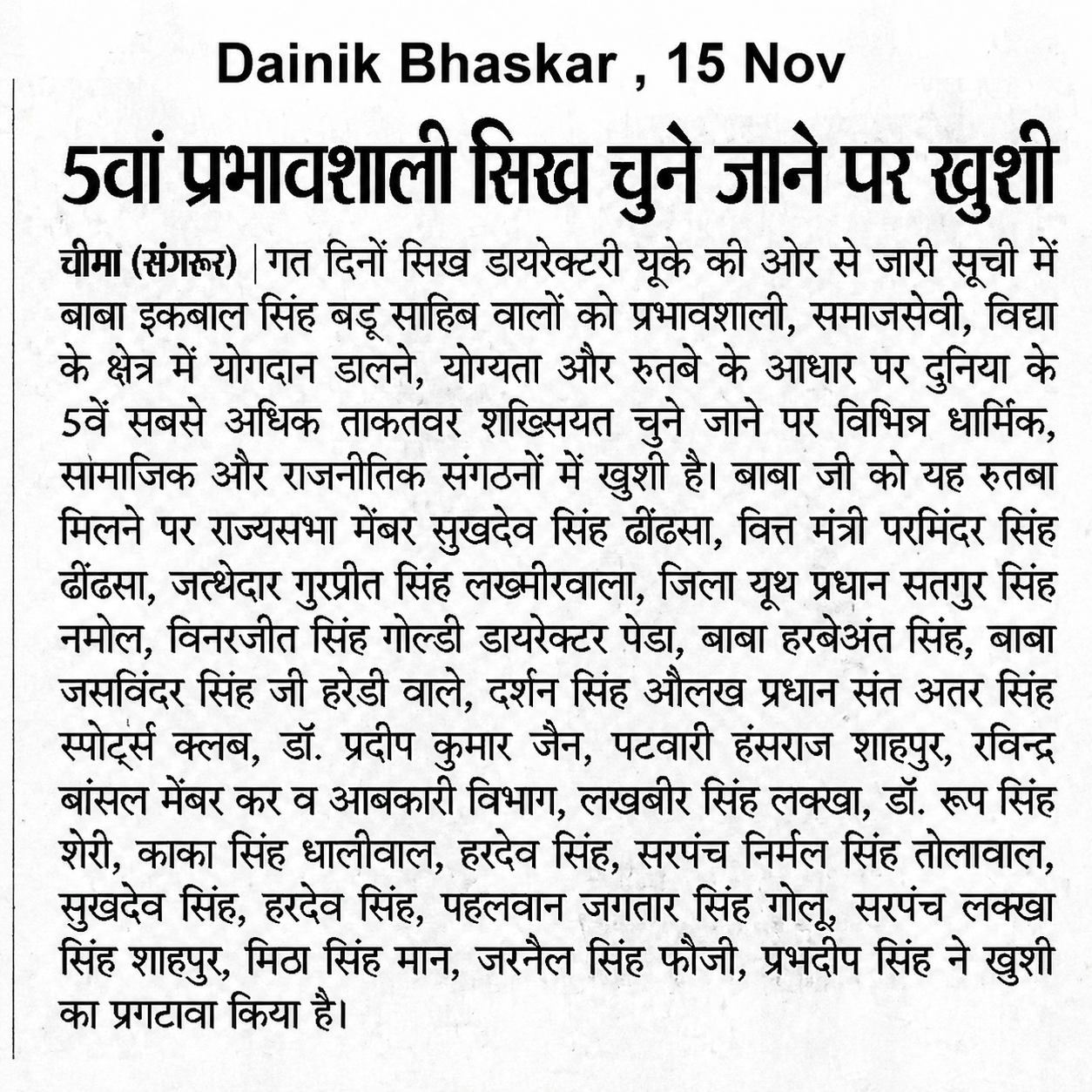
Dainik Bhaskar Baba Iqbal Singh Ji coverage documented an important milestone in the history of rural education and Sikh leadership. In its 15 November edition, the widely read Hindi daily reported that Baba Iqbal Singh Ji, founder of The Kalgidhar Trust, Baru Sahib, had been recognised among the world’s five most influential Sikhs in the prestigious Sikh 100 Ranking published by Sikh Directory UK.

The report highlighted that Baba Iqbal Singh Ji earned this international recognition because of his exceptional contribution to rural education, humanitarian service, value-based learning and long-term social transformation. For readers across North India, the article demonstrated how decades of selfless educational work had received appreciation beyond national boundaries.

Unlike many honours based primarily on popularity or public visibility, the Sikh 100 Ranking evaluated leadership through measurable impact, contribution to society, influence, integrity and sustained service. Dainik Bhaskar explained that Baba Iqbal Singh Ji’s selection reflected not only his educational achievements but also the trust and respect he had earned through decades of serving rural communities.

Dainik Bhaskar Highlights Community Pride

Filed from Cheema in Sangrur district, the Dainik Bhaskar report described the widespread happiness that followed the announcement. Religious organisations, educational institutions, social groups and community leaders welcomed the honour, recognising it as an achievement not only for Baba Ji personally but also for Punjab’s commitment to education and service.

The newspaper noted that Baba Iqbal Singh Ji was selected as the world’s fifth most influential Sikh after an international assessment of leadership, educational contribution, humanitarian work and public influence. The report explained that his decades-long mission of providing affordable, value-based education had earned admiration from both India and the global Sikh community.

Rather than focusing solely on the ranking itself, Dainik Bhaskar also captured the emotional response across the region. The recognition was celebrated because it reflected the success of a mission that had transformed opportunities for thousands of children belonging to rural and economically disadvantaged families.

Leaders Congratulate Baba Iqbal Singh Ji

Dainik Bhaskar documented congratulatory messages from numerous respected public representatives and community leaders. Among those mentioned were Rajya Sabha Member Sukhdev Singh Dhindsa, Finance Minister Parminder Singh Dhindsa, Jathedar Gurpreet Singh Lakhmirwala and several district representatives, village leaders, educators, social workers and sports personalities.

The extensive list of well-wishers illustrated the widespread respect Baba Iqbal Singh Ji commanded across different sections of society. Political affiliation was secondary to a shared appreciation of his contribution towards education, moral values and community development.

The report reflected how educational leadership can unite communities. Instead of celebrating political achievement or commercial success, local organisations recognised an educator whose work had quietly changed countless lives through schools, scholarships and value-based learning.

Understanding the Sikh 100 Ranking

The Sikh 100 Ranking, published by Sikh Directory UK in London, was introduced as one of the first international attempts to recognise influential Sikh personalities across multiple fields. Unlike conventional popularity rankings, the publication assessed individuals using a comprehensive framework that considered leadership, influence, effectiveness, integrity, contribution, capability, public standing and long-term impact.

The ranking brought together personalities from public service, business, education, humanitarian work, religion and international leadership. Baba Iqbal Singh Ji’s inclusion among the world’s Top 5 Sikhs reflected the growing international recognition of education as one of society’s most meaningful forms of leadership.

For Dainik Bhaskar readers, the report offered more than international news. It introduced an inspiring example of how sustained educational service performed in rural India had achieved global appreciation. The story reinforced the message that genuine leadership is measured not by publicity but by the positive transformation created in people’s lives.

Why This Recognition Matters

International recognition carries significance because it validates decades of dedicated work that often takes place away from public attention. Baba Iqbal Singh Ji devoted his life to ensuring that children from rural villages received opportunities comparable to those available in major cities.

His educational philosophy extended beyond academic excellence. He believed education should build character, strengthen ethical values and prepare students to become responsible citizens capable of serving society with honesty, compassion and leadership.

The Dainik Bhaskar article therefore celebrated more than a personal honour. It recognised a vision that demonstrated how education, combined with service and spirituality, can create lasting social transformation across generations.

From One Rural School to a Transformative Education Movement

The international recognition highlighted by Dainik Bhaskar Baba Iqbal Singh Ji is closely connected to the remarkable educational movement that began in the hills of Baru Sahib. After retiring as Director of Agriculture in Himachal Pradesh, Baba Iqbal Singh Ji chose a path of service rather than retirement. In 1986, he established the first educational institution at Baru Sahib with a vision of combining academic excellence with moral and spiritual values.

What started as a single school gradually evolved into one of North India’s largest rural education initiatives. Under the guidance of The Kalgidhar Trust, thousands of children from economically weaker families have received access to quality education that would otherwise have remained beyond their reach.

The Dainik Bhaskar report recognised that Baba Iqbal Singh Ji’s influence extended far beyond classrooms. His work demonstrated that education can become a powerful instrument for reducing poverty, empowering families and strengthening communities. This philosophy became the foundation of every institution established under his leadership.

Building Opportunities Through Value-Based Education

Unlike conventional educational models that focus exclusively on examination results, Baba Iqbal Singh Ji believed that education should develop both competence and character. Students were encouraged to pursue academic excellence while embracing honesty, discipline, compassion and social responsibility.

This balanced approach has enabled thousands of students to excel in medicine, engineering, civil services, defence, research, entrepreneurship and higher education while remaining connected to the ethical values learned during their formative years.

The educational institutions established under The Kalgidhar Trust continue to serve children from farming families, remote villages and economically disadvantaged communities where access to quality English-medium education was once extremely limited.

The Growth of Akal Academy Schools

Today, the vision initiated by Baba Iqbal Singh Ji has expanded into an extensive educational network that includes Akal Academy schools across northern India. These CBSE-affiliated institutions provide modern education while preserving cultural values and encouraging holistic development.

The schools combine science, mathematics, technology, languages, sports and extracurricular activities with value-based education that nurtures leadership, responsibility and respect for humanity. This distinctive educational model has attracted appreciation from parents, educators and policymakers alike.

Many students who were the first in their families to attend an English-medium school have gone on to achieve remarkable academic success. Their accomplishments reflect the lasting impact of an educational philosophy that places equal importance on knowledge and character.

Higher Education and Lifelong Learning

The educational ecosystem envisioned by Baba Iqbal Singh Ji extends beyond school education. Institutions such as Akal University and Eternal University continue this mission by providing quality higher education, research opportunities and professional development for students from diverse backgrounds.

These universities prepare graduates for careers in science, agriculture, management, healthcare, technology and social sciences while maintaining a strong commitment to ethics, sustainability and community service.

The integrated educational model created under Baba Iqbal Singh Ji’s leadership enables students to pursue learning from primary school through postgraduate education within institutions that share a common commitment to excellence and values.

Education as a Tool for Social Transformation

The significance of Baba Iqbal Singh Ji’s recognition becomes even clearer when viewed through the social impact of his work. Education was never treated merely as a means of obtaining employment. Instead, it was regarded as a foundation for building stronger families, healthier communities and responsible citizens.

Thousands of rural children who once faced limited educational opportunities have been able to pursue professional careers while contributing positively to society. The institutions established under The Kalgidhar Trust continue to inspire confidence among parents seeking affordable, high-quality education rooted in ethical principles.

This long-term impact explains why international observers considered Baba Iqbal Singh Ji among the world’s most influential Sikhs. His contribution cannot be measured solely by the number of schools established but by the countless lives transformed through education, guidance and service.

Recognition That Reflects Lasting Impact

The honour reported by Dainik Bhaskar represented more than an international ranking. It acknowledged decades of consistent work dedicated to improving educational opportunities for children who might otherwise have remained excluded from quality learning.

The recognition also demonstrated that meaningful leadership often develops quietly through sustained commitment rather than public attention. Baba Iqbal Singh Ji remained focused on expanding educational access, strengthening institutions and serving society without seeking personal recognition.

For educators, policymakers and community leaders, his example continues to illustrate how one vision can inspire institutions that benefit generations of students. The values of service, integrity and educational excellence remain central to the continuing work of The Kalgidhar Trust and its institutions.

Why Dainik Bhaskar’s Coverage Remains Historically Important

The Dainik Bhaskar Baba Iqbal Singh Ji report continues to hold historical significance because it documented not only an international honour but also the response of communities that had witnessed decades of educational transformation. By recording the celebrations across Punjab, the newspaper preserved an authentic account of how educational leadership was appreciated alongside achievements in politics, business and public service.

Historical newspaper reports become increasingly valuable with time because they capture public sentiment at the moment an important event occurs. Dainik Bhaskar’s coverage therefore serves as an important archival reference for researchers, educators and readers interested in the evolution of value-based education and Sikh leadership.

The article also highlighted that true influence is measured not merely by recognition but by the lasting impact created in the lives of others. Baba Iqbal Singh Ji’s educational movement continues to inspire thousands of students, teachers and families, making this recognition relevant long after its original publication.

Frequently Asked Questions

Why did Dainik Bhaskar report Baba Iqbal Singh Ji’s recognition?

Dainik Bhaskar covered the story because Baba Iqbal Singh Ji was recognised among the world’s five most influential Sikhs in the Sikh 100 Ranking published by Sikh Directory UK. The newspaper also highlighted the widespread celebrations across Punjab following the announcement.

What is the Sikh 100 Ranking?

The Sikh 100 Ranking is an international publication developed by Sikh Directory UK. It recognises influential Sikh personalities based on leadership, contribution to society, public influence, achievements and long-term impact.

Why was Baba Iqbal Singh Ji selected among the Top 5 Sikhs?

He was recognised for his lifelong contribution to rural education, institution building, humanitarian service and value-based learning. His educational vision has positively influenced thousands of students and communities across northern India.

What is The Kalgidhar Trust?

The Kalgidhar Trust is a charitable organisation founded at Baru Sahib that promotes value-based education through schools, universities and community initiatives dedicated to serving rural India.

Why is this newspaper article still relevant?

The Dainik Bhaskar report remains an important historical document because it records how national media recognised Baba Iqbal Singh Ji’s international honour and how communities across Punjab celebrated his contribution to education and social service.

Related Resources

References

Conclusion

Dainik Bhaskar Baba Iqbal Singh Ji coverage documented an important milestone in the history of educational leadership by highlighting his recognition among the world’s five most influential Sikhs. The newspaper presented this achievement not only as an international honour but also as a reflection of decades devoted to expanding educational opportunities, strengthening rural communities and promoting value-based learning.

The report captured the widespread appreciation expressed by educators, community leaders and public representatives, demonstrating that Baba Iqbal Singh Ji’s work had earned respect across different sections of society. His recognition reaffirmed the belief that genuine influence is built through sustained service, integrity and a commitment to improving the lives of others.

Today, this historical newspaper coverage continues to preserve an important chapter in the legacy of Baba Iqbal Singh Ji and the educational movement established through The Kalgidhar Trust. It remains a valuable reference for readers seeking to understand how education, humanitarian service and visionary leadership received international recognition while inspiring future generations to continue the mission of building a more compassionate and educated society.


This article forms part of the historical media archive documenting newspaper coverage of Baba Iqbal Singh Ji’s international recognition. The content expands upon the original news report for educational, archival and research purposes while preserving the factual context of the published coverage.

Chardikala: Baba Iqbal Singh Ji Ranked 5th Powerful Sikh

Baba Iqbal Singh Ji Top 5 Sikh: Chardikala Celebrates Global Recognition

Baba Iqbal Singh Ji Top 5 Sikh recognition received widespread appreciation after the Punjabi daily Chardikala reported that Sikh Directory UK had ranked the founder of Baru Sahib among the world’s five most influential Sikh personalities. The report highlighted celebrations across Punjab and recognised Baba Iqbal Singh Ji’s lifelong contribution to rural education, value-based learning and humanitarian service through The Kalgidhar Trust.

Published in its 15 November edition, Chardikala described how happiness spread among religious, educational and social organisations after Baba Iqbal Singh Ji’s remarkable international recognition. The newspaper noted that this honour reflected decades of dedicated service to society through education rather than political influence or commercial success.

The report explained that the Sikh 100 Ranking, published by Sikh Directory UK in London, evaluated influential Sikh personalities from around the world using carefully defined criteria including leadership, public influence, contribution to society, effectiveness, ethical conduct, relationships, achievements and lasting impact.

Chardikala Reports Baba Iqbal Singh Ji’s Top 5 Sikh Recognition

According to Chardikala, the announcement generated enthusiasm throughout Punjab because Baba Iqbal Singh Ji had devoted his entire life to transforming education in rural India. Unlike many international rankings that recognise wealth or political authority, the Sikh 100 Ranking acknowledged individuals whose work had created measurable and long-lasting social change.

The newspaper reported that leaders from various fields congratulated Baba Iqbal Singh Ji after the announcement. Community leaders, elected representatives, educationists and social workers welcomed the recognition, describing it as an honour not only for Baru Sahib but for Punjab and the wider Sikh community.

Chardikala emphasised that Baba Iqbal Singh Ji’s influence came from his commitment to serving humanity through education. His institutions had already begun transforming thousands of lives by providing quality education in rural areas where educational opportunities had traditionally remained limited.

Understanding the Sikh 100 Ranking

The Sikh 100 Ranking, published by Sikh Directory UK, was introduced as the world’s first comprehensive ranking of influential contemporary Sikhs. Rather than relying on popularity alone, the ranking considered multiple dimensions of leadership and contribution.

The assessment examined:

  • Leadership and public influence
  • Contribution to society
  • Professional excellence
  • Educational achievements
  • Ethical conduct
  • Community relationships
  • Long-term social impact
  • Recognition and honours

By applying these criteria, the ranking recognised personalities whose work had positively influenced communities across the world. Baba Iqbal Singh Ji’s inclusion among the top five demonstrated the global importance of his educational mission.

Celebrations Across Punjab

Chardikala documented that the announcement was warmly welcomed across Punjab. The newspaper reported congratulations from political representatives, educational leaders, community organisations and respected personalities who acknowledged Baba Ji’s extraordinary contribution to society.

The report noted that Rajya Sabha Member Sukhdev Singh Dhindsa, Punjab Finance Minister Parminder Singh Dhindsa and numerous regional leaders expressed happiness over the honour. Their appreciation reflected widespread respect for Baba Ji’s decades of service through education rather than public office.

For readers throughout Punjab, the recognition became a moment of collective pride because one of the state’s most respected educationists had received international acknowledgement for work that had quietly transformed rural communities over several decades.

From Baru Sahib to Global Recognition

The story behind this international honour begins in the peaceful Himalayan valley of Baru Sahib. After retiring as Director of Agriculture in Himachal Pradesh, Baba Iqbal Singh Ji dedicated his life to creating an educational movement capable of transforming rural India through quality education rooted in strong moral values.

Starting with a single school, the initiative steadily expanded into one of North India’s largest rural education networks. Guided by the vision of Sant Attar Singh Ji and Sant Teja Singh Ji, Baba Ji believed that modern education should always remain connected with ethical values, spirituality and service to humanity.

What began as a modest institution eventually developed into a movement that continues to educate tens of thousands of children from farming families and economically disadvantaged communities.

The Foundation of The Kalgidhar Trust

The Kalgidhar Trust was established with a clear mission—to make quality education accessible to rural children regardless of financial background. Under Baba Iqbal Singh Ji’s leadership, education became more than classroom learning; it became a means of social transformation.

The Trust focused on combining academic excellence with moral values, discipline, character development and community service. This educational philosophy distinguished its institutions from conventional schools and earned appreciation from parents, educators and policymakers alike.

Today, the organisation continues to carry forward Baba Ji’s vision by strengthening rural education, supporting underprivileged students and creating future leaders who contribute positively to society.


Why Baba Iqbal Singh Ji Ranked Among the World’s Five Most Influential Sikhs

Baba Iqbal Singh Ji Top 5 Sikh recognition was not based on a single achievement but on decades of sustained contribution to education, social development and humanitarian service. The Sikh 100 Ranking published by Sikh Directory UK evaluated influential Sikh personalities using multiple parameters, including leadership, effectiveness, public influence, achievements, ethical conduct and long-term contribution to society.

Chardikala reported that Baba Iqbal Singh Ji’s inclusion among the world’s five most influential Sikhs reflected the extraordinary impact of his educational mission. Unlike many globally recognised personalities whose influence originated from politics or business, Baba Ji’s contribution grew through thousands of classrooms, dedicated teachers and generations of students whose lives were transformed through education.

The newspaper observed that the recognition acknowledged a vision that had consistently focused on creating opportunities for rural children while preserving ethical values and a spirit of service. His leadership demonstrated that educational institutions can become powerful instruments of social transformation when guided by compassion and long-term commitment.

Building an Educational Movement from Baru Sahib

The educational movement founded at Baru Sahib gradually developed into one of North India’s most respected value-based education initiatives. Beginning with a single institution, the mission expanded steadily through determination, community support and a belief that every child deserves access to quality education regardless of economic background.

Over the years, the movement established schools in rural regions where educational infrastructure was often limited. These institutions sought not only to improve academic performance but also to develop responsible citizens capable of contributing positively to their communities.

The growth of the movement reflected Baba Iqbal Singh Ji’s conviction that education should prepare students for life by strengthening character, integrity, discipline and compassion alongside academic excellence.

Akal Academy and Value-Based Education

A significant part of this educational mission is the network of Akal Academy schools. These institutions have become known for combining modern education with ethical values, helping students achieve academic success while nurturing qualities such as honesty, responsibility and service.

Students studying in Akal Academy schools come from diverse social and economic backgrounds, with many belonging to farming families and rural communities. The schools emphasise holistic development by encouraging academic achievement together with leadership, environmental awareness, community participation and respect for cultural heritage.

This balanced educational philosophy continues to distinguish the institutions established under Baba Iqbal Singh Ji’s guidance and remains one of the reasons his contribution has received national and international appreciation.

Higher Education and Continuing the Vision

The educational journey envisioned by Baba Iqbal Singh Ji extends beyond school education. The movement also includes institutions of higher learning that continue promoting academic excellence together with ethical leadership and research.

Akal University and Eternal University represent the continuing expansion of this vision by offering opportunities for higher education while preserving the same commitment to value-based learning that characterises the wider educational movement.

These institutions prepare graduates for professional success while encouraging them to contribute responsibly to society through knowledge, innovation and service.

Why Chardikala’s Coverage Was Different

Unlike several other publications that concentrated primarily on the international ranking itself, Chardikala devoted considerable attention to the response within Punjab. The newspaper documented how educators, community leaders and public representatives welcomed the recognition as a matter of collective pride.

By highlighting local celebrations and congratulatory messages, Chardikala captured the emotional significance of the announcement for people who had personally witnessed the educational movement develop over many years. This regional perspective gives the report lasting historical value because it records not only the achievement itself but also the public response surrounding it.

Educational Leadership Recognised Internationally

The recognition reported by Chardikala reinforces an important message: educational leadership can influence society as profoundly as political or economic leadership. Baba Iqbal Singh Ji’s work demonstrates how long-term investment in schools, teachers and students creates benefits that extend across generations.

By ranking him among the world’s five most influential Sikhs, the Sikh 100 report acknowledged that building institutions dedicated to education and community service represents a lasting contribution to humanity. The recognition continues to inspire educators, philanthropists and social organisations committed to improving opportunities for future generations.

Why This Recognition Continues to Matter

Baba Iqbal Singh Ji Top 5 Sikh recognition continues to be remembered because it acknowledged a lifetime devoted to education and public service rather than personal achievement. While international rankings often focus on political leaders, entrepreneurs or celebrities, the Sikh 100 Ranking demonstrated that educators who dedicate themselves to transforming society can earn equal respect on the global stage.

For thousands of students, teachers and families connected with the educational institutions established under Baba Iqbal Singh Ji’s guidance, the recognition became a source of inspiration. It reinforced the belief that sincere service performed quietly over many years can create an impact that extends well beyond local communities.

Even today, the recognition remains relevant because the challenges that motivated Baba Ji’s educational mission—rural inequality, limited educational opportunities and the need for strong moral values—continue to influence society. His vision demonstrates that quality education remains one of the most effective ways to strengthen communities and create lasting social progress.

Historical Importance of Chardikala’s Coverage

Regional newspapers play an important role in preserving history by documenting achievements that shape local communities. Chardikala’s report serves as an important historical record because it captured not only the international recognition itself but also the pride and celebration expressed throughout Punjab.

Unlike short news updates that quickly disappear, historical newspaper coverage allows future generations to understand how important events were viewed at the time they occurred. The article therefore remains valuable for researchers, journalists, educators and readers interested in the evolution of rural education and Sikh leadership.

By highlighting the response of community organisations, educators and public representatives, Chardikala preserved an authentic account of how Baba Iqbal Singh Ji’s achievement resonated across Punjab.

Frequently Asked Questions

Why did Chardikala report this story?

Chardikala covered the story because Baba Iqbal Singh Ji’s inclusion among the world’s five most influential Sikhs was regarded as a matter of pride for Punjab. The newspaper highlighted both the international recognition and the celebrations that followed within the community.

What is the Sikh 100 Ranking?

The Sikh 100 Ranking is an international publication prepared by Sikh Directory UK. It recognises influential Sikh personalities whose leadership, contribution and long-term impact have benefited society.

Why was Baba Iqbal Singh Ji ranked among the Top 5 Sikhs?

He was recognised for decades of service dedicated to rural education, institution building, humanitarian work and value-based learning. His contribution demonstrated how education can become a powerful instrument for social transformation.

What role did The Kalgidhar Trust play?

The Kalgidhar Trust became the foundation through which Baba Iqbal Singh Ji’s educational vision expanded into schools and higher educational institutions serving thousands of students across northern India.

Why is this article still relevant today?

The Chardikala report remains part of the historical media archive documenting international recognition received by Baba Iqbal Singh Ji. It provides valuable context for readers interested in educational leadership, community service and the history of value-based education.

Related Resources


References

  • Chardikala Punjabi Newspaper – Historical report published on 15 November.
  • Sikh Directory UK – Sikh 100 Ranking.
  • Historical records maintained by The Kalgidhar Trust, Baru Sahib.

Conclusion

The Baba Iqbal Singh Ji Top 5 Sikh recognition reported by Chardikala represents far more than an international ranking. It acknowledges a lifetime devoted to expanding educational opportunities, strengthening rural communities and inspiring future generations through value-based learning.

By documenting both the recognition and the celebrations that followed throughout Punjab, Chardikala created an important historical record that continues to preserve this milestone for readers today. The report reminds us that genuine leadership is measured not only by public visibility but by the lasting positive impact created in the lives of others.

As part of the broader historical media archive, this article reflects how educational leadership earned international appreciation while reinforcing the enduring importance of service, compassion and quality education in building stronger communities.

This article has been prepared as part of the historical media archive documenting newspaper coverage of Baba Iqbal Singh Ji’s international recognition. It expands upon the original report with additional historical context for educational, archival and research purposes.

Navbharat Times: Baba Iqbal Singh Ji in Sikh 100 Ranking

Navbharat Times Baba Iqbal Singh Ji Coverage Brings National Attention to Sikh 100 Honour

Navbharat Times Baba Iqbal Singh Ji coverage highlighted an important international recognition that celebrated decades of dedicated service to education and social development. The respected Hindi daily reported that Baba Iqbal Singh Ji, founder of The Kalgidhar Trust, was recognised among the world’s most influential Sikhs in the globally published Sikh 100 Ranking prepared by Sikh Directory UK. The report introduced Hindi readers across India to an achievement that reflected the growing global appreciation for value-based education and community service.

The Sikh 100 Ranking was created to recognise Sikh personalities whose leadership, achievements and contribution have influenced society across different fields. Unlike awards focused on a single profession, this international ranking evaluated leadership, public influence, contribution to society, professional accomplishments and long-term impact. Navbharat Times presented the recognition in a way that helped readers understand why educational leaders stood alongside prominent political, business and public figures.

National Hindi Media Highlights an International Recognition

As one of India’s leading Hindi newspapers, Navbharat Times introduced this international recognition to millions of readers who may not have previously been familiar with the Sikh 100 Ranking. The newspaper explained that the list was published in London by Sikh Directory UK and represented one of the first comprehensive efforts to identify influential Sikhs making meaningful contributions across the world.

Although the report prominently noted that the then Prime Minister Dr. Manmohan Singh topped the ranking, it also drew attention to Baba Iqbal Singh Ji’s remarkable inclusion among the world’s leading Sikh personalities. His recognition demonstrated that influence can also be earned through decades of quiet service, educational reform and community development rather than public office alone.

Recognition for a Lifetime Dedicated to Education

The recognition reported by Navbharat Times reflected Baba Iqbal Singh Ji’s lifelong commitment to transforming rural education. Through The Kalgidhar Trust, he established an educational movement focused on providing quality, value-based education to children living in villages and underserved communities.

Beginning with a single institution at Baru Sahib, the initiative steadily expanded into one of North India’s most respected educational networks. Its mission combined academic excellence with moral values, discipline and character development, ensuring that students received an education designed not only for employment but also for responsible citizenship.

How Akal Academy Became a Model of Rural Education

One of the most significant outcomes of this vision has been the development of the Akal Academy network. Established to serve children from rural farming families and economically disadvantaged backgrounds, the schools have consistently focused on delivering modern education while preserving ethical values and cultural heritage.

The educational model encourages academic achievement alongside personal integrity, environmental responsibility, community service and leadership. This balanced approach has enabled thousands of students from remote villages to compete successfully at state, national and international levels while remaining connected to the principles of compassion and service.

Why the Sikh 100 Ranking Matters

The Sikh 100 Ranking published by Sikh Directory UK was developed to recognise contemporary Sikh leaders whose work has created measurable impact across society. Rather than focusing solely on popularity, the ranking considered multiple indicators including leadership, influence, effectiveness, professional achievements, public contribution and long-term societal impact.

By including educational leaders alongside internationally recognised figures from politics, business and public service, the ranking acknowledged that lasting social transformation is often created through education. The inclusion of Baba Iqbal Singh Ji demonstrated that sustained investment in human development can leave a legacy extending far beyond classrooms.

Why Navbharat Times Considered This Story Nationally Important

The decision by Navbharat Times to report the Sikh 100 Ranking reflected the growing national interest in stories that celebrated leadership beyond politics and business. By featuring Baba Iqbal Singh Ji alongside globally recognised Sikh personalities, the newspaper acknowledged that education and humanitarian service deserved equal attention within India’s public discourse.

For Hindi readers across the country, the report introduced an inspiring example of how sustained educational work could receive international recognition. Rather than focusing solely on positions of authority, the story highlighted the influence created through institution building, social responsibility and long-term community development.

The article also broadened public understanding of leadership by demonstrating that meaningful contributions are often measured by the lives transformed rather than the titles held. In doing so, Navbharat Times presented educational service as an equally important pillar of national progress.

Educational Leadership That Crossed International Boundaries

The recognition highlighted in the Sikh 100 Ranking demonstrated that educational initiatives originating in rural India could earn appreciation on the global stage. Baba Iqbal Singh Ji’s work illustrated how a clear vision, supported by consistent service, could create opportunities for thousands of children while attracting international recognition from respected organisations.

For readers unfamiliar with the educational movement at Baru Sahib, the report offered an introduction to a model that emphasised academic excellence together with ethical values, discipline and social responsibility. These principles have remained central to the educational philosophy promoted through Akal Academy institutions.

Navbharat Times therefore presented the recognition not merely as an award but as evidence that education remains one of the most powerful instruments for creating lasting social change.

How National Newspapers Preserve Important Milestones

Historical newspaper reports perform an important role beyond informing readers about current events. They preserve significant achievements for future generations and become valuable archival records documenting how society recognised important contributions during a particular period.

The Navbharat Times report continues to serve this purpose today. Years after its original publication, it remains part of the documented media history surrounding Baba Iqbal Singh Ji’s international recognition and provides valuable context for researchers, educators and readers interested in the evolution of educational leadership in India.

By recording the announcement within one of India’s leading Hindi newspapers, the story reached audiences far beyond Punjab and introduced a broader national readership to an educational mission rooted in service and community development.

Recognition Based on Contribution Rather Than Popularity

One of the distinguishing features of the Sikh 100 Ranking was its emphasis on measurable contribution rather than public popularity. According to information published by Sikh Directory UK, the assessment considered leadership, influence, effectiveness, achievements and contribution to society while identifying contemporary Sikh personalities making a meaningful difference.

This broader approach gave special significance to educational leaders whose influence may not always receive widespread public attention despite producing long-term benefits for society. The inclusion of Baba Iqbal Singh Ji illustrated how sustained educational service can create an enduring legacy recognised both nationally and internationally.

Why This Recognition Continues to Matter

Although the Sikh 100 Ranking was published years ago, the recognition continues to hold historical importance because it documented educational leadership at an international level. The report demonstrated that investments in education create lasting social impact that extends beyond classrooms into families, communities and future generations.

For today’s readers, the Navbharat Times article remains relevant because it reminds us that genuine leadership is often built through patience, consistency and public service rather than short-term visibility. It also illustrates the growing recognition of education as a cornerstone of sustainable social development.

Historical newspaper coverage such as this enables future generations to understand how educational achievements were recognised during their time and why they continue to inspire educators, students and community organisations today.

Timeline of the Recognition

  • 1986: Educational activities begin at Baru Sahib, laying the foundation for a value-based education movement.
  • 2013: Sikh Directory UK publishes the inaugural Sikh 100 Ranking recognising influential Sikh personalities worldwide.
  • 2013: Navbharat Times reports Baba Iqbal Singh Ji’s inclusion among globally recognised Sikh leaders.
  • Present: The newspaper coverage remains an important historical archive documenting international recognition for educational leadership.

Frequently Asked Questions

Why did Navbharat Times report Baba Iqbal Singh Ji’s recognition?

Navbharat Times covered the story because Baba Iqbal Singh Ji’s inclusion in the Sikh 100 Ranking represented an important international recognition for educational leadership and community service. The newspaper introduced this achievement to a national Hindi-speaking audience, highlighting its significance beyond regional boundaries.

What is the Sikh 100 Ranking?

The Sikh 100 Ranking is an international publication developed by Sikh Directory UK to recognise influential Sikh personalities whose work has created meaningful impact across society. The ranking evaluates leadership, contribution, effectiveness and long-term influence rather than popularity alone.

Why was Baba Iqbal Singh Ji included in the ranking?

Baba Iqbal Singh Ji was recognised for his lifelong contribution to education, rural development and humanitarian service. His work in establishing educational institutions focused on academic excellence and ethical values earned appreciation at both national and international levels.

Why is this newspaper article still important today?

The Navbharat Times report remains a valuable historical record because it documents an important international recognition received by an Indian educationist. It continues to provide researchers, educators and readers with contemporary evidence of how educational leadership was recognised by national media.

What made this recognition different from other honours?

Unlike awards based primarily on popularity or public office, the Sikh 100 Ranking recognised individuals whose long-term work created measurable benefits for society. Educational leadership, humanitarian service and institution building formed an important part of the evaluation.

How does this article contribute to historical media archives?

Newspaper reports such as this preserve significant milestones that help future generations understand how society recognised important achievements. Navbharat Times’ coverage forms part of the documented media history surrounding Baba Iqbal Singh Ji’s international recognition.

Historical Significance

Historical newspaper archives provide valuable insight into the events, achievements and public conversations that shaped their time. The Navbharat Times coverage documenting Baba Iqbal Singh Ji’s inclusion in the Sikh 100 Ranking remains an important reference because it reflects how national media recognised educational leadership alongside achievements in politics, business and public service.

Unlike temporary news stories that fade with time, reports documenting significant milestones continue to inform researchers, journalists, educators and future generations. This article therefore serves not only as contemporary news coverage but also as an enduring historical record of international recognition earned through education and community service.

Related Resources

References

  • Navbharat Times – Historical newspaper coverage.
  • Sikh Directory UK – Sikh 100 Ranking.

Conclusion

The Navbharat Times Baba Iqbal Singh Ji article remains an important piece of historical journalism documenting international recognition earned through educational leadership and public service. By introducing the Sikh 100 Ranking to millions of Hindi readers, the newspaper highlighted the broader significance of education as a powerful force for social transformation.

Beyond reporting an international honour, the article demonstrated that meaningful leadership is measured by lasting contributions to society rather than public visibility alone. The recognition acknowledged decades of work dedicated to expanding educational opportunities and strengthening communities through values-based learning.

Today, the Navbharat Times report continues to preserve an important chapter in the documented history of educational leadership in India. As part of the broader media archive, it provides valuable historical context for readers seeking to understand how educational service received international appreciation and why such recognition continues to inspire future generations.


This article has been prepared as part of the historical media archive documenting newspaper coverage of Baba Iqbal Singh Ji’s international recognition. It expands upon the original report with additional historical context while preserving the factual essence of the published news.

Ajit: Baba Iqbal Singh Ji Honoured in Sikh 100 Ranking

Ajit Reports Baba Iqbal Singh Ji’s Recognition in the Sikh 100 Global Ranking

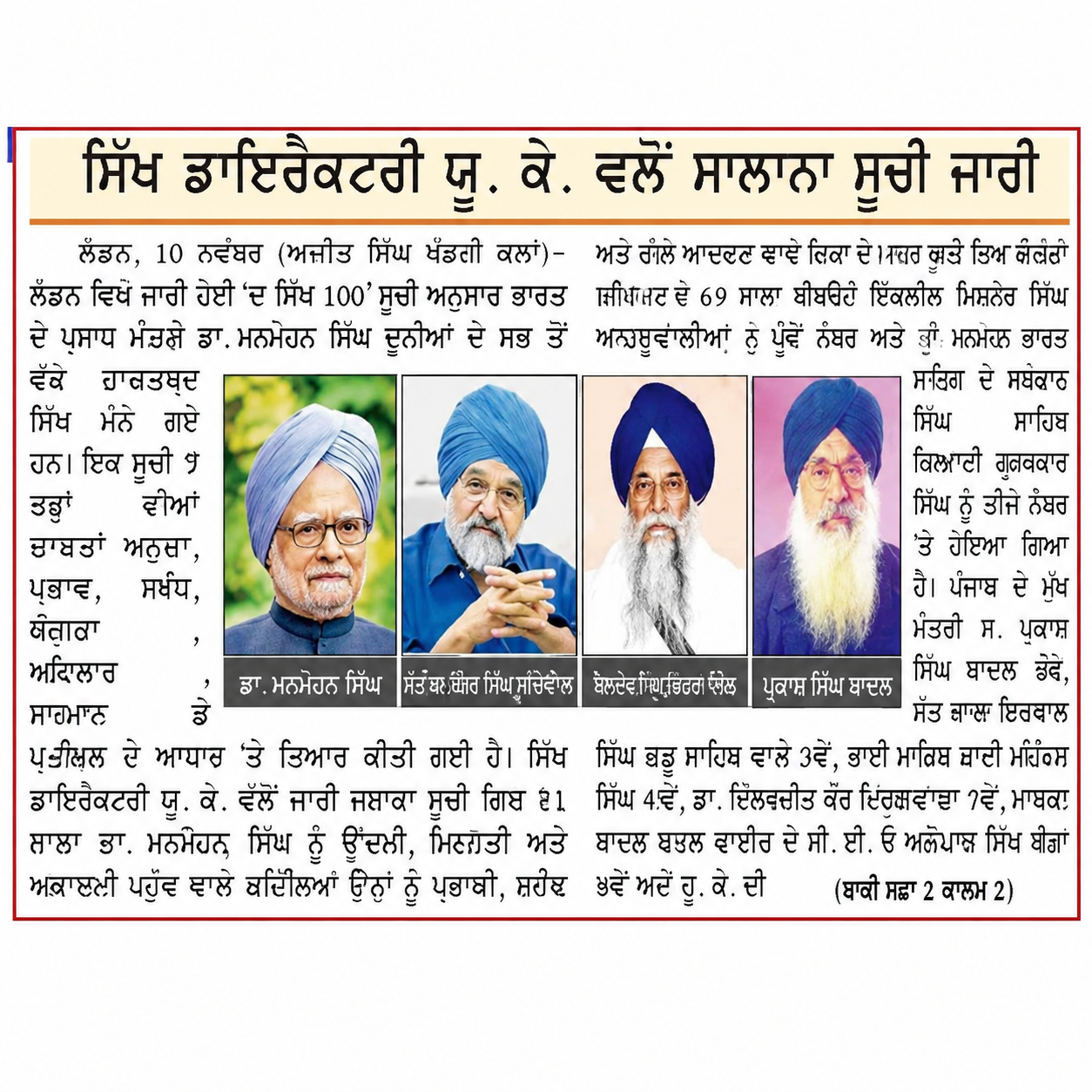
Ajit Baba Iqbal Singh Ji coverage brought international recognition to readers across Punjab after the leading Punjabi daily reported Baba Iqbal Singh Ji’s inclusion in the prestigious Sikh 100 Report published by Sikh Directory UK. The recognition celebrated his lifelong contribution to rural education, humanitarian service and institution building through The Kalgidhar Trust (The Kalgidhar Society), Baru Sahib.

The report introduced Punjabi readers to an international publication that recognised influential Sikh personalities from around the world whose work had created measurable and lasting impact across society. Baba Iqbal Singh Ji’s inclusion reflected decades of dedicated service focused on expanding educational opportunities for children living in villages and underserved communities.

Unlike awards centred on politics or commercial achievement, the Sikh 100 Report acknowledged individuals whose leadership had transformed lives through education, public service, healthcare, philanthropy and community development. Daily Ajit highlighted Baba Iqbal Singh Ji’s recognition as an important milestone because it demonstrated that sustained educational service could receive appreciation far beyond regional and national boundaries.

For readers throughout Punjab, the article represented more than a news report. It documented an occasion when the work of an educationist rooted in rural India received international acknowledgement, reinforcing the importance of education as a foundation for long-term social progress.

Quick Facts

Newspaper Daily Ajit
Country India
Recognition Covered Sikh 100 Report
Published By Sikh Directory UK
Recognised Personality Baba Iqbal Singh Ji
Recognised For Contribution to Rural Education and Humanitarian Service
Organisation The Kalgidhar Trust (The Kalgidhar Society), Baru Sahib
Category International Media Coverage

What Ajit Reported About Baba Iqbal Singh Ji

The Ajit Baba Iqbal Singh Ji article informed readers that Baba Iqbal Singh Ji had been included in the internationally recognised Sikh 100 Report published by Sikh Directory UK. The report brought together distinguished Sikh personalities from different professions whose work had demonstrated exceptional leadership, influence and public contribution.

Daily Ajit explained that the Sikh 100 Report evaluated individuals representing diverse fields including education, governance, business, healthcare, entrepreneurship, public administration, philanthropy and community leadership. Baba Iqbal Singh Ji’s inclusion reflected the growing international appreciation for educational initiatives that had improved access to learning for children living in rural areas.

The newspaper described the recognition as an important achievement because it acknowledged decades of educational service rather than political office or commercial accomplishment. Through its reporting, Ajit highlighted how sustained commitment to education could earn international respect while remaining deeply connected to local communities.

For Punjabi readers, the story also reinforced the importance of educational institutions that continue to strengthen rural society through academic excellence, ethical values and community engagement. The recognition demonstrated that meaningful social contribution often extends beyond geographical boundaries and receives appreciation from global audiences.

Ajit’s coverage served as a bridge between international recognition and local readership, ensuring that people across Punjab became aware of an achievement that reflected positively on educational leadership originating from the region.

Understanding the Sikh 100 Report

The Sikh 100 Report was developed to recognise influential Sikh personalities whose work had created significant impact within their respective fields. Rather than focusing solely on public visibility, the publication considered leadership, service, professional achievement and contribution to society while presenting a diverse representation of the global Sikh community.

Its publication attracted attention from newspapers and media organisations because it documented achievements extending across multiple professions. By recognising educators alongside political leaders, entrepreneurs, healthcare professionals and social reformers, the report highlighted the many ways individuals contribute to the advancement of society.

For Daily Ajit, reporting this recognition provided readers with insight into an international initiative that celebrated excellence beyond regional boundaries. The newspaper’s coverage connected local audiences with a global story while emphasising the importance of educational leadership as a form of lasting public service.

Why Daily Ajit Considered This Story Important

As one of Punjab’s oldest and most influential Punjabi-language newspapers, Daily Ajit has consistently highlighted stories that reflect the achievements, aspirations and social progress of the Punjabi community. Its decision to report Baba Iqbal Singh Ji’s inclusion in the Sikh 100 Report demonstrated that educational leadership deserved recognition alongside accomplishments in politics, business and public life.

For the newspaper’s readers, the story represented more than an international honour. It illustrated how decades of dedicated work in education had earned appreciation on a global platform. By publishing the report, Ajit connected an international recognition with local communities that understood the importance of education in creating opportunities for future generations.

The article also reflected a broader editorial perspective—that meaningful contributions to society are often made quietly through long-term commitment rather than public visibility. Baba Iqbal Singh Ji’s recognition became an example of how service, education and institution building can create influence that extends well beyond geographical boundaries.

Educational Leadership Beyond Recognition

International rankings often celebrate political leaders, industrialists or public personalities. The recognition reported by Daily Ajit highlighted another form of leadership—one built through education, institution building and social responsibility.

Educational institutions influence communities over generations. Their impact is reflected not only in academic achievements but also in the confidence, values and opportunities they provide to students. Media coverage of educational leadership therefore carries significance because it encourages greater public appreciation for the long-term role of education in nation building.

By reporting Baba Iqbal Singh Ji’s recognition, Ajit demonstrated that educators and institution builders also deserve international acknowledgement for creating sustainable social impact.

The Role of Regional Newspapers in Preserving History

Regional newspapers perform an important public service by documenting events that shape the cultural and social history of their communities. Reports published in newspapers such as Daily Ajit become valuable historical references that help future generations understand how significant achievements were recognised during their time.

The coverage of Baba Iqbal Singh Ji’s international recognition illustrates this role clearly. Rather than simply announcing a ranking, the newspaper preserved an important milestone in the history of educational leadership connected with Punjab. Today, the report continues to serve as an archival record for researchers, educators, students and readers interested in the evolution of educational initiatives in the region.

Historical reporting also provides context that extends beyond the original news event. It enables readers to appreciate why particular achievements attracted attention and how those achievements contributed to wider discussions about education, community development and public service.


International Recognition and Community Pride

When individuals working within local communities receive international recognition, the achievement often becomes a shared source of pride. Daily Ajit’s coverage reflected this perspective by presenting Baba Iqbal Singh Ji’s recognition as an accomplishment that resonated with readers across Punjab.

The report demonstrated that educational initiatives developed within India could earn appreciation beyond national borders. Such recognition encourages confidence in locally driven solutions to social challenges while inspiring educators, students and community organisations to continue investing in quality education.

For many readers, the story also reinforced the idea that lasting influence is measured by positive contributions to society rather than public prominence alone. This message remains relevant today as educational institutions continue working to expand opportunities for future generations.

Why This Historical Coverage Still Matters Today

Although the news was originally published more than a decade ago, its historical value has only increased with time. Media archives allow researchers and readers to revisit important milestones and understand how educational achievements were recognised within their historical context.

Daily Ajit’s report continues to provide insight into how international recognition of educational leadership was received by Punjabi readers. It also illustrates the enduring relationship between journalism and public memory, where newspapers preserve achievements that might otherwise fade from public awareness.

For students of media, history and education, articles such as this offer valuable evidence of how regional journalism documents contributions that shape society over the long term. They demonstrate that newspapers not only report current events but also help build a lasting historical record.

Timeline

  • 1986: Baba Iqbal Singh Ji began his educational mission at Baru Sahib following his retirement from public service.
  • 2013: Sikh Directory UK published the inaugural Sikh 100 Report recognising influential Sikh personalities worldwide.
  • 2013: Daily Ajit reported Baba Iqbal Singh Ji’s inclusion in the Sikh 100 Report.
  • Present Day: The newspaper coverage continues to serve as an important historical reference documenting international recognition of educational leadership.

Frequently Asked Questions

Why did Daily Ajit report Baba Iqbal Singh Ji’s recognition?

Daily Ajit considered the recognition newsworthy because it highlighted an educationist from India who had earned international appreciation through his contribution to rural education and humanitarian service. The report reflected the growing importance of educational leadership within the global Sikh community.

What is the Sikh 100 Report?

The Sikh 100 Report, published by Sikh Directory UK, recognises influential Sikh personalities whose work has made a meaningful contribution to society across fields such as education, public service, business, healthcare, entrepreneurship and community leadership.

Who is Baba Iqbal Singh Ji?

Baba Iqbal Singh Ji was an educationist, humanitarian and founder of The Kalgidhar Trust (The Kalgidhar Society), Baru Sahib. His work focused on expanding access to quality, value-based education for children living in rural and underserved communities.

Why is this Daily Ajit article historically important?

This report preserves an important historical moment when an international recognition received by Baba Iqbal Singh Ji was presented to Punjabi readers through one of the region’s leading newspapers. It remains part of the historical media record documenting educational leadership.

How does this recognition differ from other awards?

The recognition highlighted educational and humanitarian service rather than political authority or commercial success. It acknowledged long-term social impact created through education and community development.

Why do historical newspaper reports remain valuable?

Historical newspaper coverage provides contemporary evidence of important events, helping researchers, students and future generations understand how achievements were recognised when they occurred.

What role does regional journalism play in preserving history?

Regional newspapers document achievements that shape local communities and become valuable historical archives. Their reporting helps preserve milestones that contribute to the broader history of education, culture and public life.

Why is this article still relevant today?

The article continues to demonstrate how education, ethical leadership and sustained public service receive international appreciation. It also highlights the important role newspapers play in documenting achievements that influence future generations.


Historical Note

This page is based on historical media coverage originally published by Daily Ajit. The content has been expanded to provide additional historical context while preserving the purpose of the original report. It forms part of the media archive documenting significant milestones associated with Baba Iqbal Singh Ji and educational leadership.


Related Resources


References

  • Daily Ajit – Historical newspaper coverage.
  • Sikh Directory UK – Sikh 100 Report.

Conclusion

The coverage published by Daily Ajit remains an important historical record documenting the international recognition received by Baba Iqbal Singh Ji through the Sikh 100 Report. By presenting the story to readers across Punjab, the newspaper highlighted the wider significance of educational leadership and demonstrated that contributions made through service and institution building can receive appreciation on a global platform.

Beyond the recognition itself, the article reflects the enduring role of regional journalism in preserving milestones that shape public memory. Newspaper archives continue to provide valuable historical insight into how educational achievements were recognised and celebrated, ensuring that future generations can better understand the evolution of educational leadership and social development.

Today, this coverage serves not only as a record of an international honour but also as a reminder that education, ethical leadership and community service remain among the most enduring forms of public contribution. The article continues to hold relevance for readers interested in the history of education, media, rural development and the preservation of important milestones through responsible journalism.

Baba Iqbal Singh Ji Ranked World’s 5th Most Powerful Sikh in Sikh 100 Report

Baba Iqbal Singh Ji Ranked World’s 5th Most Powerful Sikh

Baba Iqbal Singh Ji, the founder of The Kalgidhar Trust (The Kalgidhar Society), Baru Sahib, received international recognition when he was ranked the World’s 5th Most Powerful, Influential and Contemporary Sikh in the inaugural Sikh 100 Report, published by Sikh Directory UK on 12 November 2013. The recognition honoured his extraordinary contribution to rural education, humanitarian service, value-based leadership, and social transformation.

For millions of people associated with The Kalgidhar Trust, this recognition represented much more than an international ranking. It acknowledged decades of selfless service dedicated to empowering rural communities through education and reflected the global impact of Baba Iqbal Singh Ji’s lifelong mission of creating socially responsible citizens.


Table of Contents


International Recognition

The recognition of Baba Iqbal Singh Ji in the Sikh 100 Report brought international attention to one of India’s most remarkable educational movements. The report ranked him among the world’s most influential contemporary Sikhs based on leadership, public service, humanitarian contribution, influence, achievements, integrity and long-term impact on society.

Unlike many global recognitions that focus on political influence or commercial success, this honour highlighted a lifetime dedicated to serving humanity through education. Baba Iqbal Singh Ji demonstrated that lasting influence is created by transforming lives rather than seeking personal recognition.


About the Sikh 100 Report

The Sikh 100 Report, published by Sikh Directory UK, was introduced as one of the first international publications dedicated to recognising influential Sikhs from around the world. The report evaluated individuals from diverse fields including education, public service, business, healthcare, philanthropy, academia and community leadership.

The assessment considered multiple factors including leadership, effectiveness, influence, conduct, capabilities, achievements, honours and the positive impact individuals created within society. Baba Iqbal Singh Ji’s inclusion among the world’s leading Sikh personalities reflected the scale and significance of his contribution to education and social development.


The Vision of Baba Iqbal Singh Ji

Before dedicating himself entirely to education, Baba Iqbal Singh Ji served as the Director of Agriculture in the Government of Himachal Pradesh. After retirement, rather than choosing a comfortable life, he moved to Baru Sahib with a vision of transforming rural India through quality education rooted in ethical values.

His educational philosophy was inspired by the teachings of Sant Attar Singh Ji and Sant Teja Singh Ji, who believed that modern scientific education should be integrated with spirituality, discipline, compassion and character development.

Baba Ji firmly believed that education should prepare students not only for successful careers but also for responsible citizenship and selfless service to humanity. This vision continues to define every institution established under The Kalgidhar Trust.


The Kalgidhar Trust’s Educational Mission

Under Baba Iqbal Singh Ji’s leadership, The Kalgidhar Trust (The Kalgidhar Society) grew from a single educational institution into one of India’s largest rural education movements.

Today, the organisation serves society through:

  • 130 Akal Academies across rural North India
  • More than 75,000 students
  • Akal University, Talwandi Sabo
  • Eternal University, Baru Sahib
  • Teacher education programmes
  • Healthcare initiatives
  • Women empowerment programmes
  • Community development projects

The Trust focuses on providing affordable, value-based education to children from farming families, economically weaker sections and underserved rural communities. Students are encouraged to develop academic excellence alongside leadership, compassion, integrity and social responsibility.

Thousands of graduates from institutions established by The Kalgidhar Trust have gone on to become doctors, engineers, teachers, researchers, civil servants, entrepreneurs, defence personnel and professionals serving communities across India and around the world.


The Significance of This Recognition

The recognition of Baba Iqbal Singh Ji as the World’s 5th Most Powerful Sikh serves as an international acknowledgement of the transformative power of education. His life’s work demonstrates that investing in children, particularly those from rural and disadvantaged backgrounds, creates lasting social change.

Beyond academic achievement, the institutions founded under his leadership have helped address social challenges including illiteracy, gender inequality, poverty and substance abuse by empowering young people with knowledge, values and opportunities.

His leadership has inspired thousands of educators, volunteers, donors and supporters who continue contributing to the mission of transforming lives through education.


Continuing the Legacy

Today, The Kalgidhar Trust continues to expand Baba Iqbal Singh Ji’s vision through innovative educational initiatives, digital learning, scholarships, healthcare services and rural development programmes.

The organisation remains committed to making quality education accessible to every child, regardless of financial circumstances. Through initiatives such as Educate To Save, thousands of children receive educational support from donors committed to creating brighter futures.

More than a decade after the Sikh 100 recognition, Baba Iqbal Singh Ji’s legacy continues to inspire educational institutions, social organisations and community leaders worldwide. His work stands as a reminder that humility, service and education have the power to transform generations.


Frequently Asked Questions

Who was Baba Iqbal Singh Ji?

Baba Iqbal Singh Ji was the founder of The Kalgidhar Trust (The Kalgidhar Society), Baru Sahib, and a visionary educationist dedicated to transforming rural India through value-based education.

Why was Baba Iqbal Singh Ji recognised in the Sikh 100 Report?

He was recognised for his lifelong contribution to rural education, humanitarian service, leadership and social transformation through The Kalgidhar Trust.

What is the Sikh 100 Report?

The Sikh 100 Report is an international publication recognising influential contemporary Sikhs who have made exceptional contributions to society across various fields.

What is The Kalgidhar Trust?

The Kalgidhar Trust (The Kalgidhar Society), headquartered at Baru Sahib, Himachal Pradesh, is a non-profit organisation working in education, healthcare, women empowerment and community development.

How many educational institutions does The Kalgidhar Trust operate?

Today, the organisation operates 130 Akal Academies, Akal University, Eternal University and several educational and social development initiatives serving more than 75,000 students.


Learn More

To learn more about Baba Iqbal Singh Ji, The Kalgidhar Trust, Akal Academies and other educational initiatives, explore the following resources:


Historical Note: This article documents the international recognition announced in 2013. It has been updated with current information about The Kalgidhar Trust (The Kalgidhar Society) to provide readers with historical context alongside the organisation’s continuing mission and impact.

The Man Who Was Everything — And Claimed Nothing

Forty-one moments. Forty-one lessons. And I have barely scratched the surface. I set out to document what Babaji taught me. What I ended up documenting was how little I understood — and how vast he was. He sat on a mattress on the floor and handed me the only equation that ever mattered: Man − […]

Forty-one moments. Forty-one lessons. And I have barely scratched the surface.

I set out to document what Babaji taught me. What I ended up documenting was how little I understood — and how vast he was.

He sat on a mattress on the floor and handed me the only equation that ever mattered: Man − Ego = God.

He sat in the back of a car on a rain-soaked highway and told me happiness has an inverse law — and that Alexander the Great died proving it.

He called us roosters when we fought like fools. He called us monkeys when our minds wouldn’t sit still. And somehow, both scoldings felt like blessings.

He told a fighter pilot’s story to teach me never to judge a slow colleague. He told Bulleh Shah’s story to expose the only freedom worth having. He told Alexander’s story to cure me of greed. He never needed a textbook — the universe was his library.

He spoke in plain Punjabi and dismantled management theories that business schools charge lakhs to teach. Tell them why, not just what. Hire the character — the skills will follow. A lame horse can’t run a long race. Harvard would have given him an honorary doctorate. He would have declined it, laughing.

He convinced a bank to lend to a Trust — with one line about CAPEX and OPEX that he never used the words for. He pre-empted the 2008 global recession from the back seat of a car heading to Baru Sahib — months before India’s economists saw it coming.

He created a 35% subsidy for the girl child because he noticed a farmer’s daughter in a flowery suit while her brother wore the Akal Academy uniform. Two questions. One car ride. A policy that changed thousands of lives.

He pried open my clenched fists when I wanted to wage war on my former partners — and four years later, they came bowing with every penny. He told my hysterical wife on the worst night of our lives: Bharosey de bede paar ne — and a drug that didn’t exist in any supplier’s inventory appeared before we reached the hospital.

He told a trembling young engineer that working for the mission was Guru Nanak di naukri — blessings and a paycheque, both at once.

He told a young man that you don’t fall in love — you rise in it.

He told a woman with aching knees to stop spending her spiritual capital on what paracetamol could fix.

He told a sevadar in a white chola craving soya chaaps: Either become a sadhu, or stay a slave to your tongue.

He told a Major General looking for a chair: Where we hang, you hang too.

He called a senior sevadar moorkha — and then taught me, hours later on a highway, that the rougher the word, the deeper the love.

He saw me sneak away an unfinished plate of food in Cuttack — when I was absolutely certain his eyes were elsewhere — and gently shamed me into a promise I have kept at every meal since.

He taught me that elections are cancer and selection is the cure. That Dasvandh is the gateway to everything. That a closed fist catches nothing — not even blessings. That what you stare at, you become. That a double mind is a troubled mind. That the only account that carries over to the next life is your spiritual capital.

And he never once — not once — claimed to be anything.

Not a CEO. Not a strategist. Not an economist. Not a visionary. Not a mind-reader. Not a healer.

He was all of these. And none of these. Because the moment you tried to put him in a box, he had already overflowed it.

He was a retired government officer who built 130 schools. A Jagirdaar’s son who became a Faqeer — Fanaah, Kinaarey, Rehamdil. A man who asked banks for loans in the morning and recited Gurbani at night. A man who read geopolitics, understood colour psychology, quoted Sufi poets, debated science with a science graduate — and won every time, not with arguments, but with truth so simple it left you speechless.

He was the best leader I have ever seen — because he never led from the front. He led from a mattress.

He was the best teacher I have ever had — because he never lectured. He lived.

He was the best father I never had — because every scolding was a prayer and every silence was a lesson.

I started this series to share his words with the world. But somewhere along the way, I realized — these words were never meant for the world. They were meant for *me*. Each one, hand-delivered, precisely timed, surgically placed into a moment when my soul needed it most.

I was just the fool who happened to be sitting in the room. On the mattress. In the car. At the airport gate. In the side room. On the highway.

And he — the wise old sage in white — was just sitting there. Being everything. Claiming nothing.

Babaji, wherever you are — and I know you are everywhere — your equations still sit in my chest. Not in a notebook. Never in a notebook.

ਜੇ ਲਿਖਣਾ ਪਵੇਗਾ ਤੇ ਰਹਿਣ ਦੋ।

I didn’t write them down, Babaji. I lived them. Or at least, I never stopped trying.

This series was my shukar. My thank you. My attempt to repay a debt that can never be repaid.

For every reader who followed along — these were not posts. They were Ardaas in ink for my Father, Mentor, Spiritual Guide, Friend, and not the least, my world. 🙏

Nirgunn

#LessonsFromASaint #BabajisWords #100Years #BaruSahib #BabaIqbalSinghJi

Kisan Mela at Eternal University: Empowering Farmers with Technology

Agricultural research and development can improve the quantity and quality of farm products. Still, the real benefits will be felt once the farming community can access the developed technology. With this aim, a Kisan Mela is being organized at Eternal University on 12- 13 April 2023. This Kisan Mela will provide a platform for farmers […]

Agricultural research and development can improve the quantity and quality of farm products. Still, the real benefits will be felt once the farming community can access the developed technology. With this aim, a Kisan Mela is being organized at Eternal University on 12- 13 April 2023.

This Kisan Mela will provide a platform for farmers and agro-industrialists to exchange ideas and spread the most recent agricultural technology and advancements.

kisan Mela baru sahib dr khem singh

About the Organizers

Dr. Khem Singh Gill Akal College of Agriculture at Eternal University, Baru Sahib, carries out a lot of research work at experimental farms and laboratories, which need to reach the user end, i.e., the farming community. With the help of ‘Sikhs in Sewa of Humanity’, Eternal University is organizing the Kisan Mela 2023.

The Kisan Mela will be held at Eternal University, Baru Sahib. The event will showcase various extension agencies, such as Krishi Vigyan Kendra (KVK) and Farm Advisory Service Scheme (FASS), working to disseminate the latest agricultural technology to farmers.

The Need to Have Such a Kisan Mela

Kisan Melas or agricultural fairs provide a platform for farmers to showcase their produce, learn about new farming techniques, and interact with experts in the field. It is an convenient platform for farmers to connect with buyers, suppliers, and other stakeholders in the industry.
Given the importance of agriculture in our lives, it is essential to have Kisan Melas regularly to provide farmers with the resources they need to grow their businesses and contribute to the overall development of the country

kisan Mela baru sahib visit

Objectives of Kisan Mela:

With special reference to agroecological situation in Himachal Pradesh, the Kisan Mela will focus on local and regional-based agrarian technology.

A solution to Farmers’ Queries

The main objective of the Kisan Mela is to provide farmers with a platform to get answers to all of their queries and seek expert advice.

Motivating Farmers

The Kisan Mela will attempt to inspire farmers to adopt cutting-edge agricultural practices that can boost their output and profitability. The agro-industrial exhibits are a great way to promote and encourage farmers to use the most recent technologies.

Promoting Value-based agri-products:

The Kisan Mela will also attempt to encourage crop farmers to compete and promote value-based agri-products. It enables farmers to compete fairly and inspires them to grow premium commodities that sell for high prices.

kisan Mela baru sahib student

Exciting Events and Activities at the Kisan Mela

The Kisan Mela will have several events and activities that will help farmers learn about the latest technology, including:

Seed sale at subsidized rates: The Kisan Mela will allow the farmers to acquire high-quality seeds at subsidized rates which will help them to improve their yields and increase their profitability.

Agro-industrial exhibition: The agro-industrial exhibition at the Kisan Mela will display the latest technology and agricultural tools. Farmers can learn about new farm machinery and methods during the event, which can help them become more productive.

Discovering the Antiquity of Agriculture: The famers will have an opportunity to visit to agri-farm and crop museum at Baru Sahib.

Food processing and agri-farm equipment demonstration feature the most up-to-date machinery and technology farmers can use to process their agricultural output. Farmers may benefit from this by having their products last longer and wasting less.

Promoting Organic farming/natural farming: The Eternal University Kisan Mela promoted organic farming, which produces healthier and sustainable products by reducing the use of chemicals and pesticides.

kisan Mela baru sahib guest

Grain storage and a cooling system for fruit and vegetable respiration: Grain Storage is also essential for farmers. The Kisan Mela will also provide how the farmers can store their produce for extended periods.

Question-answer session: It is essential to feature that farmers can get their queries solved on the spot by experts from various fields.

Participation in Self-help groups and Nehru Yuva Kendra:The Kisan Mela will provide a platform to the farmers interact and share their experiences with others as of Self Help Groups and Nehru Yuva Kendra are also participating in the Kisan Mela.

Attractive Features at the Kisan Mela

  • Banks personnel will be available to solve the queries for loan applications.
  • Stalls by various departments of Eternal University and the state department agriculture
  • Produce competition of farmers through agri-products
  • Transportation facility for the local farmers
  • Meal for farmers and employees of departments
  • Display of pesticides/insecticides by leading companies
  • Farmers are provided with herbicides, insecticides, and fungicides at discounted prices.
  • Honorarium to officials and field personnel
  • Consolation gift to various participating departments.
  • Dabur India will be graciously supporting the event and Vaisakhi celebrations, by distributing nutritional juices for all the participants. We are Thankful for their generous gesture.

The Eternal University Kisan Mela is an excellent platform for farmers to learn about the latest agriculture technologies and improve their abilities. The event will allow farmers to learn about the newest technologies, compete, and market value-based agricultural products. The Kisan Mela will ensure that agricultural technology is accessible and valuable to the farming community.

Join Us, and share the good work too


The Kalgidhar Trust, Baru Sahib unanimously selects Dr. Davinder Singh as its next President

Shimla, 30 January Following the sad demise of Padma Shri, Shiromani Panth Ratan Baba Iqbal Singh Ji on 29 January, Dr. Davinder Singh (affectionately called Dr Veerji) has been unanimously selected as the next President of the Trust. Dr. Davinder Singh’s journey with Baba Ji began 35 years ago when he left his profession as […]

Shimla, 30 January

Following the sad demise of Padma Shri, Shiromani Panth Ratan Baba Iqbal Singh Ji on 29 January, Dr. Davinder Singh (affectionately called Dr Veerji) has been unanimously selected as the next President of the Trust.

Dr. Davinder Singh’s journey with Baba Ji began 35 years ago when he left his profession as a Medical Specialist (Internist Physician) at Maulana Azad Medical College, Delhi to fulfil his desire to volunteer and serve humanity at Baru Sahib. He devoutly followed every direction of Baba Ji as a divine blessing.

Dr. Davinder Singh said, “I am grateful to all the saints and well-wishers who came to attend the cremation ceremony of Late Sant Baba Iqbal Singh Ji. Baba Ji’s life is an example of ‘Gursikhi’ in true sense, a great inspiration for me and other volunteers of the Trust. I remember that even with a high fever of 103 degree, Baba Ji never missed paying obeisance at Gurdwara Sahib for his morning prayers; and he inculcated the same values in all children. I am a very insignificant Sevadar of Baba Ji; I don’t know how much I can serve; but with the blessings of Guru Sahibaans, Sangat and everyone here, we will continue to serve mankind with value-based education and healthcare services. Baba Ji had always great faith in the next generation to take charge with even greater dedication. Such was the greatness of our beloved Baba Ji.”

Under Baba Ji’s guidance and leadership, The Kalgidhar Trust was able to grow from 17 Akal Academies to 117 Academies in just 10 years.

The ceremony was held in the Gurdwara Sahib after performing the last rites followed with Ardaas. Head Granthi of Sri Akal Takht Sahib Giani Malkit Singh Ji, along with other dignitaries and Trustees of The Kalgidhar Trust, blessed Dr. Davinder Singh with Siropao and announced him as the next President of the Trust. The remains of Late Sant Baba Iqbal Singh Ji will be preserved at Baru Sahib.

Dr. Davinder Singh Ji also the Vice-Chancellor, Eternal University, Baru Sahib; Member of Governing Body of Akal University, Talwandi Sabo; and Director, Akal Academies, a chain of 129 rural schools being run by The Kalgidhar Trust.

Dr. Davinder Singh obtained the degree of Doctor of Medicine from Maulana Azad Medical College, Delhi University in 1983. As he had decided to dedicate himself in the services of Baba Ji towards the noble cause of rural education revolution, Dr. Davinder Singh Ji obtained the degree of Bachelor of Education from Maharishi Dayanand University, Rohtak in 1994.

For his contribution in the field of education, Dr. Davinder Singh Ji was honoured with ‘Dr. S. Radhakrishnan Memorial National Teacher Award’ in 2006.

Prakash Purab of Sri Guru Gobind Singh Ji

Guru Gobind Singh Ji was born in 1666 to Ninth Master Sri Guru Tegh Bahadar Ji and Mata Gujri Ji at Patna in Bihar as Gobind Rai. According to the instructions of his martyred Father, Gobind Rai at the age of 9 was bestowed with the Guruship by the holy congregation. Guru Gobind Rai Ji […]

Guru Gobind Singh Ji was born in 1666 to Ninth Master Sri Guru Tegh Bahadar Ji and Mata Gujri Ji at Patna in Bihar as Gobind Rai.

According to the instructions of his martyred Father, Gobind Rai at the age of 9 was bestowed with the Guruship by the holy congregation.

Guru Gobind Rai Ji was married to Mata Jeeto Ji and had two sons Baba Ajit Singh Ji and Baba Jujhar Singh Ji. A year after the demise of Mata Jeeto Ji, the young Guru bowed to the persistent pleading of His mother Mata Gujri Ji and Sikh Congregation (Sangat), to enter into the holy wedlock with Mata Sundri Ji and had two sons Baba Zorawar Singh Ji in the year 1696, and Baba Fateh Singh Ji in the year 1699.

Mata Sahib Devan was not married to the Guru in the worldly sense, but her spiritual union with Him was so complete that He honored her with the title of Jagat Mata (Mother of the Khalsa Panth) and placed the entire Khalsa brotherhood in her lap.

On Vaisakhi Day, in 1699 at Anandpur Sahib, Guru Ji founded the ‘Khalsa Panth’ by blessing the Sikhs with divine Nectar (Amrit).

Guru Gobind Singh Ji took up arms in his crusade (Dharam Yudh) against tyranny unleashed on the poor belonging to the religions other than of the ruling class. He fought 14 major and minor battles and won all these but refrained from seizing even a square inch of enemy territory. Guru Ji was never the aggressor in any of these battles but always defended to protect the poor and downtrodden.

He fought the holy wars (Dharam Yudhas) only to put an end to the brutal oppression of the downtrodden by the selfish and cruel rulers.

Guru Ji introduced a unique way of Holi, which was in keeping with the glorious traditions of the holy-minded, brave, and freedom-loving Sikh nation. The devotees would gather in the morning for meditation and recitation of the hymns. The evenings would be given over to display the swordsmanship and equestrian contests as also other martial sports.

In 1704, the entire Mughal Force, allied by the forces of the hill states under the command of the Governor of Sirhind, laid siege around the fort of Anandpur Sahib for eight months. The food supplies in the fort ran out. Sikhs were trapped inside. When the Mughal forces failed to capture the fort, even after blocking the food supplies, Aurangzeb wrote a letter to Guru Gobind Singh Ji by swearing on the Quran that if the Guru vacated the fort, his forces would be granted a safe passage out to settle at some other place. Mata Gujri Ji and a few weak-minded Sikhs persuaded Guru Gobind Singh Ji to leave the fort as Aurangzeb had given the assurance by swearing on the Quran. However, the Guru replied to the mother that the Mughal Emperor would back out even after swearing on the Quran. When the mother instructed her son to obey her as a devout son, Guru Gobind Singh Ji bowed before her instructions and left the fort of Anandpur Sahib with family and followers. Exactly what the Guru had perceived, did happen. The Mughal forces did not care about the vows on the Quran by their Emperor and attacked the Guru, his followers, and his family. There was a pitched battle on the banks of river Sirsa.

While they were crossing river Sirsa, in the ensuing confusion, the Guru’s two younger sons, Baba Zorawar Singh and Baba Fateh Singh along with their grandmother, got separated from the Guru and reached the village Morinda.

Guru Ji’s two elder Sahibzaade Baba Ajit Singh Ji and Baba Jujhar Singh Ji attained Martyrdom while fighting in the Battle of Chamkaur and younger Sahibzaade Baba Zorawar Singh Ji and Baba Fateh Singh Ji attained Martyrdom when they were bricked alive at Sirhind.

Guru Gobind Singh Ji dictated the whole Granth Sahib to Bhai Mani Singh, the devoted Sikh, and included the hymns of Guru Tegh Bahadur Ji at the appropriate places and compiled a complete Granth Sahib.

Guru Gobind Singh Ji’s composition is written in Dasam Granth Sahib, it includes Jaap Sahib, Tevye Prasad Sawaiye, Chuapai Sahib which are part of daily prayer (Nitnem).

Guru Gobind Singh Ji decreed that the physical body of a human was never a Guru. Before shedding his mortal frame, Guru Ji decreed that after him, till eternity, the Granth Sahib would be the Guru Eternal. Thus, the Guru conferred Guruship on the Granth Sahib, and Sikhs were enjoined to seek the divine instructions from it for gritting rid of their ego and merge with the Divine by reciting the hymns of Guru Granth Sahib Ji, the Guru Eternal.

________________________________________________

ਮਰਦ ਅਗੰਮੜੇ ਦਸਮੇਸ਼ ਪਿਤਾ ਸ੍ਰੀ ਗੁਰੂ ਗੋਬਿੰਦ ਸਿੰਘ ਜੀ ਦੇ ਪ੍ਰਕਾਸ਼ ਦਿਹਾੜੇ ਦੀ ਸੰਗਤ ਨੂੰ ਵਧਾਈ

ਸਰਬੰਸਦਾਨੀ, ਦਸਮੇਸ਼ ਪਿਤਾ ਸ੍ਰੀ ਗੁਰੂ ਗੋਬਿੰਦ ਸਿੰਘ ਜੀ ਦੀ ਨੂਰਾਨੀ, ਅਗੰਮੀ, ਅਦੁੱਤੀ, ਬਾਦਸ਼ਾਹ ਦਰਵੇਸ਼ ਅਤੇ ਅਜ਼ੀਮ ਸ਼ਖ਼ਸੀਅਤ ਦੁਨੀਆਂ ਦੇ ਇਤਿਹਾਸ ਵਿਚ ਸਭ ਤੋਂ ਨਿਰਾਲੀ ਅਤੇ ਵਿਲੱਖਣ ਹੈ। ਸ੍ਰੀ ਗੁਰੂ ਗੋਬਿੰਦ ਸਿੰਘ ਜੀ ਸਬਰ, ਸਹਿਜ, ਸਿਦਕ, ਦ੍ਰਿੜ੍ਹਤਾ, ਸਾਹਸ ਅਤੇ ਚੜ੍ਹਦੀ ਕਲਾ ਦੇ ਅਨੂਠੇ ਮੁਜੱਸਮੇ ਸਨ। ਸ੍ਰੀ ਗੁਰੂ ਗੋਬਿੰਦ ਸਿੰਘ ਜੀ ਦਾ ਪ੍ਰਕਾਸ਼ ਸ੍ਰੀ ਪਟਨਾ ਸਾਹਿਬ, ਬਿਹਾਰ, (ਮੌਜੂਦਾ ਤਖਤ ਸ੍ਰੀ ਪਟਨਾ ਸਾਹਿਬ), ਪੋਹ ਸੁਦੀ ਸਤਮੀ ਸੰਮਤ 1723 (1666 ਈ.) ਨੂੰ ਪਿਤਾ ਸ੍ਰੀ ਗੁਰੂ ਤੇਗ ਬਹਾਦਰ ਅਤੇ ਮਾਤਾ ਗੁਜਰੀ ਜੀ ਦੇ ਗ੍ਰਹਿ ਵਿਖੇ ਹੋਇਆ।

ਸ੍ਰੀ ਗੁਰੂ ਗੋਬਿੰਦ ਸਿੰਘ ਜੀ ਦਾ ਸਮੁੱਚਾ ਸੰਸਾਰਕ ਜੀਵਨ ਹਰ ਪੱਖੋਂ ਅਚੰਭਿਤ ਕਰਨ ਵਾਲਾ ਹੈ। ਆਪ ਜੀ ਨੇ 9 ਸਾਲ ਦੀ ਉਮਰ ਵਿਚ ਆਪਣੇ ਪਿਤਾ ਸ੍ਰੀ ਗੁਰੂ ਤੇਗ ਬਹਾਦਰ ਸਾਹਿਬ ਜੀ ਨੂੰ ਦੂਜੇ ਧਰਮ ਦੀ ਰੱਖਿਆ ਖਾਤਰ ਕੁਰਬਾਨੀ ਦੇਣ ਲਈ ਭੇਜਿਆ। ਸ੍ਰੀ ਗੁਰੂ ਤੇਗ ਬਹਾਦਰ ਜੀ ਦੀ ਸ਼ਹਾਦਤ ਤੋਂ ਪਿੱਛੋਂ 1675 ਈ. ਵਿਚ 9 ਸਾਲ ਦੀ ਉਮਰ ਵਿਚ ਆਪ ਜੀ ਨੂੰ ਸ੍ਰੀ ਗੁਰੂ ਨਾਨਕ ਜੋਤ ਦੇ ਦਸਵੇਂ ਸਰੂਪ ਦੇ ਰੂਪ ਵਿਚ ਗੁਰਿਆਈ ਪ੍ਰਾਪਤ ਹੋਈ।

ਸਿਰਫ਼ 42 ਸਾਲ ਦੀ ਉਮਰ ਤਕ ਉਨ੍ਹਾਂ ਨੇ ਸ੍ਰੀ ਗੁਰੂ ਨਾਨਕ ਦੇਵ ਜੀ ਦੇ ਅਰੰਭ ਕੀਤੇ ਸਿੱਖ ਧਰਮ ਦੇ ਕ੍ਰਾਂਤੀਕਾਰੀ ਦਾਰਸ਼ਨਿਕ ਸਿਧਾਂਤਾਂ ਨੂੰ ਤੀਬਰਤਾ ਨਾਲ ਸਿਖਰ ‘ਤੇ ਪਹੁੰਚਾਇਆ। ਸ੍ਰੀ ਗੁਰੂ ਗੋਬਿੰਦ ਸਿੰਘ ਜੀ ਇਕ ਮਹਾਨ ਜਰਨੈਲ, ਉੱਚ ਕੋਟੀ ਦੇ ਵਿਦਵਾਨ, ਅਜ਼ੀਮ ਸਾਹਿਤਕਾਰ, ਗੁਰਬਾਣੀ ਸੰਗੀਤ ਦੇ ਰਸੀਏ, ਸਰਬੰਸਦਾਨੀ, ਅੰਮ੍ਰਿਤ ਦੇ ਦਾਤੇ, ਭਗਤੀ ਅਤੇ ਸ਼ਕਤੀ ਦੇ ਮੁਜੱਸਮੇ, ਮਰਦ-ਏ-ਮੈਦਾਨ ਅਤੇ ਮਹਾਨ ਸੂਰਬੀਰ ਸਨ। ਉਹ ਸ਼ਸਤਰ ਅਤੇ ਸ਼ਾਸਤਰ ਦੇ ਧਨੀ, ਸੰਤ-ਸਿਪਾਹੀ, ਸਾਹਿਬ-ਏ-ਕਮਾਲ, ਮਰਦ ਅਗੰਮੜੇ, ਦੁਸ਼ਟ ਦਮਨ, ਅੰਮ੍ਰਿਤ ਕੇ ਦਾਤੇ ਸਨ।

ਗੁਰੂ ਸਾਹਿਬ ਜੀ ਨੇ ਪਾਖੰਡਵਾਦ ਅਤੇ ਕਰਮ-ਕਾਂਡਾਂ ਦਾ ਖੰਡਨ ਕੀਤਾ ਅਤੇ ਲੋਕਾਈ ਨੂੰ ਉੱਤਮ ਜੀਵਨ ਦੇ ਧਾਰਨੀ ਹੋਣ ਦੀ ਪ੍ਰੇਰਨਾ ਕੀਤੀ। ਉਨ੍ਹਾਂ ਉਪਦੇਸ਼ ਕੀਤਾ ਕਿ ਮੂਰਤੀ-ਪੂਜਾ, ਬੁੱਤ-ਪੂਜਾ, ਤੀਰਥ ਯਾਤਰਾ ਜਾਂ ਸਮਾਧੀਆਂ ਨਾਲ ਅਕਾਲ ਪੁਰਖ ਦੀ ਪ੍ਰਾਪਤੀ ਨਹੀਂ ਹੋ ਸਕਦੀ।

ਸ੍ਰੀ ਗੁਰੂ ਗੋਬਿੰਦ ਸਿੰਘ ਜੀ ਨੇ ਮਨੁੱਖਤਾ ਨੂੰ ਸੁਖੀ ਵੇਖਣ ਲਈ ਆਪਣਾ ਸਾਰਾ ਪਰਿਵਾਰ ਵਾਰ ਦਿੱਤਾ। ਇਸੇ ਲਈ ਆਪ ਜੀ ਨੂੰ ਸਰਬੰਸਦਾਨੀ ਆਖਿਆ ਜਾਂਦਾ ਹੈ। ਆਪ ਜੀ ਨੇ ਚਮਕੌਰ ਸਾਹਿਬ ਦੀ ਜੰਗ ਅੰਦਰ ਆਪਣੇ ਵੱਡੇ ਸਾਹਿਬਜ਼ਾਦਿਆਂ ਨੂੰ ਆਪਣੇ ਹੱਥੀਂ ਤਿਆਰ ਕਰਕੇ ਸ਼ਹਾਦਤ ਲਈ ਤੋਰਿਆ। ਛੋਟੇ ਸਾਹਿਬਜ਼ਾਦਿਆਂ ਅਤੇ ਮਾਤਾ ਗੁਜਰੀ ਜੀ ਦੀ ਸ਼ਹਾਦਤ ਪਿੱਛੋਂ ਵੀ ਆਪ ਨੇ ਪਰਮਾਤਮਾ ਦਾ ਸ਼ੁਕਰ ਅਦਾ ਕੀਤਾ।

ਸ੍ਰੀ ਗੁਰੂ ਗੋਬਿੰਦ ਸਿੰਘ ਸਾਹਿਬ ਜੀ ਨੇ ਸਾਰਾ ਜੀਵਨ ਹੀ ਮਨੁੱਖਤਾ ਦੀ ਭਲਾਈ ਲਈ ਜੀਵਿਆ। ਉਨ੍ਹਾਂ ਨੇ ਮਨੁੱਖਤਾ ਨੂੰ ਅਗਿਆਨਤਾ ਰੂਪੀ ਹਨੇਰੇ ‘ਚੋਂ ਬਾਹਰ ਕੱਢ ਕੇ ਜੀਵਨ ਦੀ ਅਸਲ ਸੱਚਾਈ ਦੇ ਰੂਬਰੂ ਕੀਤਾ ਪਰ ਦੁੱਖ ਦੀ ਗੱਲ ਹੈ ਕਿ ਅੱਜ ਅਸੀਂ ਆਪਣੇ ਸ਼ਾਨਾਮੱਤੇ ਇਤਿਹਾਸ ਅਤੇ ਕੌਮੀ ਵਿਰਸੇ ਤੋਂ ਦੂਰ ਹੁੰਦੇ ਜਾ ਰਹੇ ਹਾਂ। ਅੱਜ ਲੋੜ ਇਸ ਗੱਲ ਦੀ ਹੈ ਕਿ ਦਸਮ ਪਾਤਸ਼ਾਹ ਜੀ ਵਲੋਂ ਦਰਸਾਏ ਜੀਵਨ ਮਾਰਗ ‘ਤੇ ਚੱਲ ਕੇ ਖ਼ਾਲਸਾਈ ਰਹਿਣੀ ਦੇ ਧਾਰਨੀ ਬਣੀਏ।

ਗੁਰਬਾਣੀ ਨੂੰ ਆਪਣੇ ਅਮਲੀ ਜੀਵਨ ਦਾ ਹਿੱਸਾ ਬਣਾਈਏ ਅਤੇ ਮਜ਼ਲੂਮਾਂ ਦੀ ਰੱਖਿਆ ਲਈ ਅੱਗੇ ਆਈਏ। ਸ੍ਰੀ ਗੁਰੂ ਗੋਬਿੰਦ ਸਿੰਘ ਜੀ ਦੇ ਦਰਸਾਏ ਮਾਰਗ ਉੱਤੇ ਚੱਲ ਕੇ ਸੱਚਾ ਅਤੇ ਸਹੀ ਜੀਵਨ ਬਤੀਤ ਕੀਤਾ ਜਾ ਸਕਦਾ ਹੈ।