Students of Akal Academy Dhudial celebrated Gurpurab of Guru Nanak Dev Ji in spiritual fervor!

Prakash Purab of Guru Nanak Dev ji was celebrated at Akal Academy, Dhudial in the divine and spiritual atmosphere. Students of all age groups contributed by participating in various speeches, religious poems highlighting the preachings of Guru Nanak Dev ji. Gurmat quizzes were organised to indulge the interest of students back to the glorious Sikh […]

Prakash Purab of Guru Nanak Dev ji was celebrated at Akal Academy, Dhudial in the divine and spiritual atmosphere. Students of all age groups contributed by participating in various speeches, religious poems highlighting the preachings of Guru Nanak Dev ji. Gurmat quizzes were organised to indulge the interest of students back to the glorious Sikh History. Students were genrously rewarded by the Principal.

Students were enlightened with the divine knowledge about Sikhism and lives of the Gurus. The students bowed their heads to honor the Great Guru. Kirtan rendered by children enthralled the Sangat. Pure souls singing the glory of Guru Maharaj added to the atmosphere of spirituality. Their white attires further added to the aura of purity.

Students joined hands to pay their obeisance to Guru Sahib and their divine attire added to the glory of this auspicious day.

Like & Share to hail the efforts.

~ Tapasleen kaur
~ New Delhi, 29th Nov ’14

News Coverage:

Eh Janam Tumhare Lekhe’- A Story that reveals Selfless life of Bhagat Puran Singh’

Eh Janam Tumhare Lekhe’- A Story that reveals Selfless life of Bhagat Puran Singh’ to be released in January’15. The film will depict significant moments in Bhagat Puran Singh’s life, his childhood, his time at a refugee camp after Partition, his religious belief and impact of his mother’s teachings that ultimately changed the course of […]

Eh Janam Tumhare Lekhe’- A Story that reveals Selfless life of Bhagat Puran Singh’ to be released in January’15.

The film will depict significant moments in Bhagat Puran Singh’s life, his childhood, his time at a refugee camp after Partition, his religious belief and impact of his mother’s teachings that ultimately changed the course of his life and his lifelong vow to serve social outcasts. He died in 1992.

A man of conviction and deep religious values, Bhagat Puran Singh used to roam the streets of Amritsar, carrying the destitute off the streets on a hand-pulled rickshaw and bring them to Pingalwara for care and shelter. The society has become a home to over 2,000 inmates and runs several rehabilitation and educational programmes for special children and homeless

“The idea for the film was conceived years ago, but we could make it possible only with enough finances. The intention behind the film is to let the world know about the selfless life of Babaji and show the world that despite the challenges, everything is possible. The youth today needs a role model, someone to take inspiration from. Babaji’s story will help them understand about determination, dedication and essence of helping others,” says Bibi Inderjit Kaur.

Bibi Inderjit Kaur is hopeful that the film will encourage youngsters to adopt the principles of his life, “He began his journey without a single penny in his pocket but a heart full of determination and servitude. He wanted to change the mindset of people, the ones who believe charity only begins with money. The film shows his life just as it happened without any fictionalised bits added for the sake of entertainment.”

Acclaimed actor Pavan Malhotra will be seen portraying the role of Bhagat Puran Singh and a significant part of shooting for film happened at the Pingalwara in Amritsar. The actor, who stated that he knew little about the Bhagat Puran Singh’s work, was overwhelmed by his life story. “He shared once that Babaji’s life has a lot to learn from and he could only present a fraction of it, playing the real character. There are endless tales about his life, but it’s too difficult to show everything in a two and half hours film,” says Inderjit.

The trailer of the film is already out and received appreciation. The movie will be released in January’15.

~ Neha Saini
~ The Tribune

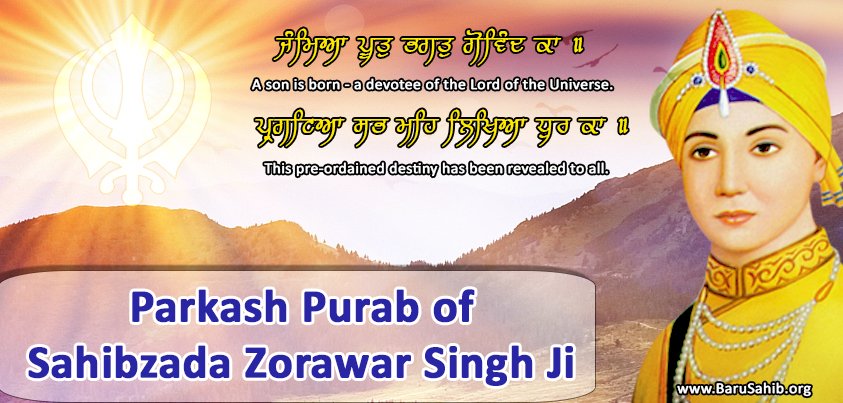
Prakash Purab of Sahibzada Zorawar Singh Ji!

The youngest sons of Guru Gobind Singh Sahib Ji, Sahibzada Baba Zorawar Singh Ji and Sahibzada Baba Fateh Singh Ji were born at Anandpur Sahib. Thier grandmother Mata Gujjar Kaur Ji was especially close to the young Sahibzadas. When Guru Ji’s family evacuated from Anandpur Sahib, Mata Ji took charge of both of them as […]

The youngest sons of Guru Gobind Singh Sahib Ji, Sahibzada Baba Zorawar Singh Ji and Sahibzada Baba Fateh Singh Ji were born at Anandpur Sahib. Thier grandmother Mata Gujjar Kaur Ji was especially close to the young Sahibzadas. When Guru Ji’s family evacuated from Anandpur Sahib, Mata Ji took charge of both of them as the column moved out of the city.

While crossing on horseback the rivulet Sirsa, then in spate, the three were separated from Guru Gobind Singh Sahib Ji. Gangu, who had worked for the Guru’s family, also succeeded in crossing the stream. He escorted them to his own house in the village of Kheri, now known as Saheri, near Morinda in presentday Ropar district. While unsaddling the horse he saw that there was some cash in the saddlebag. This tempted him to treachery. He not only stole the saddlebag during the night, but also planned to betray the fugitives to the government in hope of a reward.

On the morning of 7 December 1705, the day of the fateful battle of Chamkaur, Baba Zorawar Singh ji, along with Baba Fateh Singh ji and their grandmother, was taken into custody by Jani Khan and Mani Khan Ranghar, the officials at Morinda. They were despatched on the following day to Sirhind where they were consigned to the Cold Tower (Thanda Burj) of the Fort.

On 9 December 1705, Baba Zorawar Singh ji and Baba Fateh Singh ji were produced before the faujdaar, Nawab Wazir Khan, who had just returned from Chamkaur with his feudal ally, Nawab Sher Muhammad Khan of Malerkotla. Wazir Khan tried to lure the Sahibzadas to embrace Islam with promises of riches and honours, but they spurned the suggestion. He then threatened them with death, but they remained undaunted. Death sentence was finally pronounced. Upon Sher Muhammad Khan’s intercession for the innocent children to be spared their lives, they were given some more time to ponder over the suggestion to convert. Sahibzada Zorawar Singh ji and his brother spent another two days of severe winter in their old grandmother’s lap in the Cold Tower.

Still adamant, they were, on 11 December 1705, ordered to be sealed alive in a wall. As the masonry around their tender bodies reached chest high, it crumbled. The Sahibzadas were sent to the Cold Tower again for the night. The next day, 12 December 1705, the alternative of conversion being again turned down, Baba Zorawar Singh ji and Baba Fateh Singh ji were martyred by sealing alive in a wall. The aged Mata Gujari Kaur ji, who had all along been kept in the Cold Tower, only a little distance away, breathed her last as the news reached her ears. Mata Gujari ji through upbringing of her grandsons played such an important role in Sikhism that as Sikhs, we can owe our existence to her. It was due to her teachings that the young Babas did not bulge from their Dharma and attained martyrdom, thus continuing and emphasizing the institute of martyrdom in Sikhism.

Seth Todar Mall, a wealthy merchant of Sirhind, performed the cremation of the three dead bodies the following day. The site of the fateful happenings, since christened Fatehgarh Sahib, close to the old town of Sirhind, is now marked by four Sikh shrines. A religious fair is held here from 25 to 28 December every year to honour the memory of the martyrs.

~ Source: http://www.panthic.org/

Akal Academy, Reeth Kheri students participate in Guru Nanak Dev Ji Nagar-Kirtan City Celebrations!

A large Nagar Kirtan was organized by Akal Academy Reeth Kheri with fathomless devotion and zeal for celebrating the 545th Birthday Anniversary of Guru Nanak dev Ji , started with the blissful echo of a trumpet and ovation ‘Bole So Nihal, Sat Sri Akal’. Students of Akal Academy participated with religious fervour while singing Holy […]

A large Nagar Kirtan was organized by Akal Academy Reeth Kheri with fathomless devotion and zeal for celebrating the 545th Birthday Anniversary of Guru Nanak dev Ji , started with the blissful echo of a trumpet and ovation ‘Bole So Nihal, Sat Sri Akal’. Students of Akal Academy participated with religious fervour while singing Holy Gurbani Shabads. Exhilarating display of Gatka skills by the students was an eye candy of the holy procession.

Small Children participating in the vibrant procession were a bliss to watch. Religious Ceremonies were performed the whole day. After the culmination of the congregation, Guru Ka Langar was served to the devotees. It provides a great opportunity and platform for the students to showcase their academic & spiritual grooming and the way they are brought up in Akal Academies, known for their value-based education.

We salute the efforts and devotional spirits of both teachers and the students for gracing the celebrations of the city on an occasion of such great spirits.

Like & Share the Divinity among all!

~ Tapasleen Kaur
~ New Delhi, 28th Nov ’14

Construction of Akal Academies Heralds the Latest Pre-Stressed & Pre-Cast Concrete Technology!

Kalgidhar Trust, Baru Sahib has started using the Pre-Stressed, Pre- Cast Concrete Technology to achieve its Goal of making 500 Academy Buildings in North Indian States. As per Project Engineer, Charanjeet Singh this technology was first used in Delhi, and now it’s used for the first time in Punjab for constructing #AkalAcademies. On 23rd. November, […]

Kalgidhar Trust, Baru Sahib has started using the Pre-Stressed, Pre- Cast Concrete Technology to achieve its Goal of making 500 Academy Buildings in North Indian States. As per Project Engineer, Charanjeet Singh this technology was first used in Delhi, and now it’s used for the first time in Punjab for constructing #AkalAcademies. On 23rd. November, 2014 Trustee Jagjit Singh Ji inaugurated the first of its kind Project, in the State of Punjab at Akal Academy Chunni.

Precast concrete constructions are very common in low seismic regions as they are cost-effective, quick to assemble and build; have lower self-weight, use less raw material, etc. It uses less labour, machinery, and raw material, it provides five folds long lasting strength than other technologies. It assures safe, durable and healthy constructions.

~ Tapasleen Kaur
~ New Delhi, 27th Nov ’14

News Coverage:

Mughal’s Progeny, Sultana Begum atones for Atrocities of Aurangzeb At Sri Harmandir Sahib

Sultana Begum, The Great Grand Daughter in law of Bahadur Shah Zafar is confined to life in a slum on the outskirts of Kolkatta, struggles to make ends meet on a basic pension, despite her royal heritage.Ever since the death of her husband Prince Mirza Bedar Bukht in 1980, Sultana has descended into a life of poverty.

She undertook a pilgrimage to The Golden Temple, Amritsar and sought divine forgiveness for atrocities committed by her husband’s forefathers. Recalling the atrocities of the Mughal emperors, she said Sikh rage against their lineage was justified. “We’ve suffered too. Islam doesn’t permit cruelty against anyone,” she said, adding that they had been cursed to a fate of penury.

The Mughal carnage included many brutalities like Sri Guru Arjan Dev was tortured was put on a burning frying pan in the 16th century. Ninth Sikh Guru, Tegh Bahadur, was beheaded on orders from Mughal emperor Aurangzeb inDelhi in 1675 A.D. He was killed for siding with Kashmiri Hindus and opposing conversions to Islam. The Sis Ganj Gurdwara stands in old Delhi’s Chandni Chowk area as a reminder of that incident. Four sons of 10th Sikh Guru Gobind Singh were also done to death by Aurangzeb on opening denying to his brutal orders.

Sins committed by her ancestors haunted her and the memories of the cold-blooded massacre pushed her for this righteous initiative of praying for forgiveness at Takht ushering an era of goodwill, peace and harmony among communities living in this part of the world.

~ Tapasleen Kaur
~ New Delhi, 27th Nov ’14

10 things Everyone Should Know About Sikhism – By Simranjeet Singh

Despite being one of the world’s largest world religions, Sikhism remains one of the most unknown traditions in America. The lack of understanding has led to serious consequences, including discriminatory policies, bigoted stereotypes, traumatic school bullying and violent hate crimes. Here is a list of 10 things that the global community ought to know about […]

Despite being one of the world’s largest world religions, Sikhism remains one of the most unknown traditions in America. The lack of understanding has led to serious consequences, including discriminatory policies, bigoted stereotypes, traumatic school bullying and violent hate crimes.

Here is a list of 10 things that the global community ought to know about its Sikh neighbors.

1. Sikhism is an independent religion.

A number of people mistakenly think Sikhism is an offshoot of Hinduism, an offshoot of Islam, or a blend of the two religions.While the category of religion is itself problematic, scholars and practitioners alike classify Sikhism as an independent religion.

The Sikh tradition carries the basic markers of organized religion, including its own founder-prophet (Guru Nanak), scripture (Guru Granth Sahib), discipline and ceremonies (rahit), and community centers (gurdwara). There are more than 27 million Sikhs worldwide, making it the fifth largest world religion.

2. Rooted in oneness and love, Sikh theology encourages a life of spirituality and service.

Oneness and love serve as the foundations of Sikh theology — these are both the objective and process. Sikhs aim to recognize the divinity within everyone and everything they encounter, and this daily practice helps the individual cultivate and embody the qualities of oneness and love.

Sikhs believe that the Creator permeates all of Creation and that every individual is filled with the same divine potential. The Sikh tradition emphasizes the collective family hood of all humanity and challenges all social inequalities, including those on the basis of class, caste, gender, and profession.

Realizing oneness and love within one’s life also compels the individual to seek unity with the world around them. The tradition urges its followers to live as a sant-sipahi (warrior-saint), one who strikes a balance of cultivating spirituality while also contributing socially through community service.

3. The real meaning of “guru.”

The word “guru” literally means “enlightener,” and while it has come to refer to an expert in any domain (e.g., basketball guru, real estate guru), it carries a particular institutional meaning within the Sikh tradition. In Sikhism, “guru” refers to the line of authority, beginning with a set of 10 prophets who established and led the Sikh community. The first of these, Guru Nanak, was born in 1469 CE, and the tenth in his line, Guru Gobind Singh, breathed his last in 1708 CE.

Before he passed, Guru Gobind Singh passed the leadership to joint entities — the Guru Granth Sahib (the scriptural canon) and the Guru Khalsa Panth (the community of initiated Sikhs). Sikhs revere these two as occupying the throne of the Guru for eternity.

4. The Guru Granth Sahib is a unique scripture.

The authority accorded to the Guru Granth Sahib certainly sets it apart from other scriptural texts of the major world religions. The Guru Granth Sahib also defies common expectations of scripture in other ways.

The Guru Granth Sahib was compiled by the Sikh Gurus themselves and is primarily comprised of writings composed by the Gurus. This collection also includes the devotional writings of other religious figures, including Muslim Sufis and Hindu Bhaktas.

Unlike the prose narratives that make up a majority of western scriptures, the Guru Granth Sahib is made up entirely of devotional poetry, most of which is set to music. These writings are primarily made up of expressions of divine experiences and wisdom on religious cultivation. These writings have played a central role in Sikh practice since the time of Guru Nanak — Sikh worship consists of singing these compositions in both private and congregational settings.

5. The Sikh Gurus presented a pluralistic worldview.

As evidenced by the inclusion of writings from other religious figured within the Guru Granth Sahib, the Sikh Gurus did not believe in religious exclusivism. Rather, their pluralistic worldview posited that one could reach the Realization from any religious tradition. Sikhism teaches that diverse paths can lead to the divine, as long as the individual traverses the path with love. Because of this pluralistic outlook, Sikhism has no real history of missionizing or proselytizing.

While some misinterpret this pluralism as promoting cultural relativism, it is important to note that the Gurus also emphasized the importance of following an accomplished leader and maintaining religious discipline. Sikhism does not encourage the increasingly popular models of “a la carte religion” or “spiritual-but-not-religious,” though admittedly Sikh jurisprudence is relatively less complex than most religious traditions.

6. Sikhs have a long history of standing for justice.

Guru Nanak modeled social engagement by critiquing social inequalities, building institutions that serve and empower the disenfranchised, and publicly critiquing political oppression. The subsequent Gurus preserved and built upon the foundations laid by Guru Nanak. For example, the ninth among them, Guru Tegh Bahadur, observed Mughal state authorities forcefully converting its Hindu constituents. Although this oppression targeted a religious community to which he did not belong and whose beliefs he did not share, Guru Tegh Bahadur stood up firmly for their right to practice religion freely — and the state responded by publicly executing Guru Tegh Bahadur.

The Sikh community has drawn inspiration and guidance from such examples over the years, and it has demonstrated a commitment to justice in various ways. Sikhs are taught to defend the defenseless and have historically led responses to political oppression. Sikhs have therefore been regularly targeted by the political elite, a cycle that continues to play out in present-day India.

7. Sikhs maintain a unique identity.

Since the formative moments of the tradition, Sikhs have maintained a physical identity that makes them stand out in public, even in the context of South Asia. This identity includes five articles of faith — kesh (unshorn hair), kanga (small comb), kara (steel bracelet), kirpan (religious article resembling a knife), and kachera (soldier-shorts) — and distinguishes someone who has formally committed to the values of the faith by accepting initiation.

While many have attempted to ascribe functionalist rationales for each of these articles, these understandings do not capture the connections that Sikhs have with these articles. Perhaps the best analogy (though admittedly an imperfect one) is that of a wedding ring: one cannot reduce the significance of a wedding ring to its instrumental value; rather, one cherishes the wedding ring because it is a gift of love from one’s partner. Similarly, Sikhs cherish their articles of faith primarily because they see them as a gift from their beloved Guru. Trying to understand these articles on the basis of their function is missing the point.

Perhaps the most visible aspect of the Sikh identity is the turban, which can be worn by men and women alike. The turban was historically worn by royalty in South Asia, and the Gurus adopted this practice as a way of asserting the sovereignty and equality of all people. For a Sikh, wearing a turban asserts a public commitment to maintaining the values and ethics of the tradition, including service, compassion, and honesty.

8. Sikhism believes in absolute equality.

Sikhism was founded on the concept of oneness and justice, and the Gurus adamantly rejected all social inequalities. While women continue to be subjugated in modern South Asia, the Sikh Gurus rebuked discriminatory practices that marginalized women (e.g., sati, purdah) and openly placed women in leadership positions.

Along these lines, the Gurus established new practices to challenge social norms, such as India’s caste system, that perpetuated social inequalities. For instance, the tenth Guru asked all Sikhs to abandon their last names — which identified one’s caste — and asked them all to take on a collective last name reserved for royal families to signify the inherent equality and nobility of every individual: Kaur for women and Singh for men. Similarly, the Gurus established the institution of langar, a free meal provided at the gurdwara that is open to one and all. During this meal, everyone sits together on the ground, regardless of caste, social status, gender, or religious background.

9. Darbar Sahib of Amritsar is the epicenter of the Sikh psyche.

Known to westerners as the Golden Temple, Darbar Sahib of Amritsar, Punjab has served as the center for the Sikh community since its founding more than four centuries ago. Sikh theologian Sirdar Kapur Singh referred to Darbar Sahib as “the theo-political capital of Sikhs.” This phrase captures the role of this site as both a spiritual center where the community gathers to worship as well as a political throne where collective decisions have been made.

It is inaccurate to refer to Darbar Sahib as “a sacred space” or as “Sikhism’s holiest site.” Sikh theology recognizes that divinity permeates the entire world equally and therefore does not recognize any particular space to be uniquely sacred or holy. At the same time, Darbar Sahib does occupy a special place in the collective Sikh psyche. The site has witnessed a number of significant historical events, from the return of the sixth Guru after a stint in prison and the first public enthronement of the Sikh scripture during the 17th century to massacres of thousands of civilians and the burning of historical artifacts and relics by the Indian Army in 1984.

10. Sikhs have made immense contributions to American society.

From the time of their arrival in the late 1800s, Sikh men and women have been making notable contributions to American society. Early immigrants settled in the western frontier, where they played a major role in building America’s railroads. Sikh Americans like Bhagat Singh Thind served in the U.S. military during the World Wars, and the first Asian American Congressman was a Sikh American elected to office in 1957. The inventor of fiber optics is a Sikh American, as is the country’s largest peach grower, the mayor of Charlottesville, Virginia, and Morgan Freeman’s personal physician. Sikh American women continue to make diverse contributions, such as Grammy-winning artist Snatam Kaur, commercial airline pilot Arpinder Kaur, and Columbia University professor Supreet Kaur.

By Simranjeet Singh

~ Source: www.faithstreet.com

Surprising Results of Meditation Enthralled the Harvard Scientists!

It turns out meditating is good for more than just quiet time: It can actually help us fight the cripplingly high stress levels we experience during our busy lives, in the office or elsewhere. Scientists from Harvard University and the University of Sienna recently found that meditation is so powerful it can change the physiology […]

It turns out meditating is good for more than just quiet time: It can actually help us fight the cripplingly high stress levels we experience during our busy lives, in the office or elsewhere.

Scientists from Harvard University and the University of Sienna recently found that meditation is so powerful it can change the physiology of a person’s brain, resulting in positive changes like a decrease in anxiety and depression.

The science: Scientists put 24 participants with no history of meditation through an eight-week course on best practices for “mindfulness-based stress reduction (MBSR),” fancy science talk for meditation. The course consisted of 2.5 hour sessions each week where participants learned “body scanning, sitting meditation, walking meditation and mindful stretching movements.” The scientists also requested each participant perform at least 45 minutes of meditation each day. MRIs were performed before and after the meditation boot camp, and each participant answered a series of psychological evaluations to determine their stress and anxiety levels before and after the MBSR course as well.

The team compared these results to a control group who went through no meditation training at all during the eight weeks.

The comparison demonstrated “an increase of cortical thickness in the right insular lobe and somatosensory cortex” of the meditation group. In layman’s terms, meditation made parts of the brain corresponding to emotion and perception thicker. This ultimately resulted in “a significant after-training reduction of several psychological indices related to worry, state anxiety, depression and alexithymia.”

So ultimately, meditation made people more emotionally attuned and less depressed — a pretty good argument to spend time solemnly reflecting each day.

The takeaway: We live in a society where depression, anxiety, and stress are increasingly part of our lives. Stress levels among Americans have risen by up to 30%, and it’s not much better in Europe or Asia, where anxiety and depression is growing at alarming rates. Instead of solving the root causes of these problems, Americans are resorting to antidepressants at a higher rate than ever before. One in 10 Americans is now taking a prescription antidepressant.

Meditation, while not a panacea, can help us deal with such a society by decreasing our stress levels and increasing our abilities to emotionally relate to ourselves and others. And with further research, it could provide an alternative to being constantly doped to the gills in order to be happy (or just less sad).

~ Source: mic.com

Baru Sahib ranked 4th highest amongst top 6 Gurdwaras at The Highest Altitude in The World!

Among the top 6 Gurdwaras located at the highest altitude in the world, Baru Sahib Gurdwara is ranked 4th as the Valley of Divine Peace, Baru Sahib is located 1900M – 6233 FT Above Sea Level. Others in the list include: Gurdwara Sri Hemkund Sahib, Uttrakhand- 49,200M 15,000 Ft Above Sea Level Gurdwara Dang Maar […]

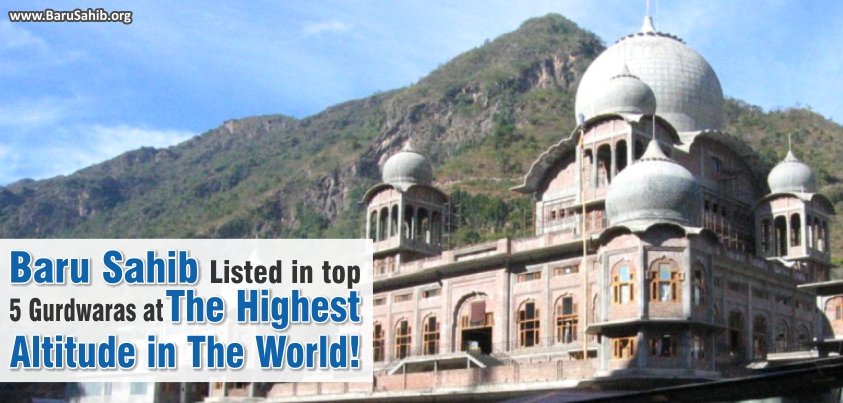
Among the top 6 Gurdwaras located at the highest altitude in the world, Baru Sahib Gurdwara is ranked 4th as the Valley of Divine Peace, Baru Sahib is located 1900M – 6233 FT Above Sea Level.

Others in the list include:

Gurdwara Sri Hemkund Sahib, Uttrakhand-
49,200M 15,000 Ft Above Sea Level

Gurdwara Dang Maar Sahib, Sikkim –
5,210M 17,100FT Above Sea Level

Gurdwara Pathar Sahib, Leh –
4,000M 13,100FT Above Sea Level

Colorado Singh Sabha Commerce City
1,574M 5,164 FT Above Sea Level

Gurdwara Nanak Sabha, Switzerland –
430M 1,411 FT Above Sea Level

Source: http://dailysikhupdates.com/

Tribute To Guru Tegh Bahadur Sahib by Students of Akal Academy, Gomptipul!

Paying a tribute to the Martyrdom of Sri Guru Tegh Bahadur ji, Akal Academy Gomtipul celebrated a Gurmat Samagam at Gurdwara Sahib. The programme began with a bhog of Sri Sehaj Paath sahib. After the bhog ceremony, the students performed various programs saluting to the great deeds of Sri Guru Tegh Bahadur Sahib Ji. Poems […]

Paying a tribute to the Martyrdom of Sri Guru Tegh Bahadur ji, Akal Academy Gomtipul celebrated a Gurmat Samagam at Gurdwara Sahib.

The programme began with a bhog of Sri Sehaj Paath sahib. After the bhog ceremony, the students performed various programs saluting to the great deeds of Sri Guru Tegh Bahadur Sahib Ji.

Poems were sung by small kids in memory of the Great Guru who sacrificed his entire family for securing the religious freedom of our country.

Speeches on the Martyrdom of Guru ji were delivered by the students evoking respect and salute to the Greatness of Guru Tegh Bahadur Sahib Ji.

Kavishri was performed by the boys of the senior classes titled as “Faiyda” and “Khede-de Gobind Rai Baapu Kol Aake te” and girls titled as “Nauve Gura nu Shaheed hunda vekh k”. Shabad kirtan was also performed by the students in the presence of Sahib Shri Guru Granth Sahib Ji in utmost devotion, paying homage to Guru Sahib.

All the students were filled up with deep sorrow, remembering to the great sacrifice done by our Ninth Guru, Guru Tegh Bahadur Ji.

~ Tapasleen Kaur
~ New Delhi, 26th Nov ’14